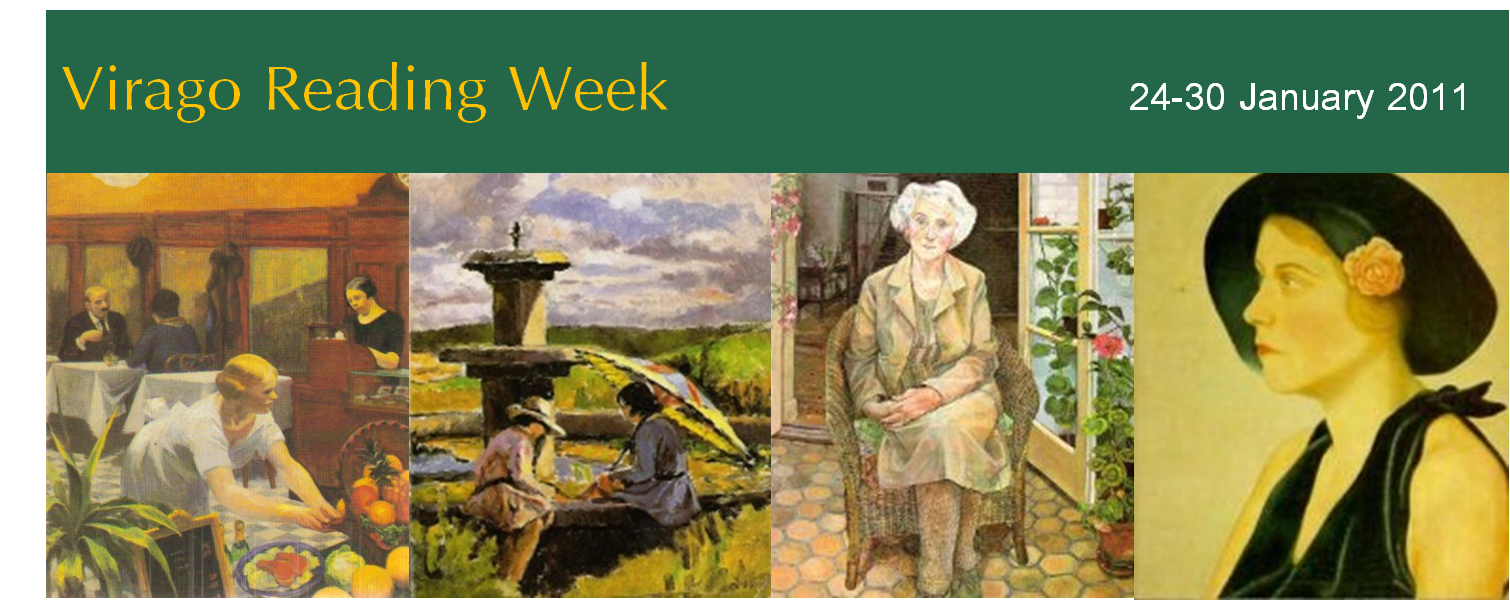
Here are the Viragos I won’t be reading this week


Day three of Virago Reading Week has me lamenting the Viragos I won’t be reading this week. Since I am determined to stick to the TBR dare until April 1st, I can only read the books that are currently in my nightstand.
So here are the books I won’t be reading this week. For those of you looking crosseyed at those black spines, I understand that there was a time when Viragos were published in the US by The Dial Press with these black liveries but otherwise looking like Viragos. Keen eyes might also note that some of those green Viragos have penguins on them. At another time, Penguin published Viragos in the US.  Virago experts: if I have any of this wrong, please let me know.

Some of you may remember this post where I talked about finding all these Viragos for cheap at an otherwise pricey second hand bookshop here in DC.

A Virago Reading Week Giveaway

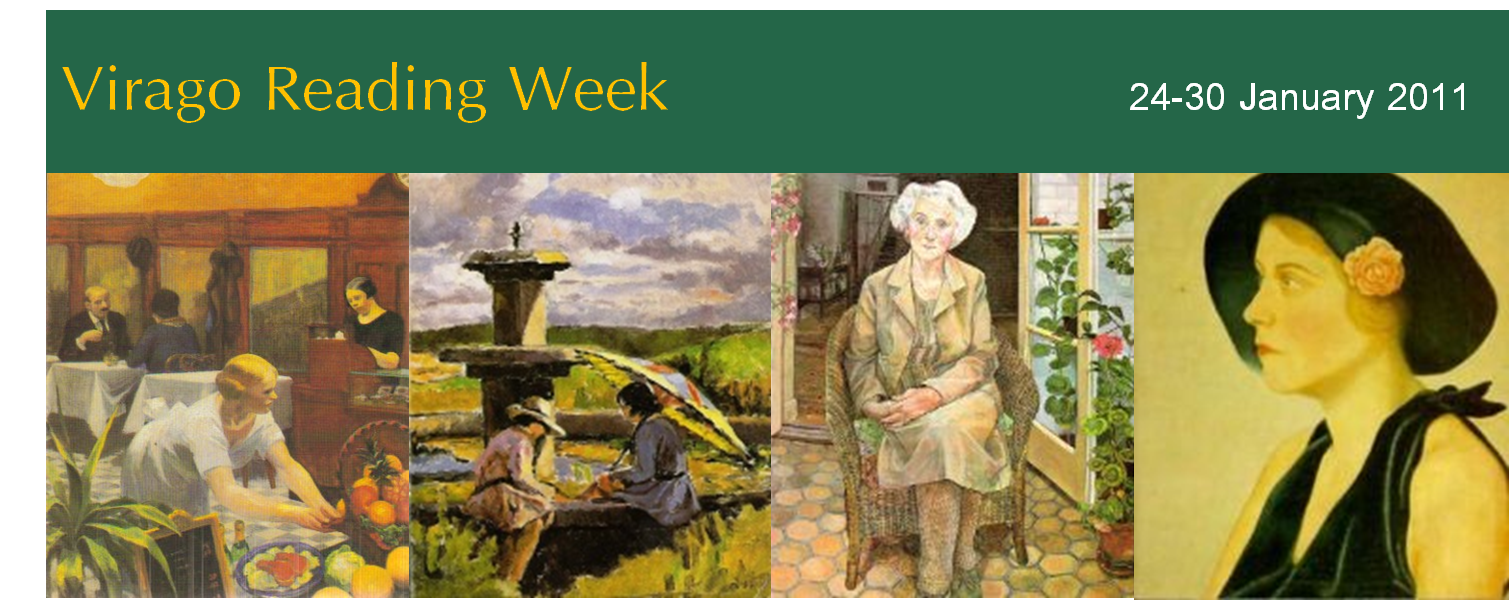
In honor of day two of Virago Reading Week, I have decided to hold a giveaway. But this is no simple giveaway, this one requires a bit of work on your part.  I will buy any VMC book currently in print for the person who can identify the Virago book cover art on the VRW banner/button I created.

Here are the rules.

1. The person with the most correct titles wins. Ties will be decided by random drawing.

2. I am looking for the title of the Virago book that had these paintings on their covers. Remember I am looking for the book title, not the title of the work of art.

3. Since I don’t want any of you giving away the answers in your comments, you must EMAIL your guesses to me at:   onmyporch [at] hotmail [dot] com

4. Guesses must be submitted no later than midnight U.S. Eastern Standard Time on Sunday, January 30, 2011.

5. Once declared, the winner will have one week to choose a Virago currently in print they want me to send. I will ship anywhere in the world, the south side of the moon, and select postal codes on Mars.

UPDATE: Out of the blue, and totally unsolicited, Little Brown and Company (UK), the parent company of Virago, have offered to fulfill the prize for this giveaway on my behalf. So cheers to the generous folks at Virago!

All Passion Spent: My First Virago Modern Classic


Riding the Tube with Vita Sackville-West.
Today is the first day of Virago reading week being hosted by Rachel and Carolyn. It seems appropriate to kick-off my participation by writing about the first Virago I ever read.
In 1992 I lived within walking distance of Charing Cross Road and the myriad bookshops on, and adjacent to, that famed stretch of book lovers’ London. I was certainly bookish back then, but two things conspired to keep me out of those shops. The first was that I had no money to buy books. I made just over 500 pounds a month and most of that went to housing, food, and transport. What little money I had left over I would use to buy tickets for concerts at the South Bank Centre and a season ticket to the Proms. The second was that I was 21 years old and living in a hostel with 27 other people my age. Who had time to spend in bookshops when there were all those hormones flying around?  That doesn’t mean I never went into them. Just not as often as I would today if given the same proximity.
One day while combing through the cheapish paperbacks in the basement of the old Quinto Bookshop I came across All Passion Spent by Vita Sackville-West in a Virago Modern Classics edition. I don’t remember why I chose it, but I do remember very vividly reading it. There is a scene in the book where the protagonist, Lady Slane is making her way to Hampstead on the Northern Line of the Underground. The narrative intersperses her progress on the Tube with her thought process. Paragraphs of text are separated by indications of which stop the train is passing through as she thinks each thought. The reason I remember this so clearly is because as I read it, I was also on the Northern Line–passing through the very same stations the fictional Lady Slane had passed through 70 years earlier (Tottenham Court Road, Goodge Street, Warren Street, etc.).
The novel is the quiet, lovely, somewhat joyful and melancholy story of Lady Slane being independent–emancipated by the death of her husband–at the ripe age of 88. I thoroughly enjoyed reading All Passion Spent. It was a type of novel that I hadn’t really encountered before. And the back cover of the green banded Virago edition suggested that there were legions of similar works by women authors just waiting for me. Over the years I picked them up here and there, but it wasn’t until into my 30s that I really began to appreciate the niche that Virago filled. I am no expert on Virago, but it seemed like there was a time when they focused on out of print, hard to find works. But today it seems they even publish the likes of Margaret Atwood. So that niche, if indeed it ever was exclusively their focus, seems not to be as tightly focused as I originally thought.
Since Viragos, especially newer editions, aren’t really sold new in the US, I am unlikely to become a devotee of their newer offerings. I am happy to maintain, however, my interest in their older titles. This probably explains why I remain equally devoted to their older cover designs, but more on that later in the week.
Interesting to note that the first version of the now iconic diagrammatic map of the London Underground was created by Harry Beck in 1931, the same year All Passion Spent was published. This means that Lady Slane would have been looking at a map quite different from the one I looked at in 1992. 
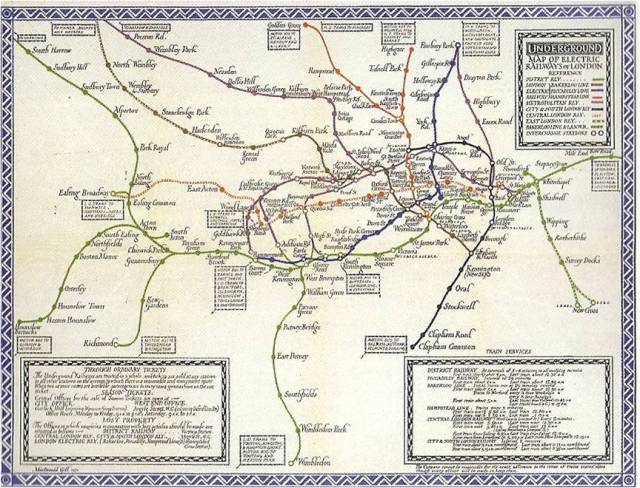
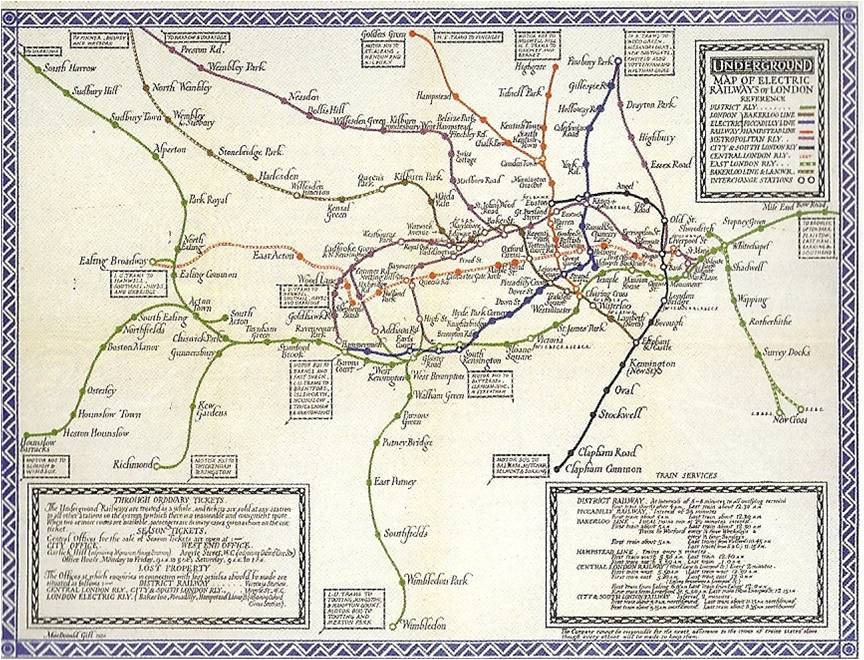
A rather pretty Underground map from 1920. While maps as early as 1908 simplified or removed geography
to make the maps easier to read. Still, this pocket map by MacDonald Gill aims to depict some
of the geography in terms of the location of stations in relation to other stations. The use of cursive
lettering was unusual for the Underground which had been using the iconic Johnston sans serif typeface since 1916.
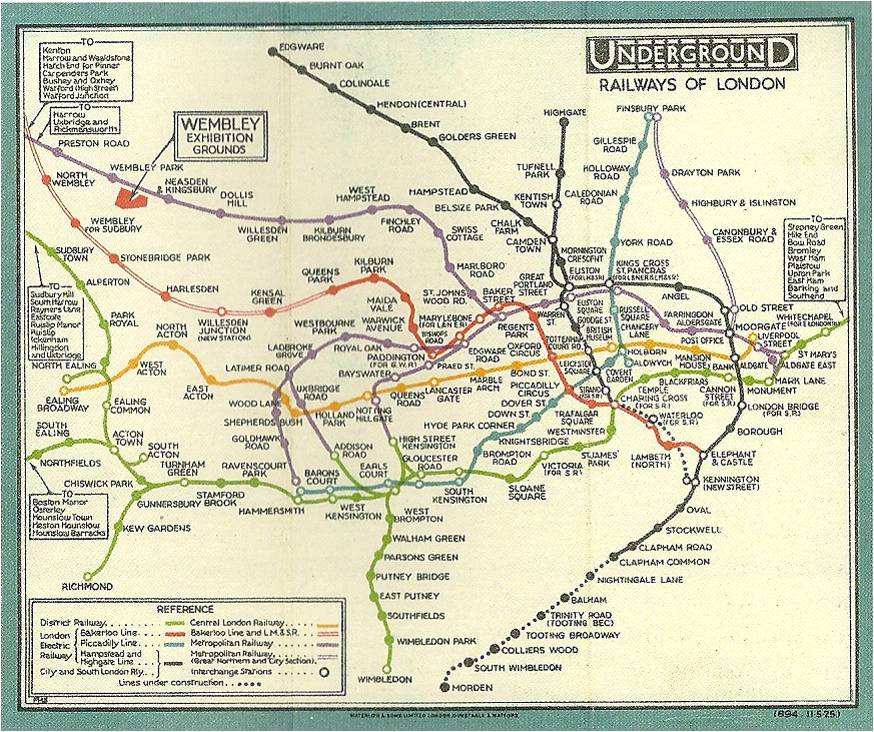
This 1925 map by Fred Stingmore is even less geographically correct to make the map
easier to read. The use of the more common Johnston typeface also improves clarity.
This is probably the map that Lady Slane would have consulted in 1931.
First sketched out in 1931, Harry Beck’s highly diagrammatic version of the Underground map system
is depicted here in a 1933 foldout map. What little evidence there is of geography, basically just
adherence to north/south/east/west and the Thames is highly stylized to maximize legibility.
This is the map that not only set the standard for the Underground to the present, it also prompted
hundreds of less than perfect adaptations in other cities as well as frequent references in popular culture.

War of the book buttons

   
Tomorrow begins Virago Reading Week, but I am also in the midst of the TBR dare where I can only read from the TBR pile in my nightstand until April 1st.

How will this bookish face off end? Which of these book buttons will be victorious? Stay tuned.

UPDATE: The buttons aren’t really fighting. I was just trying to be cute. The fight is between the lure of Virago Reading Week and the need to stay true to the TBR dare.

(By the way, I couldn’t find a button for VRW, so I made my own. Feel free to use if you are participating.)

vs.

Dogs In Motion

   
If you don’t like looking at endless pictures of other people’s dogs, you may want to scroll on down to something more bookish.

If, on the other hand, you can’t get enough of canine cuteness, look no further. We took the camera along to the dog park yesterday and Lucy had a ball.

Saying hello.

Gettin’ it goin’

Full flight

Home stretch

Coming in for a landing

Contemplating whether or not to say hello to this friend

Book Review: Lady Audley’s Secret by Mary Elizabeth Braddon


Before I read Wilkie Collins’ The Woman in White I would probably never have picked up this book even though it was only a dollar at Book for America. Then again I would have never picked up The Woman in White either. Most times I have very strong feelings about the kind of books that I think I like. This usually works in my favor as I end up not wasting time on books that I really don’t enjoy. But occasionally I am persuaded that I really should give a particular book or author a chance. It has happened over the years with books like A Prayer for Owen Meany (Irving), The Andromeda Strain (Crichton), Deliverance (Dickey), and thanks to the evangelism of Simon at Savidge Reads, The Woman in White. In all of these cases, I managed to drop my tendency toward obstinacy just long enough to discover some really great reads.

Like The Woman in White, Braddon’s Lady Audley’s Secret is a sensation novel where the normal strictures of Victorian social mores are used to frame a plot full of scandalous, sensational, comings and goings. Imagine all the proper, detailed trappings of a Trollope, but replace a purloined cheque with a bigamous, murderous, lying, mad woman and you start to get the drift of Lady Audley.

Because there is so much detailed plot in  most sensation novels it is somewhat useless to try and convey the plot in a review. One could probably outline these plots very easily, filling up a page with a bulleted list of succinct plot points but that would remove all the fun of letters, messengers, and secret compartments; to-ing and fro-ing from town to town, train station to station; and of course interviewing all manner of characters who hold some little piece of a massive, mysterious, puzzle.

Lady Audley’s Secret is the kind of mystery where you know pretty early on the truth behind the mystery–at least at a broad level. But you read along wondering by what means it is all going to unravel and be revealed. And many little surprises pop up along the way that keep you on your toes.

My third Sensation novel, I would put Lady Audley’s Secret behind The Woman in White, but ahead of Collins’ The Dead Secret.

Two Non-Reviews

 
When I first started doing my own book “reviews” on My Porch the intention was simply to put something down in writing so I would remember what I read. I got tired of coming across titles on my list of books read that left me scratching my head trying to remember what in the world they were about. So over the last couple of years I have reviewed pretty much every book that I have finished. I have no set formula for the reviews and many don’t even include plot summaries. Some are insightful, but most are fairly superficial descriptions of my experience with a particular book. Hopefully enough to jog my memory years down the road when I am trying to remember a particular book, but beyond that I don’t really have any aspirations for these musings.

You would think with such a loose review format that I wouldn’t care too much about what I reviewed and what I didn’t review. But my obsessive tendencies make it difficult for me to not review every book I finish. However, sometimes I just can’t pull my brain together enough to come close to anything that would pass for a review.

And so it is this week. I have two books to review that I really enjoyed: Lafcadio’s Adventures by Andre Gide and Isabel’s Bed by Elinor Lipman, but I just don’t feel like writing about them.

Book Review Isabel’s Bed by Elinor Lipman


Regular readers will know that I love Elinor Lipman. The Inn at Lake Devine is one of my favorite books. And then there are couple other novels of hers that I really enjoyed, and few I found just okay. Isabel’s Bed falls short of being a favorite and kind of falls kind of at the bottom of those that I really enjoyed. Interesting and fun and full of twists, it just wasn’t as clever as My Latest Grievance or Ladie’s Man. But when comparing Elinor Lipman to Elinor Lipman she can’t lose right.

Struggling writer Harriet Mahoney is dropped by her boyfriend of 12 years. You know the type, won’t commit but finds himself married just months after he breaks up with you. She goes off to live on Cape Cod to be a ghost writer for Isabel who was in bed with her older, rich lover when his jealous, crazed wife shoots and kills him. Intelligent chicklit with enough 1990s detail to make you want to put on stirrup pants and an over sized sweater and then cinch it.