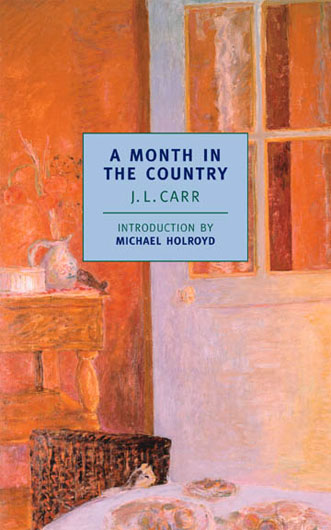
Tom Birkin, a Londoner, and a somewhat shell-shocked veteran of World War I arrives in Yorkshire to uncover a suspected wall painting in the village church. Written as a memoir, Birkin’s story is equal parts country idyll, love story, and ethnographic sketch. Over only 135 pages, Carr’s poetic writing conjures up so many moving, beautiful, and humorous images, I feel very clumsy writing about it.
Through Birkin’s experience we meet the people of Oxgodby and are introduced to their various quirks and natural distrust of a city boy from the South. We learn the value of vocation and art for their own sake. And we see Birkin slip almost imperceptibly into the life of the village. He takes up Methodism despite working and literally living in an Anglican church, becomes close friends with Charles Moon a fellow WWI vet who has been hired to unearth the grave of the ancestor of an important local family, becomes an honorary member of the Ellerbeck family, and falls in love with the vicar’s wife.
There was so much time that marvelous summer. Day after day, mist rose from the meadow as the sky lightened and hedges, barns and woods took shape until, at last, the long curving back of the hills lifted from the Plain.
…their mother worked out how it was with me and usually sent a bit of whatever was being manufactured in her kitchen–rabbit pie, a couple of currant teacakes, two or three curd tarts. So, over the weeks, a splendid repertory of North Riding dishes was performed amanti bravura to an applauding Londoner, dishes Mrs. Ellerbeck had helped her mother bake, who had helped her mother bake who…Sometimes I’d share this bounty with Moon and it was he who suggested that we were eating disposable archaeology.
“How are you two getting on together?” Moon would say, waving a hand at my wall. “Do you ever feel him breathing down your neck, nudging you–‘Good lad, Birkin! Attaboy!’ You must know him pretty well. Go on–tell me about him. who was he?”
And the idea that his work might be minutely observed five hundred years after his death would have been preposterous. In his day, buildings were being drastically remodeled every fifty years as fashions changed, so that my man would calculate his painting, at the longest would last no more than a couple of generations.
…was fair-headed; hairs kept turning up where his beard had prodded into tacky paint, particularly the outlining in red ochre which he’d based in linseed oil. There was no mistaking it for brush hair which was recognizable from its length, an inch, never more than an inch and half. Sow’s bristle for the rough jobs, badger’s gray for precision.