Book Review: Two Stories by Mrs. Oliphant

   
As it happens the only Persephone in my TBR nightstand was The Mystery of Mrs. Blencarrow by Mrs. Oliphant. It is coupled with another story Queen Eleanor and Fair Rosamund.

I enjoyed both stories, but as I am still feeling unbloggy, I am going to let others speak for me. A rare occurrence indeed. (I will say that I caught the Brown reference in the Mrs. Blencarrow almost immediately.)

Hayley at Desperate Reader

Claire at Paperback Reader

Feeling Unbloggy


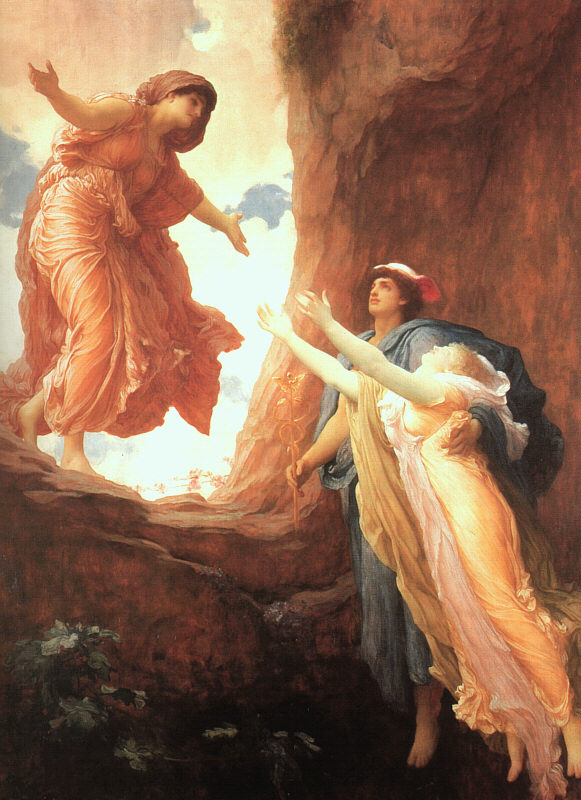
The Return of Persephone [Reading Weekend]
Frederic Leighton
Just a few bits and bobs for a Friday. I am not in much of a bloggy mood right now.
Persephone Weekend
Last year I had a blast and a half participating in the Persephone Reading Week hosted by Claire and Verity. This year they have winnowed it down to a more host-friendly weekend. I will do at least one Persephone review, but I think this year I will quietly enjoy everyone else’s Persephone posts. (Is “else’s” a word?)
Spy Fiction
I think I am giving up on John Le Carre’s Tinker, Tailor, Soldier, Spy. I kind of like all of the British intelligence agency background detail, but at page 165 it doesn’t seem to be much else. Even as I write this I am tempted not to give up. Early in 2010 I read The Arena which is a crime novel, but it had some elements of intelligence agency/international intrigue that kind of piqued my interest in the a spy novel so I asked around the blogosphere for recommendations and came up with TTSS. I don’t think the recommendations were wrong, I just think my interest in this type of fiction is more limited than I thought.
A Clockwork Orange
Last night while walking Lucy, I got into a bit of a verbal altercation that probably escalated more than it needed to. I was totally in the right, but I let my OCD need to communicate exactly why the other person was wrong get the best of me. He was just so damn condescending (and wrong) that I couldn’t let it go. The net effect is that I felt a little sick to my stomach afterwards. That makes it sound more ominous than it was. It really was just a garden-variety altercation. But I have made a lot of progress in NOT being the cranky person who just gets crankier and crankier as he realizes that everyone else is an idiot. I guess the occasional slip is to be expected. It is kind of like the aversion therapy in A Clockwork Orange. I have seen the crazy movie but not read the book, but in that story a violent hooligan is injected with an illness-inducing drug while being exposed to violent images. The effect is that he eschews violence lest he become ill. In a much, much more milder form, these days when I get all hot and bothered over something, I get a little queasy afterwards.

Fewer Lesses and More Fewers
Literacy is a never-ending journey. It wasn’t until I was getting my second Master’s degree that I began to understand that the words “less” and “fewer” were not interchangeable. Simply put, the word “less” applies to things that are uncountable and “fewer” applies to things that can be counted. So something may have “less fat” by virtue of having “fewer grams of fat”. Once I fully took this concept on, I couldn’t keep myself from correcting people (in my head) every time they used “less” when they should have used “fewer”. But now I have gotten myself to the point where anytime anyone uses the word “less”, even when it is being used correctly, I change it to “fewer” in my head. It is like it has become an OCD (ah, mentioned twice now in this post) Mad Lib game for me. The other day on TV I heard someone say “I am less concerned about that” and in my head I changed it to “I am fewer concerned about that”. I’ve gone mental.

Book Review: Homecoming by Bernhard Schlink

    
In my reading, Bernhard Schlink is now 2 for 2. I thought The Reader was amazing, and while I don’t think the plot of Homecoming is as tight as The Reader, it is still a compelling, well-written novel that encouraged all the appropriate emotional reactions. And like The Reader, Homecoming deals with the Nazi legacy in Germany. Regular folks trying to deal with (or forget about) their individual or collective culpability in genocide. Unlike The Reader, however, Homecoming takes a more philosophical look at good and evil and never really broaches the details of Nazi barbarism explicitly.

In Homecoming Schlink weaves the tale of Peter Debauer who attempts to track down the ending of a novel. He has an incomplete proof copy of a novel that his Swiss grandparent’s edited that is missing not only the ending but also any indication of author or title. Peter’s search for the ending and the identity of the author lead him not only to find love but also to discover more than a few secrets about his past. (As Peter tries to track down people and publications all I could think about was how much easier it would have been if Google had been around. It was to the point where I found myself having a hard time imagining how he could even attempt his searches without the Internet. Amazing how the “old” ways can disappear so quickly.)

I am tempted to say that Schlink writes historical and legal fiction, but I am not sure if his work would really fit into those genre. It seems too readable for that. His writing is never pedantic nor pedagogical. The points of history or law introduced into his novels are expertly woven into the emotional, relationship-oriented drama. His characters and their motivations, while sometimes alien to the reader, are wholly believable. And you find yourself caring quite a bit about the characters. As I mentioned earlier, the plot in Homecoming wasn’t as tight as it could have been. There are a few twists and turns that are too pat. And there are others that seemed rather clumsy. Like Schlink had too much he wanted to say. Still, there is nothing in this criticism that should keep you from reading Homecoming. There is much here that makes you think, and perhaps more importantly for a novel, makes you feel.

[It is hard to mention The Reader without mentioning the amazing film adaptation. I really thought that was a fantastic film. And Kate Winslet is easily one of the best actors of our time.]

My love/hate relationship with big box booksellers

Not Borders.
Borders, the bane of so many small, independent bookstores has gone into full meltdown. Filing for bankruptcy this week, Borders plans to shutter most of its stores. I wouldn’t be surprised if this were just the prelude to end of the chain’s final demise.
Like many of you, my relationship with big box booksellers has been confusing to say the least. Having grown up in the far suburbs of Minneapolis the nearest bookstore (that I knew of) was a pitiful B. Dalton at Northtown Mall about 30 minutes from my home. I didn’t know it was pitiful at the time. I loved the place. But in contrast to the big boxes that would emerge in the late 1980s and early 1990s, that little B. Dalton was indeed pitiful. (Of course in retrospect the mall itself was, and probably still is, pitiful as well, but it was like Shangri-La to a kid from the sticks.)
Then in college I was exposed to independent bookstores in Minneapolis like Odegard Books and Baxter Books. And of course there was the wonderful (and new to me) world of used bookstores. The Book House in Dinkytown was a particular favorite. But then sometime around 1989 or so I went to my first Barnes and Noble in Roseville. Fifty thousand square feet of books. I couldn’t quite believe how much fun it was.
Not long after this I began to understand the socio-economic-geo-politico-david-goliath implications of big box retailers in general and booksellers in particular. The two arguments most often heard from the independents were that the independents offered much better customer service and that the big boys would have a homogenizing effect on book publishing.  No doubt the big guys have had an impact on publishing but I have a hard time believing too much in the homogenizing horrors that were predicted. My access to small presses and esoteric books has never been better. (Of course that is thanks to the Internet, which has its own set of issues.)
And as for the smaller guys having better customer service, that hasn’t necessarily been true in my experience. In fact, in late 1999 I took an evening job at the very same Barnes and Noble that I first walked into a decade earlier. It turned out to be an amazing experience. Not only did I love working in a bookstore, but I was really impressed with the book knowledge of my co-workers. We really knew our books. Workers had specialities for sure and weren’t necessarily experts at everything, but it was truly wonderful how well our in-store network of knowledge worked for the customer.
This still doesn’t mean that I am a total fan of big box booksellers, but they have been really helpful over the years. When I moved to Honolulu (sight unseen) in 1995, I was definitely missing the familiarity of my life back on the mainland. The one spot in town that made me feel at home was the Borders. It was a giant book oasis in a town that had pretty awful small bookstores. The fact that it was within spitting distance of the beach and gorgeous Pacific Ocean didn’t hurt it much either.
Over the years I gradually moved away from the big boxes favoring either small bookshops, or more often second hand bookshops. And when I do favor the big boxes these days I much prefer Barnes and Noble. I also prefer Barnes and Noble online over Amazon. I like the fact the B and N is primarily about books as opposed to Amazon’s we sell everything approach.
And let’s face it, for those of us who can remember the lifestyle shopping center boom of the 1990s the demise of Borders can’t be too much of a surprise. For those that don’t know what I am talking about, retailing in the 1980s was all about the regional and sub-regional mall. Enclosed shopping centers with a few department store anchors linked together by chain stores. In the 1990s we started to see glorified and yuppified strip malls pop up. But instead of the mattress stores and beauty shops they had things like Borders, REI, Old Navy, Petco, Staples/Office Depot and even Tower Records. And the stores were big. And the Borders, Barnes and Noble, and Tower Records seemed to be less about buying and more about browsing, meeting friends, having coffee, and experiencing the product in the store.
The fun and abundance of these wonderfully big mega book stores seemed to go perfectly, and ironically, hand in hand with the tech boom of the ’90s. Everything looked rosy, people were making money hand over fist, the tech companies taught us that life and work were supposed to be fun, fun, fun. And the stores were everywhere. Every suburb seem to have its own giant Borders or Barnes and Noble or both. I could never go into to one without thinking “who reads all these books?” I did, but I knew I wasn’t in the majority. So how were these stores staying open?

The original tech boom quickly went bust because the thousands of Internet start-ups knew how to have fun but didn’t know how to make money. Now that Internet commerce has come of age, the bricks and mortar stores that thought that abundance and fun, fun, fun would help save them are feeling the death blow from the Internet and perhaps the advent of the e-book.

So am I happy or sad that Borders is going belly up? I don’t know. I would be greatly depressed if brick and mortar book stores, whether big or small, become too hard to find. But then there is a part of me that thinks that secondhand shops will never disappear. But who am I to try and predict the future? I do grieve the loss of Tower Records a few years back. Far worse than small bookstores, small record stores, especially those who carry classical music, have become harder to find than dinosaurs. Tower was the only game in town if you wanted to see rows and rows of classical CDs. Sigh. I really miss them. Buying classical music on iTunes is a bit of a joke and going to CD retailers on line makes it much harder to discover new and unique classical music.
Which puts me in mind of the human cost. Back when Tower was open here in DC there was a manager there, probably in his later 40s at the time who used to be fairly knowledgeable about classical music. After Tower disappeared, he reappeared at the big Borders here in town. I just saw him in there the other day and wondered how long his job would last. And where a fifty-something man, who had obviously made his life in retail would find his next job. Starbucks?

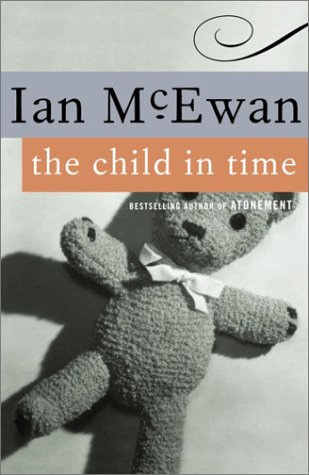
Book Review: The Child in Time by Ian McEwan


Huh. I am not sure where to begin on this one. Many people I respect really like this McEwan novel, but I don’t. There were parts of the story line that I found interesting, but taking it all as a whole I thought it was a little contrived and some passages were downright tedious. I can only handle so many dream sequences, day dreams, imagined situations, and narrative ambiguity. I feel like McEwan tried too hard to weave together too many narrative strands to illustrate and generally reinforce the meta-theme of the book–which appeared to have something to do with childhood. The kidnapping of his child (that’s not a spoiler), the breakdown of his marriage, his parents’ relationship, his friend’s career/mental health, a government subcommittee all employed to say something about childhood and apparently something about Thatcher’s Britain.

And there were three scenes that I found stretched my willingness to suspend disbelief to the breaking point. Not surprisingly for my OCD mind, they weren’t the quasi-ghost stories sprinkled here and there. It had more to do with details that I just didn’t find plausible. The scene where Stephen thinks he has found his daughter would never have played out the way that it did. Even in the relatively innocent days of 1987 a strange adult would never have been allowed access to a nine-year old student even if in the presence of the headmaster. The scene where the Prime Minister comes to visit read like a bad Hollywood movie. And the scene where he hops a ride in the engine of a train. Yeah right.

I forgive anyone who finds me a bit thick for not getting this book. I am sure there is something important here. McEwan is a great writer and I have enjoyed many of his books, and indeed I found some parts of this book very compelling and enjoyable. But overall it was just a little tedious and precious. I am not prepared to say that I absolutely did not like it, but I came close.

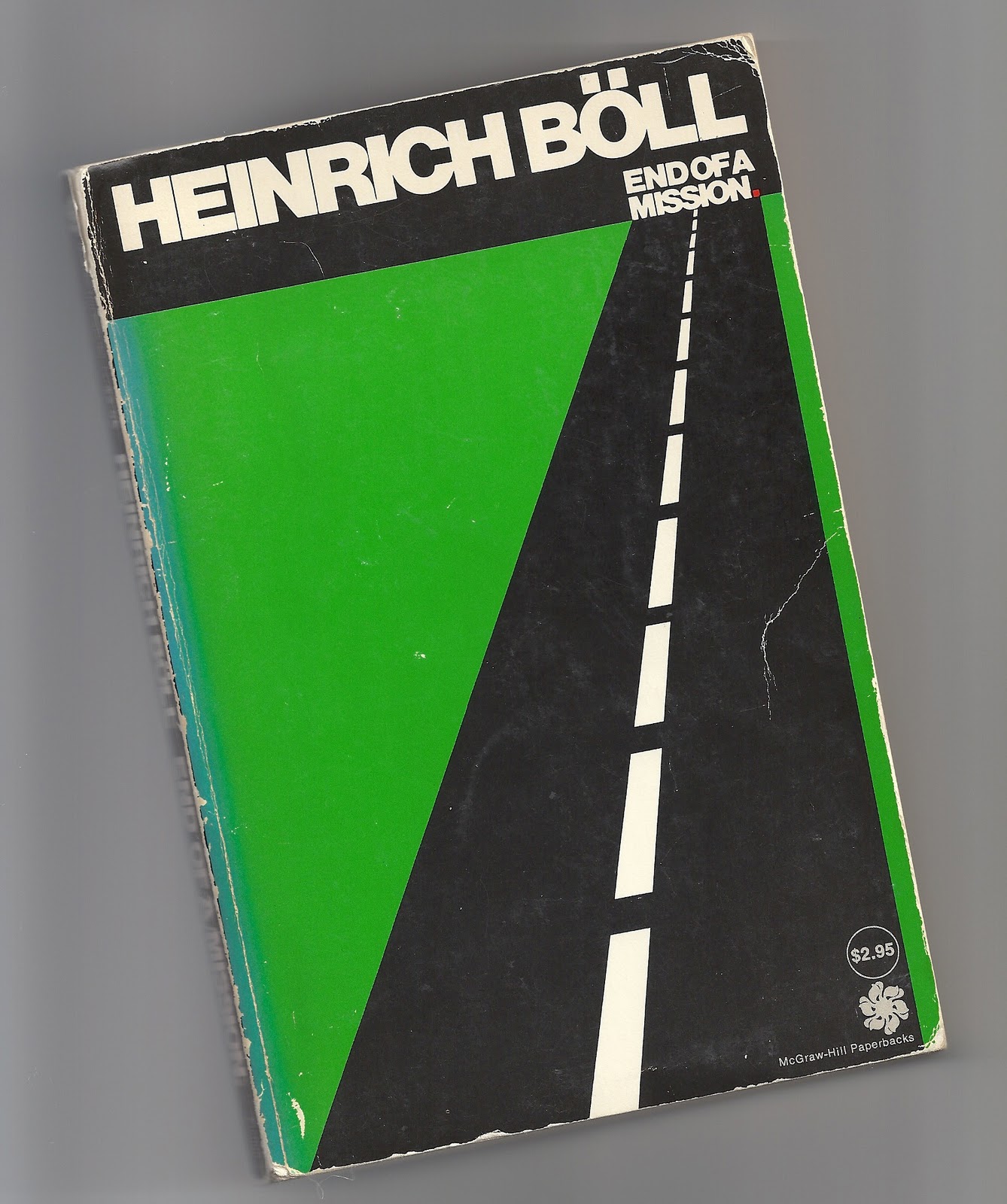
Book Review: End of a Mission by Heinrich Boll


For a short time there was a great little travel bookstore here in DC. What made the store unique is that they would tuck in amongst the travel guides and travel writing works of fiction representative of each country. It was there that I stumbled across my first Heinrich Boll, The Lost Honor of Katharina Blum. I ended up loving the rather spare, precise way that the story unfolded. Since then I have read two other Boll works and liked them less. And with this most recent title I am left wondering if I truly like Boll or just liked that one book. At only 206 pages I assumed that I would fly through End of a Mission. But that wasn’t the case. Since I bought the book sometime back in 2009 it has been in my nightstand. There have been many times I thought I was in the mood to read it. I even took it on several vacations. Yet it stayed unread for a long time, always returning to my nightstand. Several months ago I finally got into the rhythm of the book and started to enjoy it. But even then I got distracted by some other book about half way through it and so it sat for at another couple of months until the TBR Dare made me face all of my nightstand reading with renewed committment.

So what is this book about? The whole of the narrative follows the trial of a father and son who have been arrested for setting fire to an army vehicle. I think part of my disappointment in the book is that I was expecting a different kind of book. I thought that there was going to be some great reason for their action and expected more of a plot. Instead End of a Mission is like a tableau of personalities. Taking place in a small village every character is truly a character. All of the quirkiness of village life and relationships are played out in the descriptions and actions of everyone from judge to bailiff, to lawyers, police, witnesses, innkeepers, observers, the press and of course the accused father and son. It also took me a while to realize that much of the book is meant to be humorous. Throughout the book Boll shows the somewhat absurd juxtaposition of a society that likes rules at the same time that it seems to be rebelling against them. Perhaps it is in the wake of World War II and the role of law and order in the Holocaust that prompts these small town Germans to want to thumb their noses at authority. But even then there is an almost orderly quality to their small acts of rebellion. Being at least one quarter German and one quarter control freak, I often feel an affinity for the stereotype of German precision and linear thinking. I had a history professor in college who abhorred any attempts to define a national character, either for individuals or for the collective society. But darn if it isn’t satisfying to trade in generalities sometimes.

There were moments that I enjoyed, and there are many aspects that would make End of a Mission a good book for discussion. But not a book club discussion. I think it would do much better in a more academic setting, and one that was focused more on German post-WWII history rather than one specifically about literature. For these reasons I am wavering between giving this book a 5 (ambivalent) on the My Porch Scale or a 6 (almost liked it).


Book Review: The Professor’s House by Willa Cather


I first read The Professor’s House by Willa Cather in 2003. At the time I was captivated by the novel and ranked it as one of my all time favorites. Since then I have recommended it widely and have been happy to see it crop up with some frequency on various book blogs. Most recently Karen at Books and Chocolate read it during Virago Reading Week. Reading Karen’s review made me want to go back and re-read the book to see if my initial love of the book would stand. Thankfully I had a paperback edition of it in my nightstand so I could remain true to the TBR Dare.

In the latter days of his academic career at a small university on the western shore of Lake Michigan, Professor Godfrey St. Peter decides he isn’t quite ready to leave behind his quirky old study when he and his wife are meant to be moving into their new house. He contemplates his career, his wife, his grown daughters and their husbands, and most significantly, his relationship with Tom Outland a protege who was much like a son to St. Peter and who was killed in World War I. After convincing his wife, daughter, and son-in-law to go off to Europe without him, St. Peter means to edit Outland’s diary. As he prepares an introduction to the diary, St. Peter recounts Outland’s life before they met. A major chunk of the book is about Outland’s life in New Mexico, where among other things, he discovered a group of abandoned cliff dwellings. St. Peter’s summer alone with his thoughts brings new clarity to his life, both past and future.

When I first read The Professor’s House back in ’03, I saw it mainly as the story of someone who wanted a little solitude. Being quite independent myself with a tendency toward being a loner, I really identified with that. Now seven years later, I can still see that in the book, but it seems like a minor detail given all of the other thoughts and emotions St. Peter processes. Through Outland’s story St. Peter comes to terms with what his own life has turned out to be and how different it is from what St. Peter thinks is truly important. There is much that could be considered melancholy in this book, but I find that the overall feeling is really about hope and possibility. As the blurb on the book notes, St. Peter turns emotional dislocation into renewal.

I feel an affinity for St. Peter’s intellectual and emotional outlook. He is someone I would like to know, or be. For that reason alone, The Professor’s House is wonderful. But there is also something about the section on Tom Outland’s life in New Mexico that I find breathtaking at times. Cather does a brilliant job evoking the beauty and spiritual timelessness of New Mexico. Several years ago I was lucky enough to spend two weeks in Las Cruces in southern New Mexico. While I was there I went up into the Gila National Forest alone and saw some cliff dwellings for myself. Set on a green wooded mountain, on a beautifully crisp, sunny February morning, I felt like I had been transported to another time, and not just in an intellectual and historical sense. There was something about the dry, clean air, the brilliant blue sky, and the amazing quiet that I found quite moving. The contemplation of geology and nature, and geologic time in particular, is perhaps the closest I come to any sort spirituality. I find something oddly comforting in the fact that my life is just an infinitesimal blip in the billions of years of geologic processes that happened before me and will happen after me. And that my body will become part of that geology. I should be clear that I am conflating Tom Outland’s story with my own experience in New Mexico. Cather’s text doesn’t really strive to be so lofty, but it does say important things about what is truly ours and what is important in life. Having said that, one does not need to find or even want to find something spiritual in this book to thoroughly enjoy it.

There is one scene as Tom contemplates the cliff dwellings that reminded me of the A Month in the Country, the last book I read. In that book, Tom Birkin feels a certain connection to the the painter of a work he is uncovering five hundred years after its creation. Tom Outland’s experience discovering the cliff dwellings is similar:

To people off alone, as we were, there is something stirring about finding evidences of human labour and care in the soil of an empty country. It comes to you as a sort of message, makes you feel differently about the ground you walk on every day.

For a interesting analysis of this book and some great photos check out Nearly Lucid.

Book Review: A Month in the Country by J.L. Carr


Tom Birkin, a Londoner, and a somewhat shell-shocked veteran of World War I arrives in Yorkshire to uncover a suspected wall painting in the village church. Written as a memoir, Birkin’s story is equal parts country idyll, love story, and ethnographic sketch. Over only 135 pages, Carr’s poetic writing conjures up so many moving, beautiful, and humorous images, I feel very clumsy writing about it.

Through Birkin’s experience we meet the people of Oxgodby and are introduced to their various quirks and natural distrust of a city boy from the South. We learn the value of vocation and art for their own sake. And we see Birkin slip almost imperceptibly into the life of the village. He takes up Methodism despite working and literally living in an Anglican church, becomes close friends with Charles Moon a fellow WWI vet who has been hired to unearth the grave of the ancestor of an important local family, becomes an honorary member of the Ellerbeck family, and falls in love with the vicar’s wife.

Passages like this transported me to Birkin’s bucolic time in Oxgodby:
There was so much time that marvelous summer. Day after day, mist rose from the meadow as the sky lightened and hedges, barns and woods took shape until, at last, the long curving back of the hills lifted from the Plain.
And there are many scenes that beautifully describe connections to the past.
…their mother worked out how it was with me and usually sent a bit of whatever was being manufactured in her kitchen–rabbit pie, a couple of currant teacakes, two or three curd tarts. So, over the weeks, a splendid repertory of North Riding dishes was performed amanti bravura to an applauding Londoner, dishes Mrs. Ellerbeck had helped her mother bake, who had helped her mother bake who…Sometimes I’d share this bounty with Moon and it was he who suggested that we were eating disposable archaeology.
Similarly, both Birkin, in the course of his work restoring the painting, and Moon in his archaeological digging, contemplate the creators of the work they are unearthing. Here is Moon asking Birkin about the unknown artist:
“How are you two getting on together?” Moon would say, waving a hand at my wall. “Do you ever feel him breathing down your neck, nudging you–‘Good lad, Birkin! Attaboy!’ You must know him pretty well. Go on–tell me about him. who was he?”
Birkin contemplates how alien the idea of fame would have been to this unknown master.
And the idea that his work might be minutely observed five hundred years after his death would have been preposterous. In his day, buildings were being drastically remodeled every fifty years as fashions changed, so that my man would calculate his painting, at the longest would last no more than a couple of generations.
Not only would this unknown artist never have contemplated the immortal nature of his work, he certainly wouldn’t have supposed that Birkin, five hundred years later could intelligently deduce that in addition to being right handed, likely a monk, and didn’t trust his apprentice, the artist
…was fair-headed; hairs kept turning up where his beard had prodded into tacky paint, particularly the outlining in red ochre which he’d based in linseed oil. There was no mistaking it for brush hair which was recognizable from its length, an inch, never more than an inch and half. Sow’s bristle for the rough jobs, badger’s gray for precision.
He also surmises something about the unknown artist’s end. But I don’t want to give too much away. What has just occurred to me as I write this is that Birkin’s restoration work, his contribution to history, as well as his connection with Oxgodby becomes similarly anonymous as it was for the original artist. It is enough for Birkin to have played his part in a continuum of human endeavor as well as to have had, at least for one summer, received so much from his time in Oxgodby.
This review is a little over wrought and under thunk. I warned you that was going to be tough to write about this little gem. I think it is a beautiful book and it gives me deep comfort about my place in the cosmos.