
Is it May yet?

Darlene over at Roses Over a Cottage Door posted a picture of a London Blue Plaque that her mate (?) made for her. Thankfully she also included the link to blueplaque.com so I could waste um…I mean spend all morning making plaques for friends–most of which can’t be displayed here to protect the guilty.
So I decided to commemorate the time I spent living in London in 1992. I worked as a front desk clerk at the Sydney House Hotel in Chelsea, but I shared a room with three others and a kitchen with 27 others in the BUNAC Hostel on Store Street just off of Tottenham Court Road. It was just up the street from Senate House at the University of London and just a stone’s throw from Charing Cross Road.


The Brontes Went to Woolworths
Rachel Ferguson
The Brontes Went to Woolworths is the rather quirky tale of the Carne family’s prodigious creativity. Despite one daughter’s attempt at being a novelist, and another’s quest to be an actress, the Carnes don’t really have much in the way of productive outlets for the output of their endlessly spinning minds. Between the four of them (mother plus three daughters) they have created a web of imaginary relationships with people they don’t really know. That is, until one day they actually get to know two of their imagined friends. Thankfully for the Carne family their quarry is interested in playing along.
The Brontes Went to Woolworths was definitely an enjoyable read, but I really think you need to be in the mood for something so whimsical it borders on nonsense. Despite some of its rather edgy subject matter (for 1931) the book feels somewhat saccharine. Like a mix of Waugh and Wodehouse but without being very clever. One could imagine a room full of Hollywood studio types turning this quirky, sweet tale into a thriller about a family of psychotics stalking a judge and his wife. In that tale someone would no doubt end up dead or in jail. No such outcome in this book.
Don’t get me wrong, there were many enjoyable moments reading The Brontes Went to Woolworths. I think I just wasn’t in the mood for that much whimsy. It is also entirely possible that I may have missed the point. It wouldn’t be the first time a meta-narrative went over my head.
For a more sensitive and substantive take on the book check out Dovegreyreader Scribbles.
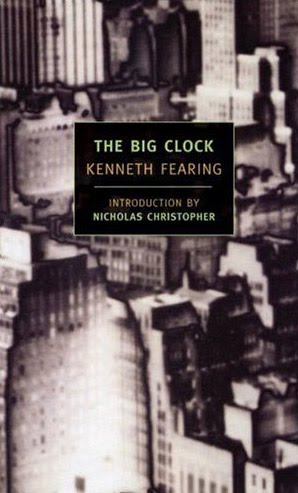
The Big Clock
Kenneth Fearing
It took me a while to get into The Big Clock, but once I did, it was hard to put down. Written in 1946 this murder mystery doesn’t keep you wondering whodunit, but it does keep you wondering who is going to get away with what.
The victim is Pauline Delos, mistress to publishing magnate Earl Janoth who is also her killer. (Janoth’s publishing empire is strikingly similar to Time Inc. during the time of Henry Luce.) It turns out someone saw Janoth with Delos right before she was murdered. Trying to stay ahead of the police investigation, Janoth’s right hand man Steve Hagan uses a false premise to put crime-magazine writer and Janoth employee George Stroud in charge of finding the unknown witness. But it turns out that Stroud himself was the witness. Fearing for his marriage, his liberty, and even his life, Stroud has no choice but to lead the investigation. Compelled to use the full resources of the company, Stroud has to stay one step ahead of the 53 employees investigating a trail that can only lead to him.
I won’t say anymore about the plot. But I will say that I really enjoyed this book. Not much of a reader of mysteries, I may not be the best judge of how this stacks up with others in the genre. On the other hand, my outsider status should give assurance to anyone similarly inclined that you don’t need to be a mystery fan to like this book.
Raymond Chandler, perhaps a bit full of himself, had this to say:
I’m still a bit puzzled as to why no one has come forward to make me look like thirty cents. But except for an occasional tour-de-force like The Big Clock, no one has.
But I will let the wonderful Nancy Pearl have the last word:
Read The Big Clock to get a feel for Kenneth Fearing as social critic, spinning out an edgy corporation-as-hell thriller.
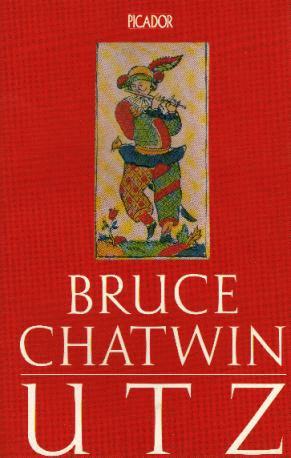
Utz
Bruce Chatwin
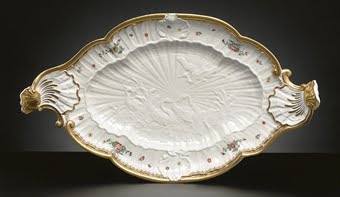
Despite World War II and the later challenges of a repressive Communist state, Kaspar Joachim Utz has managed to collect over 1,000 pieces of Meissen porcelain and cram them into his tiny two-room flat in Prague. The novel begins with Utz’s funeral in 1974 and the tale unfolds through the recollections of the narrator who interviewed Utz once in 1967 and whose knowledge of Utz’s life is less than perfect or complete.
At the heart of the story is Utz’s decision to stay in Communist Czechoslovakia despite having the opportunity and financial means to defect to the West on his yearly state-approved pilgrimage to the healing waters of the spas in Vichy. His reticence to leave Czechoslovakia is largely based on not wanting to leave behind his collection, but he also harbors a secret and seemingly intense love for his housekeeper. The luxuries of the West also seem to Utz to have lost their attractiveness and he seems rudderless at the prospect of choosing somewhere new to live.
Switzerland? Italy? France? Three possibilities. None of them inviting. Germany? Never. The break had been final. England? Not after the Dresden raid. The United States? Impossible. The noise would depress him dreadfully. Prague, after all, was a city where you heard the snowflakes falling. Australia? He had never been attracted to the colonies. Argentina? He was too old to tango.
The more he considered the alternatives, the clearer the situation seemed to him. Not that he would be happy in Czechoslovakia. He would be harassed, menaced, insulted. He would have to grovel. He would have to agree with every word they said. He would mouth their meaningless, ungrammatical formulae. He would learn to ‘live within the lie’.
But Prague was a city that suited his melancholic temperament. A state of tranquil melancholy was all one could aspire to these days!
 I have only read one other book by Chatwin, his amazing On the Black Hill. Although Utz and On the Black Hill are worlds apart in setting, they both deal with characters who make choices that may seem restrictive and unattractive to those of us used to a large degree of self-determination. But their lives seem to retain a richness nonetheless. For those of us who are warm and well fed and have the personal and political freedom to make seemingly infinite choices, it is a little hard to understand. But it is also comforting to know that diminished or limited circumstances don’t have to mean a diminished or limited life.
 I liked Utz quite a bit. But for me, if you are only going to read one book by Bruce Chatwin, make it On the Black Hill. (Recently Cornflower has been writing glowingly about On the Black Hill as well.)
Since it snowed this weekend in the DC area I thought I would pay homage to the white stuff. Unfortunately, we were out of town and missed the snow, and now that we are back there isn’t much in the way of remnants, so I will gaze at this scene of snowy Paris instead. Oddly enough, this particular painting of Paris lives in Melbourne, Australia which is where we saw it back in 2007.
The scan quality isn’t as good as it should be for some reason.

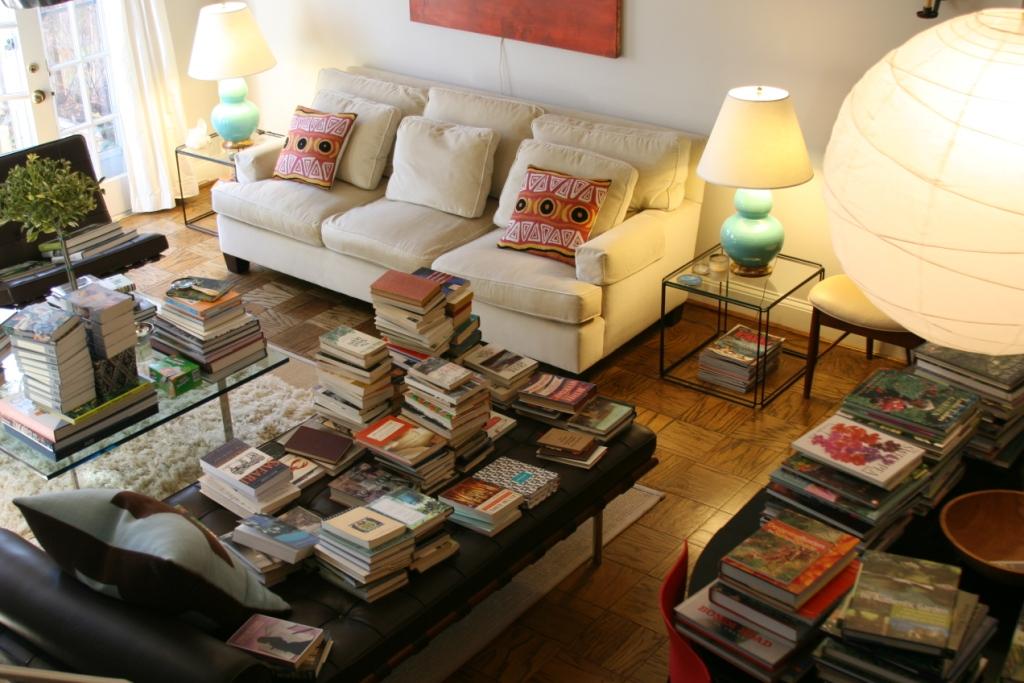
After my most recent purchases, the structural soundness of the books stacked in front of the bookshelves was in serious jeopardy. After much sorting I ended up getting rid of only about 12 books. So the end result wasn’t so much a reductionn in the stacks, but merely neater, sturdier stacks. I really can’t buy any more books until we find a house. We just don’t have the room anymore.
Since we are off to Phoenix this weekend to visit my parents and my sister and her family I probably won’t have time to blog. So knowing that many of you share my interest in gazing at piles of books, I thought I would leave you with a whole gallery. Sorry you can’t see many of the titles.




Last weekend when we were up in Doylestown, Pennsylvania for Thanksgiving I was just going to browse some used books while John and Shane were getting pedicures. It turned out the building with the used bookstore actually houses TWO used bookstores. Needless to say, I did not come out empty handed. The first pile is from Central Books, which is general purpose reading copy type secondhandbooks, the second one from Bucks County Bookshop which deals in more antiquarian and rare stock.

Rumer Godden – In This House of Brede (have never read this author)
Julian Barnes – Talking it Over (interested in more Barnes after reading Arthur and George)
Elinor Lipman – The Pursuit of Alice Thrift (I love Elinor Lipman)
Graham Greene – The Human Factor
Graham Greene – The End of the Affair
E.M. Forster – The Hill of Devi (memoir of his time in India)
J.M. Coetzee – The Master of St. Petersburg (like Coetzee a lot)
Ian McEwan – On Chesil Beach (I really love this book but I didn’t own a copy)
Kate Chopin – The Awakening (about time I read this one)
E.M. Delafield – Diary of a Provincial Lady (was surprised and delighted toto find this one, heard lots about it on other blogs)

With the exception of the Haggard, these are all authors I have read and liked.
Elizabeth Bowen – The Little Girls
Wilkie Collins – The Dead Secret
Wilkie Collins – Hide and Seek
Bruce Chatwin – What Am I Doing Here
Bruce Chatwin – Utz
W. Somerset Maugham – Christmas Holiday
Muriel Spark – The Takeover
Muriel Spark – Symposium
Heinrich Boll – A Soldier’s Legacy
Heinrich Boll – The Safety Net
Heinrich Boll – What’s to Become of the Boy or: Something to Do with Books
Shirley Jackson – Life Among the Savages
William Haggard – The Areana (I have never run into a green Penguin crime book in the USA. So even thought it is not a genre I read, I am going to give it a whirl.)
So what do you think? Favorites? Cautions? Tips?

The Pilgrim Hawk
Glenway Wescott
This was the fourth and final novella I was to read for the November Novella Challenge. I can’t quite put my finger on why, but I must say I am not a huge fan of novellas. I finished this one last night right before midnight, so I finished the challenge, but I didn’t enjoy it like I thought I would. The good thing is all of the titles were in my TBR so I didn’t buy anything especially for this.
Despite being a very short 108 pages, I really struggled with The Pilgrim Hawk. There is nothing I can think of to write that is even remotely enlightening or interesting. So I will let the New York Review of Books (who published this edition) stand in for my review. It doesn’t mean I agree with their review, it just means I don’t care enough about the book to write my own. You might be interested to note on the NYRB link that Christopher Isherwood, an author I quite like, gave it a fulsome blurb.
Out of the four I read for the challenge I liked Hemingway’s The Old Man and the Sea the best. Strachey’s Cheeful Weather for a Wedding and Fitzgerald’s Bookshop are tied for second place. Both were interesting and had their moments, but didn’t necessarily satisfy. The Pilgrim Hawk comes in a distant fourth.
November Novella Challenge: 4 down, 0 to go.
I have been tagged by Skirmish of Wit to list 7 things I love. True to my nature, I find it very hard to limit myself to just seven things. Suffice it to say I love, love, love books, food, travel, classical music, and television. But those are big, broad categories and I am tempted to list seven things for EACH of them, but that seems to defy the spirit of the challenge. So, I decided to find a few specific things that serve as examples of some of the broader themes listed above. They are in no particular order.
7 (Specific) Loves
Mutts
We can’t wait to get a dog, hopefully sometime in early 2010. And although there are some breeds that I take a shine to (like Golden Retrievers), there is nothing quite like a cute, lovable mutt. Especially one rescued from a shelter.

Pipe Organs
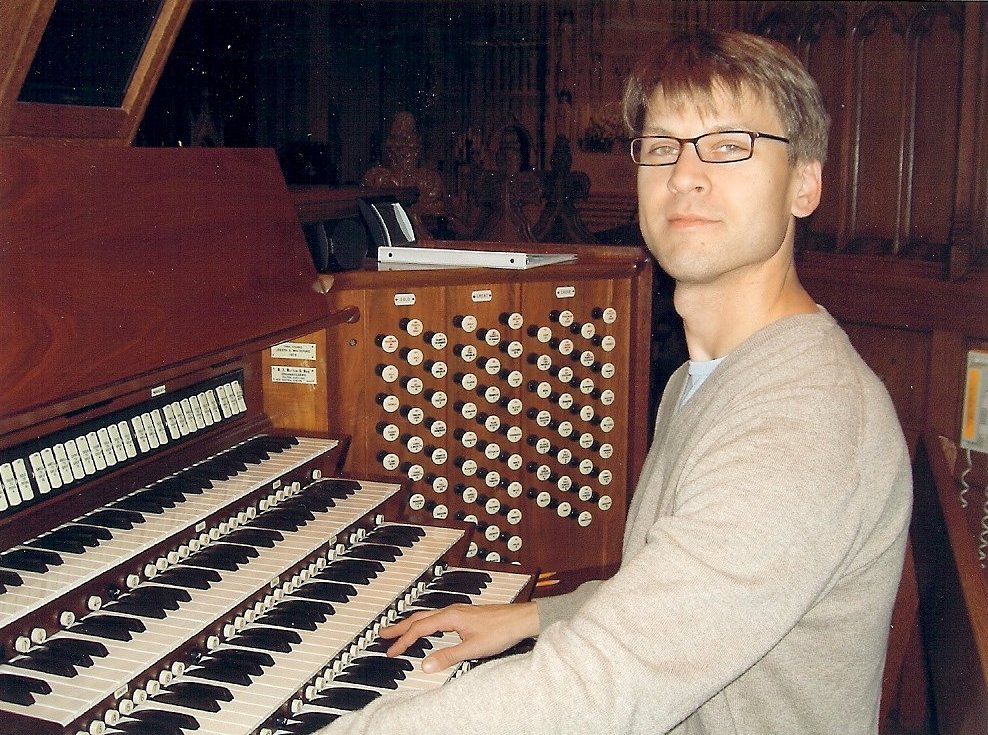
I get a fair amount of teasing for this one. Apparently the sound of a pipe organ is an acquired taste. But I find the sound magnificent. The variety and power of the sounds available in even smaller instruments is impressive, but when you get a really big mother going it is a sound you literally and physically feel as much as hear. And I love the way they look. The pipe cases are beautifully sculptural and architectural and they are usually in the stunning surroundings of a cathedral or a grand hall. (Passau Cathedral shown below.)

Excel
In general I love to organize things. I love to sort, and throw, and donate, and stack, and line up, and tidy, and well, organize. And I love to organize data in an Excel spreadsheet. There isn’t much that doesn’t benefit from a good Excel spreadsheet. From all the books I have read since 1994, to concerts, budgets, CDs, travel arrangements, you name it.
Sissinghurst
A few summers ago when John and I were in London we spent a day at Sissinghurst, once the home of Vita Sackville-West and her husband Harold Nicholson. Between Vita’s cozy study in the tower and the amazing gardens, Sissinghurst is a little slice of heaven. Even with lots of tourists it was possible to find a quiet spot at the edge of the orchard looking across the moat to the surrounding pastures. It’s a place I could sit for hours.


Fonts and Graphic Design
I love good graphic design in general (please don’t judge me by my poorly designed blog), but am particularly fond of fonts and their use in graphic design. No doubt this is tied to my love of the written word, books, letters, etc. One of the reasons I loved our visit to the Plan Museum in Antwerp in October. But I love fonts and good graphic design wherever it is, books, signs, stationary, posters, product packaging. If you haven’t been there, The Book Design Review is a great place to see some of the best and most interesting book covers out there. There is also a site called Brand New that is all about corporate branding with lots of before and after images of logo redesigns. And don’t even get me started on the brilliance of the graphic design on the London Underground. I am probably going to blog about that one of these days.

The Alcotts movement from Charles Ives’ Concord Sonata
I urge you to immerse yourself in this movement from Charles Ives’ Concord Sonata. I think this is one of the most sublime six minutes of music every written. The interpretation on this video isn’t my favorite but it still does the trick. I think she is a little too bombastic and literal with the Beethoven quotations at about 1:44 minutes, but the performance overall is pretty satisfying. There are a few commercial recordings of the sonata available. My favorite is by Canadian Marc-Andre Hamelin.
Charles Ives was an American composer (and fulltime businessman) whose output can sometimes challenge even modern ears. In his Concord Sonata he gives a movement each to American transcendentalists Ralph Waldo Emerson, Nathaniel Hawthorne, Bronson and Louisa May Alcott, and Henry David Thoreau.
Modes of Transportation
When it comes to planes, boats, trains, and to a lesser extent, cars I turn into a 12-year old. I am particularly fascinated with fixed-rail public transport systems. I love the variety from city to city. Light rail, heavy rail. Underground, overground. Stations, platforms, and signage. It all fascinates me. On one trip to London, I took the District Line out to Wimbledon, hopped on the light rail to Croydon, then took British Rail back into town. All just for the fun of it, and to see (and ride) the new light rail line. (The tram shown is in Grenoble, not London.)

And I am one of those people who buy those airliner magazines that are like commercial jet porn. Except instead of buxom blondes or hunky guys, the centerfolds are pictures of jets taking off and landing or showing off new (or old) livery. (That’s right, the paintjob on a plane is referred to as its livery. How cool is that?)

Now I need to tag seven others. I realize you may not want to (or have the time to) participate, but if you do, let us know about your 7 Loves.

