After my recent post about Upstairs Downstairs, it seemed that many of you have never seen this wonderful show, and would probably like it. So I found this clip from from the 2007 Bafta awards that gives a quick glimpse of what Upstairs Downstairs was all about. The laugh track is absolutely awful, the director/producer of the Bafta show should be ashamed. Although the show had its humorous bits, none of the clips shown here and overlaid with laugh track fall into that category. Also, based on the delivery of some of the casts’ lines at the award show, they meant this whole thing to be funny. I don’t know why. It’s like a bad episode of Jonathan Ross–oh wait, every episode of Jonathan Ross is a bad episode of Jonathan Ross. The audio is also a bit off from the video, but despite all of this it is still worth a look.
Sunday Painting: Vincent Desiderio
You really have to see this painting in person, or at least see it in larger format in a book, to fully appreciate it. When you see the detail of the art books scattered on the floor (can you spot the Vermeer pearl earring picture?) it is easy to understand why it took Desiderio ten years to complete this large canvas.
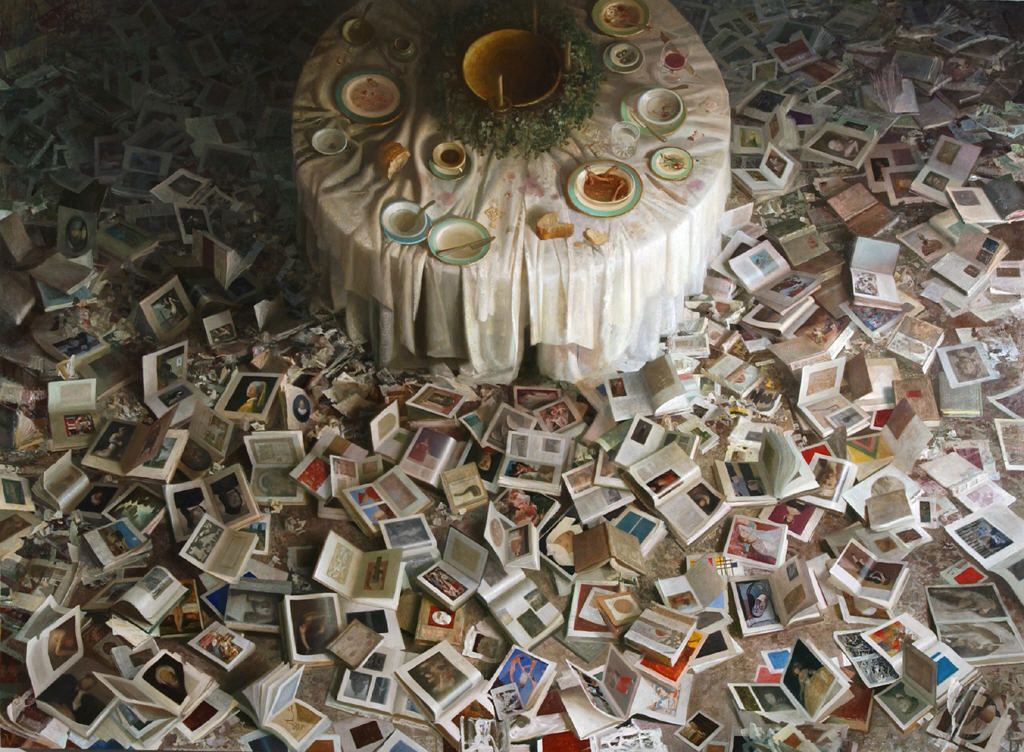
Cockaigne, 1993-2003
Vincent Desiderio (American, b. 1955)
Copyright: Smithsonian Institution. Photo by Lee Stalsworth.
Book Review: My Latest Grievance

My Latest Grievance
Elinor Lipman
If you are looking for interesting, smart, well-written, popular fiction Elinor Lipman is an author you need to know. Although her books tend to be quick, fun reads with likeable characters, they are by no means without substance. My Latest Grievance is narrated by Frederica Hatch, a precocious teenager who has grown up in a dormitory at a women’s college just outside of Boston, where her parents are professors and live-in houseparents. The professors Hatch have always treated their daughter like a mini-adult, so very little is kept from Frederica’s ears and she, in turn, is quick to insert herself into any conversation. The result is amusing.
The action centers on Frederica’s discovery that her father had been married before he was married to her mother and the subsequent arrival on campus of said ex-wife. Needless to say the arrival of Laura Lee causes a bit of a domestic stir in the Hatch family and sets into motion a string of events that changes everything. Despite a few tragedies, moral and otherwise, along the way, the tone of My Latest Grievance is always light and mostly humorous.
Being the third Lipman novel that I have read and thoroughly enjoyed, I feel like you could probably pick up any of her books and enjoy them. No doubt some may be better than others, but my guess is they are probably all worth a read. Especially if you are looking for something fast and fun.
Thanksgiving

Since I will be out of blogging range for the Thanksgiving holiday, I thought I would leave you with this image of what passes in my family for an inside joke and heirloom all crocheted into one kitschy little turkey. Affectionately known as Helmut due to his helmet-like red cap, he somehow made the jump from childhood tchotchke to cherished family member. At some point when I was in college or graduate school my mother was getting rid of stuff from the basement and decided to send me Helmut as a bit of a joke. Being away from home at the holidays, I actually appreciated this vestige of past family holidays. And despite John’s good taste and keen eye for good design, he has also taken a shine to Helmut on his yearly Thanksgiving appearance.
So, happy Thanksgiving to all of you.
For those of you bored with football or shopping this long weekend (or those of you outside the US who don’t give a fig for Thanksgiving), I thought I would give a few suggestions.

On Bookish Things
You can peruse my reviews of The Year of the Flood and The Queen of the Tambourine.
Check out this fantastic classics-only bookstore/salon in San Francisco.
Read about the film Helvetica and my love of fonts.
My 2008 reading wrap-up gives a glimpse into My Porch before it turned its focus to books.
Or maybe just some cool pictures of a used bookstore in Chicago.
Travel to the Beach on My Porch
Lizard Island on the Great Barrier Reef in Australia a few years back.
Pacific coastline in Big Sur, California.
Pink sands of Bermuda.
Travel to the Mountains on My Porch
Whistler, British Columbia, home to the 2010 Olympics.
Grand Tetons in Jackson, Wyoming.
And, or course, the recent trip to Switzerland.
Paying Tribute to The Womenfolk
For those that haven’t seen it, you should really check out my tribute to The Womenfolk, a fabulous folk group from the 1960s. It still gets lots of page hits and it even led to an article about me in the local press.
Or what about my “Best of” series?
Best Chip Dip Ever
Best City in the USA
Best Whoopie Pie in America
Best Bar in the World
Best Book Ever
Book Review: The Year of the Flood

The Year of the Flood
Margaret Atwood
Margaret Atwood prefers the term speculative fiction rather than science fiction to describe her latest novel The Year of the Flood (and her other works like it). Some might be hard pressed to understand the difference, but perhaps the distinction may be that Atwood speculates about the future based on our current trajectory rather than making up a new universe out of whole cloth. Not having read much science fiction over the years, I am not going to weigh in too much on this one. Suffice it to say that Atwood calls it speculative fiction. And since she is a goddess among us, I will defer to her wishes.
All of the speculative oddities included in The Year of the Flood seem less crazy not only because one can see the roots of the idea in what is happening in the present, but also because Atwood is a master prose writer and draws the reader effortlessly into this world. She doesn’t hammer these ideas home, she gently, in bits and pieces, introduces the reader to this dystopian future. Like all of Atwood’s novels, the characters are interesting and nuanced and don’t necessarily need the setting to make them so.
This story of survival, in the most trying of ecological and societal circumstances, is at times as whimsical as it is an overwhelmingly sad prediction of our future. A religious sect interested in bringing the biblical peaceable kingdom to fruition on earth attempts to get the lion and lamb to lay down together by genetically engineering “liobams”. The thought being that these lion/lamb hybrids would make such peace possible. However, as Atwood notes in the novel, the results were less than vegetarian. But this is only the tip of the iceberg (which don’t seem to exist in the future). In The Year of the Flood Atwood creates a complete world full of creatures and circumstances that are fascinating and yet seem entirely plausible after a few chapters.
This brings me to another aspect of Atwood’s great talent/skill. In addition to her writing ability, she knows so much about so many subjects or at least does the research to make it seem like she does. Like other great writers she is adept at weaving in deep layers of religious, mythological, psychological, philosophical, scientific, and cultural references. She also doesn’t shy away from sex, drugs, and violence, and writes about them in a way that makes you forget that she just entered her eighth decade.
One aspect of the story I found disappointing was her depiction of gender roles. Atwood’s future contains all kinds of advances in science but it doesn’t seem to include any evolution of male/female roles and attitudes. It is possible that this was a conscious choice on her part. Maybe she thinks the future doesn’t look bright for gender equality, or perhaps in this dystopian world where physical survival is paramount and weapons are hard to come by, gender roles devolve to something a little more Neanderthal. But I got the feeling that at least some of it suggests that Atwood’s personal outlook on gender–which doesn’t seem to grasp that men frequent spas–is stuck somewhere in the past.
There is definitely an environmental message here. About global warming, genetic engineering, the promise and danger of technology, and the effects they all will have on life as we currently know it. At no time does it come across as a political tract, unless you are one of those folks who believe we can do whatever we want to the planet and not suffer any consequences. If that is you, you will hate this book. As depressing as Atwood’s future world is, it kind of helps me cope with the stress of feeling powerless to do much about the enviro-political greed and stupidity we must deal with these days. Of course it is a fatalistic kind of relief. As in, won’t the planet be a better place without us? And personally, the idea that death means donating oneself “to the matrix of life” is quite comforting to me.
Finally, some of you are going to ask if you need to read Oryx and Crake first. The answer is no. It might enhance certain aspects of the book as some of the characters do reappear, but the book is fabulous enough to stand on its own.
Other views (if you have reviewed it, let me know and I will link):
Boston Bibliophile
Shelf Love
Books – Sliced and Diced
Savidge Reads
The Mookse and the Gripes (This reviewer hated it so much I wasn’t sure we read the same book.)
Book Review: The Queen of the Tambourine
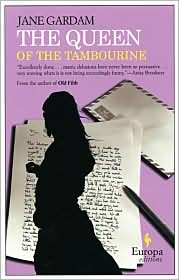
The Queen of the Tambourine
Jane Gardam
Even though I read this book before I read The Year of the Flood, I wrote the review of TYOTF before this one, and I don’t appear to have much steam left.
Winner of the Whitbred Prize for Best Novel of the Year, The Queen of the Tambourine is a funny and poignant book about Eliza Peabody, a housewife whose sense of reality isn’t what it should be. The entire book is written as a series of letters to her friend Joan. I don’t want to go into my love/hate relationship with epistolary novels again. Suffice it to say this one starts off very well in that regard, with each of the letters seeming very believable, but they eventually stray into pretty conventional narrative posing as letters.
I enjoyed this book, it was humorous and kind of satirical, but with the right amount of sentiment never far from center. Sympathetic and villainous characters, twists and turns, tension and resolution, etc. The whole nine yards as it were.
This is the kind of book that is good to pick up if you run across it somewhere. But, even though I enjoyed it, I wouldn’t necessarily tell someone to go hunt it down.
Sunday Painting: Hans Holbein (maybe)
This striking painting is at the Mauritshuis in Den Haag, The Netherlands. This is the same museum that has the Vermeer painting that inspired the novel Girl with a Pearl Earring. It isn’t a huge museum, but has plenty wonderful things to see, including really beautiful abstract painted ceiling panels over the main stair. It is one of the places you can see yourself visiting on a regular basis if given the chance.

Portrait of a Young Woman
Formerly attributed to Hans Holbein, the younger. (1497-1543)
Don’t ask me who it is attributed to now.
Wow.
I stayed up until 2:00 AM reading Margaret Atwood’s The Year of the Flood. Woke up this morning at about 8:30, and grabbed it off of my nightstand as soon as I could see clearly enough to read. Didn’t put it down until I finished. As I if I needed more proof of Atwood’s genius. What an amazing book. I will review it sometime this week hopefully.

Upstairs Downstairs
 12/18/09 UPDATE: Welcome People of Finland! I am not sure what’s going on in Finland these days, but I am getting lots of site traffic for Upstairs, Downstairs from the land of Sibelius. Please leave a comment or two. I would love to hear from you. Why so much interest in Upstairs, Downstairs?
The first four in the back row Left to Right are Daisy, Ruby, Edward, and Rose. The two ends of the seated row are Georgina and James (see picture below).
My recent reading of Ivy Compton Burnett’s Manservant and Maidservant made me think more than once about the fabulous Upstairs Downstairs. They aren’t all that related, but there were hints here and there. I was trolling around the Interwebs when I stumbled on this story and photo from the Evening Standard. It was great to see the picture below from 2007 with some of the cast members. I think the most amazing thing is how well Jean Marsh (number 8) looks. March played Rose on the show and was one of the show’s creators along with Eileen Atkins. Not only does she look really good full stop, but she is actually the oldest person in the photo. If I look that good at 73 I will be very happy. And if she has had work done she has a very good plastic surgeon. (I also just noticed at IMDB that she did an episode of Love Boat. That would be fascinating to see.)
I have heard some rumors online that they are going to remake UD with Jean Marsh’s involvement. Since the 1970s’ sets and film quality are a bit lacking by today’s standards, I would love to see that. But I am not sure how I feel about other actors playing any of the roles. But then again, who am I kidding. This would be great to see.

In character: 1. Edward Barnes 2. James Bellamy, 3. Thomas Watkins, 4. Hazel (Forrest) Bellamy, 5. Georgina Worsely, 6. Daisy (Peel) Barnes, 7. Sarah (Moffat) Watkins, 8. Rose Buck, 9. Ruby Finch.
Go here for a “where are they now” update.
Trying not to finish an author’s back catalog too quickly

The reading room
Jayne Dyer, 2007
My recent read of another novel by Nevil Shute got me thinking about authors whose novels I like so much I worry about running out of their work. For those that have passed on already the dilemma is already clearly delineated. For those authors still among the living, there are wishes for a long, long life and speedy, speedy writing.
This is slightly different than favorite authors. For instance I love Hermann Hesse, but I doubt I will ever read The Glass Bead Game. I will, however, read every work of fiction by these authors (if I haven’t already):
Margaret Atwood
Elizabeth Bowen
Anita BrooknerWilla CatherMargaret Drabble
Timothy Findley
EM Forster
Ward Just
Sinclair Lewis
Penelope Lively
W. Somerset Maugham
Ian McEwan
Cheryl Mendelson
Iris Murdoch
Anne Patchett
Barbara Pym
Muriel Spark
Carol Shields
Nevil Shute
Anthony Trollope (I don’t think I will live that long.)
Edith Wharton
I am sure I have forgotten some.
Thank god some of these authors wrote (or are still writing) a lot. I have sadly finished Forster and Shields and neither are around to write more. And there are others like Brookner and Atwood who I have almost caught up to their output. And then others whose work I am rationing so as not to finish too quickly.
Who are yours?

