Book Review: Cheerful Weather for the Wedding by Julia Strachey

Cheerful Weather for the Wedding
Julia Strachey

(Aside: Don’t you love this portrait of Julia Strachey by fellow Bloomsbury-ite Dora Carrington? And the cover painting “Girl Reading” by Harold Knight shown below is also pretty darn fabulous.)

It is a good thing I included this title in my November Novella Challenge, because I have been having a hard time deciding which of my fabulous first twelve Persephones I should read first. One would think diving into that stack wouldn’t really be an issue, but the existential angst over which to read first was killing me. Then again, who am I kidding, now I just have existential angst over which to read second.

I liked Cheerful Weather for the Wedding less than Simon at Stuck In A Book, but I liked it more than Nicola at Vintage Reads. And I felt a bit like Bride of the Book God when she writes:

The word that kept on springing to mind as I read this was brittle; not a criticism as such, but the story struck me as being one of those bright and witty pieces produced by many in the twenties and thirties, some of which were much more successful than others.

Frankly, in my mind the bride probably looked about as happy on her wedding day as dear old Julia Strachey does in her portrait.

This novella is only 118 pages but it took me until about page 60 before I started to really feel the rhythm of the book and get over my urge to quit reading it. I know that makes it sound pretty dire, and it isn’t as bad as that by any means. I actually think I would enjoy the first 60 pages much more now that I have finished the whole thing. It is kind of like the brilliant TV series Extras with Ricky Gervais and Stephen Merchant. I only truly appreciated the first season after I finished the second season and the finale show. I agree with Simon that the humor in Cheerful Weather for the Wedding is funny and charming—especially the green socks thread (no pun intended). I think I was just worried that I hadn’t really caught on to an actual story by page 60. But then after page 60 when one finally starts to feel like something is happening, it all starts to fall in place and feel right.

I think it is also the kind of book that would benefit from a real face-to-face book club discussion. A little back and forth banter with others who had read it would help put it into perspective for me. It was worth reading, but perhaps an inauspicious place to start my Persephone experience.

UPDATE: Apparently I was channeling Paperback Reader’s May review of this book when I compared Simon’s review to Nicola’s.

November Novella Challenge: 3 down, 1 to go.

Sunday Painting: Four More by Jon Schueler

This week for Sunday Painting, I chose four more works by American Abstract Expressionist Jon Schueler. Even though my first post also featured his work, the Sunday Painting feature won’t always be about Jon Schueler–I will branch out at some point. The images are just so striking that I couldn’t resist sharing.

He was a prolific painter and these images don’t even begin to scratch the surface.

The Sea and Yellow Sky, Clamart 1958
Copyright: Estate of Jon Schueler
Snow Cloud Over the Sound of Sleat, New York 1959
Copyright: Estate of Jon Schueler
The First Snow Cloud, Mallaig Vaig 1958
Copyright: The Estate of Jon Schueler
Forgotten Blues II, 1981
Copyright: Estate of Jon Schueler

Kenya a Year Later

One year ago today we hopped on a BA flight out of Heathrow and landed in Nairobi, Kenya for an amazing week of Safari. We are lucky to get to travel a fair amount but nothing will ever compare to our week in Kenya.

UPDATE: If you want to see more pictures, you can go back into the My Porch archives from December 2008 to see them. After clicking on the link just scroll past the first few posts  to see all the photos from the Safari.

Book Review: Pied Piper by Nevil Shute

Pied Piper
Nevil Shute

For those of you who have never read a book by Nevil Shute, now is the time. No special anniversary that I know of, it’s just that you are missing out on a really great storyteller. I attach some qualifications to this recommendation, but nothing that even comes close to diminishing my enthusiasm for his work. Some of Shute’s novels use some appallingly dated racist language, but I chalk that up to the era in which they were written, and I have my fingers crossed that the man himself wasn’t actually racist. There is also a certain corniness to some of Shute’s dialog. It sometimes sounds like it comes straight from one of those fast talking, black and white films from the 1940s. And his novels tend to be the kind where if every line doesn’t move the plot forward, your foreshadowing alarm should go off. Although there is usually a romance of some kind that is part of the mix, I would be remiss if I didn’t mention that his books are shot full of testosterone-laden adventures. But interesting and suspenseful enough to enthrall even someone like me who likes a lot of “old lady” books.

Pied Piper is the story of John Howard, a retired Englishman who is on holiday in France at the outbreak of World War II. Reluctantly agreeing to take two small English children back to England with him, Howard ends up finding it increasingly difficult to make his way home with the Nazis rolling into France with much more speed than anyone anticipated. During the journey home Howard comes across five more children that need his help escaping France. Since the story unfurls as a flashback, I won’t be giving anything away by mentioning that Howard makes it back to safety. I won’t say whether or not his young charges were as lucky–but have you ever seen a movie with a child character whose stupidity ends up getting folks in trouble? ‘Nuff said about that. The fact that book was published in 1942, long before the end of the war, gives one a different perspective on the tale as well. With the war not yet won, personal heroism (and more than a tinge of Commonwealthism/nationalism) have to take the place of a larger WWII victory narrative.

There is always enough non-fiction in a Shute novel that most of them have me racing to the Internet or some reference material to investigate further some aspect of the story. Pied Piper is no exception. As I made my way through this page turner, I pulled out my big map of France to follow Howard’s progress, which made the story all the more exciting.

Shute was born in England in 1899, worked as an aeronautical engineer, and, upset over the direction England was headed, emigrated to Australia with his family in 1950 and died in 1960. Although I have enjoyed other Nevil Shute novels, it was the recent reissue of four of his books in these great Vintage Classics’ covers (available in the UK) that made me pick up Pied Piper. Vintage has other Shute titles available without the cool covers, but I think many of his 23 novels are out of print. But they can be fun quarry while book hunting at garage sales, charity shops, and secondhand bookstores.

Other Shute books I have read include:

On the Beach (1957)
This was the first Shute I ever read. I was in high school and sobbed like a baby for the last 30 pages. I could barely read it through the tears. Atomic war has wreaked havoc on the northern hemisphere. Shute chronicles life in Melbourne as they wait for the radioactive fallout to reach them. Also made into a good movie with the young (and very handsome) Anthony Perkins of Psycho fame.

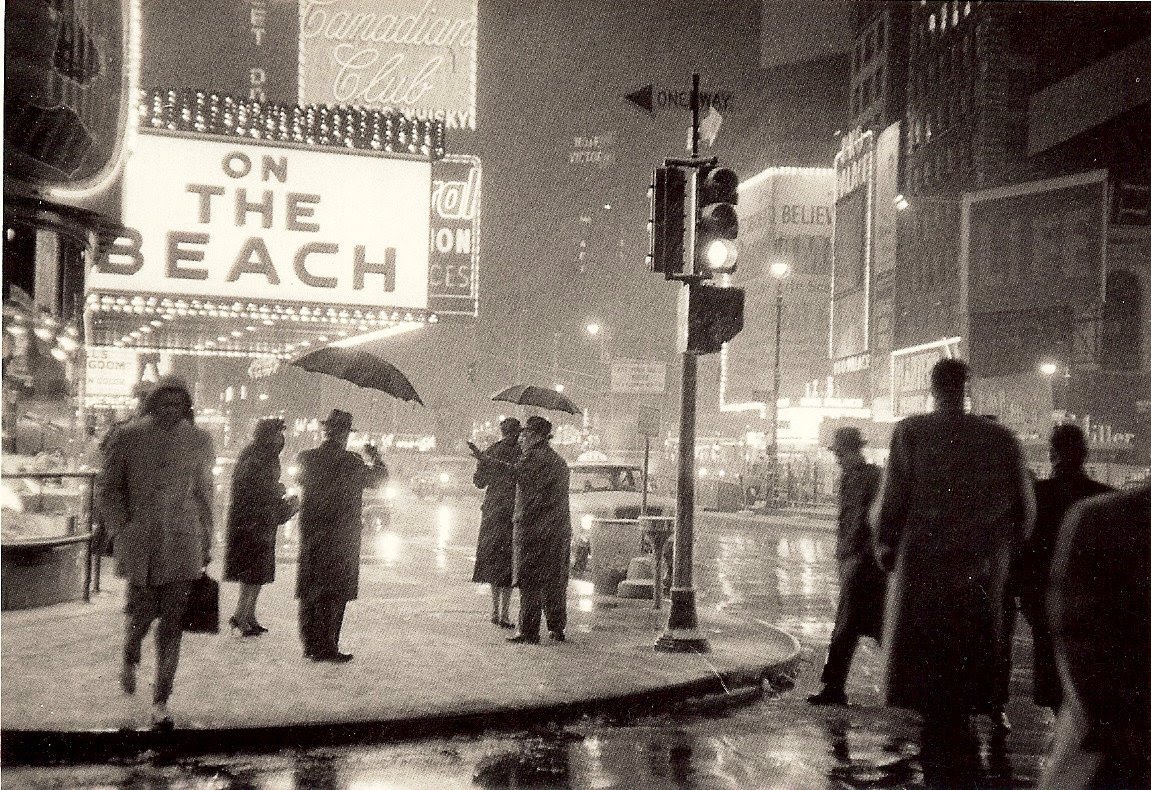
Times Square at Night, c. 1955* by Bedrich Grunzweig
(*I love the image on this postcard and the fact that On the Beach is on the marquee makes it even more special to me. But I just realized that the estimated date of the photograph on the card is wrong. On the Beach was published in 1957, and the film came out in 1959, so it couldn’t date from ’55.)

In the Wet (1953)
This is probably my favorite Shute because of the subject matter. Another “flashback” novel (this time to 1980!), it tells the story of a biracial Australian airman who finds himself in very interesting circumstances. As England trends towards socialism the royal family face the possibility of exile. But the Commonwealth comes to the rescue! The Australians and Canadians agree to build and operate a two-craft fleet of super cool De Havilland jets, for the sole use of the royals. The fleet is soon put into use to shuttle the Queen and her consort to various Commonwealth countries around the world as they escape from England until things settle down a bit. I loved this book because of the hardware component (I am a sucker for airplanes) but also for its Royal fantasy element—in the same way I liked Alan Bennett’s alternate universe in The Uncommon Reader.

Ordeal (1938 – or What Happened to the Corbetts in the UK):
Also hugely enjoyable. How one family survives when Southampton is bombed and sickness and disease are causing all kinds of shortages and quarantines. The Corbetts live on their little sailboat, skirting the coast of England trying to stay outside the quarantined areas and survive.

A Town Like Alice (1950):
Aside from Pied Piper, this was the most recent Shute I have read. I enjoyed it, but it isn’t one of my favorites even though it is one of Shute’s most popular. A couple meets while prisoners of the Japanese in Southeast Asia during World War II. They meet later in Australia where the heroine is determined to create a successful community in a small town in the middle of nowhere.

Pastoral (1944):
I enjoyed this one but I don’t remember too much about it. Life and love in and around an aerodrome in southern England during World War II.

Nancy Pearl, in More Book Lust (a follow-up to the much more fantastic Book Lust) says that Nevil Shute is “too good to miss”. And she is right.
  

My Favorite Bookmark

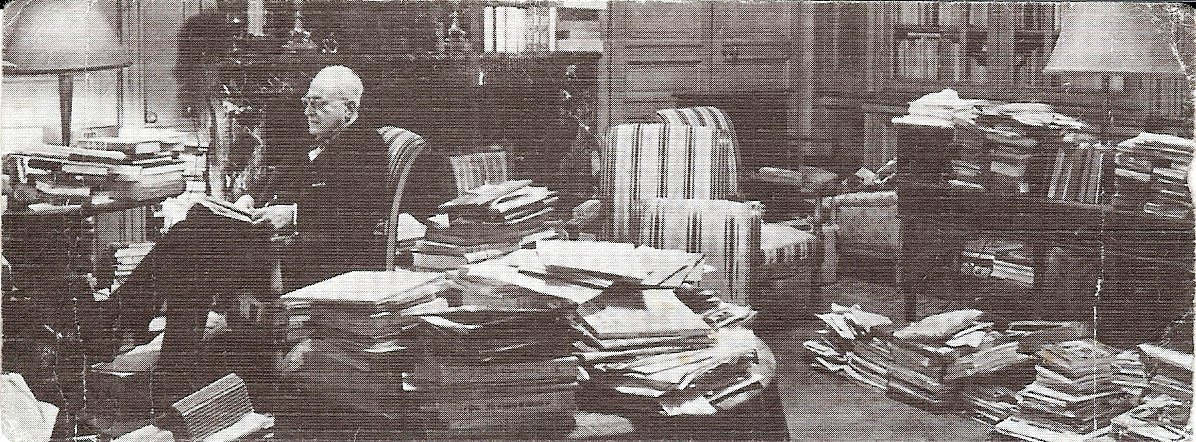
I have had this bookmark for at least ten years. It was a free one from a Border’s books in Uptown Minneapolis. It has gotten much use over the years but I took it out of rotation a few years back so it wouldn’t deteriorate any more than it already has. The worst part is that there is no photo credit or description of any kind so I have no way of tracking down the image.

I love it because:

  1. I wish this grand and fabulous yet cozy library belonged to me.
  2. It would be so much fun to dig around in those piles and on the shelves and see what everything is.
  3. I would love to bring some order to that chaos. Tidying that library would be my idea of a great vacation.

Do you have a favorite bookmark? Why is it your favorite? Do you fantasize about tidying other people’s libraries? Do you ever tidy the shelves while you browse at a bookstore or library? (I do.)

UPDATE: Thanks to Lethe, I now know where this image came from: André Kertész. It can be found on p. 56 of his book On Reading (reissued 2008) and is titled “André Jammes, Paris. November 4, 1963”.

I LOVE the  Internet!

Homage to the Women Unbound Challenge

I won’t be participating (at least not officially) in the Women Unbound Challenge being hosted by Aarti at BookLust, Care at Care’s Online Bookclub and Eva at A Striped Armchair. I am trying to limit any book challenge participation in the next year to books that I already own. I have lots of books by and about women, but I didn’t feel like I had the right ones to really do the challenge justice. Over the years I have read a fair amount of what would be considered women’s studies texts, both fiction and non-fiction, that range from profound and enlightening to unsophisticated and solipsistic. And although, my TBR pile is full of books by and about women, just finding eight books that only sort of fit the bill just didn’t seem right to me.

From about the age of 13 all the way through my undergraduate days, my friends were almost exclusively female—a direct result of not being like the other boys. I was always a little ashamed and embarrassed that all my friends were girls. It wasn’t until I started college that I realized how ridiculous and wrong it was to be ashamed of my fabulous female friends. This was the end of the oppressively retrograde Reagan 80s and the women in my social sphere were decidedly feminist and had a huge influence on my personal and academic world view. (I remember plowing through The Edible Woman by Margaret Atwood and feeling more than a little affinity with the protagonist.) In the years since then I have never really lost that sensibility and it has definitely influenced my reading.

As I looked through my TBR pile, I was hoping to find eight appropriate books so I could achieve the “suffragette” level in the challenge. (The word suffragette always makes me think of my trip to the Women’s Rights National Park in Seneca Falls, NY where Elizabeth Cady Stanton helped organize the first Women’s Rights Convention in 1848.) I found many books that would probably work for the challenge, but not having read them there was no way of knowing for sure. I was worried that many of them might fall into the category of being by a woman, but not being terribly relevant, or even antithetical, to the spirit of the challenge. Plus, in my mind Women’s Studies taken as a whole should be inclusive in terms of race and ethnicity. And I gotta admit, my TBR pile right now is pretty darn white.

So instead of being an official participant in the Women Unbound Challenge I pulled together a list of four literary pairs that may or may not turn out to be appropriate for the challenge. Each of the four pairs is based on a biographical work of a female author, each of whom, I think blazed some trails for women writers. And then I paired each bio with a work of fiction by the same author. In most cases the works of fiction aren’t necessarily the best representations of the author’s feminist proclivities. And in the case of Barbara Pym, her feminist proclivities are still up for debate. But, hey, it’s what I have in my TBR. In any case, here are my four literary pairings:

Willa Cather (pictured)
Non-Fiction: Willa Cather, The Emerging Voice by Sharon O’Brien
Fiction: Collected Stories

Fanny Trollope
Non-Fiction: The Life, Manners, And Travels of Fanny Trollope by Johanna Johnston
Fiction: Widow Barnaby

Edith Wharton
Non-Fiction: A Backward Glance (autobiography)
Fiction: The Glimpse of the Moon

Barbara Pym
Non-Fiction: A Lot to Ask, A Life of Barbara Pym by Hazel Holt
Fiction: Excellent Women

So what do you think? Is this a worthy list for shadowing the Women Unbound Challenge?

Book Review and Cool Cover of the Week: The Old Man and the Sea

The Old Man and the Sea
Ernest Hemingway

What can be said about Hemingway that hasn’t been said before? It is like “reviewing” Jane Austen. What is the point?

What I can say is that I thoroughly enjoyed reading The Old Man and the Sea. Essentially a fishing story with layers of meaning about life and getting old, and a plot that makes one want to read it in one session. Which I did.

November Novella Challenge: 2 down, 2 to go.

Book Review: The Bookshop

The Bookshop

Penelope Fitzgerald

This was actually my second time reading The Bookshop. When I first read it back in January of 2002, I think I expected it to be some cozy little tale of a woman opening a bookshop. Florence Green does indeed open a bookshop in a small village in England, but Fitzgerald’s story never comes close to being cozy. The first time I read it I was so discombobulated at having my expectations challenged, that I really didn’t take much of it in. Since then I have had it in my head to re-read this one to see what I might have missed. When I stumbled across a copy at a charity shop in late September I considered it a sign and bought it. When I culled my TBR pile to see what I could include in the November Novella Challenge there sat The Bookshop just waiting for me.

I am glad I took the time to re-read it, but I also see why I was disappointed the first time around. In essence it is a tale of a failed experiment (the opening of the bookshop), the limitations of the woman who opened it, and the petty jealousies of the small town crowd who made trouble for her along the way and ultimately got her booted off of her property.

As other reviewers will point out, there is a lot going on in this 123-page novella, but ultimately for me, not enough to make me fully like this book. I kind of like it, but I had a hard time suspending my own personal animus at Florence’s inability to run the shop properly. I wouldn’t have held her failure against her if she had done everything right and failed, but her lack of managerial talent was more than my over-organized brain could handle. Slow to make decisions, sloppy with the accounts, and without proper focus, Florence’s bookshop doesn’t last long. I enjoyed reading it, and some of the characters and scenes in the book will stick with me. But I can’t really muster much in the way of enthusiasm.

November Novella Challenge: 1 down, 3 to go.

Walt Whitman in a pair of Levi’s

Even in a Levi’s commercial Walt Whitman is a genius. Normally I don’t watch commercials. I end up fast forwarding through all that noise. But last night I was in the kitchen when this Levi’s commercial came on. I was stunned to hear the insistent words of Walt Whitman calling from the other room.

It sounds stupid, but this Levi’s commercial was a transcendent moment for me. I feel Whitman’s poetry deeply. To me it represents the best of what humans can be and what these United States can be. It may be a commercial to sell jeans, but frankly I think the montage in the commercial actually catches the lust and energy, and the youth and promise in Whitman’s poetry. I don’t care if it was created to sell, sell, sell. We could use more Whitman in popular culture.

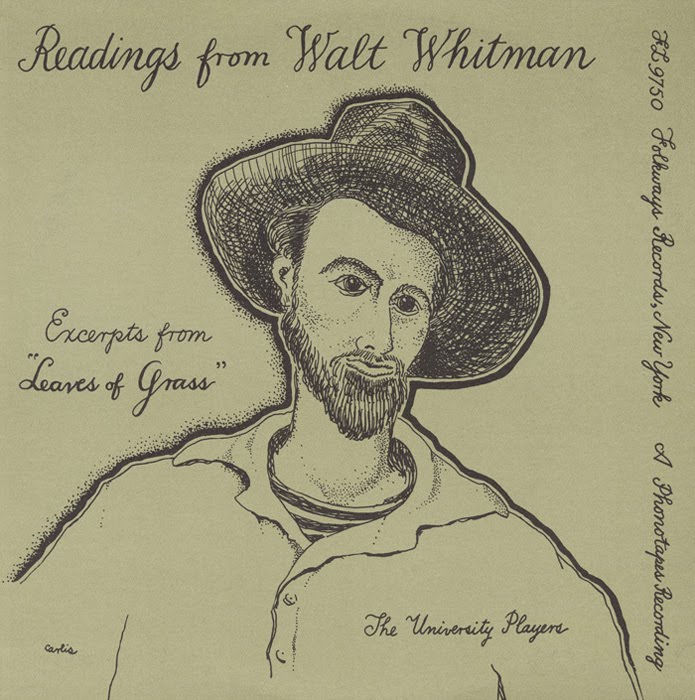
Hearing “Pioneers! O Pioneers!” performed in this commercial sent me to iTunes to try and find a recording of Whitman’s poetry. In general I have very little interest in audio books, but I do like some spoken word recordings. Unfortunately, most of the Whitman available on iTunes is truly abysmal. I could read his poems better than the people who made these recordings. Then I came across this fabulous 1957 recording. As I sampled the tracks I realized that the “Pioneers! O Pioneers!” on this recording is the same as the Levis commercial. What a happy discovery. Thanks Levi’s.

And it turns out there is another one, that, if we are to believe the Interwebs, is actually the voice of Whitman on an old wax cylinder.