As regular readers know, each spring I build a spreadsheet with all the repertoire for about 66 orchestras in the U.S. and Canada in order to figure out where I want to go to hear music. I don’t care so much about conductors, and while some orchestras are clearly better than others, my main interest is in hearing pieces that don’t get played very often. So I get around.
For 22 years I lived in DC and regularly went to the NSO (let’s send them some good vibes at the moment) and the Baltimore Symphony Orchestra, and would sometimes visit my home state of Minnesota for a weekend doubleheader with the Minnesota Orchestra and Saint Paul Chamber Orchestra. Now that I am back living in Minnesota (send us some good vibes at the moment), I get to hear the MO and SPCO on the regular (about 22 and 11 concerts respectively for those two).
Since the “end” of Covid when I started travelling for rep in earnest, I have traveled to Boston, Buffalo, Calgary, Cincinnati, Cleveland, Detroit, Montreal, Nashville, New York, Philadelphia, and Phoenix. (I do some overseas travel for music as well, but that is the topic for another time.) If you didn’t figure it out from the title, in the past three weeks I have seen seven concerts in six cities, which added Salt Lake City and Louisville as well as returns to New York and Cleveland.
When I crunched the data for the 25/26 season, there were two programs of largely American music that really caught my eye. Both of them were must dos. Only problem is that they were the same weekend in two cities nowhere near each other.
First Stop: Salt Lake City
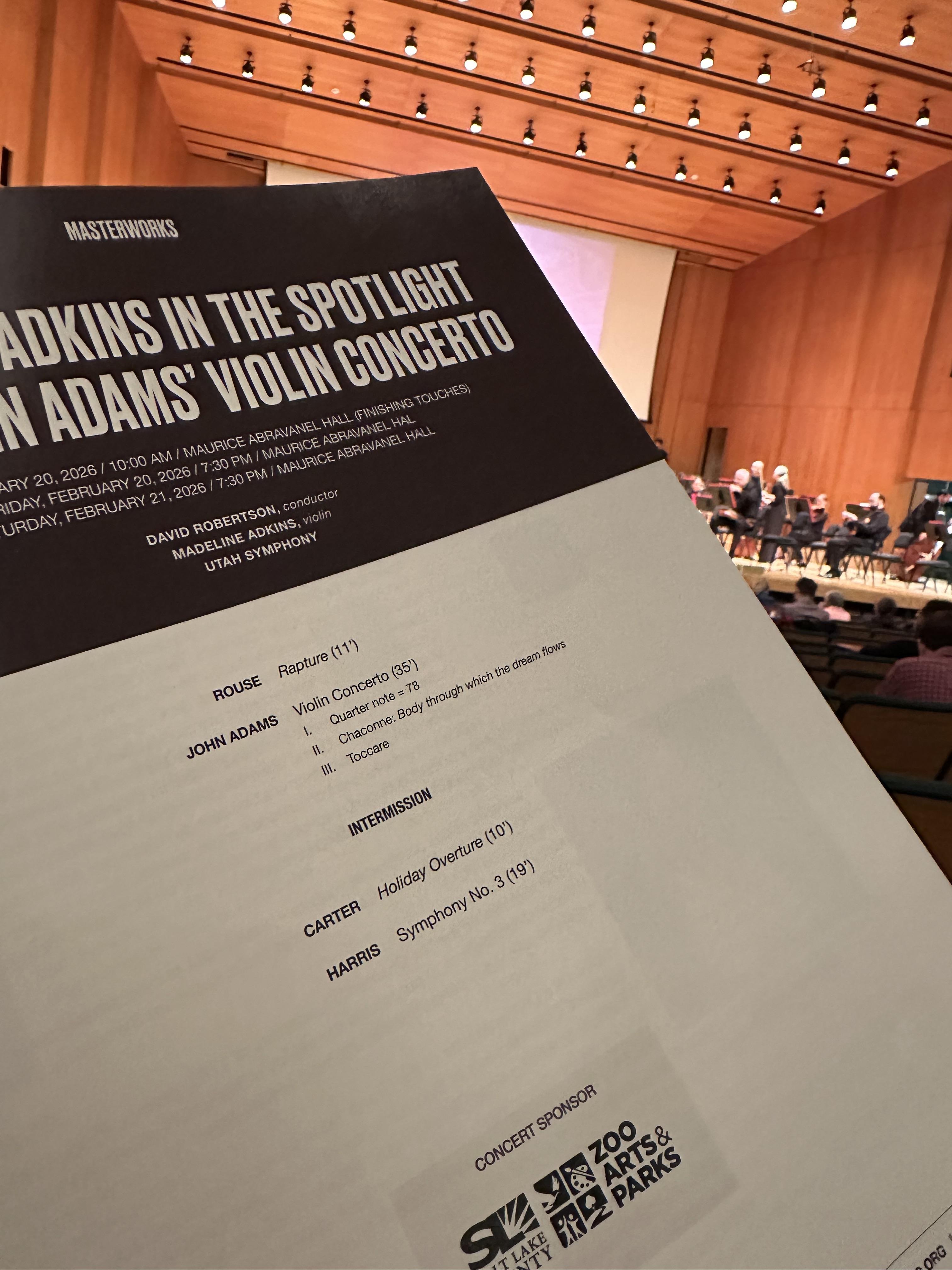
This was a corker of a program. All American and all new to me. Rouse’s Rapture was transcendentally beautiful, my favorite thing on the program. (And I have since noticed Philadelphia has it planned for 26/27.) I liked the Adams Violin Concerto more in recording than in person. I think I was too worried about whether the audience around me was enjoying it. If that is not the stupidest thing ever. Carter and Harris are almost never on programs. It was great to hear these pieces live. I must admit, for as much as I love this ‘off the beaten path’ rep and wish more orchestras had this courage, the hall on this particular Friday night was barely half full. I’m just glad I didn’t look behind me until intermission.
Running to Louisville
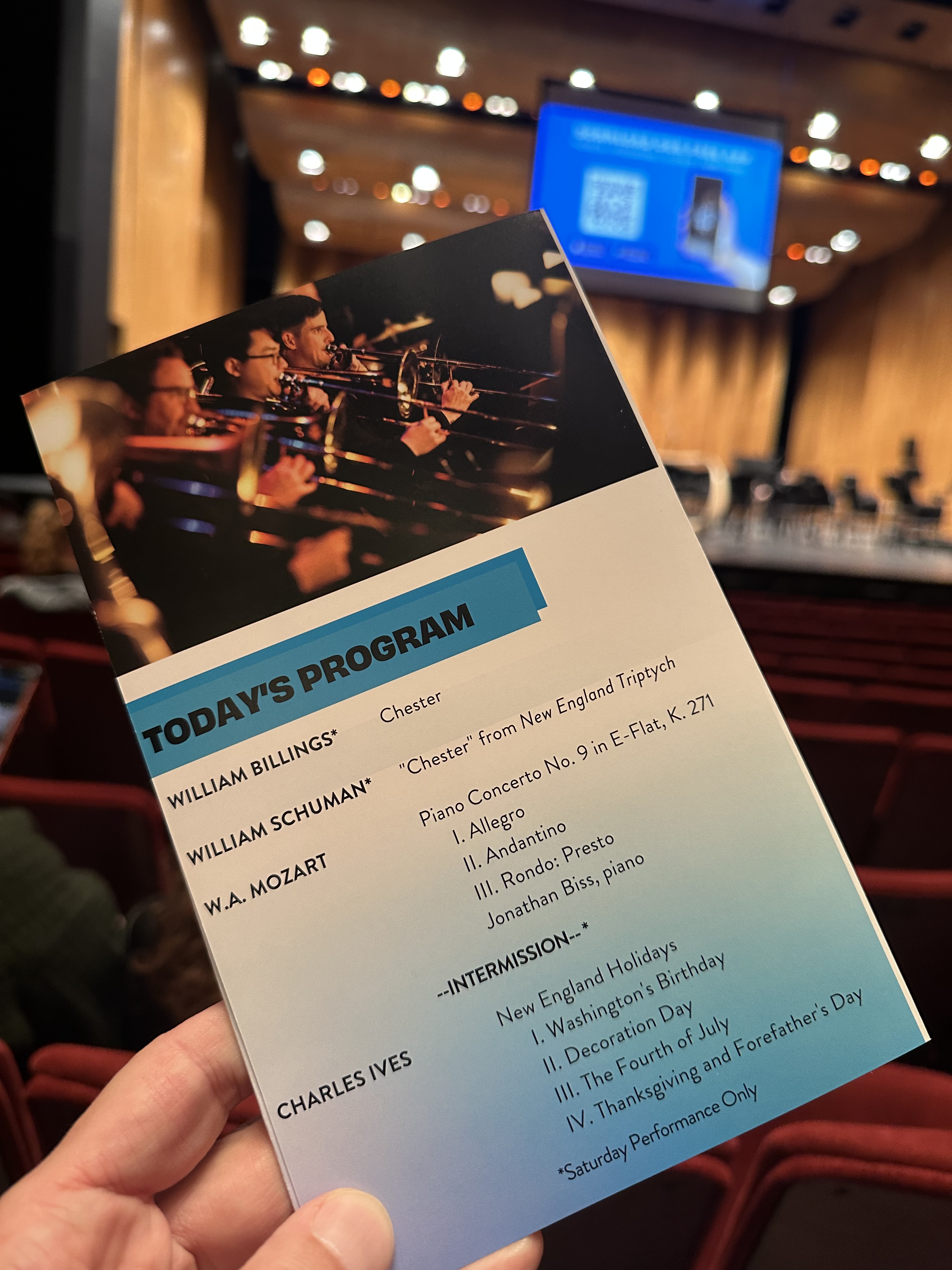
After not enough sleep, I got on an early flight to Cincinnati so I could drive 90 minutes just in time for my next must-hear concert with the Louisville Orchestra under Teddy Abrams. Happily, Louisville was either much more in the mood for American music or that Mozart Piano Concerto was a big draw. The concert started off with the University of Louisville Cardinal Singers performing William Billings arrangement of Chester which was the inspiration for the William Schuman piece in the second slot. It was great seeing the young singers open the concert with a song that was popular in during the Revolutionary War. I loved the Schuman piece that followed and got a bit fidgety during the Mozart. I recognize the greatness of Mozart, blah, blah, blah, but I find it incredibly tedious to sit through at a concert. Plus I was excited for the main event after the intermission.
For those of you who don’t know a thing about Charles Ives (1874-1954), he was an insurance executive who just happened to turn out to be the godfather of American classical music. Over a hundred years after most of his music was written, it is remarkably fresh. I happen to be a bit of an Ives fan (the Alcotts movment from his Concord Sonata is perhaps my favorite piece of music ever written) and the New England Holidays symphony on this program is perhaps the Ives’y-est thing he wrote. It is bananas. Layers and layers of overlapping ideas and song fragments and more than a little bit of humor.
One of the most amazing things about Ives on this particular night happened when the chorus came in for the final five minutes or so of the piece. As the fourth movement progressed, I kept wondering when the choir was going to return to the stage. Scanning, waiting, wondering, where were they? Then the conductor essentially started a countdown with three fingers and I think to myself “where the heck are they?!”
And then two young singers about four seats from me stood up and started singing. My immediate thought was that college-aged singers in isolated pairs scattered around the hall was going to be a disaster. But holy shit, I was wrong. The kids did brilliantly and the very surprised audience was surrounded by some pretty glorious singing adding an ethereal and absolutely immersive finale. I kid you not that I had to choke back tears. It is something I would love to experience again.
A St.Paul surprise
After crossing the country for concerts on Friday and Saturday nights, I was back in Minneapolis by 8:00 AM on Sunday. And then I realized I had a subscription ticket for a St. Paul Chamber Orchestra that afternoon. Happily I rallied, because it was a pretty spectacular way to finish out the weekend. Now, this was decidedly a program I would not travel for, but quite appreciated when it’s played in my own backyard. Selections from Handel’s Water Music, Bach Orchestral Suite No. 4, and Beethoven’s Symphony No. 4. The often conductorless orchestra was led by Richard Egarr who doubled on the harpsichord on the Handel and the Bach.
And let me tell you, the SPCO really laid that shit out. They absolutely dazzled. It was a bit of a palate cleanser after the previous two nights. The Handel is something I loved as a teen but had never heard it live. Bach is someone who I have a hard time sitting through in concert (much like the Mozart reference earlier), but I found it to be a bit of a revelation. The SPCO was joyous and precise and just alive. The Beethoven was also a delight from beginning to end.
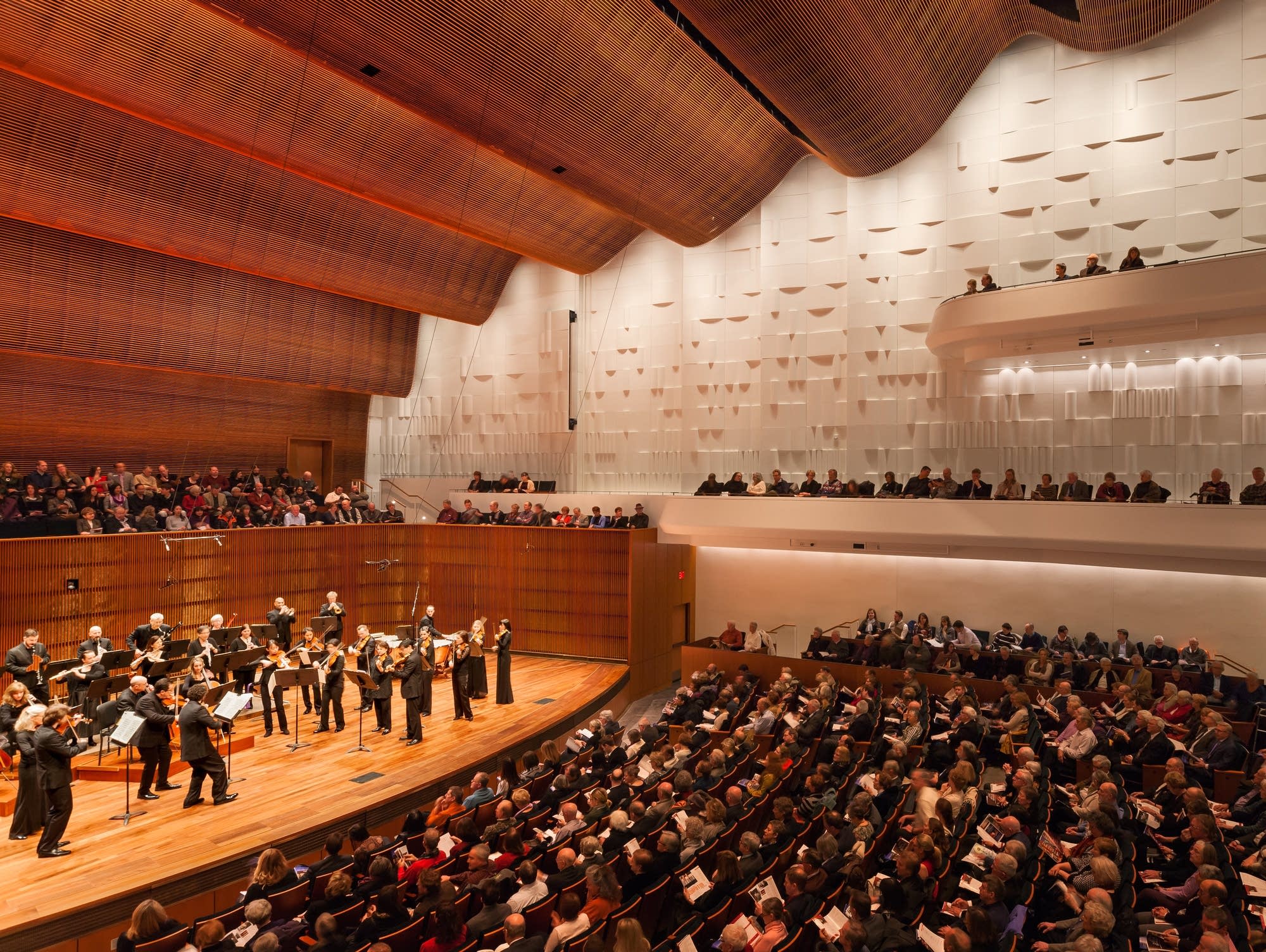
I should note, the concert was not at their lovely purpose-built hall in St. Paul (pictured above) but rather at one of the many other area venues they play at regularly. It just so happened to be at the University of Minnesota School of Music’s Tedd Mann Concert Hall. The venue, inside and out, is nothing to look at. Institutional design at it’s most bland. However, the acoustics in the hall are amazing, particularly for this kind of concert. The whole experience made me happy I can call the SPCO one of my hometown bands.
Phamily in Phoenix
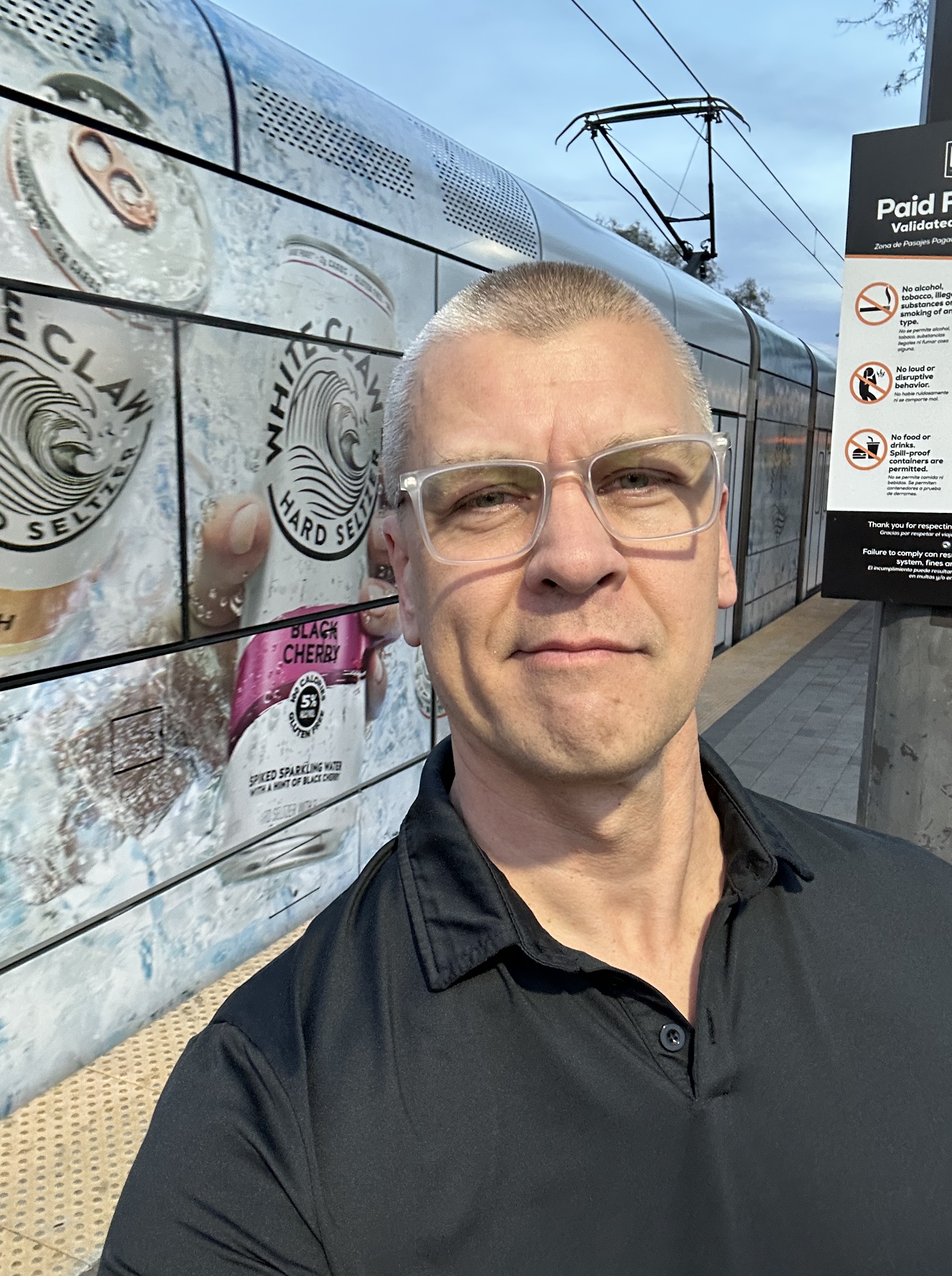
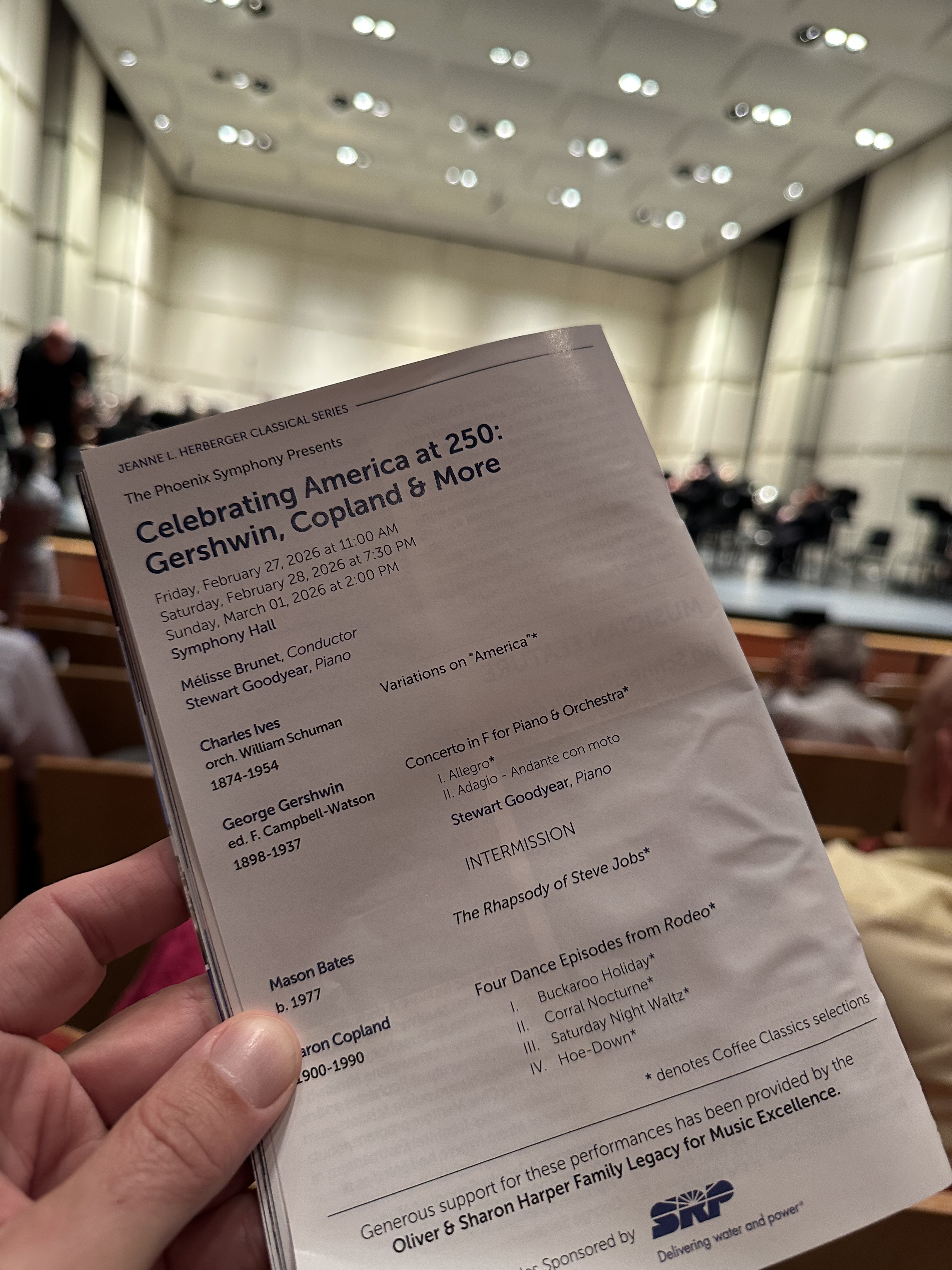
A few days later I hopped on a plane to visit my parents who live in the western suburbs of Phoenix. Last season I heard the Phoenix Symphony play a great Hovhaness Symphony No. 2, I decided to try and squeeze in a concert with them on this trip. (You can see me above taking light rail from my airport hotel to the concert. Public transit. In Phoenix. Very handy.)
You won’t be surprised to know that the Ives was my favorite part of this concert. Originally written for organ (when Ives was 17) this orchestration by William Schuman is brilliant. Makes you wonder if you will ever like the original version again. The Gershwin Piano Concerto was brilliantly played by Stewart Goodyear, but I’m not sure why they they only did two movements. I’ve heard other things by Mason Bates that I’ve liked but this Rhapsody of Steve Jobs doesn’t do much for me. The Copland was, of course, wonderful, but I do sometimes think that all of Copland maybe sounds too much like Copland.
New York Philharmonic – Tuesday Edition
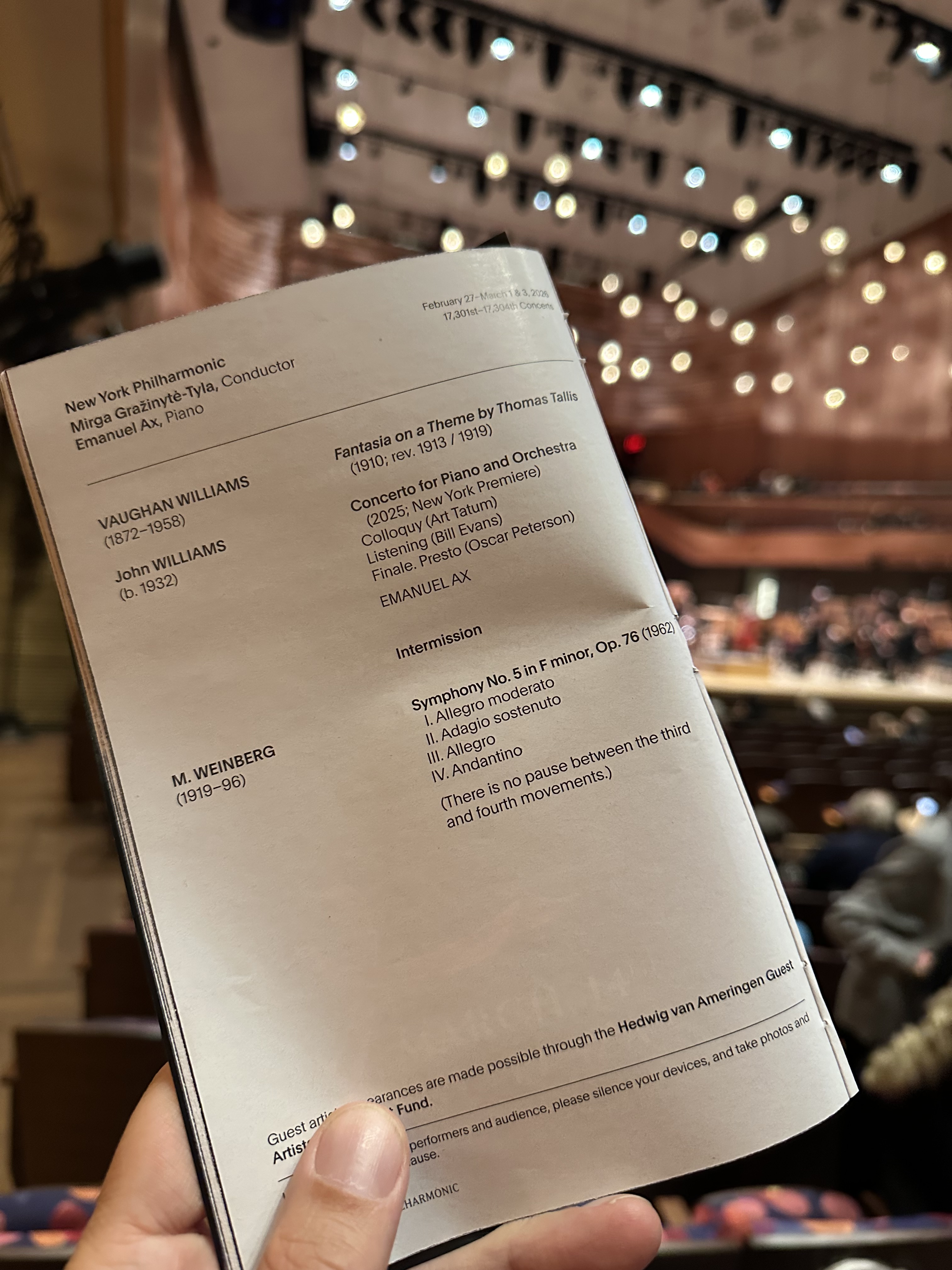
Couple days after returning from Phoenix I find myself in New York for two different concerts both conducted by Mirga Gražinytė-Tyla. The first was on a Tuesday night and started off with a ravishing performance of Vaughan Williams’ Fantasia on a Theme by Thomas Tallis. Such a glorious, moving piece of music, especially with the small chamber group set way back on the stage in dialog with the much larger string section of the full orchestra.
I think the VW is a hard one to follow. It’s a flawless expression of beauty. And then a Piano Concerto by John Williams. I was kind of looking forward to something fun and cinematic. Alas, it had none of the Williams flash, and it didn’t make much of an impression. Seeing Emanuel Ax also made me think that a lot of old people need to enjoy their retirement. Nothing wrong with his playing, but I’m tired of old people in every field who won’t retire and let successive generations have their shot. Of course I am an older Gen Xer who at 56 is realizing that by the time the boomers finally give up the reins we will all be on the cusp of retiring–or dying.
Whenever there is a full symphony by a lesser known/played composer I am likely to consider traveling for it. Even if I know nothing about it. And so Weinberg’s Symphony No. 5 was the impetus for this trip. Definitely worth the trip if not exactly a highlight of my season.
New York Philharmonic – Thursday Edition
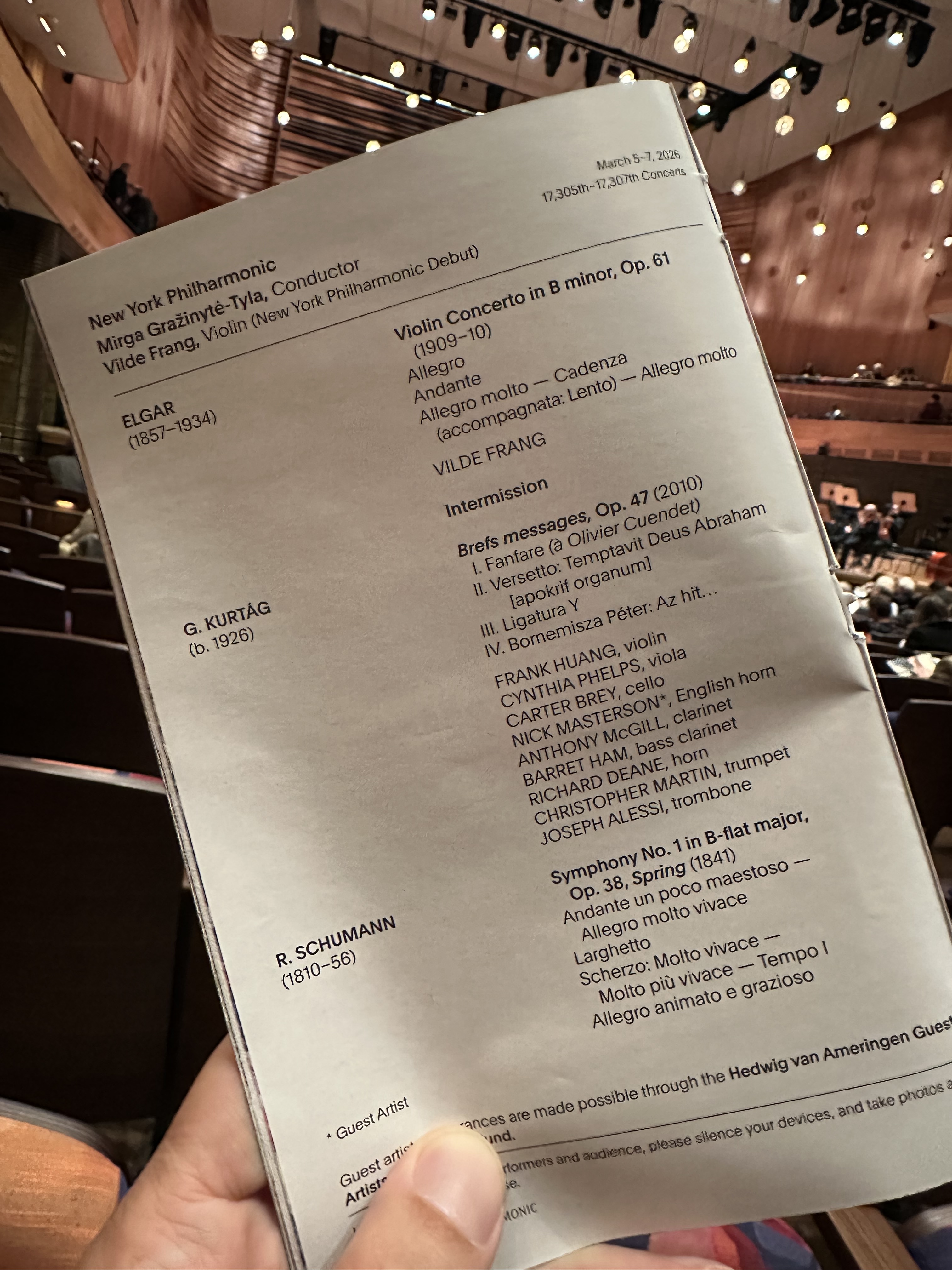
Most orchestras don’t play Tuesday concerts so the fact that I could hear a different program in NY separated by only one day it was a little hard to say no. And the fact that they were doing Elgar’s Violin Concerto sealed the deal. I had never heard it live and I must say, as much as I love Elgar, recordings of the piece never really did much for me. After having heard this amazing performance by the Norwegian violinist Vilde Frang in person, I’m now hooked. What an epic piece. The Kurtag falls into what Dave Hurwitz might call the bleep bloop school of composition. I’m all for “modern” music but this I don’t need to hear again. (You may note the composer is 100 years old!) The Schumann could have been a palate cleanser, but it started off a bit sloppy and was just so/so.
Cleveland is an astounding gem of an orchestra
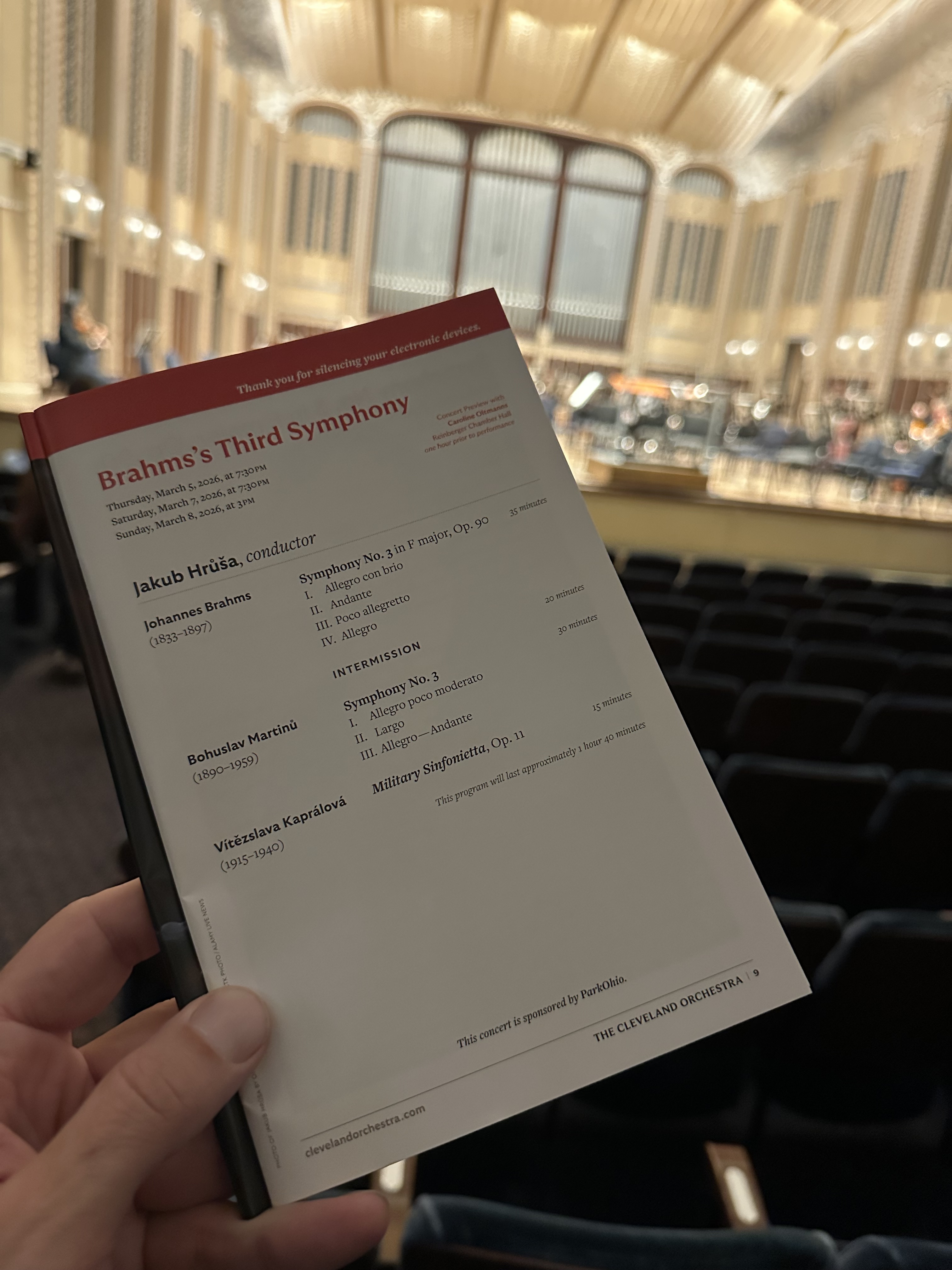
This was my sixth time hearing the Cleveland Orchestra at Severance Hall, in addition to hearing them at the Royal Albert Hall and the Kennedy Center. I am nowhere near being an expert on the relative quality of orchestras, but when you know you know. As soon as they started playing the Brahms, I was astounded once again at how good they are. Although I have heard a ton of very fine orchestras, there is something about Cleveland (and Boston and Berlin) that transcends all the others. Instead of the US Big Five, I think there should be the Top Two and then the rest can just fight it out for the next tier. (It has been a long time since I’ve heard Chicago, so maybe it would be a Top Three…?)
Never that excited about Brahms, Cleveland made me a believer. What a gorgeous performance. The Martinů was the main reason for the trip and was well worth it. The icing on the cake was the rousing closer by Vítězslava Kaprálová, a prolific Czech composer who died when she was only 25. The Military Sinfonietta was written around the time Hitler was annexing the Sudetenland, Kaprálová said that the piece “depicts the psychological need to defend that which is most sacred to the nation.” As an exhausted Minnesotan, all I can say to that is Amen sister.