That’s a big title for this post, and I’m going to only be looking at one little snapshot of what’s going on in the land of classical music.
Recently on Bluesky, I was involved in a conversation about the share of women and composers of color who are being played by professional orchestras. It was pointed out to me that looking at the share of work by composers who fit into one or both of those demographics against all programming may not be the best gauge. Since it’s only in the last hundred or so years that marginalized groups have had increasing access to the resources and opportunities needed to be a composer and get their work programmed by orchestras, it makes more sense to look at their numbers in the context of when they lived. Or something like that. My explanation may not properly express the online discussion nor withstand academic scrutiny, but I think you probably get the point.
Since I have been keeping track of orchestra subscription seasons since 2022, it occurred to me that I now have five years to data to crunch that could help illuminate this question. (Take a look at the caveats at the bottom of this post if you want to know more or are a data nerd. It’s hard for a trained regional planner like me not to have some sort of explanation of my dataset. Plus, it provides me some cover if a more rigorous scholars come along and tell me I’m full of shit.)
So what are the takeaways from my number crunching?
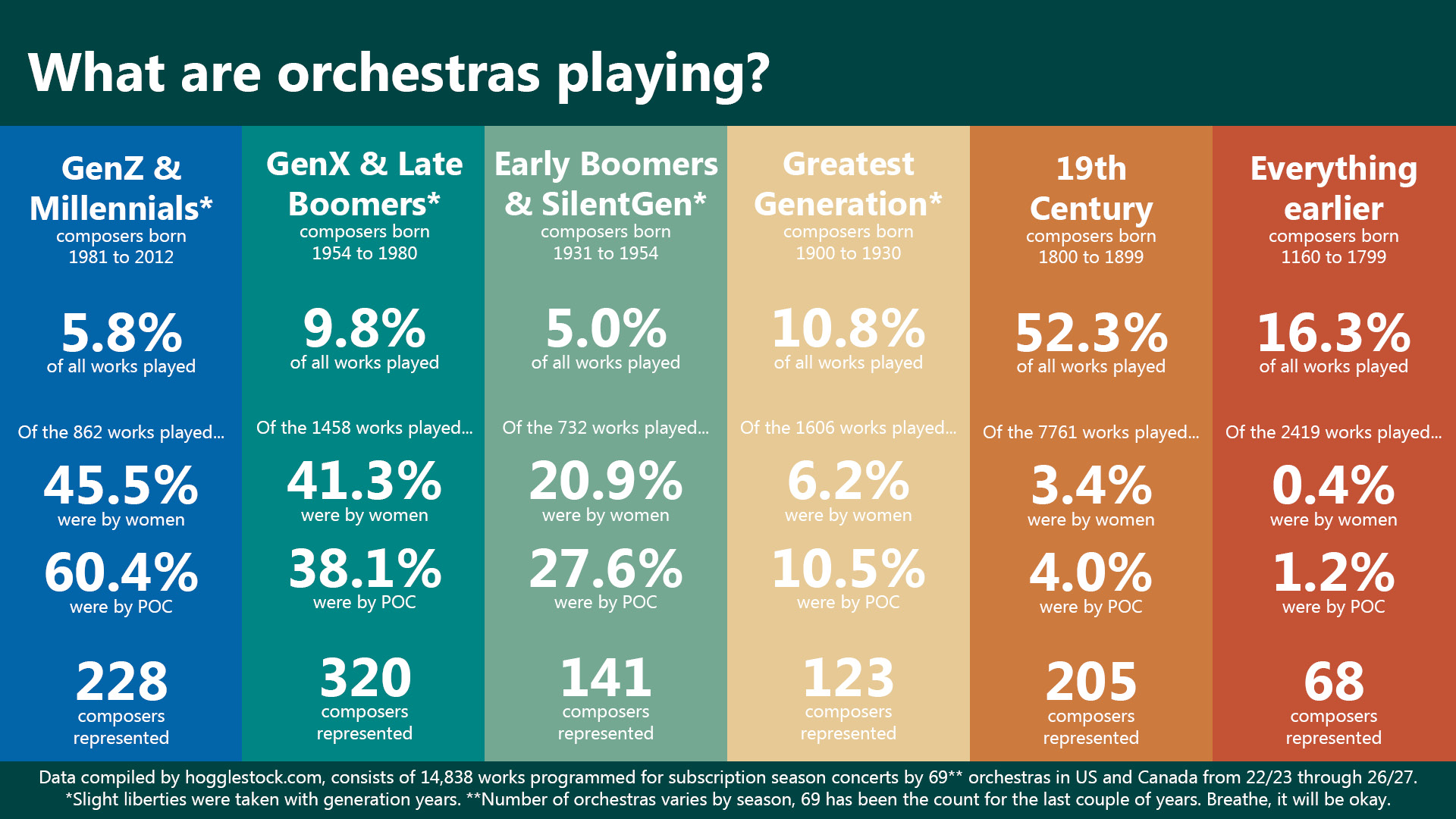
Takeaway 1: No surprise to anyone, a music format that came into full flower in the 19th century is dominated by music from the 19th century.
Takeaway 2: Women composers and composers of color are fairly well represented among the three most recent generational groupings in my data. I will leave it up to readers to decide how fair a statement this is. One HUGE thing to note, among the youngest group I looked at, there was a pretty big drop in works by women and by composers of color in the 26/27 season. Prior to the season, the average was 47% for women and 64% for composers of color, but for 26/27 those numbers were 39% and 45% respectively. Given how far out programming and commissioning happens, is this a ripple from the anti-DEI animus that the orange fuckface delivered in January 2025?
Takeaway 3: Although I haven’t crunched the actual numbers, the works from the youngest three generations are rarely the headliner piece after intermission. This must have some impact on what living composers choose to write and how long those pieces are.
Takeaway 4: Year of birth is a crude way to break up composers, and using demographic generations as a guide for my groups is also a crude substitute for the evolution of the art form.
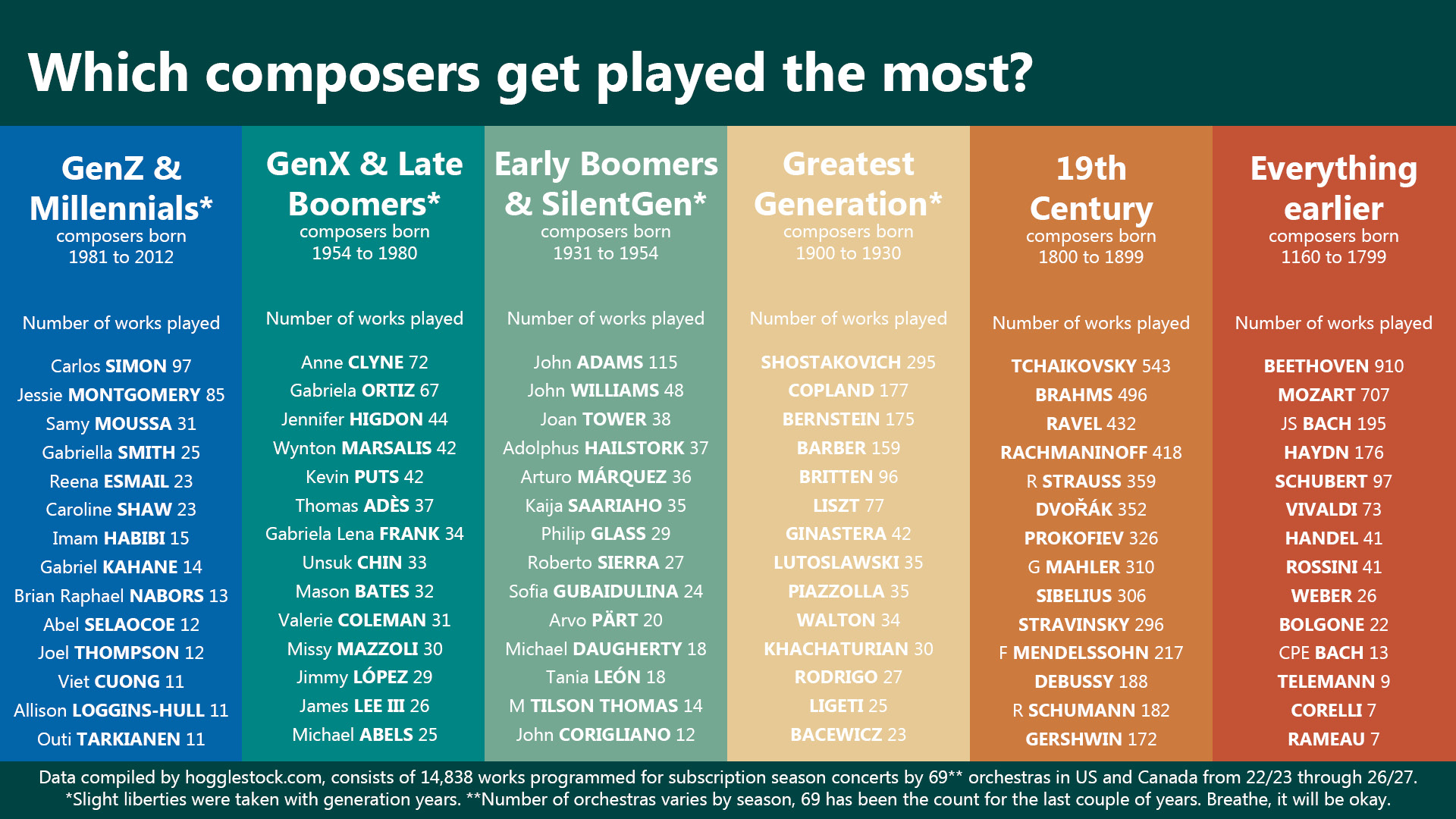
Takeaway 5: Apparently Gustav Holst only wrote one piece. It gets played a lot, but I feel a bit bad for him.
Takeaway 6: Do we really need 496 pieces by Brahms and 432 by Ravel? I don’t want to yuck anyone’s yum, and I recognize their genius, but man oh man would I like to hear more from late 19th century composers that aren’t them. So many underrepresented composers who wrote really satisfying pieces. Were they as brilliant as Brahms and Ravel (and many others I could mention)? Maybe not, but I would love more variety.
Caveat 1: The number of orchestras I’ve been tracking has increased most seasons. For 22/23 there were 51 US and Canadian orchestras in the mix, but for the last two seasons that number has been around 69. They range from behemoths with huge budgets, to more modest efforts in smaller markets where they might only do five concerts a season.
Caveat 2: I don’t include any pops, Christmas, or Messiah concerts that may be included in an orchestra’s season. So, if John Williams is on the list, it’s been programmed in a traditional concert program not a special night at the films, etc. And I can guarantee that about 75% of orchestras do Messiah every season.
Caveat 3: Sometimes concert programming for specific concerts is on the creative side and I can’t rightly tell what is actually going on…so I leave those out.
Caveat 4: When it comes to composers of color, the definition can be a little squishy and hard for me to always discern. For instance, does an Asian composer living and working in Asia fall into this category, in my estimation, yes. Without having a better working definition and frankly, being a little lazy, the test I used was: Would this person have a likelihood of being bothered on a US street by Trump’s goons.

