Four Women Who Rocked the 60s and Changed the World

  
NOTE: I wrote this post back on June 25, 2006. Although I read tons of fiction by women, I haven’t made any nod yet to this being Women’s History Month. So I am recycling this old post on these four fabulous women (who all happen to have been authors among other things).

——————————

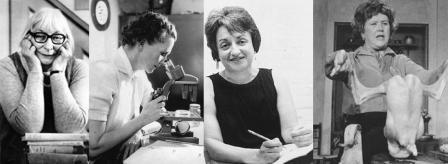
The recent deaths of writer and urban planning iconoclast-turned-icon Jane Jacobs and feminist godmother Betty Friedan has me pondering how four women altered the contours of American life. I realize that the conversations I have had about these four women and this post are not particularly original thought, but bear repeating anyway.

Jane Jacobs (1916-2006)
When journalist Jane Jacobs published The Death and Life of Great American Cities in 1961 she helped pull the urban planning profession from its darkest days of “slum” clearance and the worst excesses of 1950s urban renewal. Originally decried by planners of the day, Jacobs’ view of what constituted the components of a healthy neighborhood and a healthy city is the standard by which they are still judged today. Jacobs’ description of her Greenwich Village neighborhood and the ways in which it nurtured its residents provided a powerful example in favor of mixed-use, mixed-income, walkable neighborhoods that are the mantra of virtually every municipal planning department today. Like the other three women discussed here her work is not without its flaws. But, like the others, her clarion call woke up a sleeping nation and defined the terms of discussion for going on fifty years now.

Rachel Carson (1907-1964)
The marine biologist/zoologist, professor, and author’s 1962 book Silent Spring stood the US and the world on its ear about the connection between chemical pesticides and the degradation of the environment. Her book woke up America and kicked off the modern environmental movement. Of course she has her detractors even today (not being a scientist I am not going to try and wade through the arguments), but the fundamental truth is her work put environmental issues firmly on the policy table and in the minds of the American public.

Betty Friedan (1921-2006)
The 1963 publication of Betty Friedan’s The Feminine Mystique ushered in the modern feminist movement. Despite the book’s somewhat limited perspective of the white, college-educated, middle class woman (i.e., the typical Smith graduate), the notion that the sexist, conformist expectations of the times had trapped most women into a life of unfulfilled potential had near virtual universal application. (One could also argue that suburban sprawl contributed greatly to the imprisonment of women in the 1950s, but that is the topic for another post.) Friedan’s writing and her co-founding of the National Organization of Women (NOW) and National Association for the Repeal of Abortion Laws (NARAL) set the U.S. on an unstoppable path toward the as yet unfulfilled equality of women in America.

Julia Child (1912-2004)
When I was a child in the 1970s the whole family would gather around the TV on Sunday afternoons to watch The French Chef with Julia Child on PBS. We never made any of her recipes but we sure liked watching. Her show, which began in 1963, and her contribution to the popularization of TV cooking shows is not the most impressive change she brought to American life. Julia introduced Americans to recipes and ingredients that were anathema to the post-World War II salt, pepper, and paprika school of American cooking. When her show began Americans were gorging on TV dinners and canned vegetables. Thanks to Julia and others in her circle or under her influence, we have so much to choose from today when we head to the grocery store. Not all of the “food” created by scientists but those fabulous ingredients that no one had heard of thirty years ago.

Bookstores in Odd Places

 
If you don’t know the amazing blog Book Patrol you should really check it out.  Today it features a really wonderful story on the London Library in St. James Square. It is a private lending library that I had never heard of and it looks like a brilliant place. And last week it had a post on the El Ateneo bookstore in Buenos Aires which is in a splendid old opera house.

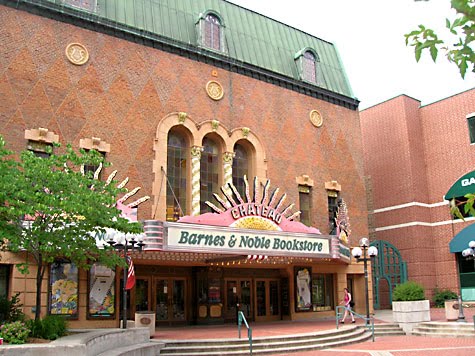
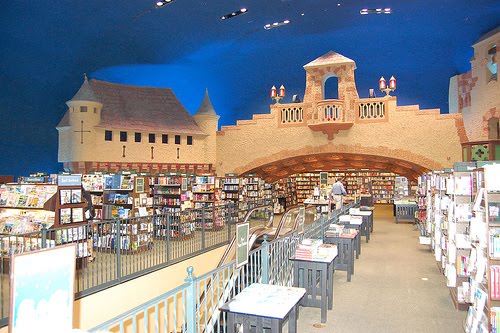
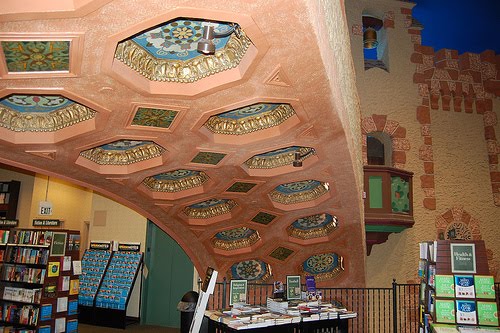
Well, that post put me in mind of a bookstore I recently came across in Rochester, Minnesota. It is a Barnes and Noble that has been retrofitted into an old cinema. It isn’t half as grand as El Ateneo, but with its mock medieval interior it sure makes for an interesting place to browse. (All photo credits except for the exterior shot go to J.M. Wetherington.)

How many Barnes & Noble have a lobby, let alone one that looks like this?

This old cinema was no doubt saved from the wrecking ball to become a bookstore.
The mock medieval interior makes for some interesting views.
The old proscenium arch provides a wonderful entrance to the fiction section.
The escaltors up to the second (more spectacular) floor.
All photo credits except for the exterior shot go to J.M. Wetherington.

I’ll be spending the month of April on an English Journey


From the moment I first saw a few of the volumes in this Penguin English Journeys series I knew I had to own the whole set. I loved the art work, I loved that they were all about the English countryside in one way or another, and perhaps most appealing of all was that they were part of such a well coordinated set. That really appealed to my anal retentive (in)sensibilities. My husband was able to buy me all but one of the 20 volumes through The Book Depository.

One, A Shropshire Lad was on back order and over the course of several months never came back into stock. Which is where Cornflower and her reading club member Jill came to the rescue to help me get the final volume to complete my set.

So for a while now I have had all 20 volumes sitting in my TBR pile. I have toyed off and on with the idea of reading them all at once. I always knew I would read them sequentially, even though the sequence seems to be based solely on alphabetical order. But since none of them are very long, I finally decided that it would be interesting and a fun spring activity to go on a vicarious English Journey during the month of April. So I have decided to read these twenty books during the month of April. And I will, of course, read them in order. I am anxious to start now, but I am going to force myself to wait until April 1 to begin.

Voices of Akenfield – Ronald Blythe

The Wood – John Stewart Collis

From Dover to the Wen – William Cobbett

The Pleasures of English Food – Alan Davidson

Through England on a Side-Saddle – Celia Fiennes

Elegy Written in a Country Churchyard and other poems – Various

A Shropshire Lad – A.E. Housman

Cathedrals and Castles – Henry James

Walks in the Wheatfields – Richard Jefferies

The Beauties of a Cottage Garden – Gertrude Jekyll

Country Churches – Simon Jenkins

A Wiltshire Diary – Francis Kilvert

Some Country Houses and their Owners – James Lees-Milne

The Clouded Mirror – L.T.C. Rolt

Let Us Now Praise Famous Gardens – Vita Sackville-West

One Green Field – Edward Thomas

English Folk Songs – Ralph Vaughan Williams and A.L. Lloyd

Country Lore and Legends – Jennifer Westwood and Jacqueline Simpson

Birds of Selborne – Gilbert White

Life at Grasmere – Dorothy and William Wordsworth

I am terrible at doing reading challenges, even ones that I create for myself. So why in the world I am setting myself a challenge for April? I don’t have the answer to that. Maybe I will know at the end of April.

    

Book Review: Reality and Dreams by Muriel Spark

 Reality and Dreams
Muriel Spark

As usual, Dame Muriel Spark in her 1996 novel Reality and Dreams creates a quirky, dysfunctional, yet highly believable cast of characters. At the center of all the action is aging film director Tom Richards who, by the nature of his profession, has the god-like ability to create whole new worlds, to transfer what is in his head to the screen, indeed to turn dreams into reality. With the opening line Spark foreshadows Tom’s position in his personal universe:

He often wondered if we were all characters in one of God’s dreams.

But just as humans have the free will to diverge from their assigned roles in God’s dreams, so too do the characters surrounding Tom have the tendency to operate freely and independently while maintaining just enough piety and obeisance to keep Tom happy. And he is perhaps much more manipulated than he would ever suspect. The other characters swirling around him include his wealthy wife Claire with whom he shares an open marriage full of his-and-hers infidelity, their grown daughter Marigold who disappoints them in many ways, Tom’s beautiful grown daughter Cora, a taxi driver-confidante, various in-laws, and a few flaky actresses.

The book looks at the blurry lines between reality and dreams from many angles and on many levels, both obvious and subtle. Tom’s movie plots are not just dreams turned into “reality”, but they also take real life events and turn them into cinematic dreams. I also think in some ways that Tom’s reality is more of a dream than he would like to admit.

Reality and Dreams is satirical and often humorous and, like many an Iris Murdoch novel, has lots of mix-and-match bed hopping. The brilliance of Muriel Spark is her ability to create characters and plots that are crazier than most of us encounter in our own lives, but not so crazy as to make them unbelievable. Similarly, we don’t end up liking these characters in the sense that we would want to know them personally, but we do love to watch them and live out some of our darker thoughts and personality disorders vicariously. A kind of safety valve to keep us all from becoming miserable bastards.

For other views:

Novel Insights
Book-Drunk
His Futile Preoccupations

Book Review: Dr. Wortle’s School by Anthony Trollope

Dr. Wortle’s School
Anthony Trollope

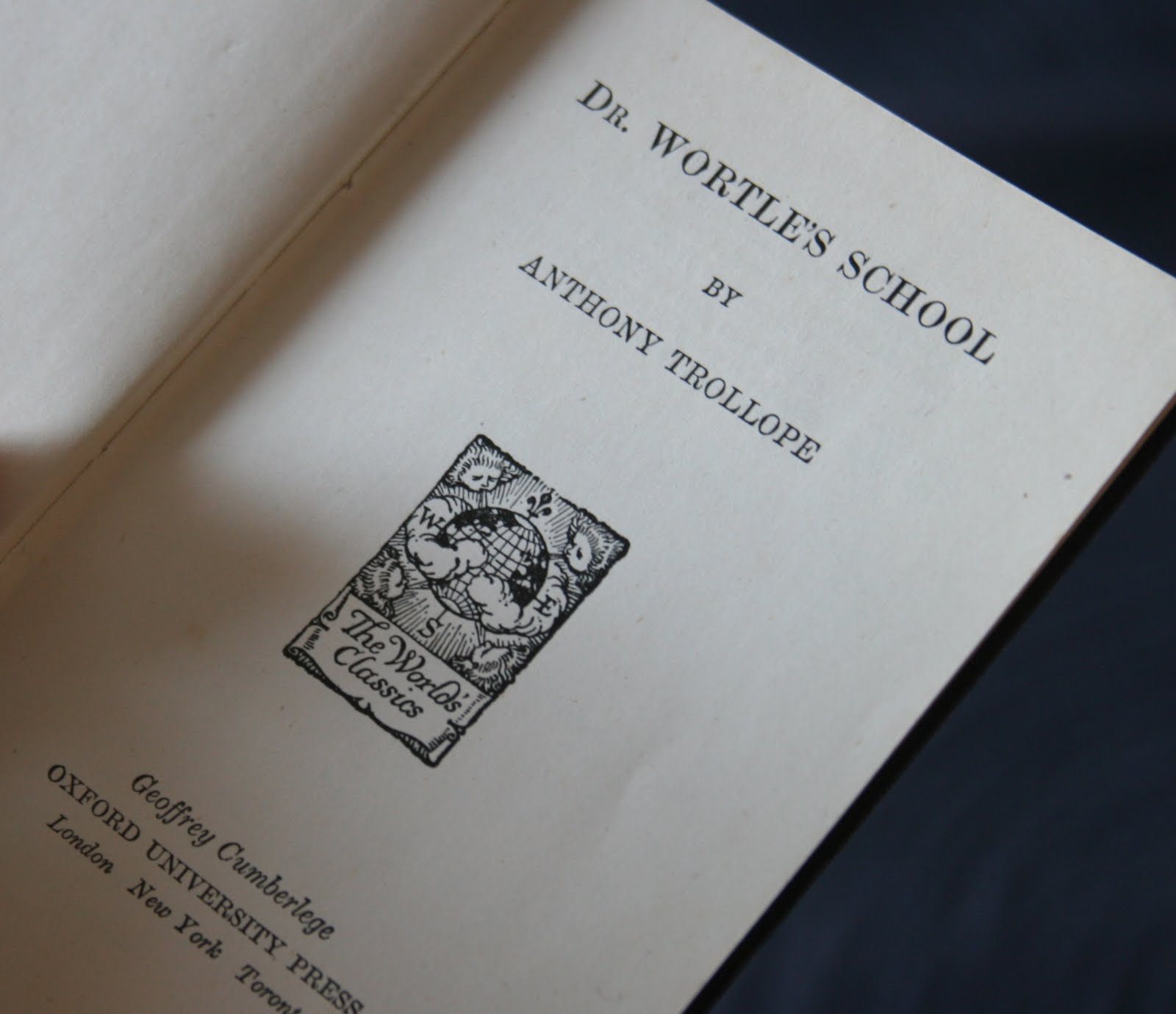
I am not sure where I picked up this little honey of an edition, but it has been sitting in my TBR for quite some time. In the world of Trollope, this almost 300-page book is practically a short story and it is full of all of the clerical intrigue that one comes to expect from this Victorian master. If the opera Aida could have just as appropriately been called Amneris after the mezzo-soprano role (or if Barber’s opera Vanessa could have been called Erica after that mezzo role), so too could Dr. Wortle’s School have been called Mr. Peacocke’s Secret. It is, after all, the revelation of Mr. and Mrs. Peacocke’s secret that put Dr. Wortle and his school to the test. The Peacocke’s have come to work at Bowick School and soon become indispensible to its success, but it turns out they are hiding something.

Early in the novel Trollope lets us in on the secret so I will not feel bad about revealing said secret here. But I guess I should officially issue a spoiler alert, although I don’t think knowing the secret will lessen the interest of anyone wishing to read this book in the first place. While teaching classics at a university in the USA Mr. Peacocke marries Mrs. Peacocke thinking that her abusive, drunkard, deserter husband has been killed, thus freeing her to remarry. Sometime after they are married Mrs. Peacocke’s husband reappears very much alive. So, rather than put her back in the hands of the abusive husband, the Peacockes move to England and take positions at Bowick. Well you can imagine what the society folks of 1882 think of the Peacockes once the secret gets out. Even worse is that Dr. Wortle decides to defend the couple, putting the reputation of his school and its very existence on the line.

What I won’t tell you is if Dr. Wortle’s school or his soul are saved.

This isn’t the most fantastic Trollope of all time, but it might be a good intro for someone who has never read any of his prodigious output. It certainly provides a cozy read and a forward momentum that makes it a bit of a page turner. And the rather racy nature of the secret, at least by Victorian standards, makes it a little more risque than one normally expects from Trollope.

Book Review: The Assault by Harry Mulisch

 
The Assault
Harry Mulisch

In 1945, in the final throes of the Nazi occupation of Haarlem, Anton Steenwijk’s parents and older brother are killed in retaliation for the murder of a Nazi collaborator that happened on the street in front of their house. From the event itself and the immediate aftermath The Assault is broken down into chapter “episodes” that chronicle Anton’s life in the 1950s, 1960s and 1980s. We follow him as he alternately gets on with his life, love, and career while dealing with the remnants of his haunting past. One of the more interesting aspects of the novel is how Anton comes across various people who had connections to the events that led up to his family’s death. When we, and Anton himself, least expect it, another piece of the puzzle gets put into place helping not just to explain what happened that night, but also showing different dimensions of Anton’s emotional state and his capacity (or incapacity) to forgive and forget.

All of this is set against the backdrop of the politics of the times. Although I remember the nuke-crazy, Reagan 1980s with its frightening scepter of imminent Soviet attack, a lot of geo-political water has gone under the bridge since this book was published in 1982. With the current state of world affairs and the fact that our planet is perched precariously and perhaps irreversibly on the brink of environmental ruin, it is much more difficult to remember the emotion and fear of those times. Even harder to comprehend for those of us who were too young to remember, is the fear of the “Commies” in the aftermath of World War II and the saber rattling in the early days of the Cold War. For those around the world who marched en masse to try and head off the ridiculous Iraq War, the futility of the anti-nuke marches of the 1980s, like the one Anton attends in the final episode, is much easier to understand.

Mulisch’s prose is pretty straight forward but it rarely fails to draw the reader into circumstances and emotions that most of us can thankfully hardly imagine.

Book Review: The Vanishing Act of Esme Lennox by Maggie O’Farrell

  
The Vanishing Act of Esme Lennox
Maggie O’Farrell

Months and months ago, a book club friend of mine had fantastic things to say about The Vanishing Act of Esme Lennox. And our reading tastes are generally quite in line with each other. But for some reason I just couldn’t get into it. But then back in January when we were in Thailand I stumbled upon O’Farrell’s The Distance Between Us in the library of our resort and ended up loving it. So when I came across TVAEL in a secondhand bookshop in Philly last month I decided I needed to give it another chance.

In a nutsell the story is about vintage clothing store owner Iris Lockhart finding out that she has a great aunt named Esme Lennox she didn’t know about. More startling to Iris than the fact that no one in her family had ever mentioned this great aunt, Esme has spent the past 60 years in a mental health facility. But Iris’ incredulity is stretched to the limit with the knowledge that she is Esme’s only blood relative still alive. After some hesitation, Iris starts to do the right thing and takes responsibility for Esme.

I wanted this to be a warm, uplifting story of the the two women discovering themselves as they discovered each other. And especially to see Esme discover the real world after 60 years of incarceration.But alas, this tale is a shade or two darker than that. I won’t say more about the plot so as not to spoil it for anyone.

(For about seven years now, I have been associated off and on (and most recently back on) with the redevelopment of a large, disused, historic mental health facility campus. Some aspects of TVAEL really made me stop and think about the thousands of souls, both sane and insane, who have lived there).

I enjoyed reading the book and it certainly gives food for thought. But in the end I think my expectations about the book’s plot got the best of me. I think TVAEL is probably a better book than The Distance Between Us from a literary standpoint, but I enjoyed the latter much more than the former.

Mothering Sunday


Persephone Books sent out an email this week with a special deal in honor of what is known in the UK as “Mothering Sunday”. Originally a pagan observance, it later turned into a Christian holiday when believers would make a pilgrimage to their mother church or the nearest cathedral. In the UK it is now synonymous with Mother’s Day as it is known here in the USA. Although I think the name “Mothering Sunday” sounds a bit corny, I kind of like the name better than Mother’s Day. “Mothering” with all its verbish suggestions of action rather than just a state of being opens the door to varied interpretation. Perhaps anyone who provides a little mothering to someone in need could be honored on Mothering Sunday regardless of their gender or reproductive ability.

Last weekend in Philadelphia we stumbled across a plaque right in front of City Hall that honored Anna Jarvis the West Virginia native who campaigned to establish Mother’s Day. According to Wikipedia it was started in response to Jarvis losing her own mother, but according to the plaque it came into being in response to the rise of feminism. John Wanamaker, the department store impresario became a big supporter and it was eventually recognized by Congress in 1914.