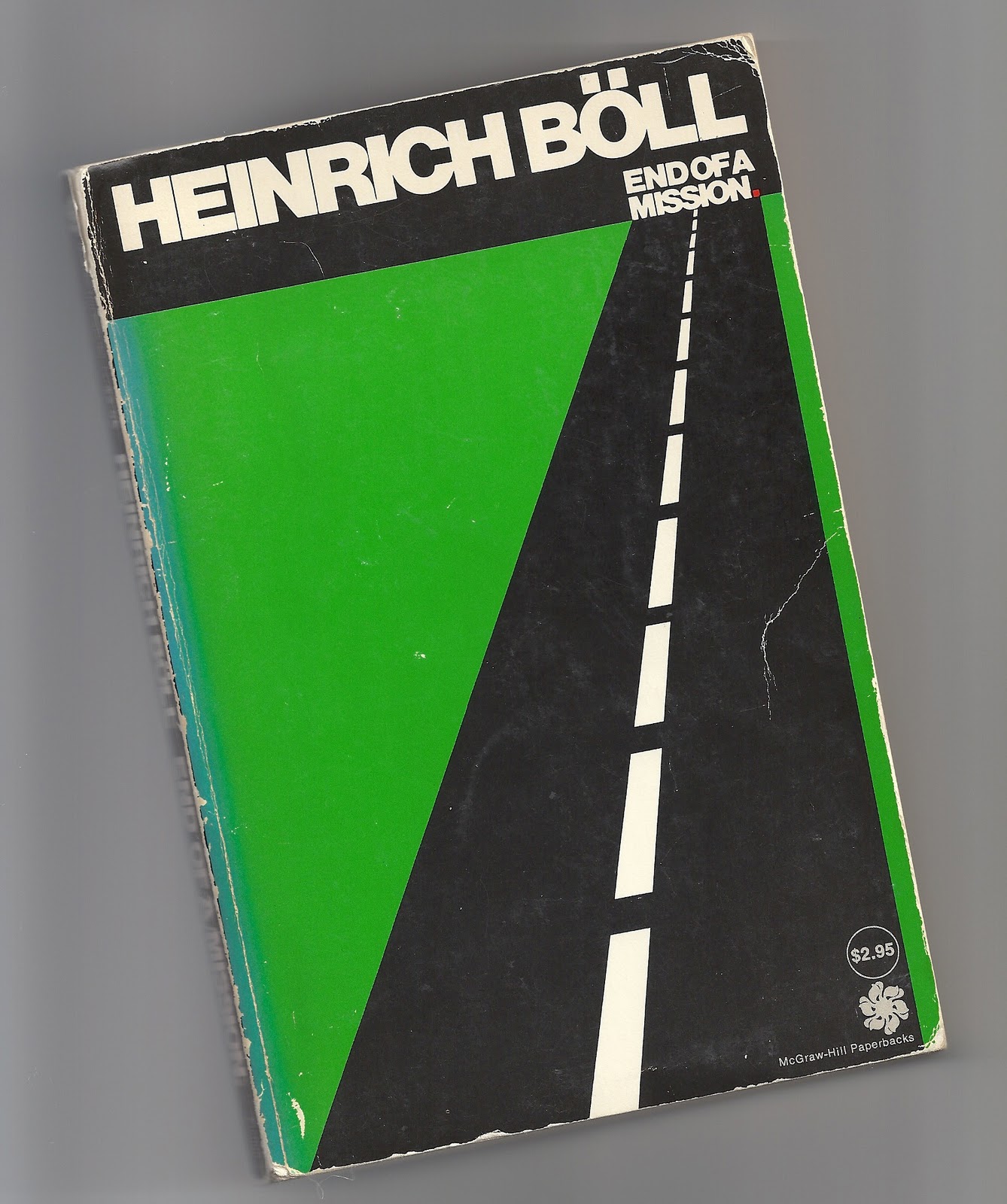
Book Review: End of a Mission by Heinrich Boll


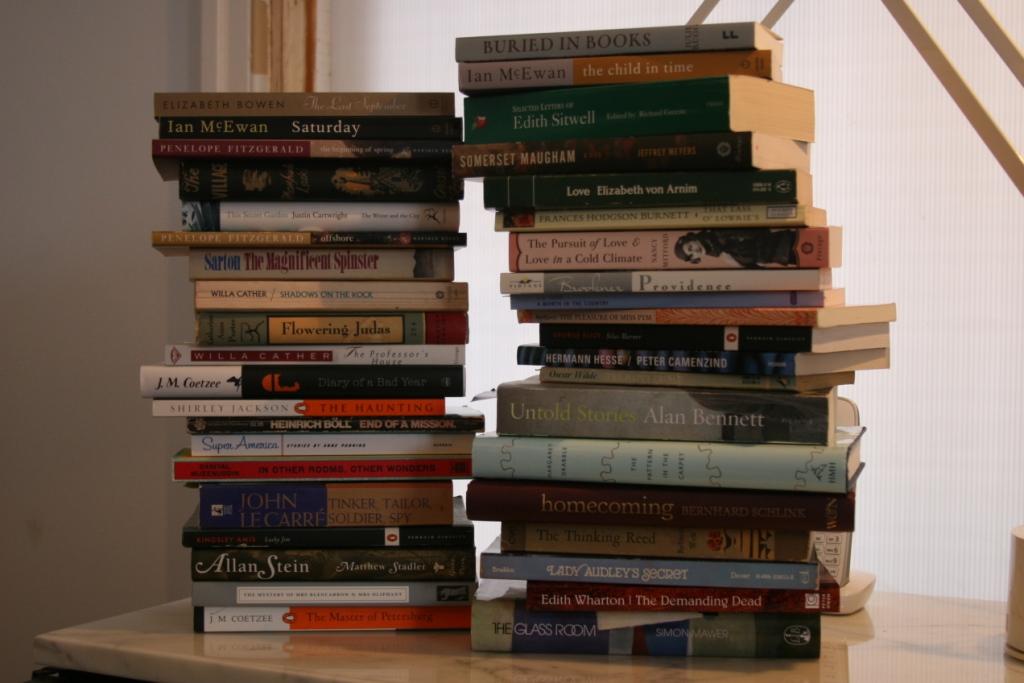
For a short time there was a great little travel bookstore here in DC. What made the store unique is that they would tuck in amongst the travel guides and travel writing works of fiction representative of each country. It was there that I stumbled across my first Heinrich Boll, The Lost Honor of Katharina Blum. I ended up loving the rather spare, precise way that the story unfolded. Since then I have read two other Boll works and liked them less. And with this most recent title I am left wondering if I truly like Boll or just liked that one book. At only 206 pages I assumed that I would fly through End of a Mission. But that wasn’t the case. Since I bought the book sometime back in 2009 it has been in my nightstand. There have been many times I thought I was in the mood to read it. I even took it on several vacations. Yet it stayed unread for a long time, always returning to my nightstand. Several months ago I finally got into the rhythm of the book and started to enjoy it. But even then I got distracted by some other book about half way through it and so it sat for at another couple of months until the TBR Dare made me face all of my nightstand reading with renewed committment.

So what is this book about? The whole of the narrative follows the trial of a father and son who have been arrested for setting fire to an army vehicle. I think part of my disappointment in the book is that I was expecting a different kind of book. I thought that there was going to be some great reason for their action and expected more of a plot. Instead End of a Mission is like a tableau of personalities. Taking place in a small village every character is truly a character. All of the quirkiness of village life and relationships are played out in the descriptions and actions of everyone from judge to bailiff, to lawyers, police, witnesses, innkeepers, observers, the press and of course the accused father and son. It also took me a while to realize that much of the book is meant to be humorous. Throughout the book Boll shows the somewhat absurd juxtaposition of a society that likes rules at the same time that it seems to be rebelling against them. Perhaps it is in the wake of World War II and the role of law and order in the Holocaust that prompts these small town Germans to want to thumb their noses at authority. But even then there is an almost orderly quality to their small acts of rebellion. Being at least one quarter German and one quarter control freak, I often feel an affinity for the stereotype of German precision and linear thinking. I had a history professor in college who abhorred any attempts to define a national character, either for individuals or for the collective society. But darn if it isn’t satisfying to trade in generalities sometimes.

There were moments that I enjoyed, and there are many aspects that would make End of a Mission a good book for discussion. But not a book club discussion. I think it would do much better in a more academic setting, and one that was focused more on German post-WWII history rather than one specifically about literature. For these reasons I am wavering between giving this book a 5 (ambivalent) on the My Porch Scale or a 6 (almost liked it).



Book Review: The Professor’s House by Willa Cather


I first read The Professor’s House by Willa Cather in 2003. At the time I was captivated by the novel and ranked it as one of my all time favorites. Since then I have recommended it widely and have been happy to see it crop up with some frequency on various book blogs. Most recently Karen at Books and Chocolate read it during Virago Reading Week. Reading Karen’s review made me want to go back and re-read the book to see if my initial love of the book would stand. Thankfully I had a paperback edition of it in my nightstand so I could remain true to the TBR Dare.

In the latter days of his academic career at a small university on the western shore of Lake Michigan, Professor Godfrey St. Peter decides he isn’t quite ready to leave behind his quirky old study when he and his wife are meant to be moving into their new house. He contemplates his career, his wife, his grown daughters and their husbands, and most significantly, his relationship with Tom Outland a protege who was much like a son to St. Peter and who was killed in World War I. After convincing his wife, daughter, and son-in-law to go off to Europe without him, St. Peter means to edit Outland’s diary. As he prepares an introduction to the diary, St. Peter recounts Outland’s life before they met. A major chunk of the book is about Outland’s life in New Mexico, where among other things, he discovered a group of abandoned cliff dwellings. St. Peter’s summer alone with his thoughts brings new clarity to his life, both past and future.

When I first read The Professor’s House back in ’03, I saw it mainly as the story of someone who wanted a little solitude. Being quite independent myself with a tendency toward being a loner, I really identified with that. Now seven years later, I can still see that in the book, but it seems like a minor detail given all of the other thoughts and emotions St. Peter processes. Through Outland’s story St. Peter comes to terms with what his own life has turned out to be and how different it is from what St. Peter thinks is truly important. There is much that could be considered melancholy in this book, but I find that the overall feeling is really about hope and possibility. As the blurb on the book notes, St. Peter turns emotional dislocation into renewal.

I feel an affinity for St. Peter’s intellectual and emotional outlook. He is someone I would like to know, or be. For that reason alone, The Professor’s House is wonderful. But there is also something about the section on Tom Outland’s life in New Mexico that I find breathtaking at times. Cather does a brilliant job evoking the beauty and spiritual timelessness of New Mexico. Several years ago I was lucky enough to spend two weeks in Las Cruces in southern New Mexico. While I was there I went up into the Gila National Forest alone and saw some cliff dwellings for myself. Set on a green wooded mountain, on a beautifully crisp, sunny February morning, I felt like I had been transported to another time, and not just in an intellectual and historical sense. There was something about the dry, clean air, the brilliant blue sky, and the amazing quiet that I found quite moving. The contemplation of geology and nature, and geologic time in particular, is perhaps the closest I come to any sort spirituality. I find something oddly comforting in the fact that my life is just an infinitesimal blip in the billions of years of geologic processes that happened before me and will happen after me. And that my body will become part of that geology. I should be clear that I am conflating Tom Outland’s story with my own experience in New Mexico. Cather’s text doesn’t really strive to be so lofty, but it does say important things about what is truly ours and what is important in life. Having said that, one does not need to find or even want to find something spiritual in this book to thoroughly enjoy it.

There is one scene as Tom contemplates the cliff dwellings that reminded me of the A Month in the Country, the last book I read. In that book, Tom Birkin feels a certain connection to the the painter of a work he is uncovering five hundred years after its creation. Tom Outland’s experience discovering the cliff dwellings is similar:

To people off alone, as we were, there is something stirring about finding evidences of human labour and care in the soil of an empty country. It comes to you as a sort of message, makes you feel differently about the ground you walk on every day.

For a interesting analysis of this book and some great photos check out Nearly Lucid.

Seen on the Bus


Before she ended her blog Bookish NYC, I used to love reading Karen’s weekly post about the books she saw people reading on the subway that week. I have often contemplated doing something similar on my blog, but I know I wouldn’t be as good as Karen was at describing the people who were reading the books.

And then part of me didn’t want to do it here in DC because it seemed that most folks on the Metro here read either non-fiction, bibles/daily devotional books, or news periodicals. Non of which I find interesting enough to blog about.

But, since moving to our new neighborhood, I have been surprised to see people on my local bus to the Metro reading lots of interesting fiction. No “Girl with the Whatever” books, no vampire books. Instead I have seen things like Anita Brookner and Elizabeth Bowen and even a Barbara Pym. And sure, there are still plenty of people reading the previously mentioned stuff I don’t feel like blogging about. But given the rather wonky make up of my new neighborhood (25% have bachelor’s degrees and an additional 36% have graduate degrees) rather than the de rigeuer copies of The New Yorker or The Economist that are everywhere in DC, you see things like Meteoritics and Planetary Science. And, although it may be non-fiction I saw a young woman reading Mad World, the story of Evelyn Waugh and the writing of Brideshead Revisited.

I still don’t plan to follow in Karen’s footsteps, but on Monday on the morning bus I couldn’t help but note the following:

Trim, tidy, forty-something gentleman with briefcase reading Manhattan Transfer by John Dos Passos. If MT is anything like Dos Passos’ USA trilogy, I wouldn’t exactly call it light reading.

Casual thirty-something guy who looks like he has young kids and who usually has an e-reader had a wonderful. slightly ratty old Penguin Classics edition of V.S. Naipaul’s A House for Mr. Biswas.

And then there was me with my copy of Heinrich Boll’s End of a Mission.

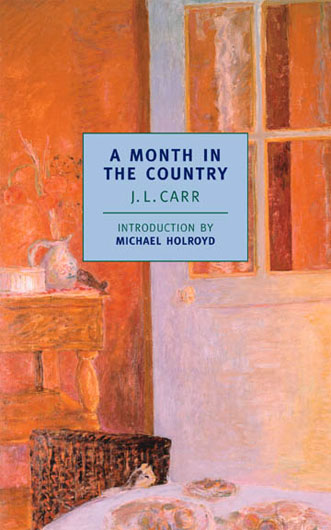
Book Review: A Month in the Country by J.L. Carr


Tom Birkin, a Londoner, and a somewhat shell-shocked veteran of World War I arrives in Yorkshire to uncover a suspected wall painting in the village church. Written as a memoir, Birkin’s story is equal parts country idyll, love story, and ethnographic sketch. Over only 135 pages, Carr’s poetic writing conjures up so many moving, beautiful, and humorous images, I feel very clumsy writing about it.

Through Birkin’s experience we meet the people of Oxgodby and are introduced to their various quirks and natural distrust of a city boy from the South. We learn the value of vocation and art for their own sake. And we see Birkin slip almost imperceptibly into the life of the village. He takes up Methodism despite working and literally living in an Anglican church, becomes close friends with Charles Moon a fellow WWI vet who has been hired to unearth the grave of the ancestor of an important local family, becomes an honorary member of the Ellerbeck family, and falls in love with the vicar’s wife.

Passages like this transported me to Birkin’s bucolic time in Oxgodby:
There was so much time that marvelous summer. Day after day, mist rose from the meadow as the sky lightened and hedges, barns and woods took shape until, at last, the long curving back of the hills lifted from the Plain.
And there are many scenes that beautifully describe connections to the past.
…their mother worked out how it was with me and usually sent a bit of whatever was being manufactured in her kitchen–rabbit pie, a couple of currant teacakes, two or three curd tarts. So, over the weeks, a splendid repertory of North Riding dishes was performed amanti bravura to an applauding Londoner, dishes Mrs. Ellerbeck had helped her mother bake, who had helped her mother bake who…Sometimes I’d share this bounty with Moon and it was he who suggested that we were eating disposable archaeology.
Similarly, both Birkin, in the course of his work restoring the painting, and Moon in his archaeological digging, contemplate the creators of the work they are unearthing. Here is Moon asking Birkin about the unknown artist:
“How are you two getting on together?” Moon would say, waving a hand at my wall. “Do you ever feel him breathing down your neck, nudging you–‘Good lad, Birkin! Attaboy!’ You must know him pretty well. Go on–tell me about him. who was he?”
Birkin contemplates how alien the idea of fame would have been to this unknown master.
And the idea that his work might be minutely observed five hundred years after his death would have been preposterous. In his day, buildings were being drastically remodeled every fifty years as fashions changed, so that my man would calculate his painting, at the longest would last no more than a couple of generations.
Not only would this unknown artist never have contemplated the immortal nature of his work, he certainly wouldn’t have supposed that Birkin, five hundred years later could intelligently deduce that in addition to being right handed, likely a monk, and didn’t trust his apprentice, the artist
…was fair-headed; hairs kept turning up where his beard had prodded into tacky paint, particularly the outlining in red ochre which he’d based in linseed oil. There was no mistaking it for brush hair which was recognizable from its length, an inch, never more than an inch and half. Sow’s bristle for the rough jobs, badger’s gray for precision.
He also surmises something about the unknown artist’s end. But I don’t want to give too much away. What has just occurred to me as I write this is that Birkin’s restoration work, his contribution to history, as well as his connection with Oxgodby becomes similarly anonymous as it was for the original artist. It is enough for Birkin to have played his part in a continuum of human endeavor as well as to have had, at least for one summer, received so much from his time in Oxgodby.
This review is a little over wrought and under thunk. I warned you that was going to be tough to write about this little gem. I think it is a beautiful book and it gives me deep comfort about my place in the cosmos.

Book Review: In Other Rooms, Other Wonders by Daniyal Mueenuddin


Fascinating book overcomes deep-seated reading quirks.

As regular readers of My Porch will know, in the pantheon of quirks related to my reading habits perhaps none is more stubbornly ingrained in my psyche than my inability to embrace (or even read) books handed to me by others. Don’t get me wrong, I have read many, many, wonderful books recommended by friends and bloggers. But there is something about the act of someone actually handing me a book, and the expectations that go along with that act, that makes it hard for me to want to read the book. This knee-jerk aversion is almost entirely a function of deep seated control issues that makes “no” my initial response to almost everything. Thankfully I have worked hard on getting over that and even if I say “no” right off the bat, I will often quickly change course to “maybe” or even “yes”.
Back in May we were visiting friends in Sonoma, California when we got to talking about books. One of our friends handed me In Other Rooms, Other Wonders and said that he thought I would enjoy it. Working against my natural inclinations, and trusting this friend’s judgment, I cheerfully accepted the book and was intrigued with its premise. But then I get back to DC, the book gets added to my nightstand TBR* pile, and the reality of “no” starts to hover over the book. Not only is it languishing unread because of my control issues, but it is a collection of linked short stories. Normally, short stories are not my cup of tea, but last year I read a number of great collections that had me rethinking my dislike of the form. And there was still one other hurdle to overcome. The stories are set in Pakistan. Nothing against Pakistan, but my reading tastes tend to focus on North America, the UK, and parts of Europe. Xenophobic as it may be, I am just disinclined to go beyond that geographically and culturally narrow (but richly populated) band of reading material.
So, In Other Rooms, Other Wonders sat and sat until the TBR Dare prodded me to look at it in a new light and with some enthusiasm. Granted, I was thinking I would just read it to finally get it off of my plate, but at least I was going to read it. Imagine my surprise when I ended up liking it.
Each of the linked stories are wholly compelling. As I often discover when I read outside my comfort zone, I was fascinated by the contrast between the action and setting of the stories and my own comfortable life. Interwoven around a modern day feudal landowner, his family, his employees, and his servants, the stories run the gambit from the halls of wealth and power to the basest of living conditions. What was most surprising to me was the corrupt, wild west kind of mentality that pervades most of the stories. Either as background, or as a major component of the plot, and in every socio-economic strata, corruption is everywhere. And for so many of the characters, rich and poor, the corruption is both the reason for their situation as well as the avenue for escaping poverty or maintaining wealth. Some of it is garden variety greasing the wheels of justice and business with bribes, but in other cases it is violent and desperate. And as with women all over the world, the women in the stories are the ones most often at the biggest disadvantage, many resorting to sexual favors for survival. (Now that I reflect on it, I am struck by how well Mueenuddin writes about the plight of women.)

As gloomy as some of the scenarios can be, they are not without beauty and humor.  And Mueenuddin paints a vivid picture of life in Pakistan. One can almost feel the heat and smell the food. In Other Rooms, Other Wonders was a National Book Award finalist and it is easy to see why. I am glad I overcame my natural disinclination to read this book. Had I not, I would have missed out on a fascinating world and a well written book. And it will make me less resistant the next time someone hands me a book. (But don’t do it until after April 1st when the TBR Dare ends.)

*TBR = to be read

Super Bowl Sunday

   
If you are like me you couldn’t care less about football and the Super Bowl. So I thought I would try a different kind of super bowl Sunday. Also check out this week’s Sunday Painting, and my TBR Dare update.

Footed Bowl by Frances Palmer

Hammered Stainless Steel by Simon Pearce

Ceramic bowl made by a friend.


Urchin Bowl by Element Clay Studio

A bowl in the spa at our hotel in Chiang Mai, Thailand

Basalt bowl by Wedgwood

Ancient Celtic bowl

Beautiful, simple ironstone bowl found on Faded Plains

Lots of bowls at John Derian

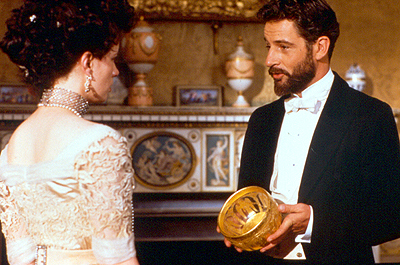
And how could I forget hotty Jeremy Northam holding this golden bowl from
the movie adaptation of Henry James’ The Golden Bowl

TBR Dare Check In


At just over a month into the TBR Dare, I am, for the most part, loving it. As you may recall, rather than reading from my full TBR pile of some 300+ books, I decided to narrow the dare down to the 42 books in my nightstand. Since I had such a wide range of books in my nightstand, I have been actually having a great time focusing on them. I also have the added satisfaction of moving through some titles that I have been avoiding or have been slow to warm to. With the exception of the Henry James and one book that I decided not to continue with, I have enjoyed even the ones that were previously hard to get into. It can sometimes be rewarding to be “forced” to read certain books.
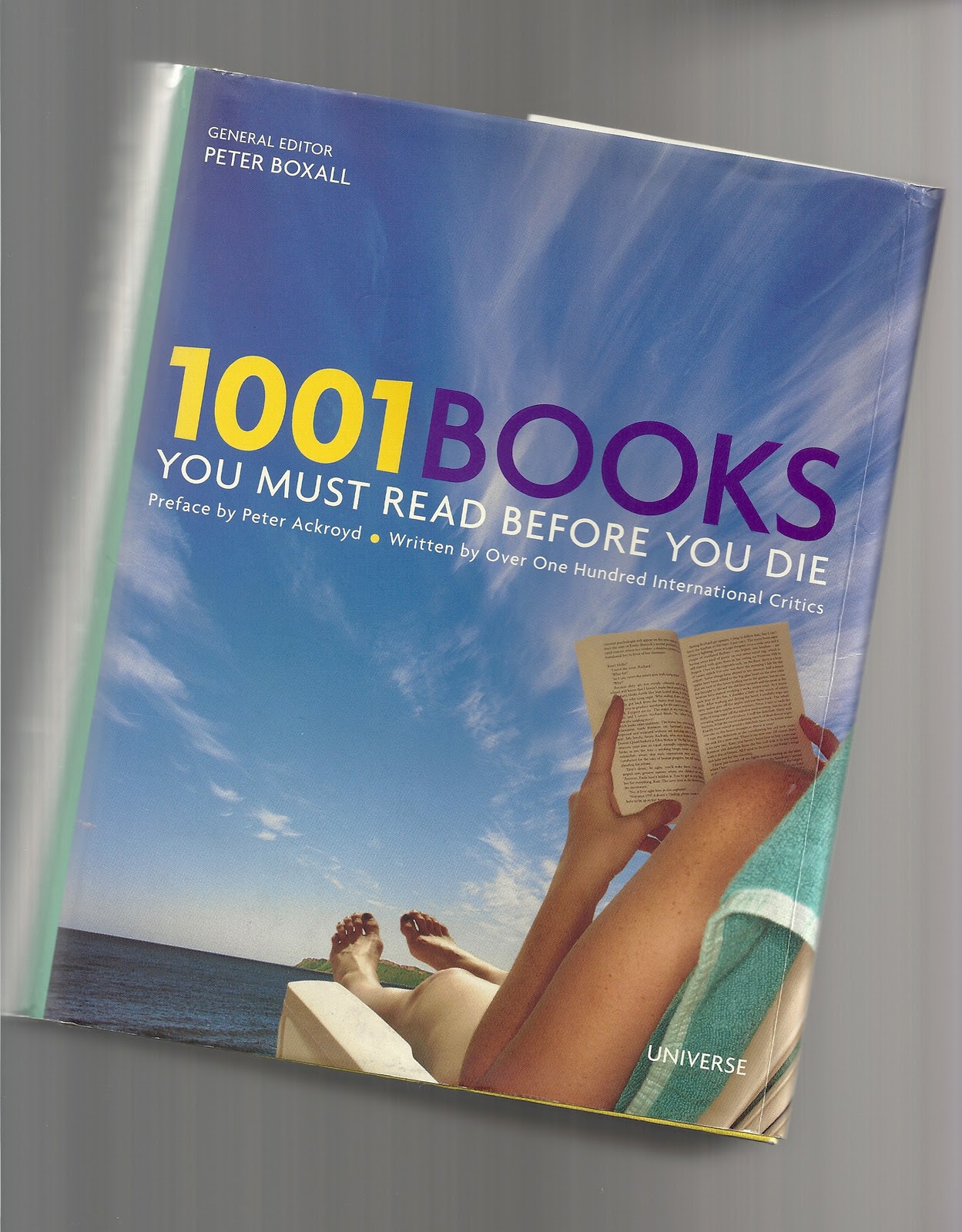
This morning I was perusing my library and was struck by all of the books that I want to read. It was the first time since beginning the dare that I really had the desire to read something off limits. As I sometimes do, I started to leaf through 1001 Books You Must Read Before You Die. In doing so, I realized that I have read two more of the 1001 since the last time I leafed through it (War and Peace and The Golden Notebook). I also began to notice just how many of the books in my TBR pile were also in the 1001 book. I have never consciously purchased books with the 1001 list in mind, so it is particularly interesting that so many of them are on my shelves. And thankfully 11 of the 42 in my nightstand are in the book. So instead of getting frustrated while leafing through the 1001 book, I realized just how good my nightstand TBR is and how it should be a cinch to get to April 1st without failing the TBR Dare. Plus, just think how many more titles in the 1001 book I will get to check off come April 1st.

I couldn’t post about this without noting that, like all lists, the 1001 book is by no means perfect. They have a pretty good cross section but it is heavily 20th century, I guess critics don’t read many classics. And in some cases I think they highlight some authors a little too much. Although I like Ian McEwan I think they list too many of his books especially when some great authors aren’t included at all. And does any list really need that much D.H. Lawrence? Of course it has all the ones you expect by Lawrence, but it also has several I had never even heard of. I also think it has too many Amis, pere et fils.  I understand the list/book keeps getting updated since my 2006 edition, but I am not going to try and keep up with that. I am certainly not going to buy a new copy.
So, in a nutshell I am really finding the TBR Dare to be quite satisfying.

Of these books (my nightstand TBR pile), the following are listed in the 1001 book:

The Amis, Bowen, Cather, Coetzee (Petersburg), Eliot, Le Carre, both McEwan, both Mitford, and the West.

Winners of Virago Giveaways


The winner of the random draw for my extra copy of The Lost Traveller by Antonia White is:
 Susan in TX
So email me your mailing address Susan. A little bit of Virago will be heading the Lone Star State.

The cover contest also turned into a random draw since everyone who sent me an email got all four titles correct. It must have been easier than I thought. How did you all do it? What was your technique?

Since Virago have agreed to fulfill the winner of this competition, I decided to pick two winners. Virago will take care of one winner and I will take care of the other. The winners can be found after the images of the mystery covers.
And the two winners out of 21 correct entries are:
Michelle Foong and Karen Librarian

Both of you have one week to email me and let me know which Virago currently in print you would like to have and where it should be sent.

Thanks to all who entered. It was a lot of fun.

I forgot I owned this Virago

 
[On this final day of Virago Reading Week I have not just one VRW post, but three. Here is the third and final for the day. Scroll down to see the others.]

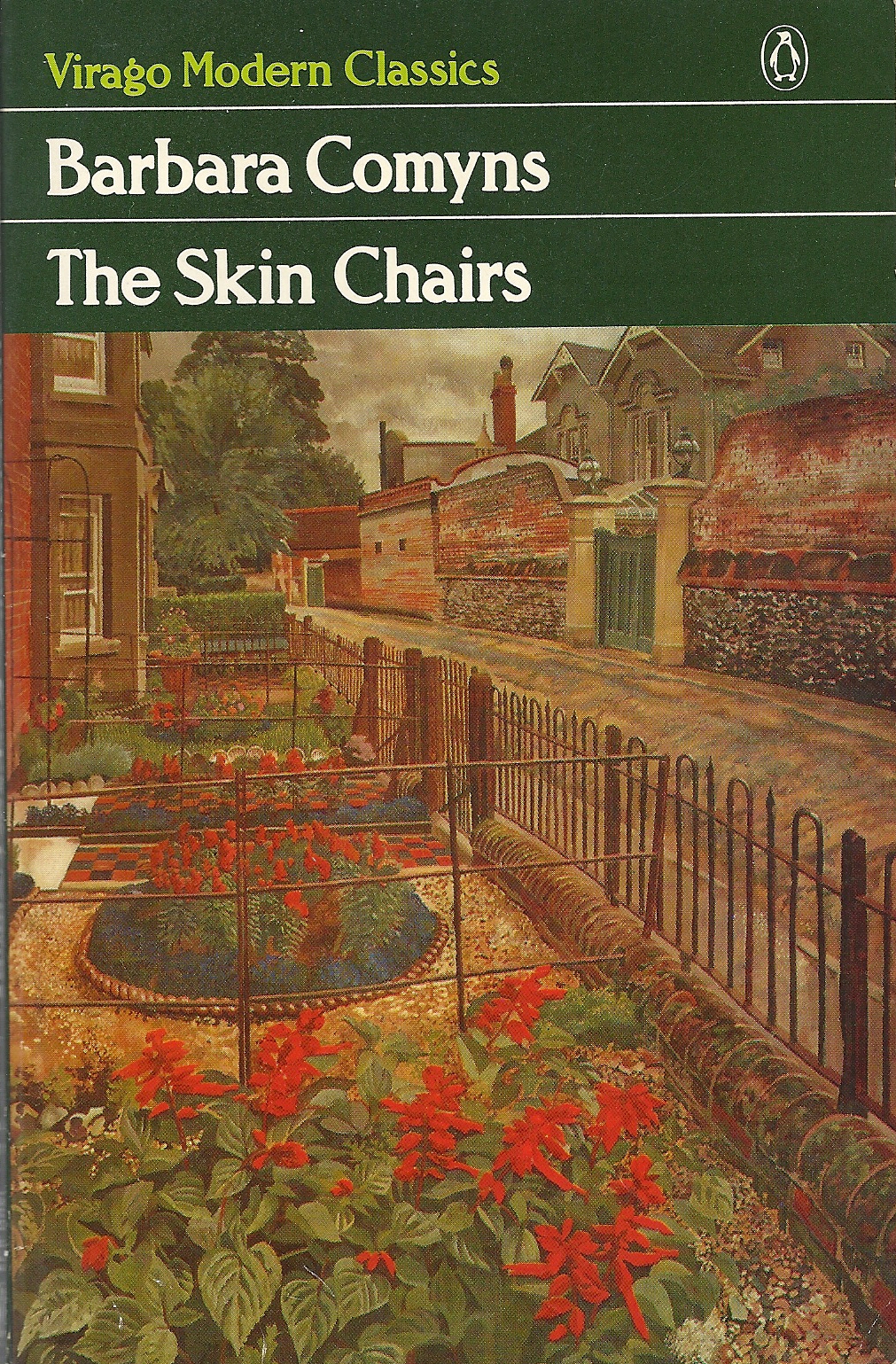
Earlier this week I posted a picture of all the Viragos that I owned that I wouldn’t be reading during Virago Reading Week. Absent from that photo was this book by Barbara Comyns. It was on my shelves where I keep all my other TBR books that aren’t in my nightstand and which aren’t part of some other collection in my library (e.g., Persephone, VMC, etc.). So I was somewhat surprised when I noticed it today. Especially since Barbara Comyns has gotten a fair amount of notice among book bloggers lately, and this book in particular was the subject of one of Simon’s posts this week.

I am in love with the cover, and based on all the Internet buzz, I really want to read it today. Alas, I can’t. I will have to wait until after April 1st.

Oh, danger, I just read the opening line and really, really want to read it today. Must. Be. Firm.

A few weeks after my tenth birthday I was sent to stay with some very horsy relations in Leicestershire.