Long Live the Surtitle!

In this Sunday’s New York Times, Anthony Tommasini writes about opera surtitles* being used for operas that are performed in English. Tommasini uses a recent trip to the English National Opera where they did not use surtitles for Benjamin Britten’s opera “Death in Venice” as his jumping off point. He is not exactly anti-surtitles, but he does seem to suffer from a bit of elitist angst over the use of surtitles when operas are performed in the native language of the audience.

Among other things, Tommasini is supportive of the ENO’s mission to present all of their productions in English. I take the exact opposite view and think that the ENO’s continued use of English translations is silly since the advent of surtitles. Contrary to Tommasini’s point of view, there are very few vocal lines that allow singers to produce truly clear—understand it in the cheap seats—diction. Nor are there many singers who can pull it off even if such vocal lines existed. Some of the best voices don’t necessarily come with the best diction.

When I lived in London in 1992, making a measly 540 GBPs a month while paying rent in the West End, the only reason I went to the ENO was because it was affordable. And for all the time I spent at the ENO then and more recently, I can tell you I understood precious few of the words sung on any given night.

Tommasini also makes the rather obvious observation that it would have been inconceivable to Verdi and Wagner to have their operas performed without being translated into the vernacular language. Oh brother. I bet they wouldn’t have been able to conceive of a lot of things that happen in modern opera performances from staging, to the price and quality of the food available during intermission, to lighting, heck, maybe even to flush toilets.

No doubt Verdi could not have imagined someone sitting on a train or running on a treadmill listening to one of his works through a pair of headphones. Hmm…I guess that means no more Macbeth on my iPod. Sorry Verdi, didn’t mean to blow your mind.

*Surtitles are like subtitles in a foreign film except they are usually projected above the stage during an opera performance. Some places like the Metropolitan Opera in New York and the Staatsoper in Vienna have individual readouts on the seat in front of you that you can turn on or off as you wish. In Vienna you can even choose among German, English, and the language in which the opera is being sung.

Renee Fleming: The Inner Voice Over-Emotes

On my recent field trip to Daedalus Books, I picked up Renee Fleming’s book The Inner Voice: The Making of a Singer for $4.98. Considering I almost paid the full $24.95 list price when it first came out, I considered this to be quite a bargain. Miss Fleming (or “Double Creme” if you believe Sir Georg Solti’s nickname for her) is not really my cup of tea these days, but having seriously studied voice as an undergraduate I was intrigued by the book nonetheless.
This is not your typical Diva autobiography. Encouraged by her friend, the insanely wonderful writer, Ann Patchett, Fleming wrote a book that is about all of those things that are left out of gossipy Divagraphies. She talks about the everyday life of an opera singer, from vocal technique to business management. The book was interesting for what it was, but I couldn’t help but wish for a little more gossip or at least a few more peeks at her famous diva friends and colleagues.

Despite the overly cautious, slightly boring “how to” quality that pervades The Inner Voice, reading it encouraged me to reconsider my dislike for Miss Double Creme’s singing. She is the toast of the singing world after all and has lots of fans (including the lovely Ms Patchett who fashioned the heroine of her novel Bel Canto with Fleming’s voice in mind). After finishing the book I popped in the one Fleming disk that I own (“Renee Fleming By Request”) and listened to her sing “E strano…” from La Traviata to see if maybe I had been wrong in my opinion of her singing. I actually had a hard time listening to the entire track. She puts so much color and emotion into every single note that she sounds like an overblown caricature of an opera singer. Like someone with a good voice pretending to be an opera singer.

A couple of years ago, before I had developed a dislike for Fleming, I heard her in a recital of french songs with the mezzo soprano Susan Graham at the Kennedy Center. All I could think that night was how much better Graham was. At the time I felt like there must be something wrong with me, after all Fleming was a much bigger star. But with every set they sang I couldn’t help but conclude that Graham was by far the better voice and the better artist. Still, it wasn’t until I saw a Fleming Christmas special taped in some church in Germany that I really began to dislike La Fleming. My main beef was not with the quality of her voice, but rather with her seemingly uncontrollable need to emote and emote and emote so that every note is so dripping with bathos it makes your teeth hurt. I don’t think “O Holy Night” is supposed to sound like a love song–divine love perhaps–but not a “hey baby I will literally die if you don’t come over here and make love to me” kind of love. It’s not Wagner’s Liebestod after all. In fact I don’t even want to hear the Liebestod with that much schmaltz.

What is the point of all this? Fleming will continue to make a good living and I will no longer feel like there is something wrong with me for not wanting to listen to her sing.

Field Trip to Daedalus Books

Check out my haul from a recent field trip to Daedalus Books Warehouse Outlet in Columbia, Maryland. Daedalus is a fabulous discount book wholesaler which just happens to be located in the outer suburbs of my fair city, Washington DC. Despite having 104 unread books in my capacious nightstand I can’t resist a field trip to Daedalus, especially when I have friends in town who I know will also enjoy such a trip. Eleven books for $80 and that included the big one that was $27 all on its own. Take that one out and I averaged $5.30 a book. At those prices you can’t go wrong.

My Big Love for "Big Love"

For someone who loves TV as much as I do, this blog has been wildly remiss in bringing to your attention that which is wonderful in the world of television.

If you don’t have HBO you need to get it. The Sopranos may be over (a show I never watched, for no real reason, just didn’t watch it) but Big Love lives on. It is the story of a polygamist family in suburban Salt Lake City trying to live a mainstream life. With Bill Paxton as the patriarch, Jeanne Tripplehorn as first wife and Chloe Sevigny and Ginnifer Goodwin as sister wives two and three respectively, the cast is amazing but the writing is even better. To me the hallmark of a good drama is one that lets you see the humanity in the characters even when you don’t necessarily want to. For most non-polygamists it might be a little startling to find yourself rooting for Bill and his family, but you do.

Of course it often seems batshit crazy but you still end up liking this family. The normality of the Henrickson family is set in stark contrast to the polygamist compound Juniper Creek that plays a central role in much of the drama on Big Love. Not only did Bill grow up at Juniper Creek but Nicki, wife number two, is the daughter of the “prophet” who rules the community. Grace Zabriskie’s brilliant portrayal of Bill’s looney mother Lois who also lives on the compound steals every scene she is in. It is one of those shows that always ends too soon with you clamoring for the next episode.

If you haven’t seen it, start out by renting or buying season one on DVD.

In other TV news.

I have recently gotten in to Family Guy. After years of ignoring it (I couldn’t get over the talking baby) I now can’t get enough of it. In fact, Stewie the talking baby, is my hands down favorite. Perhaps the greatest clip I have seen (relating to my love of books no less) can be found here. I was snorting like a pig as I tried to stifle my laugh while watching it at work. The show couldn’t be more random–or funny.

Entourage (also on HBO) continues to be one my favorites. Why can’t everyone make shows as good as HBO?

Counting the days until I can see The Simpson’s movie! 7/27/07!

Apparently Project Runway will not be making its annual appearance until the fall. Easily the best of Bravo’s reality show but I find Top Chef a decent substitute.

Booking Through Thursday: Great American Novel

In honor of Independence Day, Melanie over at Tea Reads posted the Booking Through Thursday Meme for this week: What is the Great American Novel? My first thought was something by Theodore Dreiser, but then I quickly settled on Main Street by Sinclair Lewis. In fact, I think almost anything by Lewis could fall into this category, but his tale of small town America in Main Street is a classic. A little cynical perhaps but still a valid depiction of one slice of life in America. The first American recipient of the Nobel Prize for literature, Lewis was also prescient enough in 1935 to write: “When fascism comes to America, it will be wrapped in the flag and carrying a cross.”

By the Decade Reading Challenge UPDATE

Following the lead of Blogger 3M I have been making my way through a list of 12 books from 12 consecutive decades in 2007. With seven books down with six months to go I thought I would give an update on my progress with mini-reviews of the books that I have read so far.

1910s: The Rainbow by D.H. Lawrence – 5/23/07
I must admit this book was a bit of a slog for me. The book follows three generations of the Brangwen family in semi-rural/semi-industrial England. Written in 1915 the book was fairly frank in its discussion of sexual and emotional relationships. I had a friend who used to say “C’mon Oprah, not everything can be a life changing experience.” In that vein I want to say to Lawrence “C’mon D, not every action or emotion needs to be that complex or fraught with meaning.”
1930s: The Big Money by John Dos Passos (3rd in his USA trilogy) – 5/30/07
Each volume of Dos Passos’ USA trilogy uses a mix of narrative forms to tell the tale of the great American experience. In addition to straightforward chapters telling the stories of various characters, Dos Passos intersperses those chapters with non-fiction accounts of famous Americans of the time and sections that highlight snippets of newsreel headlines, stories, song lyrics, and advertising slogans. Once you get used to all of that the trilogy still seems like a bit of an acquired taste. I will say that I enjoyed this volume the best of the trilogy.
1940s: Dirty Snow by Georges Simenon – 5/20/07
I had never heard of Simenon before I picked up this novel from a bookstore. The story takes place in something that seems like occupied Belgium or France during WWII. It captures a fascinating slice of life when the moral depravity of the occupiers becomes a way of life for the occupied. The book doesn’t address the issues of the genocide central to WWII, rather it focuses on the everyday ways that humans can lose their humanity. I quite enjoyed this one.
1950s: Mountolive by Lawrence Durrell (3rd in his Alexandria Quartet) – 2/27/07
Each of the volumes of the Alexandria Quartet tells roughly the same story from a different point of view. As someone who generally prefers to read about Western Europe or North America I have become oddly and intensely fascinated with these books as they describe Egpyt before and during World War II. I find that I like each volume more than the previous. This bodes well for the final volume which I will probably put off (savor) until next year.
1960s: The Mandelbaum Gate by Muriel Spark – 7/1/07
In many ways I found the setting of this book (1961 Israel and Jordan) fascinating in the same way I appreciated the setting in Mountolive as described above. The book describes the highly charged and unstable atmosphere in Israel and Jordan in the years following the creation of Israel. Not being a middle-east expert it was a bit of an education for me. The story revolves around a British woman who is a half Jewish convert to Catholicism who decides to go on a pilgrimage to the Christian holy sites in Jordan and Israel. Religion, sex/love, and political intrigue all play an equal part. This Muriel Spark book felt very different, less quirky, than other Spark books I have read. Almost a cross between Iris Murdoch and Ward Just.
1970s: A Word Child by Iris Murdoch – 6/4/07
What can I say. I love Iris Murdoch. She was a philosophy fellow at Oxford who wrote many wonderful novels that read like religious/ethical soap operas. Like most of her books, A Word Child has a large cast of educated characters who jump from bed to bed or relationship to relationship within that circle of characters and under the weight of religious, moral, and ethical dilemmas. Tragedy is just under the surface of every page, but the reader doesn’t really know which of those tragedies will ultimately break that surface to end the book. Every time I read Murdoch I wish a filmmaker with the skill of Merchant Ivory would put her 1950s, 1960s, and 1970s period pieces on film.
2000s: I Am Charlotte Simmons by Tom Wolfe – 4/20/07
Having read The Right Stuff, Bonfire of the Vanities, A Man in Full, and From Bauhaus to Our House, I think that Wolfe is incapable of writing a boring book. Whether or not you agree or disagree with his books, his politics, or his gimmicky way of dressing, Tom Wolfe knows how to write smart, compelling page turners. Charlotte Simmons is a real doorstop of a book but you fly through it in no time. It is amazing how the aging Wolfe captures the essence and much of the detail of the lives of college students at the turn of the 21st century. Having said that, some of Wolfe’s characterizations, including parts of Charlotte, are somewhat one dimensional and implausible. Still no reason to stay away from this one, it is definitely worth the read. Perhaps most unrealistic is the dearth of technology usage among the students. Wolfe doesn’t realize just how wired and wireless students today have become.

Favorite Performances of All Time

As some of you know from reading a previous blog, I keep track of every concert and opera that I go to in a spreadsheet. I have information going back to about 1989. My temptation in picking my favorite performances of all time was to go back to look at the spreadsheet to jog my memory. Then I thought that would be cheating. After all, if it doesn’t pop into my head it couldn’t have been that good right?

So here they are off the top of my head (with performance details added after peeking at my spreadsheet) in no particular order…

Le Sacre du Printemps – Igor Stravinsky
London Symphony Orchestra, Barbican – London
Riccardo Chailly, 23 March 2000

At age 30 I had never heard this piece before. I knew the lore behind the riotous premiere of the work but had never heard the piece. Well, I was blown away. The front row of the balcony at the Barbican put me pretty close to the LSO and it was stunning. Also heard Salonen and Cleveland do it at Severance Hall in 2004 to similar effect.

The Dream of Gerontius – Edward Elgar
Bavarian State Opera Orchestra and Chorus, Opera House – Munich
Zubin Mehta, Catherine Wyn-Rogers, Dennis O’Neill, Rene Pape, 10 June 2002

This performance was so spot on it was amazing. Despite the German “t” at the end of words like “god” and “lord”, the chorus was muscular and beautiful all at the same time. The soloists were also wonderful, Rene Pape was filling in for Thomas Quasthoff–I was disappointed that TQ wasn’t going to be there until RP opened his mouth. What a voice. The brilliance of this performance was reinforced when I heard a sloppy, lackluster performance by the NSO here in DC later that same year.

Symphony No. 8 (Symphony of a Thousand) – Gustav Mahler
Minnesota Orchestra/Gothenberg Orchestra, Midsummer Festival – Bloomington, MN
Neeme Jarvi, June 1988

This performance got terrible reviews (“Heat Deals Death Blow to Mahler”) but it was incredible for me because I was in the mammoth chorus. It was held outside in a giant tent as part of the short lived Midsummer Festival. Too bad about the bad acoustics and heat, everything else was right – Jarvi, two orchestras, soloists and choruses from Sweden and Minnesota.

Symphony No. 11 (The Year 1905) – Dimitri Shostokovich
Minnesota Orchestra, Orchestra Hall – Minneapolis
Leonard Slatkin, 27 October 1990 (Hat tip to Spartacus for providing correct conductor)

One of many great nights at Orchestra Hall, but this night was special. The playing was wonderful and the place was packed. The audience was not only well behaved, but it was one of those nights where everything just feels electric–as if the entire audience was holding its breath.

Tannhauser – Richard Wagner
Metropolitan Opera, New York
Mark Elder, Deborah Voigt, Michelle De Young, Thomas Hampson, 26 November 2004
Two years earlier I went to Vienna to hear Deborah Voigt sing both soprano roles in Tannhasuer but she cancelled. Of course the Vienna performance was still good even without her, in fact it was only a shade or two less fabulous than this Met performance which was a sonic delight.

Macbeth – Giuseppe Verdi
Deutsche Staatsoper, Unter den Linden – Berlin
8 June 2002

I don’t remember who sang in this, I don’t remember who conducted…all I remember is that Lady Macbeth sang the s**t out of that role. Her voice was beautiful and powerful. The production was very abstract and she looked a bit like she was wearing one of Phyllis Diller’s feathery hats from the 60s but it was a great performance. There was a kind of runway/catwalk that followed the outer rim of the orchestra pit so Lady Macbeth was all that much closer to the audience.

War Requiem – Benjamin Britten
Minnesota Orchestra, Orchestra Hall – Minneapolis
Robert Shaw, 13 March 1998

Powerful, well-sung performance. Although I love Britten, I had a hard time warming up this work in recordings, but in person it all makes wonderful sense. The interplay of the various ensembles and texts is quite moving. One of the fun things about this performance came at the end when the choristers took their bows standing in the two aisles on the main floor. This made the usual “standing evacuation” that takes place at the front of the house during the applause impossible.

Symphony No. 2 – Gustav Mahler
Cleveland Orchestra, Severance Hall – Cleveland
Jaha Ling, 16 March 2002

I have heard this piece in concert about five times and this was definitely the best of them. One of the soloists was a little hard to hear but it didn’t diminish the power of the performance by the stunning Cleveland Orchestra in what has to be one of the most beautiful halls in America.

Holidays Symphony – Charles Ives
Royal Liverpool Philharmonic, Royal Albert Hall – London
Libor Pesek, 29 July 1992

This is another of those pieces that isn’t done justice on record. To hear this crazy work in person is a little mind blowing. At one point a second conductor rises from the orchestra to try and manage an orchestra within the orchestra that is playing something totally different like two separate marching bands bump coming down the same street destined for a head on collision. With Dvorak Symphony No. 9 (From the New World) and the Stars and Stripes Forever on the program, there was also a certain pride in being an American in London that night.

Rhapsody for Orchestra – Yuzo Toyama
Minnesota Orchestra, Orchestra Hall – Minneapolis
Eiji Oue, 13 May 1999

The controversial Oue at his best. Flashy, fast, and loud. This piece opened a concert and the response from the audience was so enthusiastic I seem to remember they actually repeated the piece. But to be truthful, I can’t remember if they really did repeat it or if it was just my imagination. I know I wanted them to repeat it, but I no longer remember what really happened.

Symphony No. 7 – Beethoven
Honolulu Symphony, Blaisdell Center – Honolulu
Eiji Oue, 1996 or 1997

I know Oue has his critics, and I am no fan, but this performance was truly engrossing. No doubt some would quarrel with his extremes of dynamics–especially the pianissimo–but score be damned, it was enjoyable.


Tribute to The Womenfolk


UPDATE: Check out this link for the latest–including how to download the Womenfolk on iTunes…

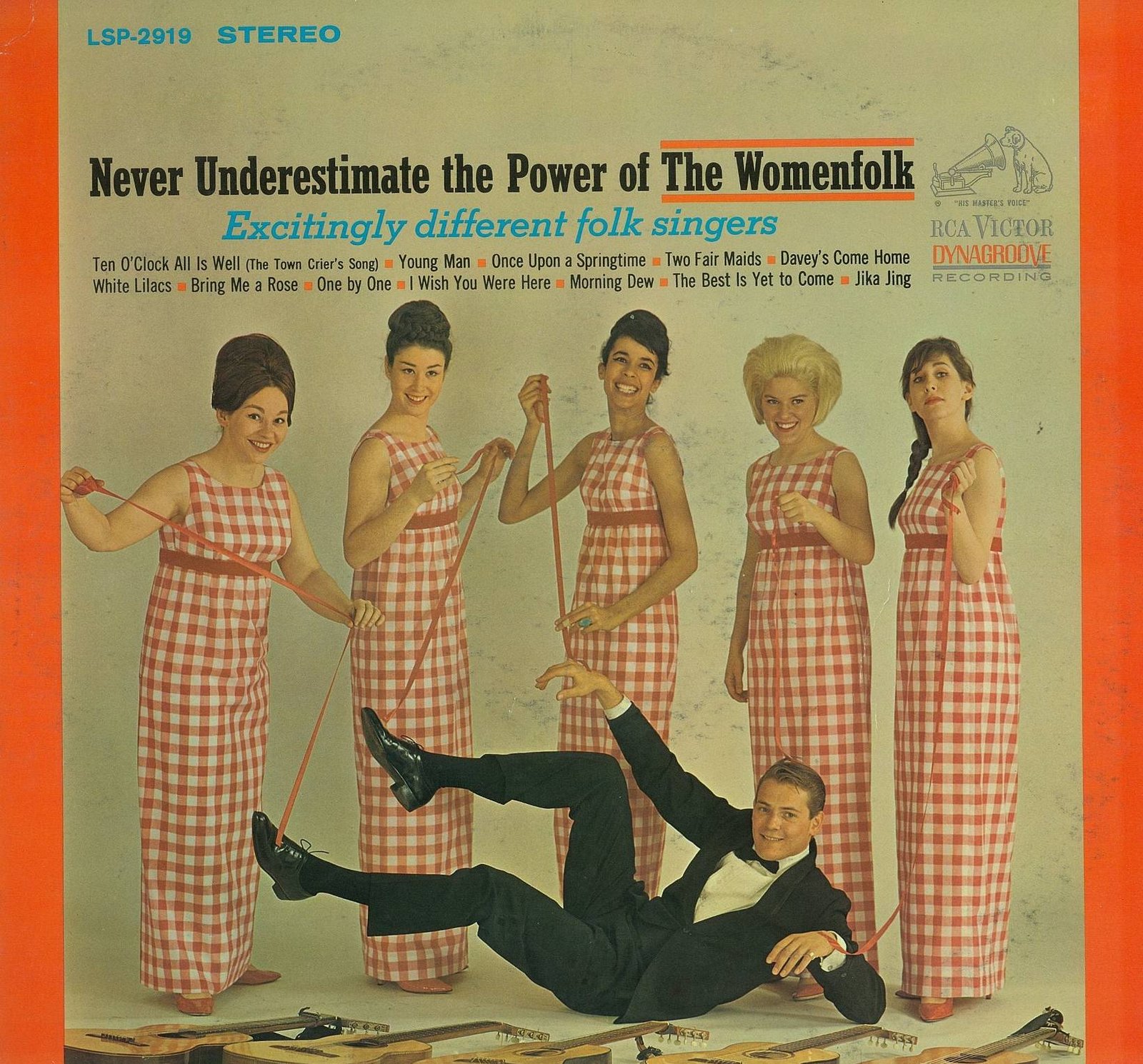
I was first drawn to The Womenfolk by the cover of their 1964 album “Never Underestimate the Power of The Womenfolk”. Decked out in fabulous red gingham, Empire-waisted, maxi dresses, I was instantly excited by the prospect of what those five women might sound like. It was the very hot, very dry summer of 1988. I was sharing a room in a run down boarding house near the University of Minnesota. The album belonged to my roommate Annie who brought it with her when she moved to Minneapolis from Chicago. It was included in a bunch of other campy old albums of her father’s that she found funny. I joined in her amusement when she showed me the dated album cover.

Once we put the needle down on the album, however, my ironic chuckles immediately ceased. Since I was a child I had always had a secret love of groups like the New Christy Minstrels and just about anything that sounded like a well-coordinated sing-a-long. I was especially drawn to female voices. As soon as I heard this strong, clear chorus of women I was hooked.
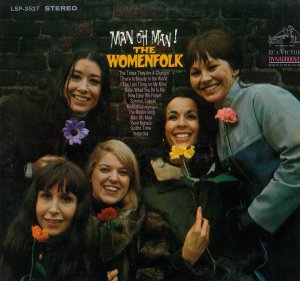
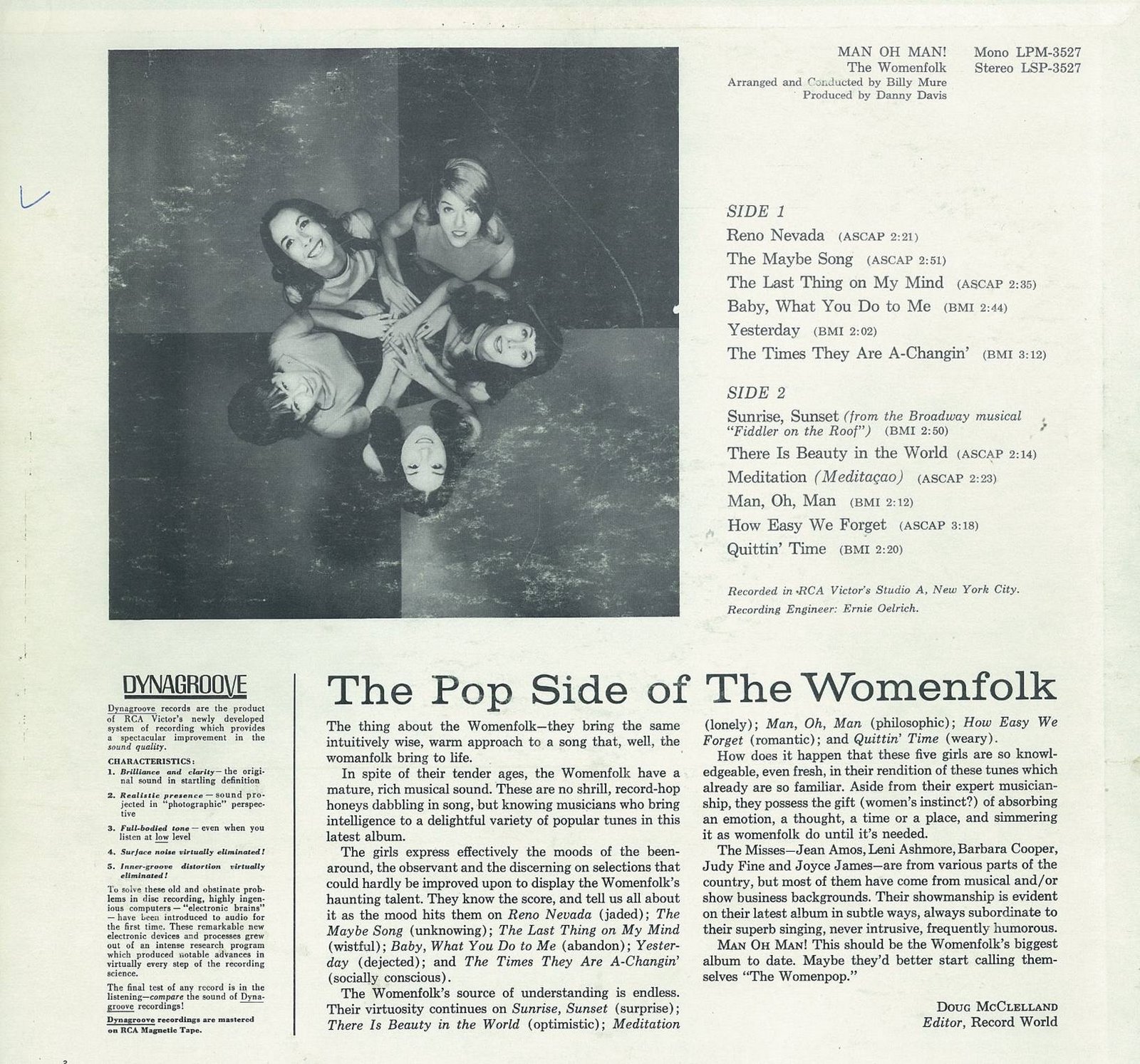
In the following months I played The Womenfolk for anyone who would listen. Most found it amusing and something silly to laugh at. Occasionally, however, I would find a friend or acquaintance who found the sound as fabulous as I did. My obsession with The Womenfolk became common knowledge among my friends. My roommate let me keep the album when we moved into different apartments. Later, another roommate stumbled across The Womenfolk’s last album when she was browsing in a used record store. These were the waning days of the LP when sources of used vinyl began to outnumber sources of new. That album “Man oh Man!” from 1966 was, as the album notes describe, more like the “Womenpop” with the women covering such pop tunes as “Yesterday”, Baby, What You Do to Me”, and “Reno Nevada”. The album also showed the women without the gingham and with about 75% less backcombing and hairspray.

For years these were the only two albums of theirs I could find. In those pre-Internet days the only real opportunity I had to track them down was by checking every used record bin I came across. As I described them to confused record store owners I described their music as Glam-Folk, that is, folk music that was generally happy, wholesome, non-controversial, non-political, and non-threatening. Even covering “The Times They Are A Changin” in 1966, their sound and look seemed apolitical and sanitized.

It wasn’t until years later when I found the live 1963-album they shared with The Villagers and their 1964 eponymous album with songs like “Little Boxes” that I got some sense that the women may have been more than the well-packaged glamour that their later albums portrayed. For the most part the subjects of the songs don’t seem very edgy, in fact they seem the opposite of edgy. But there is an attitude in their singing that is missing in later albums and, at least in my imagination, suggests that, had the times been different, The Womenfolk might have been something entirely different as well.

28 June 2007 UPDATE: I have since heard their Live from hungry i album. I love it, and it definitely shows a edgy side of the Womenfolk including Shel Silverstein’s “Hey Nelly Nelly”.

Where are The Womenfolk?
Little is known about The Womenfolk. Over the years I have called and emailed producers, record companies, and anyone who might have some information with absolutely no luck. No doubt I could do a much better job if I had nothing going on in my life, but thankfully I keep pretty busy. There are a few threads on various Internet discussion boards with bits and pieces of information but not much to go on. In the interest of documenting what is known about The Womenfolk and in the hopes of eliciting more information I want to chronicle as much of what I know here. I had fantasized about a PBS reunion special long before Christopher Guest brilliantly satirized the 60s folk music scene in the reunion mockumentary “A Mighty Wind”. But seeing that at least one of The Womenfolk has passed away, I have all but given up any hope of that happening.

One of the few mentions of the Womenfolk that can be found online at Answers.com is not very enlightening nor accurate. The Internet Movie Database lists several appearances on The Toast of the Town and The Hollywood Palace as well as Hullabaloo. According to the cover notes on one of their albums they also appeared on the Red Skelton Show and the Tonight Show. I am in the midst of seeing whether or not the Museum of Television and Radio has copies of these episodes in their library. They even hosted a short-lived television show in Canada called A Singin’

Online video exists!
Imagine my surprise when I found a clip posted on YouTube from Hullabaloo. The women appear in the middle of a medley by various groups at about the 1:38 minute mark. UPDATE 7/2/7: The clip has been removed from YouTube for violation of their use policy. Maybe it will resurface at some point. It’s too bad too, the women looked lovely and sounded lovely. UPDATE 11/12/07: I guess it has been out there for a while, but I just stumbled across this video of the women, thanks to the conversation thread over at Mudcat.com

The Women

  • Joyce James – Unfortunately the wealth of information about Joyce James comes from her obituary. She passed away in 2001 in Newmarket, New Hampshire. She was very active in her community and at the University of New Hampshire where they have created an award in her honor. Her obituary notes that she hosted a children’s television show on CBS called “Around the Corner”.
  • Leni Ashmore – Listed on “We Give a Hoot” as Len Isabel Ashmore, Leni went on to star in the original LA cast of HAIR. June 28, 2007 UPDATE: Leni is as lively as her pictures suggest. She now lives in Virginia where she is a research historian. In addition to African-American and women’s history Leni’s interests extend to rural, agricultural, and culinary history. She earned her Ph.D. in American Studies in 2005 from the College of William and Mary. She is married and has four children.
  • Barbara “Babs” Cooper – Originally from Memphis Cooper graduated from San Fernando High School in 1961. She recorded in 1962 for Indigo Records. No other information known. June 28, 2007 UPDATE: Babs has lived on the East Coast since the Womenfolk relocated to New York in 1965. After leaving the group she worked as a songwriter, and on the fringe of Madison Avenue; singing and writing lyrics and some music for commercials. She branched out into real estate in the 1980s, and nowadays she’s involved in the legal word processing field. Although she no longer takes part in any organized singing, she says she is always singing—her songwriter’s mind constantly recalling old lyrics from the speech of the people around her. She let me know that this upsurge of interest is tickling her muse. Who know what the future may bring.
  • Judy Fine – She went to Pomona College. July 17, 2007 UPDATE: Judy Fine has never stopped singing and recently come out with a CD of her own songs. Using her middle name and her married name she now answers to the name Lalah Simcoe. You can check out some audio tracks of her recent work and buy the CD at her website. Lalah has two children and with her husband owns the Bluegrass Grill & Bakery in Charlottesville, VA.
  • Jean Amos – Appeared on the final three albums replacing Elaine Gealer. She grew up in France, Germany and the San Fernando Valley. Her father was an operatic Bass and her mother was a pianist. Before joining the Womenfolk she was part of the duo Penny & Jean. Update 11/12/07: Jean has posted this over on the Mudcat.com thread: “OK, well, I have been living in San Francisco since 1969. I taught guitar for many years – basic, ragtime and classical.”
  • Elaine Gealer – Appeared on “The Womenfolk” replacing Terry Harley. She wrote into this online forum in January 2007 saying she doesn’t know where the rest of the group is these days.
  • Terry Harley – Appeared on “We Give a Hoot”. No other information known.

Discography

We Give A Hoot – Womenfolk and Villagers (1963)
The Womenfolk (1964)
Never Underestimate the Power of The Womenfolk (1964)
The Womenfolk at the hungry i (1965)
Man oh Man! (1966)

For a listing of all of the music on their albums check out this link.

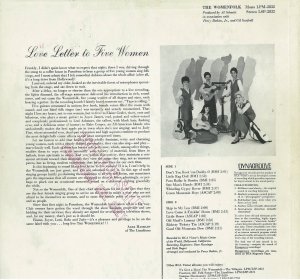
I have all but The Womenfolk at the hungry i. For a picture of that album go to this page about the hungry i. For those of you in the San Francisco Bay area, you can also check out this exhibit about the hungry i that is going on until August 2007. Here are the backs of the albums that I own. You can click on the images to make them bigger so you can read the text.

UPDATE (11/19/07): Babs Cooper sent me album images for the hungry i LP. The front is shown here to the left, the back is toward the end of this post.

“We Give a Hoot” – 1963

“The Womenfolk” – 1964

“Never Underestimate the Power of The Womenfolk” 1964

“The Womenfolk at the hungry i” – 1965

“Man Oh Man!” – 1966

Sorry, I am no expert at getting photos in these posts, so the album art is a little untidily placed.

See the latest picture of The Womenfolk here.

40 by 40

Some of you may have seen on the blogosphere people posting lists of 101 things they would accomplish in the next 1001 days. As my 38th birthday approaches, I am putting my own twist on that challenge by making a list of 40 things to do by the time I am 40. I need to finish the following things by August 17, 2009.

(Updated 5/30/07–had too many travel related tasks, sadly not enough vacation time…)

1. Quit my job (completed 10/12/07 and again on 12/01/08)
2. Get another job (completed 10/13/07 and again on 2/5/09)
3. Go to my 20 year high school reunion (completed 7/28/07)
4. Pass the TAP Exam (completed 8/10/07)
5. Make four new friends (1 down, 3 to go)
6. Write a blog tribute to the
Womenfolk (completed 6/9/07)
7. Finish my first novel
8. Submit novel for publication
9. Outline my second novel
10. Finish my business plan
11. Take a cruise (completed 1/18/09)
12. Become a homeowner
13. Reduce my cholesterol below 200
14. Make a timpano (see the movie Big Night)
15. Volunteer during the next Presidential election cycle (completed Oct and Nov 2008)
16. Get a letter published in the New York Times (completed 7/18/07)

17. Spend a long weekend in Vienna, Berlin or Barcelona
18. Start and finish the “Write Now” better handwriting program
19. Release 25 books into the wild through BookCrossing (abondoned 7/29/07)
20. Make pudding from scratch (completed 7/7/7)
21. Hear Mahler’s 8th Symphony again
22. Read at least the first volume of Proust’s In Search of Lost Time
23. Finish the rest of the Modern Library’s list of 100 top novels of the 20th Century (except for Faulkner and Joyce-I just can’t do it)
24. Go back to the house in Italy for 2 weeks
25. Get the maximum Roth IRA for ’08 and ’09 (I got one for 2007 thinking it was part of the challenge, oh well, now I will be able to retire a week earlier than expected.)
26. Go a month without TV
27. See every best picture Oscar nominee
28. Go to the Udvar-Hazy Air and Space Museum near Dulles (completed 3/08)
29. Go back to
Ithaca, NY for a long weekend (completed 8/08)
30. Finish organizing my recipe files
31. Don’t curse for two weeks
32. Go to the Museum of Television and Radio (completed 12/08)
33. Streamline my wardrobe (completed 10/01/07)
34. Have a vegetable garden
35. Go to a BSO concert at Strathmore
36. Go to a concert at the Library of Congress
37. Find an opera/orchestra/concert buddy
38. Go to a concert at the Peabody Institute
39. Sing in a choir
40. Give 10 dollars to charity for every item not finished by August 17, 2009