Does anyone know of a complete edition of Shakespeare’s plays in paperback? I’m not talking about an omnibus edition, but rather one where each play is a separate paperback volume and they all have a uniform appearance?

Does anyone know of a complete edition of Shakespeare’s plays in paperback? I’m not talking about an omnibus edition, but rather one where each play is a separate paperback volume and they all have a uniform appearance?
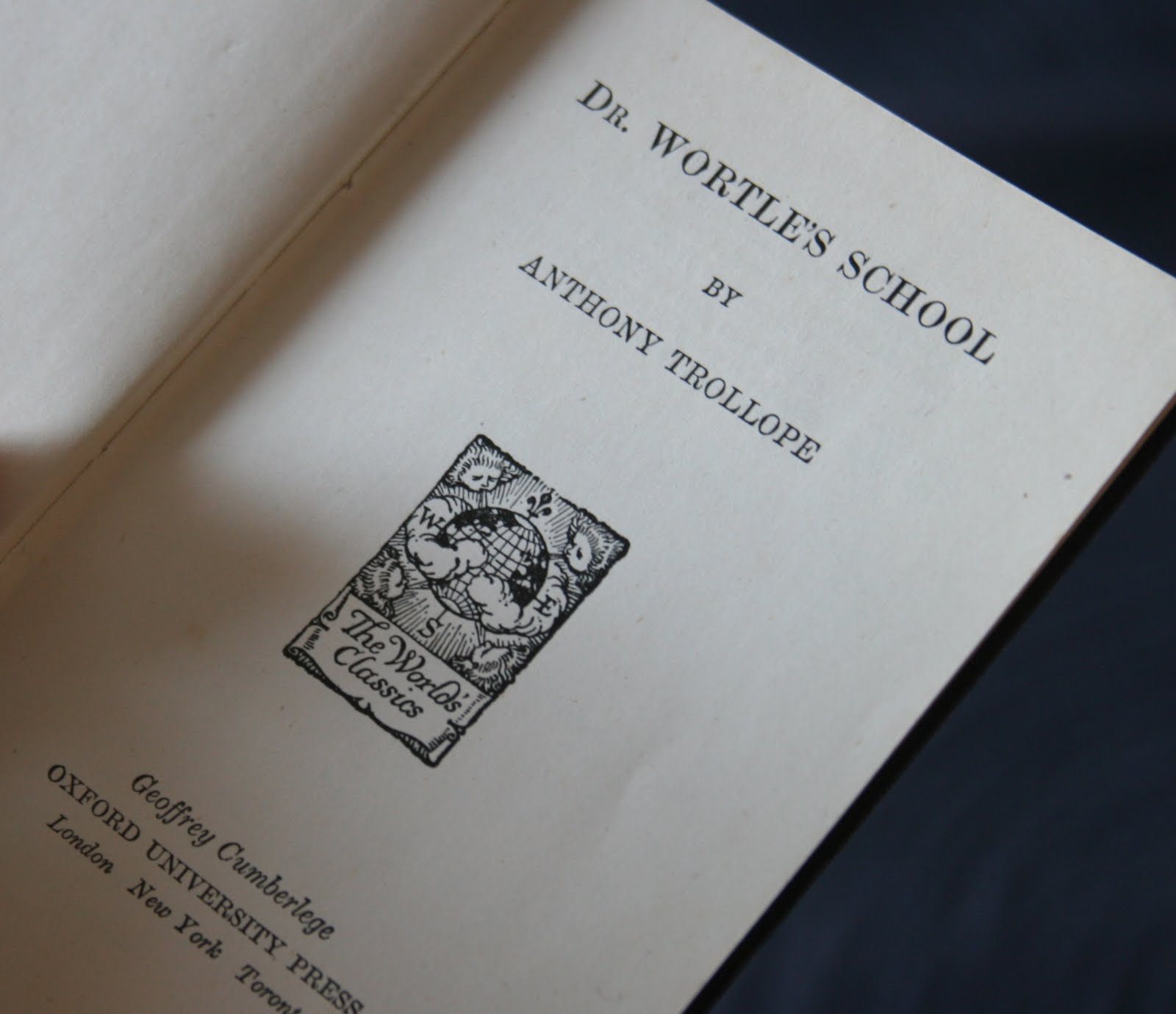
Dr. Wortle’s School
Anthony Trollope
I am not sure where I picked up this little honey of an edition, but it has been sitting in my TBR for quite some time. In the world of Trollope, this almost 300-page book is practically a short story and it is full of all of the clerical intrigue that one comes to expect from this Victorian master. If the opera Aida could have just as appropriately been called Amneris after the mezzo-soprano role (or if Barber’s opera Vanessa could have been called Erica after that mezzo role), so too could Dr. Wortle’s School have been called Mr. Peacocke’s Secret. It is, after all, the revelation of Mr. and Mrs. Peacocke’s secret that put Dr. Wortle and his school to the test. The Peacocke’s have come to work at Bowick School and soon become indispensible to its success, but it turns out they are hiding something.
Early in the novel Trollope lets us in on the secret so I will not feel bad about revealing said secret here. But I guess I should officially issue a spoiler alert, although I don’t think knowing the secret will lessen the interest of anyone wishing to read this book in the first place. While teaching classics at a university in the USA Mr. Peacocke marries Mrs. Peacocke thinking that her abusive, drunkard, deserter husband has been killed, thus freeing her to remarry. Sometime after they are married Mrs. Peacocke’s husband reappears very much alive. So, rather than put her back in the hands of the abusive husband, the Peacockes move to England and take positions at Bowick. Well you can imagine what the society folks of 1882 think of the Peacockes once the secret gets out. Even worse is that Dr. Wortle decides to defend the couple, putting the reputation of his school and its very existence on the line.
What I won’t tell you is if Dr. Wortle’s school or his soul are saved.
This isn’t the most fantastic Trollope of all time, but it might be a good intro for someone who has never read any of his prodigious output. It certainly provides a cozy read and a forward momentum that makes it a bit of a page turner. And the rather racy nature of the secret, at least by Victorian standards, makes it a little more risque than one normally expects from Trollope.

The Assault
Harry Mulisch
In 1945, in the final throes of the Nazi occupation of Haarlem, Anton Steenwijk’s parents and older brother are killed in retaliation for the murder of a Nazi collaborator that happened on the street in front of their house. From the event itself and the immediate aftermath The Assault is broken down into chapter “episodes” that chronicle Anton’s life in the 1950s, 1960s and 1980s. We follow him as he alternately gets on with his life, love, and career while dealing with the remnants of his haunting past. One of the more interesting aspects of the novel is how Anton comes across various people who had connections to the events that led up to his family’s death. When we, and Anton himself, least expect it, another piece of the puzzle gets put into place helping not just to explain what happened that night, but also showing different dimensions of Anton’s emotional state and his capacity (or incapacity) to forgive and forget.
All of this is set against the backdrop of the politics of the times. Although I remember the nuke-crazy, Reagan 1980s with its frightening scepter of imminent Soviet attack, a lot of geo-political water has gone under the bridge since this book was published in 1982. With the current state of world affairs and the fact that our planet is perched precariously and perhaps irreversibly on the brink of environmental ruin, it is much more difficult to remember the emotion and fear of those times. Even harder to comprehend for those of us who were too young to remember, is the fear of the “Commies” in the aftermath of World War II and the saber rattling in the early days of the Cold War. For those around the world who marched en masse to try and head off the ridiculous Iraq War, the futility of the anti-nuke marches of the 1980s, like the one Anton attends in the final episode, is much easier to understand.
Mulisch’s prose is pretty straight forward but it rarely fails to draw the reader into circumstances and emotions that most of us can thankfully hardly imagine.

The Vanishing Act of Esme Lennox
Maggie O’Farrell
Months and months ago, a book club friend of mine had fantastic things to say about The Vanishing Act of Esme Lennox. And our reading tastes are generally quite in line with each other. But for some reason I just couldn’t get into it. But then back in January when we were in Thailand I stumbled upon O’Farrell’s The Distance Between Us in the library of our resort and ended up loving it. So when I came across TVAEL in a secondhand bookshop in Philly last month I decided I needed to give it another chance.
In a nutsell the story is about vintage clothing store owner Iris Lockhart finding out that she has a great aunt named Esme Lennox she didn’t know about. More startling to Iris than the fact that no one in her family had ever mentioned this great aunt, Esme has spent the past 60 years in a mental health facility. But Iris’ incredulity is stretched to the limit with the knowledge that she is Esme’s only blood relative still alive. After some hesitation, Iris starts to do the right thing and takes responsibility for Esme.
I wanted this to be a warm, uplifting story of the the two women discovering themselves as they discovered each other. And especially to see Esme discover the real world after 60 years of incarceration.But alas, this tale is a shade or two darker than that. I won’t say more about the plot so as not to spoil it for anyone.
(For about seven years now, I have been associated off and on (and most recently back on) with the redevelopment of a large, disused, historic mental health facility campus. Some aspects of TVAEL really made me stop and think about the thousands of souls, both sane and insane, who have lived there).
I enjoyed reading the book and it certainly gives food for thought. But in the end I think my expectations about the book’s plot got the best of me. I think TVAEL is probably a better book than The Distance Between Us from a literary standpoint, but I enjoyed the latter much more than the former.

Persephone Books sent out an email this week with a special deal in honor of what is known in the UK as “Mothering Sunday”. Originally a pagan observance, it later turned into a Christian holiday when believers would make a pilgrimage to their mother church or the nearest cathedral. In the UK it is now synonymous with Mother’s Day as it is known here in the USA. Although I think the name “Mothering Sunday” sounds a bit corny, I kind of like the name better than Mother’s Day. “Mothering” with all its verbish suggestions of action rather than just a state of being opens the door to varied interpretation. Perhaps anyone who provides a little mothering to someone in need could be honored on Mothering Sunday regardless of their gender or reproductive ability.
Last weekend in Philadelphia we stumbled across a plaque right in front of City Hall that honored Anna Jarvis the West Virginia native who campaigned to establish Mother’s Day. According to Wikipedia it was started in response to Jarvis losing her own mother, but according to the plaque it came into being in response to the rise of feminism. John Wanamaker, the department store impresario became a big supporter and it was eventually recognized by Congress in 1914.
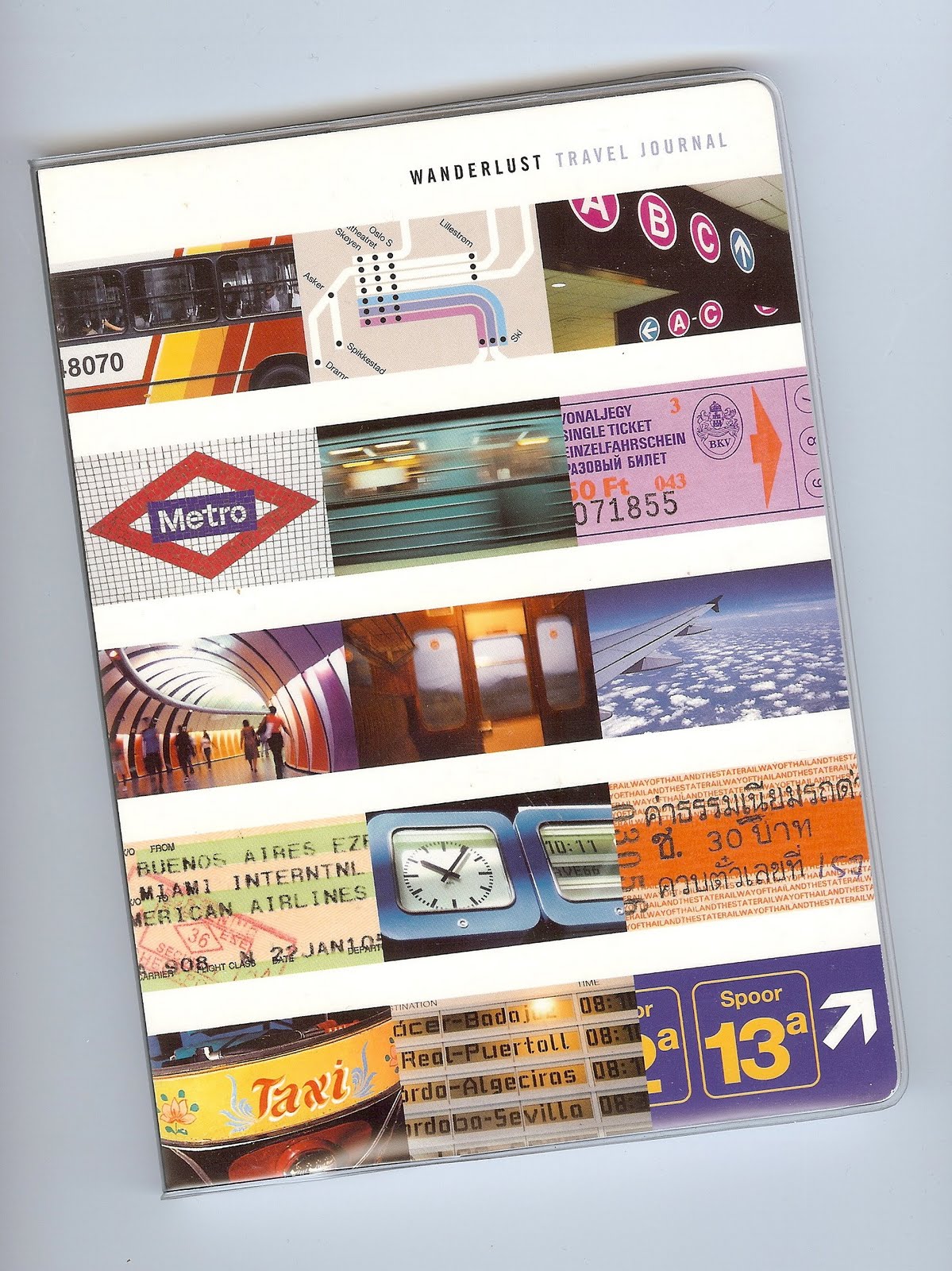
I almost forgot to do my drawing for this lovely travel notebook. Well, this is one travel notebook that will be doing a little traveling itself because Mae of Mad Bibliophile won it. She is librarian (yay)and she lives in Melbourne. A lovely city if ever there was one. We had a lovely time there in 2007. Thanks to all who entered the drawing.
It is a total coincidence that I chose this David Hockney painting called “My Parents” this morning, when my parents just happen to be in DC staying with us.

After my post about A Room With a View and the Puccini aria “O Mio Babbino Caro” the fabulous Architect Design and I exchanged a few personal recollections about soprano Kiri Te Kanawa. When I mentioned to him that I had pictures of Te Kanawa that I had taken in 1992, it occurred to me that my loyal readers might enjoy the tale of my summer at the Proms. For those who don’t know, the Proms is shorthand for The Henry Wood Promenade Concerts presented by the BBC. The Proms is an eight-week classical music festival held at Royal Albert Hall in London. With over 70 concerts each year, the Proms is an amazing place to hear the world’s greatest orchestras, conductors, and soloists.
On my first trip to London in 1989, I managed to get to a concert by the venerable Chicago Symphony Orchestra performing Berlioz’s The Damnation of Faust with Anne-Sofie von Otter, Jose van Dam and conductor Sir Georg Solti. It was a fantastic concert but what always seems to pop up from my memories of that night is the fact that before the concert I tripped and fell flat on my face in front of hundreds of people. Thankfully I was unhurt and I never saw those hundreds of people again.

In 1992 when I was working in London I got a half-season pass for the Proms so I could go to as many concerts as I wanted to over the final four weeks of the eight-week period. The thing about the Proms is that they have two rather large areas for standing room, the entirety of the circular main floor and the very top gallery. Those who want the main floor (the Arena) stand in one queue, and those that want the gallery queue in another. At the time the cost of a single Promenade ticket was about £2—a steal even by 1992 standards. The other thing to know about the Proms is that various self-selecting groups among the rabble who take standing room places on the floor and gallery often breakout with witty comments that they annunciate loudly to the rest of the auditorium before the concert and during the interval. Unfortunately, I think I only ever understood what they were saying once. They also make sound effects whenever the grand piano is raised up onto the stage.
Over the course of the season I heard an amazing array of concerts by an even more amazing array of orchestras, Cleveland, Vienna, Berlin, St. Petersburg, London, Royal Phil, BBC, City of Birmingham, BBC Welsh, and the list goes on. But the cultural highlight of the season, if not musical highlight, is the Last Night at the Proms. The program is heavy on light music with a decidedly British emphasis and rowdy renditions of “Land of Hope and Glory”, “Rule Britannia” and “God Save the Queen”. Thankfully this American knew the words to each of these patriotic chestnuts and was able to join in with just as much enthusiasm as the Brits and Commonwealthers who surrounded me. I found out later from those watching on telly that I was on camera a fair amount. Years later I managed to procure a video of that evening and I am indeed quite clearly on camera singing my heart out, but looking rather grim at the same time.
So what does all of this have to do with Kiri Te Kanawa? Well the Last Night of the Proms always features a vocal soloist and in 1992, that turned out to be Dame Kiri. I was in the equivalent of about row seven so I had a fantastic view of her. It was kind of a full circle moment for me. One of the earliest manifestations of my Anglophilia was getting up at 3:00 AM when I was 12 years old to watch Charles and Diana get married. As I am sure all of you know, Te Kanawa sang at the wedding and so began my fascination with her career. That twelve year-old boy in Elk River, Minnesota sitting alone watching the wedding in the wee hours would have never imagined that eleven years later he would actually be living in London seeing Kiri Te Kanawa in person at the Royal Albert Hall.
If you don’t have at least a half-season ticket to the Proms, you have to enter into a lottery to gain entrance to the final night. Since I had a half-season I cleared that hurdle. But then you still need to queue up the day of the concert to make sure you get a good spot (or get in at all). I arrived at 6:43 AM and placed my name on the queue list, which allows you a certain amount of freedom of movement throughout the day without losing your place in line. This is a fuzzy, pre-digital photo, but here is the list where I am number 130.

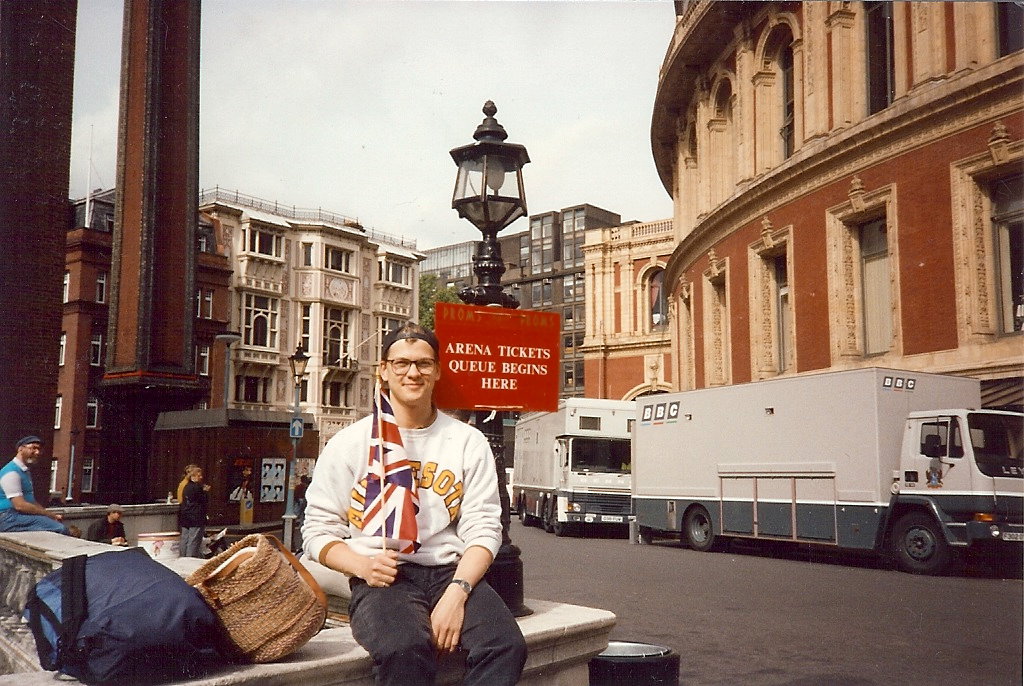
Here I am with my Union Jack at the start of the Arena queue.
The hall before the performance.

The hall once everyone got inside.

Kiri in dress number one – in which she sang arias from operas by Massenet.

Kiri in dress number two, decidedly showing her commonwealth and Kiwi pride. She sang the verses on Rule Britannia.

The post concert aftermath.

Regular readers of My Porch will know that I love, love, love the book and film, A Room With a View. But I also love the soundrack. I first heard the aria “O Mio Babbino Caro” from Puccini’s one-act opera Gianni Schicchi in the fantastic Merchant-Ivory adaptation of A Room With a View. New Zealand soprano Kiri Te Kanawa does the honors with a beautiful translucence and purity. This video captures the magic of the film, the aria, and the performance by Te Kanawa.
One of the many great things about YouTube is the ability to listen to the same aria sung by many different singers. And what a way to while away the hours when you could be doing something more productive. “O Mio Babbino Caro” is one of those little chestnuts that most every soprano sings at some point in her career and often as an encore in a solo recital. So there is a lot to chose from.
The sound quality on this 1981 recording of Leontyne Price with the Boston Pops isn’t so good, but her high notes are flawlessly pure.
The cherubic Lucia Popp has a wonderful silvery shimmer in her voice. No actual video here, but the recording is too beautiful not to share.
Not only is Angela Gheorghiu beautiful, but her voice is lovely with lots of kick and spin that must make it thrilling in person.
Some of Anna Netrebko’s vowels on the low notes seem a little under water, but her voice has lots of beautiful color. I would love to hear her live.
This is kind of an odd, uneven performance, but there are parts of it that show some of the nicer qualities of Sumi Jo’s voice.
And how about this violin version from Joshua Bell. With all his money and talent he never seems to come up with a decent haircut.
There are tons more where these came from including train wreck versions by Callas and Battle. Long in the tooth versions by Tebaldi and Caballe. And many, many amateur versions, which I did not screen for this post.
Now that I have listened to so many different versions, I am not sure I want to hear it again for a while.
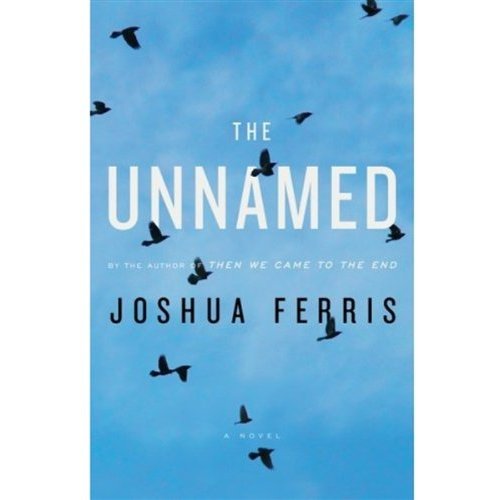
The Unnamed
Joshua Ferris
I know the book world is divided on this, but I LOVED Joshua Ferris’ first novel Then We Came to the End. I thought it was a wonderful mash up of Austen, Trollope, and “The Office”. And it has, in my humble opinion, one of the best opening lines of all time: “We were fractious and overpaid.”
Well, Ferris’ sophomore novel The Unnamed, is nothing like Then We Came to the End, but it is still a really fantastic book. Some professional reviewers have dinged him because the two books are so dissimilar in style. But I think professional reviewers, as a rule, suck. I prefer the uninformed ramblings (like mine) of people (and blogs) I trust.
The Unnamed tells the story of Tim Farnsworth, a successful lawyer in Manhattan who has an unusual malady that defies diagnosis. His unnamed affliction compels him to walk (and walk and walk). We aren’t talking about a nice stroll through Central Park on his lunch hour kind of walking, but the kind that takes him across bridges to other boroughs, across state lines, through all kinds of weather and with the inability to stop until his body/mind decides it/they is/are ready to stop.
This is a compelling, kind of fast read that had me tearing up from time to time. His condition seems totally implausible in most ways, but the emotion, fear, and uncertainty that it illustrates feels very plausible and frightening. And it is somewhat of a paean to unconditional love, although a kind of sweetly sad paean (is that possible?).
I enjoyed reading it, and it made me love my husband a little more than I already do.

