At Last

 
Why in the world has no one ever told me about James Last and his orchestra? This stuff is gold. (Well his stuff from the early ’70s is gold. The later stuff gets kind of bad.)

I came across it after JoAnn at Lakeside Musing honored Verity and Ken on their wedding day with a YouTube video of Peter, Paul, and Mary singing “The Wedding Song”. (Since I couldn’t participate in the Verity festivities I offer her my congratulations now.)

Well, a child of the 1970s, I love The Wedding Song. It makes me so nostalgic. So I went to YouTube and listened to many other versions (Petula Clark, The Letterman, Nana Mouskouri, etc.) and then I came across James Last and loved the harmonies. I looked for more like it but instead discovered the world of Jame Last.  And it is awesome. Seriously cheesy and way corny, but so darn awesome I can’t stand it.

Here is the one that got me started

But then this one blew my socks off

And then Orange Blossom Special no less. This was a huge favorite of mine as a kid.

Numbers

  
989
The number of new blog posts in my Google reader when I got home Saturday night. By the time I checked back on Sunday it was well over a thousand. I managed to get that number down to the 120 range.

1,642
The number of pictures we took over the past two weeks. I can guarantee you that at least 1,000 of them are crap. Can anyone even remember what life was like before digital cameras?

1
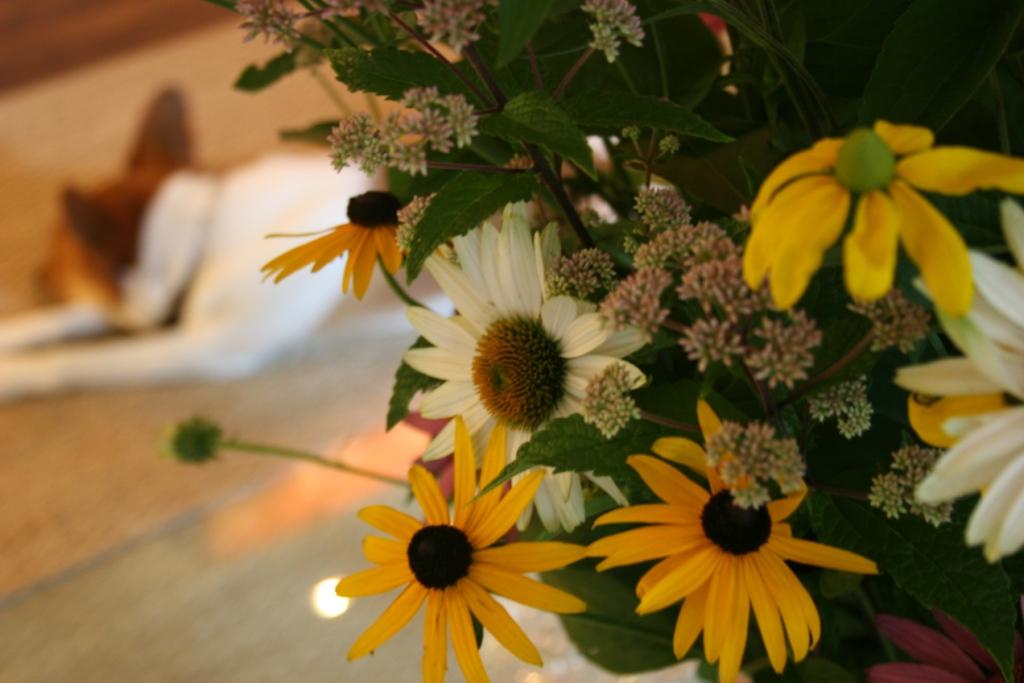
The number of insanely cute dogs in the photo below.  (The flowers are from John’s garden.)


Vacation Books


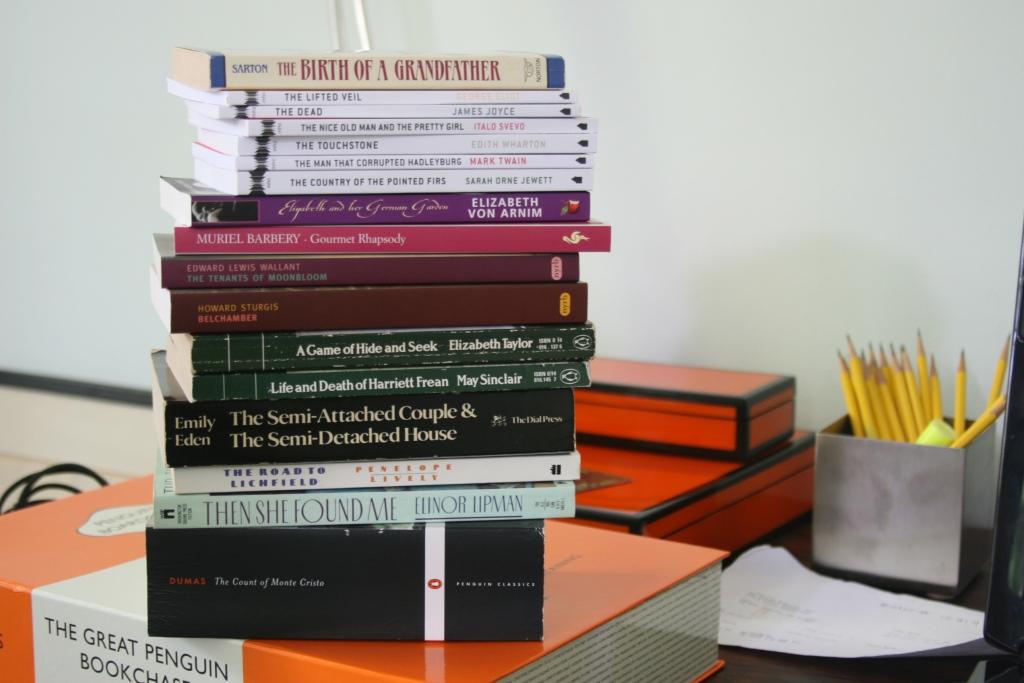
As I wrote about earlier this week, I plan to unplug from everything but music while we are in Maine for two weeks. This means I will have plenty of time to read. I may be overly optimistic with this pile, but I want to make sure I have something for every mood. I realize as I look at the photo, that I don’t have enough lightish contemporary fiction, just the Lipman and Lively. I might need to rectify that.

In picture order:

May Sarton – The Birth of a Grandfather
Not only do I love Sarton, but part of this book takes place in Maine.

George Eliot – The Lifted Veil
James Joyce – The Dead
Italo Svevo – The Nice Old Man and the Pretty Girl
Edith Wharton – The Touchstone
Mark Twain – The Man that Corrupted Hadleyburg
Sarah Orne Jewett – The Country of the Pointed Firs
These are all from Melville House Publishing’s The Art of the Novella Series. And since I took up Frances’ TAOTN reading challenge for August, I figured I better bring a few along with me. I have already read the Sarah Orne Jewett but I don’t think I paid very close attention to it and it takes place in Maine, so I had to include it.

Elizabeth von Arnim – Elizabeth and Her German Garden
I loved that other book of hers, the name of which totally escapes me at the moment and I refuse to click open another browser to remind myself. Something about a summer Italy. Boy howdy why can’t I think of it. Oh well, you guys will tell me.

Muriel Barbery – Gourmet Rhapsody
Although I own it, I haven’t read the Hedgehog book and I understand this was written prior to it. You know how I like to read things in order.

Edward Lewis Wallant – The Tenants of Moonbloom
Howard Sturgis – Belchamber
I decided I needed to include a few from my very large NYRB Classics pile. Although I enjoy most of their books, and have found some that I turly loved, there is something about them that makes starting one seem daunting. I think it is because they often take me out of the cozy cardigan zone.

Elizabeth Taylor – A Game of Hide and Seek
May Sinclair – Life and Death of Harriet Frean
Emily Eden – The Semi-Attached Couple and The Semi Detached House
Speaking of cozy cardigans, I have to include some old VMCs.

Penelope Lively – The Road to Lichfield
Here’s hoping this one is closer to Consequences than it is to Moon Tiger. I liked MT, but would prefer the lighter side of Penelope on this trip.

Elinor Lipman – Then She Found Me
She will never top the joy of The Inn at Lake Devine, but EL is always  good for a quick, enjoyable read.

Alexandre Dumas – The Count of Monte Cristo
When we took a road trip back several years ago I read The Three Musketeers for the first time and loved it. Hoping for a repeat of that experience.

Do you think I have enough? Have you picked out your summer vacation reading pile?

Time for Game Night!


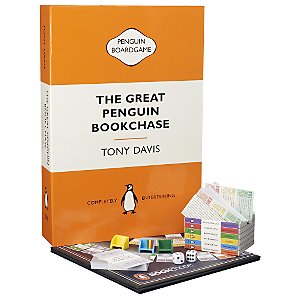
Back in November I had this game in my hands when we were in The Conran Shop in London. For some reason I didn’t buy it. Probably because it was too big for my suitcase and I had 100 Penguin books I was already taking as carry-on.

Then I got back to the U.S. and found out how hard it is to actually get this game on this side of the pond.  I think Frances had tried to no avail as well. I emailed a friend in London and asked him to get it for me and ship it to me. He never replied to my email. So what is a boy to do?

A few weeks ago Polly had a post about The Literary Gift Company which has so many fantastic things for booklovers it will make your head (and your credit card) spin. Well, it cost me a pretty penny to have it shipped, but it arrived yesterday and I couldn’t be more excited.

So, DC Book Bloggers: Let’s have game night.

As much as I want to, I am not even going to open the sealed box of questions until we play it for the first time. (Although the game box itself is huge, I must admit that I am a little surprised at the somewhat small size of the box of questions. Frances’ game of literary first lines seemed to have many more. )

Frances, Teresa, Hannah, others….when should we take the game for a spin?

The Great Luddite Reaction of 2011

   
I have decided that for the two weeks that we are in Maine I am going to indulge my inner Luddite.
 

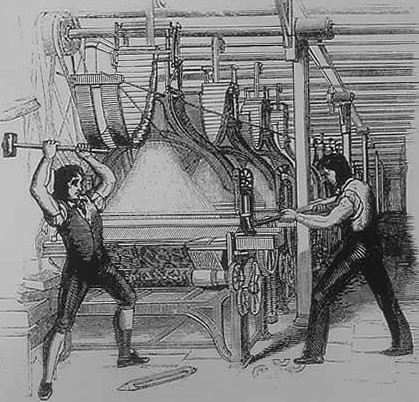
I don’t plan to go around smashing any mechanized looms, but I do plan to take those two weeks to revert to a less technological state of being. For years I have harped about wanting to get away from all the mental clutter of our plugged-in lives. Cell phones, the Internet, TV, the 24-hour news cycle, the relentless beat of now, now, now. So I am going to ignore it for a week. I don’t think it will be too hard. The house we are renting doesn’t really have TV and while it has Internet access, I am going to pretend like it doesn’t exist. And I am going to put John under strick orders not to share any news he comes across while he is online.

I have a stack of great books that I am taking along which I will blog about before we leave. I was tempted to set up some automatic posts while I am away, but I know if I do that I am going to be too tempted to look online to see if they posted correctly and to see if anyone has commented. So I am going to go cold turkey. Of course this means that I won’t be able to read your blogs for two weeks either. I will certainly miss all of you. But how often does one get to unplug for two weeks?

(Since the automobile, telephone, credit card and iPod all predate the Luddite movement which began in 1811, I will still be using those technologies.)

10 Things to Expect from a Brookner Novel

  
When Simon and I decided to create International Anita Brookner Day, the first thing I thought was that Peta Mayer had to be involved. Mayer is a Brookner scholar in Australia whose blog is a wonderful resource on the work of Anita Brookner and she has graciously agreed to write something special for the IABD blog.

And what she has given us is truly something special. A top 10 list of sorts. But this one gives you insight in Anita Brookner, her work, and her critics. And plenty of food for thought for those who think nothing happens in a Brookner novel.

There are links at the bottom to each of the ten things, but you can also see them all over at IABD.


10 Things to Expect From a Brookner Novel

While reflecting on this topic, I was reminded of Brookner’s own comments about expectations, offered in an interview in 1985. ‘I do envy those who can take life a little more easily,’ she said: ‘I am too handicapped by expectations.’ The novelist’s words suggest, then, that she might disapprove of this list; literary expectations in one way being the evil stepmother of the contemporary ‘spoiler’ (and expect a few mild spoilers in the list to follow). In Brookner’s case I think she meant that, like most people, she expected to get married and have children – and therefore to act a certain way – when in reality a completely different and magnificent life presented itself. Brookner’s early expectations not only occluded her ability to recognise the life unfolding, they also became embedded in her personality and thereafter determined a negative response to her emerging reality. ‘I find the moral position of many modern novels faintly ridiculous, as if you can start editing your life halfway through it and do something you’ve never done before and which you’re unprepared for anyway. I don’t think that’s feasible,’ she told Hermione Lee in her only ever televised interview, also in 1985. But another piece of Brookner wisdom also springs to mind in this context, and it’s a theme that resurfaces time and again in her fiction. ‘The worse thing in life is not knowing what is going on’ she told a reviewer in The Times in 1983. Similarly, a character’s discovery that she’s been acting in the dark is not an unusual denouement in the Brookner narrative and has incited more than one critic to accuse her of sadism. But what do the critics know?!
I first started reading Brookner in the late 90s. My mother handed me Visitors (1997) when I went to stay at her house with a boyfriend. I read the book then and there in one sitting (its theme of obnoxious houseguests was perhaps prophetic). I thought the book was hilarious and I immediately became obsessed with the author and her reception. I couldn’t understand why Brookner was so underrated and I dedicated the next ten years of my life to researching this very pressing issue. But now it seems she is enjoying a renaissance. As indicated by the International Anita Brookner Day, this great tribute to Brookner that Thomas and Simon have organised, readers are fighting back. The list below represents my own injunction to entertain a life spent in the grip of this highly-affecting novelist.  


IABD: I know you can read 200 pages in 16 days


For most of us reading 200 pages is like a walk in the park. We aren’t like those sad people who only manage to read a book a year.

So, there is nothing (and I mean nothing) to keep you from participating in International Anita Brookner Day:

  • I don’t think any of her 24 novels are over 200 pages. If they are over 200, it can’t be by much.
  • Her books are pretty darn easy to find in second hand shops and in libraries.
  • You have 16 whole days to read one and then write something about it in time for Brookner’s 83rd birthday on July 16–and in this, the year that marks her 30 years of writing ficiton.

And here is food for thought:

  • I know Brookner will not be everyone’s cup of tea, but I have been amazed by some of the reactions I have gotten so far. One blogger wrote to tell me that she meant to sit down and read 20 pages in her first attempt to read a Brookner novel. Instead she had to pull herself away from it 130 pages later so she could eat something.
  • Perhaps even more amazingly, another blogger tried one Brookner novel and couldn’t finish it. But then, somewhat reluctantly tried another one some weeks later and ended up loving it (hope I didn’t put that too strongly). 
  • And then there is the blogger who reads mainly non-fiction who took IABD as a reason to read her first Brookner and she was very glad she did.

So what are you waiting for? Sixteen whole days to read 200 pages.

There are prizes!

You can include your pet!

There are almost no rules!

You don’t have to be a blogger!

Be a part of Internet history! There is a dedicated website where your review, pet photo, or other Brookner-related posting will live on in perpetuity (or at least until Blogger ceases to exist). It will be the most comprehensive place on the web for blogger and blog reader reviews of Brookner’s novels.

And if you have a blog, this is a perfect time for you to exhort your readers to be part of the fun.

What’s wrong with this picture?

  
We all love a good library picture. And I am guessing I am not the only one who likes scanning pictures of bookshelves in magazines to see if there is anything interesting. Usually one can’t see many of the spines clearly but yet we no doubt see a few that we recognize by color/size/design even without being able to read the titles.

And then along comes this picture. I tore it out of a magazine quite a while ago so I don’t remember where it came from. You would think that with so many books visible I would have fun combing the stacks as it were. But it doesn’t take long to realize this is not a library worth browsing. At least not to me. In the first place the picture is staged, and poorly staged at that. Those piles do not look the least bit organic. In the second place, and this is the important part, there are so few books shown that I would even consider reading, that there might as well not be any books in the picture.

I can see a few that would keep me from getting entirely bored. The Sherlock Holmes boxed set in the foreground and the Jon Stewart book on the topo shelf.  In a pinch I might pick up the two Harry Potters in the collection. I would probably scan the Suze Ourman book because I love reading about saving money, but I sure wouldn’t pick up the Wally Lamb, Bridget Jones or Smilla’s Sense of Snow again. None of them warrant a re-read. And while Empire Falls is a good book, I was a little bored by it and didn’t finish it.  So after that, what are you left with? Tons of Patterson, Steele, Brown, Baldacci and Grisham.

Has this ever happened to you: you see a full boookcase and think “oh fun”. But as soon as you scratch the surface you realize it is all crap?

If you want a closer look at the boring books
click the picture to make it larger.

Book Radio


When we bought our car in 2005 we had Sirius satellite radio installed. We bought the life-time membership which is a good thing, because I don’t think we ever would have kept paying the monthly fee after we had actually used the service.

We don’t spend enough time in the car (thankfully) to really make such a service worth it. Add on top of that the fact that the sound quality is really quite bad. Most of the talk stations sound like AM radio in a tin can. The music stations are better but not as good as broadcast FM stations. I know it is not the stereo system in the car or the speakers because regular FM radio and the iPod sound brilliant.

But then there is all the variety. John heads straight for the 70s or 80s whenever he has control of the dial. That can be fun, but I like to explore the less mainstream options like the CBC and the BBC. I find the CBC in particular to be quite fascinating. For some reason it seems so much more foreign to me than the BBC. Maybe because it is more Canada-focused whereas the BBC is more global in its approach.

Of course I do remember the halcyon days of living within reach of Minnesota Public Radio, which is, in my humble opinion, the best public radio network in the country without question. One station devoted entirely to classical music and one to news and information. Back in the 1990s, before satellite radio and the Internet, MPR would broadcast both the CBC every night and the BBC World Service. (I was in college at the time and didn’t have cable TV either.) To have these two exotic streams of information every night was a revelation and it made me feel so smart and cosmopolitan. And I think it really appealed to my nascent wanderlust inclinations. (I’m having a seriously groovy moment right now thinking of those days. Sigh.)

Oh  yeah, the title says Book Radio. Maybe I should get to that part.

The other day I was in the car trying to avoid listening to the news and not caring for the insipid, pedestrian, overplayed, classical music chestnut that was on broadcast radio, I flipped over to the Book channel on satellite. Despite the tinny audio quality I was immediately enchanted by the book. Which is odd for me because I don’t really do audio books. But there it was: English accent, check. Cosy theme, check. But then it suddenly stopped. I guess it was time for them to change programs but the abrupt stop was, well, abrupt. To make matters worse, they didn’t even follow it up with “You’ve been listening to…” Oh yes, they eventually did, but all they said was “You’ve been listening to the Penguin Book Hour” or something like that. Yes?! And what else?! What is the BOOK being read, you idiot?! And then they played all these loud, promos for other Sirius stations.

Okay, Thomas, don’t panic. Google will save the day, just pop in some of the key words that you heard in the text…

“club lunch”–so many guests arriving at various times that lunch would be serve yourself

…his inkwell was dry which made (some woman’s name) wonder what else in the house wasn’t up to scratch…

Cardiff Castle…

Ulrich

Oh god, not even Google is going to help this time. The main problem is I didn’t know how to spell Ulrich, wasn’t even sure I heard it correctly. But I was wrong, Google is amazing. With that little information it actually did find the right book. (I had, surprisingly, already found out the book name on Sirius’ website where they actually had a detailed program schedule. But I still did the Google test and was still surprised that it found the right info.)

Turns out the book was Fall of Giants by Ken Follett. I have never read any of his books and have been turned off by the double whammy or their immense size and the fact that they tend to be popular. But after hearing this bit of the book, I may actually pick this one up.

I used a foreign language
edition image because
all of the English ones
are ugly and are the type
of covers that make me
not want to red Follett.
I am a book snob,
no doubt about it.

So back to Book Radio. Like all things on Sirius it generally sucks. I think they have some original programming, but most of the schedule appears to be simply them playing existing audio books. No intelligent chatter, just canned announcements and promos between audio books that don’t really give much information. Plus the choice of books and flashy razzmatazz of the promos are meant to appeal to a reading public that is somewhat, shall we say, more mainstream than my own tastes.

Like cable TV, there is so much potential for cultural programming. But instead it gets dumbed down to be almost as banal as everything else. Too bad I can’t read and drive at the same time. Then again I have only listened to about 6 minutes of Book Radio, maybe I will give it another chance on the drive up to Maine this summer.

[Since writing this post we travelled down to Richmond, Virginia for a wedding and I listened to more Book Radio. My estimation of it improved slightly but only slightly. They played Gaskell’s North and South but then also seem to have a regular show on comic books. Not graphic novels mind you, but comic books.]

Seen on the Subway

     
My Antonia by Willa Cather
The Reader: Forty something petite Chinese woman wearing a rather chic black cotton shirt-dress with black flats and a clear, see through backpack.
The Book: Everything Cather writes is pretty brilliant but this is definitely one of her major works and rightly so. Life on the prairie was never more compelling and touching.
The Verdict: I have read it before and I know I will read it again.
Story and Structure by Laurence Perrine
The Reader: Forty something balding white guy with dark grey suit, pink shirt, and a bow tie that had yet to be tied.
The Book: Apparently this is an all-time bestselling introduction to literature. Certainly falls into the text book category, the prices certainly reflect the extortionate nature of text book pricing. The edition being read by the man on the train was $77.00 on Amazon. Yikes.
The Verdict: When I first saw this book I just assumed it was some kind of theory book about some field. Didn’t realize, despite its title, that it might be about literature. But even then I probably would have thought that it was on the theoretical side. But the description of the book on Amazon makes it sound like a pretty straight forward intro to the study of literature. I might actually keep my eye out for this one. Having had no post-high school course on lit, I could use the assistance.
Ender’s Game by Orson Scott Card
The Reader: A cute-as-a-button little boy, maybe about 10 years old wearing a soccer camp t-shirt (most likely on his way to soccer camp) and shorts. And because he was a little kid it was easy to see the title as he had it propped up on his lap as kids will do with books. Good eyesight I guess. He was with dad who was reading something on an iPad, and his grandmother  who had some kind of hardcover bestseller mystery from the library. Clearly the family that reads together, stays together.
The Book: Normally I would not feature this kind of book. But the little boy was so intent on reading it despite the early hour and the fact that every other kid seems to be playing some sort of electronic game. “This twenty-five-year-old science fiction classic has been repackaged for younger readers. Unlike many hard-core science fiction titles, this book is particularly appropriate for a younger audience, for its protagonist, Ender Wiggin, is just six years old at the novel’s beginning and still a pre-teen at its end.”

The Verdict: I will not be reading this book.