Book Review: Heart of Darkness by Joseph Conrad


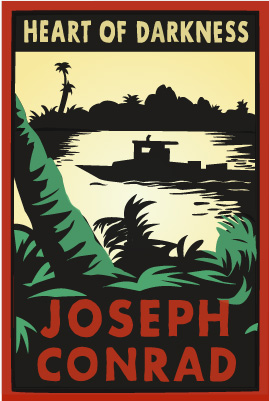
One of the so-called greats of the western canon and one of the Modern Library’s Top 100, The Heart of Darkness, for whatever its merits, was such a slog for me. Its 96 pages might as well have been 996. This is the kind of book that sours students on literature for a lifetime. I can’t exactly put my finger on the reason why I found this book so difficult to get through. Whether it was sentence structure, or word choice, or transitions from scene to scene, I often found myself confused and needing to re-read whole paragraphs.  It was as if Conrad wanted to convey the disorientation one feels in the heat of the jungle. If that was his intent, then well done.

There were moments when I was actually engaged in the story but they were brief moments. I worry that my aversion to this book is an indication of what I might feel when I attempt Lord Jim, Nostromo, or The Secret Agent. All of these are on the Modern Library Top 100 list, and I am attempting to read that whole list. I have made pretty good headway, I am at 62 at this point, but I have already decided I am not reading the multiple Joyce and Faulkner titles on the list. Am I going to have to add Conrad to that “no chance in hell am I going to read them again” file? (Not to mention that Philip Roth might not be too far behind in joining that company.)  I get it, they are all authors with important things to say and they do so in brilliant ways, but I guess my mind isn’t up to the task. The good news is I am not going to lose sleep over my inability to understand these important authors.
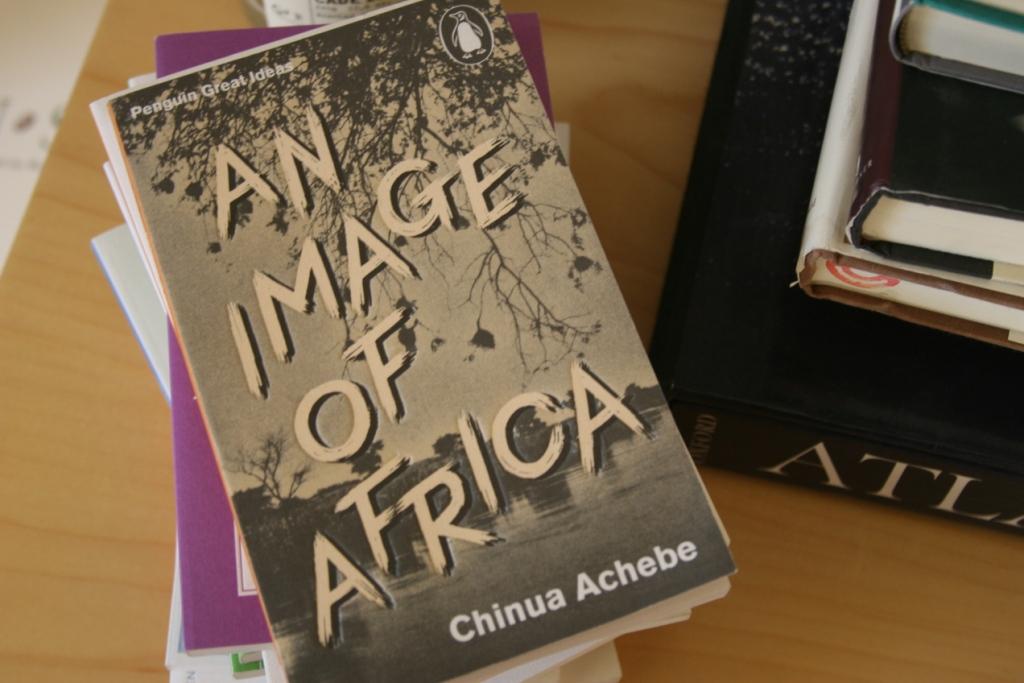
I have Chinua Achebe’s An Image of Africa (from the beautiful Penguin Great Ideas series) which is a critique of Heart of Darkness. While I think Conrad successfully challenged the imperial orthodoxy of his day, I am interested to see what an African thinks of the book.

Book Review: The Sexual Life of an Islamist in Paris by Leila Marouane


This was another of the Europa Edition books I picked up cheap at the Border’s going out of business sale. And like Jenn Ashworth’s A Kind of Intimacy (which I really enjoyed), front and center in Marouane’s tale is an unreliable author. If we take Mohamed Ben Mohktar (aka Basile Tocquard) at his word, he is desperately wanting to break free of his domineering mother, his devout younger brother, and their expectations of religious orthodoxy. At the age of 40 despite having a well paying job in Banking, Mohamed still lives at home and is still a virgin. In the opening pages Mohamed has a singular focus: to get his own apartment in Paris so that he can pursue his delusions of sexual grandeur.

I actually quite enjoyed this book as long as it seemed like a straightforward narrative. But the author had something much more clever in mind that eventually had me scratching my head. You see I love stories of people finding themselves and forging their way in the world. And this one had that quality until it began to dawn on me that perhaps Mohamed’s story was not as it seemed. And now that I have looked around on the Internet, I understand what the author was up to. A re-read would be a semi-fulfilling thing to do, but time marches on and I must move on to the next book.

This review by Emma Garman at Words Without Borders explains it much better than I can.

Book Review: Because of the Lockwoods by Dorothy Whipple


Thanks again to Rachel at Book Snob for the photo.

I couldn’t believe my luck in getting a copy of this out of print Whipple. I thought that I would hold onto it for a while–save it for a rainy day if you will–but I think I had it for only about a week before giving in. As with all Whipples, Because of the Lockwoods is a wonderful book and a wonderful read. I ended up staying up to almost 2:00 AM (on a work night!) to finish it.

The story centers around the Hunters (mother and three children) and their diminished circumstances after husband/father passes away. The Lockwoods, the Hunters’ previous neighbors, appear to be, and certainly think of themselves as a benevolent force in the lives of the Hunter family. Mrs. Lockwood insists that Mr. Lockwood help Mrs. Hunter make sense of her husband’s estate. In the process Mr. Lockwood perpetrates a swindle upon Mrs. Hunter that further diminishes her circumstances. The swindle, however, is not appartent to Mrs. Hunter and she lives her life in perpetual gratitude and obesiance to the Lockwoods. With very few resources to fall back on, the two eldest Hunter children are eventually forced into accepting jobs they abhor because the seemingly munificent Lockwoods insist that they have no other prospects. But Thea, the youngest, manages to pursue her dreams both despite and because of the Lockwoods. In the process she finds herself a social pariah and her hopes for the future dashed. That is until working class neighbor Oliver Reade manages to provide opportunities for the upper class Hunters that they never would have expected or contemplated.

As much as I love them, there is a certain deus ex machina aspect to most of Whipple’s novels. Chapters and chapters of privation are wiped clean with a fairly quick succession of fortuitous events. Perhaps this tendency in her fiction is one of the reasons Whipple never moved beyond being just a popular–and now largely forgotten–author. While my literary expertise falls squarely into the “I know what I like” school of thought, I think if one is going to critique Whipple’s fiction one certainly has to at least acknowledge her joyously ham-handed approach to making everything turn out. Having said that, while things end up looking rosy for the Hunters there is in the final pages of Because of the Lockwoods perhaps the darkest thread that I have yet to find in Whipple. I don’t count too much on the darkness in Someone at a Distance because the characterizations in that novel just don’t ring true to me as they do in her other works.  (In fact the more distance I have from Someone at a Distance, the less I like it.)

Still, I loved Because of the Lockwoods. I am chuffed to note that I have a copy of Every Good Deed coming from an ebay buy in Australia and that Persephone will be reissuing Greenbanks soon.

And by the way, has anyone else noticed a superficial similarity between Because of the Lockwoods and Barbara Comyns’ The Skin Chairs? Diminished circumstances, telling off the snooty folks who were supposedly their benefactors, the self-made man rescuing the family from drudgery?

Book Review: Travelling Light by Tove Jansson


I am not sure I ever would have picked up this book if not for the fact that Simon at Stuck In A Book raves about Tove Jansson’s work. And a good thing too. These are brilliant, beautifully written short stories that make me look forward to reading Jansson’s longer fiction.

I am always at a loss as to how to review a book of short stories–and this collection of Jansson’s stories seem particularly hard to capture by an amateur such as myself. Although Jansson’s writing is fairly straightforward, there is something kind of otherworldly about these stories. As I reflected on the collection, I was thinking that its other worldliness had to do with the words themselves. I started to remember her writing as poetic. But then I looked back and sampled some of her prose and realized that it was not the source of the other worldliness. On a superficial level there is something very European about the stories that feels otherworldly to me, but that doesn’t seem to be the source of it either. I think what it really comes down to is that each of the stories, no matter the details, feels infused with a contentment and restlessness that seems only knowable through the lens of old age. There is a perspective that either rises above, or rebels against, the mundane details of life.

Among the varied stories included in this collection their were a few that I particularly liked. A couple alone in a little cottage on a gull-filled island. An old man who arrives at his destination only to forget where he is staying. A woman unhinged by the death of an acquaintance. An old man (another one) in a silent skirmish over a park bench unwittingly makes a friend.

As it is for me with many short stories, there were a few that made me scratch my head a bit, wondering if I really understood what was going on. I think sometimes my way of thinking requires a single answer, one correct, officially author-authorized way to interpret a story.  The obsession for clarity abates with a little discussion, but sometimes when I am in the middle of such abstraction it makes me wonder why I don’t get it. But alas, that says much about me, and not much about these stories.

Now I can’t wait to see what Jansson does with a novel.

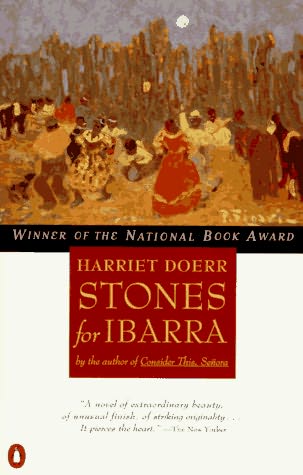
Book Review: Stones for Ibarra by Harriet Doerr


When I picked up Stones for Ibarra, all I knew about it was that I had seen the title many times over the years and it was only $1.50. Now I look, and the googles tell me that Stones for Ibarra was Harriet Doerr’s first novel; that she wrote it at the age of 73; and that it won the National Book Award. Even more fascinating is that she went back to college after a 30-some year absence to get a Bachelor’s degree in history at the age of 67.

Originally written as short stories, Stones for Ibarra tells the story of Richard and Sara Everton who move from San Francisco to Mexico in the 1960s to revive a family copper mine that has been out of use since 1910. While somewhat episodic, and despite its beginnings as a few short stories, the novel hangs together and has more of an arc then you would normally encounter in a book of linked short fiction. Early in their struggle to bring new life to the old mine Richard is diagnosed with leukemia. Told from Sara’s point of view, their struggles and those of the people and the world around them is described with straightforward but rather atmospheric and somewhat abstract detail. I know that sounds like an oxymoron, but Doerr’s writing has a poetic quality that doesn’t compromise comprehension. It offers enough detail that one doesn’t scratch one’s head wondering what is going on.

The reader is told early on that Richard and their efforts to revive the mine only make it six years past his diagnosis. Those years, autobiographical on the main points, are described by Doerr like a memoir that is as grateful as it is elegiac. Doerr’s writing brings impoverished rural Mexico to life and looks at the humor and frustration of being a fish out of water. Although sympathetic to the culture and the plight of the community around them, there is a certain amount of the colonizer evident in Doerr’s tale.

I am glad I picked this one up not knowing much about it. I tend to veer toward novels that are comfortable and Euro-centric so it is always a happy surprise to read about something out of my comfort zone.* I enjoyed the descriptions of ways of life that are so foreign to mine. Not just the foreigness of the lives of Mexicans, but the lives of Richard and Sara as they embark on a rather difficult adventure and confront a fatal illness. (knock on wood)

*I have become so confused about when to use the British ‘s’ and when to use American ‘z’ in words like cozy/cosy that I almost went back and changed ‘zone’ to ‘sone’.
   

Book Review: No Name by Wilkie Collins


I am convinced that my interest in the work of Wilkie Collins has something to do with all the letter writing involved. Of course there is also intrigue and suspense and all sorts of other goings on that make his novels page turners. But I love the fact that despite the fact that the action of the books clip along at a quick pace, if you think about how it would have played out in real time, it would have been like watching paint dry. Imagine trying to get to the bottom of any mystery without the aid of the telephone, car, email, Internet, forensic science and any number of other methods of investigation. And think about it on a personal level. Have you ever had something that you needed answered immediately and the time it took to get an email reply, even though it may have just been minutes, felt like an eternity? Imagine if you had to wait 14 days to get an answer via mail from Zurich. That would certainly slow down your plans wouldn’t it? And it is all those furious letters and documents and meetings with solicitors and trusting interviews with landladies, coach drivers and servants, that make these “detective” stories so enjoyable for me. I am willing to suspend my disbelief for these Victorian mysteries in a way that I cannot for more modern mysteries.

Like other of Collins’ sensation novels No Name takes place on the fringes of propiety. Those ruffled edges of polite society where perfectly moral people teeter on the edge of social oblivion due to some technicality that turns them into pariahs overnight. This is my third Wilkie Collins novel and my fourth sensation novel (Braddon’s Lady Audley’s Secret) and they all rely heavily on the fact that women had so few independent rights at the time. How awful to be in a position to not be able to earn your living because a man is going to take care of it and then something happens to the man and you left with nothing and no way to do anything about it.

In No Name Magdalen (18) and her sister Norah (22, I think) find out after losing their parents that they are technically illegitimate children and are now destitute thanks to an evil uncle and cousin. So for six hundred pages the plots thicken and thin and then thicken again, the letters fly, and in the end it all comes up roses. Most, of Collins’ novels were written as serials so verbal economy is not the order of the day. For anyone who has ever liked a costume drama but wants to read something a little more racy than Jane Austen or Anthony Trollope, Wilkie Collins is your man.

When looking for an image to include with this post, at the bottom of the tenth page of a Google image search using the terms “no name wilkie collins” one stumbles across a picture of Rachel from Book Snob. That photo led me to Rachel’s much more complete (and well written) review.

I have an extra copy of No Name to give away. Just let me know in the comments if you are interested. (US only please, the older Dover edition I have to give away is kind of heavy.)

Book Review: A Kind of Intimacy by Jenn Ashworth


What a great find. Knowing nothing about A Kind of Intimacy or its author Jenn Ashworth, I picked this one up at the Border’s closeout for 60% off. I actually picked up a few Europa Editions that day just because they have interesting covers and are well made books. So I guess it is icing on the cake that I really liked the novel itself.

In the early (and I mean early) pages I found myself rooting for Annie as she leaves her past behind and pledges to get a fresh new start in life. I love the opening scene where she kicks her old couch a few times as she prepares to leave her old house for good. I had such a hopeful feeling for Annie and her future. When she arrives in her new neighborhood I bristled at the insensitivity of her new neighbor who mistakes her for a char woman and can’t get it through his head that she is single–that there is no husband and no child still to arrive.

And then you start to realize that something is a little off about Annie–that is until you realize that there is A LOT that is off about Annie. This might be kind of spoilery, but I don’t think it will ruin the suspense created in the book. Annie is a total whack job. She is delusional and a pathological liar. I will leave it up to you to find out if her story is a tragedy or a triumph. I don’t want to give too much away.

I was absolutely drawn into Annie’s story and couldn’t wait to see what happened next. There were moments when I was absolutely squirming in embarassment as Annie is about to get caught in a lie. But like all pathological liars she brilliantly deflects scrutiny, at least for a while. There was suspsense, and humor, and more than a little hmm…kinkiness. Its dark, its disturbing, but eminently readable.

This is a fantastic book. And a debut novel to boot.

Book Review: They Were Sisters by Dorothy Whipple


Aaaaargh!

My review of They Were Sisters disappeared in the Great Blogger Annoyance of 2011. If Blogger gets around to restoring things that were lost during their “fix” you will get to read the review. But I am not sure I have the mental energy to recreate it.

I will leave you with two thoughts from the lost review:

1. This is the kind of book that makes you miss your train stop.

2. I think this is now my favorite Whipple.

Persephone just noted today on Facebook that the film of They Were Sisters is now out on DVD. Huzzah.

Book Review: The Thin Man by Dashiell Hammet

 
I don’t normally read much in the way of mysteries or crime fiction. I tend to find them a little too rat-a-tat-tat from one plot point to another. Granted, sometimes that kind of formula can be rather comforting to my linear way of thinking, but not too often. What I never find comforting, however, is that so many (most?) crime fiction is about murder. I am not so squeamish that I can’t abide reading about murder or other morally repugnant events, but most mysteries treat murder so nonchalantly it makes me wonder a bit.

Knowing that The Thin Man is a bit of a classic, I satisfied my desire to own a classic green Penguin by picking this up when we were in London in November. The book is the first written by Hammet starring the husband and wife team of Nick and Nora Charles. A dynamic duo who don’t let a page go by without having a cocktail. The book reads like an old black and white Hollywood film which is why I put the film version at the top of my Netflix queue. You know the kind of thing, speakeasies, gangsters, dames, and people named Studsey. The thing that attracted me was less the “glamour” of this world than the now archaic way of communicating–both verbally and technologically–and the effort to gather information. This was not the world of crime databases and Internet searches but rather good old fashioned gum shoe detective work. And don’t even think about civil liberties. Search warrant? Who needs it?

Although I did enjoy reading The Thin Man, I was a bit surprised that the many twists and turns melted down in the final five or so pages to a denouement that only barely tracked with the action of the preceding 178 pages. It is not that one should be able to predict the outcome of a detective story, but I certainly would have appreciated seeing Nick make some of the connections along the way rather than having everything miraculously explained all at once in the final minutes like some live action version of Scooby-Doo.

To paraphrase Gertrude Stein: for those that like this kind of thing, this is the kind of thing they will like.

Book Review: The Skin Chairs by Barbara Comyns


The room had the sickly smell of caged birds and spiteful women…

This is the first novel I have read by Barbara Comyns. I probably would have picked it up just because it was a Virago with a cool cover, but I had also been seeing her name around the blogosphere quite a bit. I thought the title The Skin Chairs sounded creepy but thought that it couldn’t really mean what it sounded like. But indeed it did. Comyns actually wrote about chairs covered in human skin. Granted they don’t play a huge role in the book, but it is creepy nonetheless. Add in animal and child abuse/neglect and the creepy factor really goes up. From the vantage point of 2011 (or 2001, or 1991, or 1981…) much of the abuse and neglect would have been remedied with the appropriate government social services. But in the early 20th century people kind of turned a blind eye. Oddly enough even with the creepiness and sadness The Skin Chairs is mostly a cheerful book about the adult world seen through the eyes of ten-year-old Frances.

Pretty typical English domestic tale. The kind of book Persephone might publish. Recently widowed mother, snooty relatives, reduced circumstances, eccentric neighbors, and with more than a few humorous moments. I quite enjoyed it but I am not sure if this review will benefit from further description. I feel like any plot points I may describe would be too spoilery. The writing is good and there are many likable characters. Even the villains have a heart–with the possible exception of Vanda. She just seems good for nothing and bad for everything.

Read it.