The other day I was walking Lucy in a neighborhood about two miles from our house when we walked by a yellow 1970’s Chevrolet Vega parked kittywampus in someone’s driveway. It was kind of dusty but in pretty good shape for a 45-year old car. I looked up and noticed that it had been pulled out of a garage that appeared very unstable and looked like a full-on hoarding situation was going on inside.
A day or two later the Vega was gone but the garage was as crazy as it had been the first time we walked by. This time I looked at the rest of the yard and house. The house was a cute little bungalow that had seen better days with the windows all covered in old plastic from the inside. Clearly this person had been a hoarder for decades. I got the feeling that maybe the hoarder had died. It was then that I noticed there were some potted plants along the front walk including a very healthy looking tomato plant with ripe fruit on it. This made me second-guess my death theory–given the health of the plant it must have been a sudden death if indeed the owner had passed away. Made me a bit sad to think that one minute someone has a nicely tended tomato plant and then next minute the tomato plant doesn’t have anyone to tend it.
The third time Lucy and I walked by the house there was a large dumpster out front which was being filled with trash. I also noticed a fair amount of organic material and quickly looked over to where the plants had been. All of them, including the healthy tomato plant, had been removed and chucked into the bin. This made me infinitely sad. First, because it seemed to confirm my hunch that the owner had passed away–or I suppose moved to a home. And second, because more than any of the other stuff that was associated with this unknown owner the tomato plant seemed the most personal. Here was a living thing that had been planned for, brought to life, and tended to by this person. He or she used that fruit to nourish themselves and probably took joy from gardening. The plant had seemed almost like a loved one left behind. And now the plant was presumably somewhere in the pile of green stuff in the dumpster. Did the person cleaning the property at least pick off the ripe red tomatoes on the plant before throwing it away? The whole thing was heartbreaking to me and not unlike a novel I read while we were in Maine.
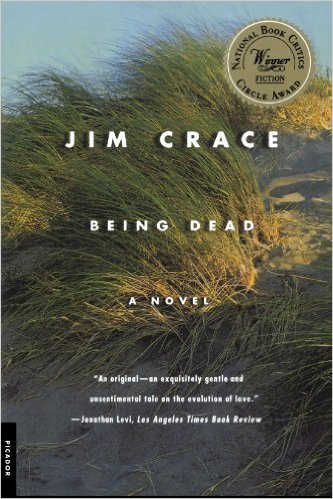 Being Dead by Jim Crace
After two short introductory chapters, Being Dead starts from the moment of death for Celice and her husband Joseph a few seconds later. Brutally murdered on a beach Celice was in mid-sentence when she was killed (“It’s not as if…”). Crace describes the physical processes overtaking their bodies and the various parts of the natural world that do their bit to help the couple return to the earth. Rather than find this disturbing I think it is one of the more comforting aspects of both the book and my thoughts of dying.
From there Crace uses a couple of different time lines to tell the story of Celice and Joseph’s life and death. I can sometimes get a little put off by clever chronologies in books, but this one was never confusing and worked really well. One timeline follows the couple backwards from the moment of their deaths to the moment they woke up that morning completely unaware of what the day would bring. This timeline shows how differently the long-married couple viewed the progression of that day and the meaning of their interactions and the emotions they experienced. Two people on close but separate tracks that sometimes intersect but more often just run side by side.
Other timelines–moving forward–describe the couple’s early life and courtship and nature of their life together, and another much shorter timeline covers the time between their death and when their bodies are discovered.
I liked everything about this book.
I liked its omniscience, we know what is going on in everyone’s heads including the murderer.
I liked the exploration of lives interrupted and what it means to die a sudden death. I don’t want to suffer pain when I check out. But I would like some time to mentally prepare for it. I know, when you are dead you are dead, but the thought of leaving things unfinished makes me crazy. I’m not stupid, I know that every death leaves things unfinished. But my God, Celice didn’t even get to finish her last sentence.
I liked the exploration of the natural world and death and how the couple’s professional lives were tied into those processes.
I liked the way Crace lays out scientific facts so that they are not only fascinating but compelling as part of the story.
I liked how Crace describes the ways the couples’ deaths effect different people in emotional and practical terms, from their daughter and colleagues to the police, to the people who have to take away their rotting corpses.
For some, the subject matter will keep them from fully embracing the beauty of this book. I know my efforts to explain it to John as I read it left him thinking I was a little morbid. But for me, I think it may be my favorite book of the year so far.
Post-script: When was the last time you did a Google search and only got one hit? How precise and esoteric does something have to be to only get one hit these days? But that is what happens when you Google ‘Negrita gleewater’. When I came across it in Being Dead, I wrote it down because I was reading the book during the two weeks I had decided to stay off the internet. I just looked it up to see what it was exactly and the only hit is the appearance of the term in the text of the novel itself. Is it not a real thing? Since 1999 no one has bothered to post a question on some forum somewhere online wondering about it? It’s time it got a larger digital footprint.















 hogglestock