The angst of finite space

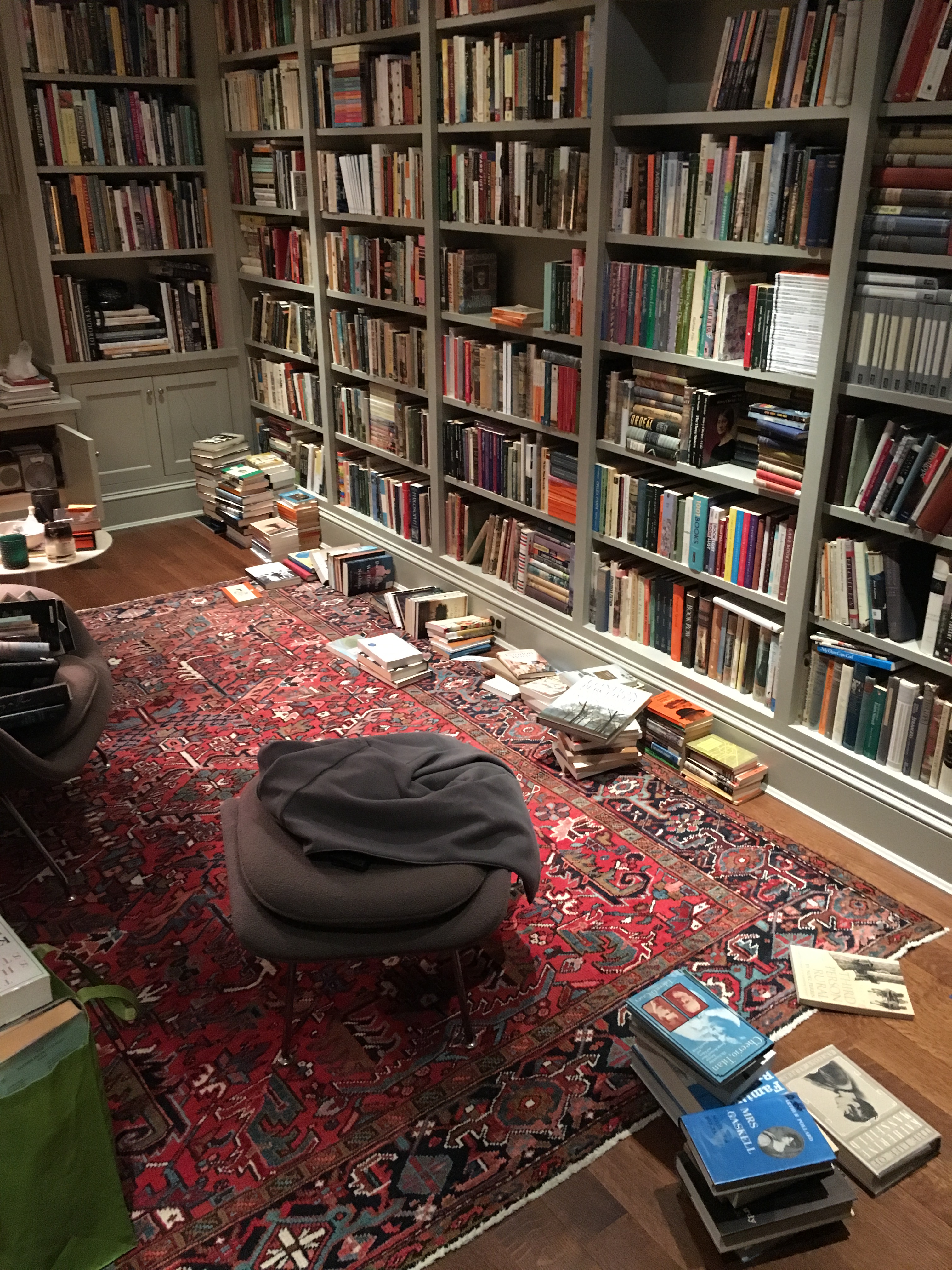
This is kind of misleading. By this point in the process I had already removed quite a few books to make room. But this does show you the general chaos that existed before and during.

I’ve run out of room in my library and I’ve run out of ways to weed my books. You might suggest, as John did, that we could get some shelves in another room. That could be a perfect solution if it weren’t for two things: 1) John’s idea of another room is a basement bedroom. It’s a perfectly pleasant room with no moisture issues, but I’m not going to spend time in it. But, even if I could convince him to put shelves in some other room–and I’m pretty sure I could–there’s this: 2) The thing taking space away from fitting all the fiction I’ve been buying is a collection of non-fiction books that I don’t really read, but I like to see them on the shelves, I like to occasionally dip into them, and I like to think of them as part of a little mini-reference library.

I don’t have to tell any of you how important a reference library is. My particular collection is not very broad and it is by no means deep enough on any topic to be of serious use. But it does give me delight. I mainly have books on books, collections of letters, bios and memoirs of novelists, oldish books on UK topics and a very small amount of history. When my shelf by shelf feature gets there (soon) you can see the range of things that I have. Some of these things are esoteric like an illustrated guide to military aircraft from WWII. I’m not a military aircraft buff by any means, but the illustrations are nice and I read tons of fiction from that era and I like having a visual frame of reference. I also have a 1950s atlas of London that is like an A to Z but nicer and, once again, a lot of my characters lived in 1950s London. So, how can I take these kinds of books, and put them in some other room? They need to be visible on a regular basis. And don’t even think of telling me to put some of my fiction in another room.

Speaking of fiction, I have done a ton of weeding. I’m starting to get to the point that I only keep stuff I know I want to re-read. Having done a fair amount of re-reading in recent years, I’ve discovered I quite like it, so this is not a meaningless criterion. Of course the TBR pile seems to grow exponentially and has been starting to pile up on the floor and my nightstand. I wish I had counted or taken a picture of all the newish (to me) unread books that weren’t on the shelves. It was pretty daunting, and fun. I realized I couldn’t get rid of any more books but I needed to do something. So I made a pile of all the non-fiction that I was less likely to consult as a reference book, and I took the work of two fiction authors off my shelves and put them in a holding place on some shelves in the basement. I don’t think I will get rid of them, but maybe if they sit down there long enough I will realize I really don’t want them. The result was that I was able to make enough room to fit everything on the shelves in the library.

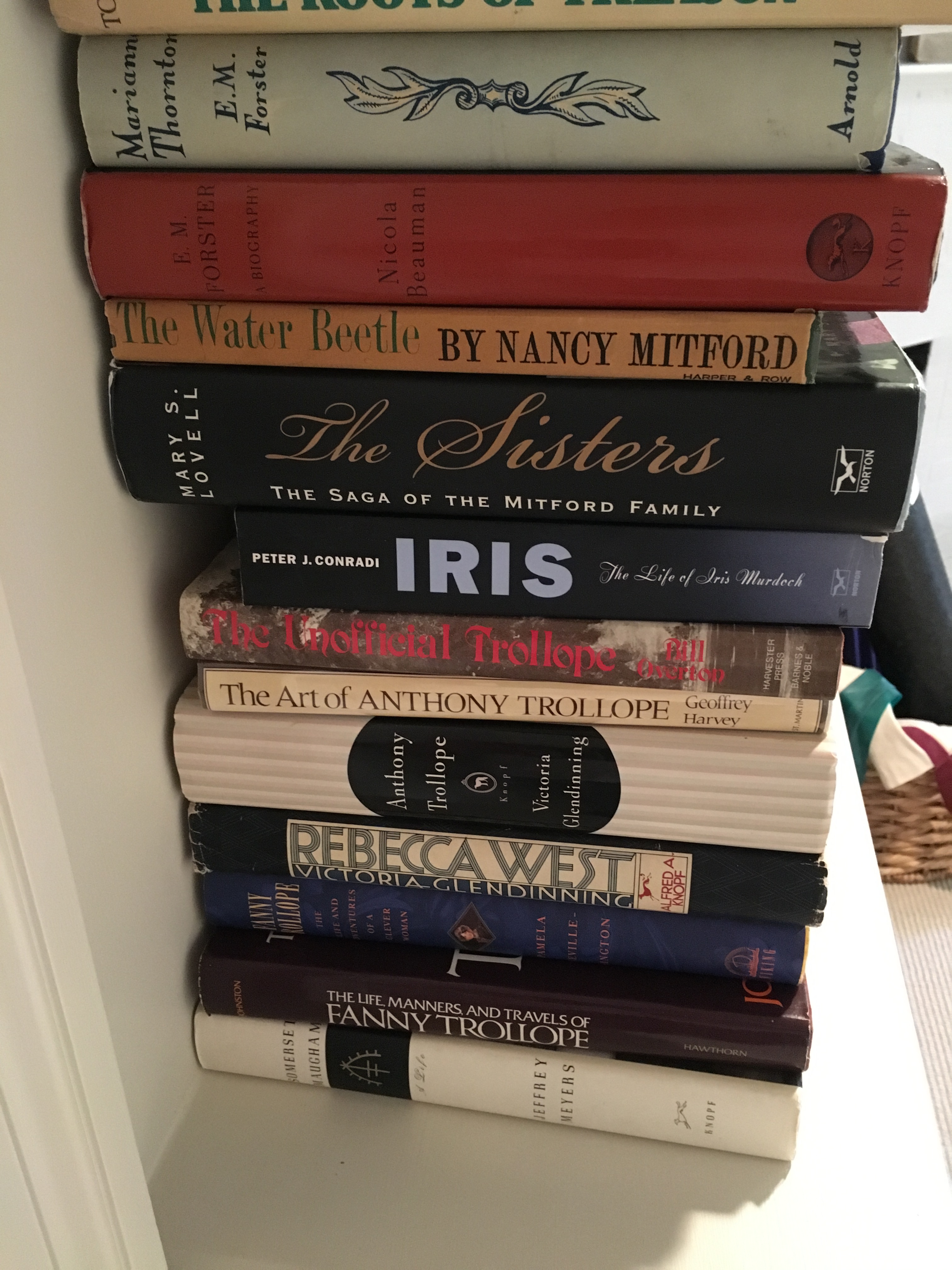
Some of the books in their temporary stacks in the basement. Not sure what their ultimate fate will be. And yes, there are three shelves that were already full of books. Mainly John’s books, my old urban planning books, and travel books.


I kept most of the novelist memoirs and collections of letters in the library but most bios ended up down here. Yes, I have two biographies of Fanny Trollope. Don’t you? How am I to know which one is going to be better? It doesn’t matter that I’ve only read one novel by Fanny.  And despite the three volumes on Anthony Trollope here, I still have an illustrated one in the library. Not to mention a copy of his autobiography.

For now, I am happy with the result. It is nice to have everything off the floor. The books also shifted enough that new book vignettes were created on the shelves as new books were added and everything was given a bit of breathing room. I might need to stop buying books for a while. Like none of us have said that before.
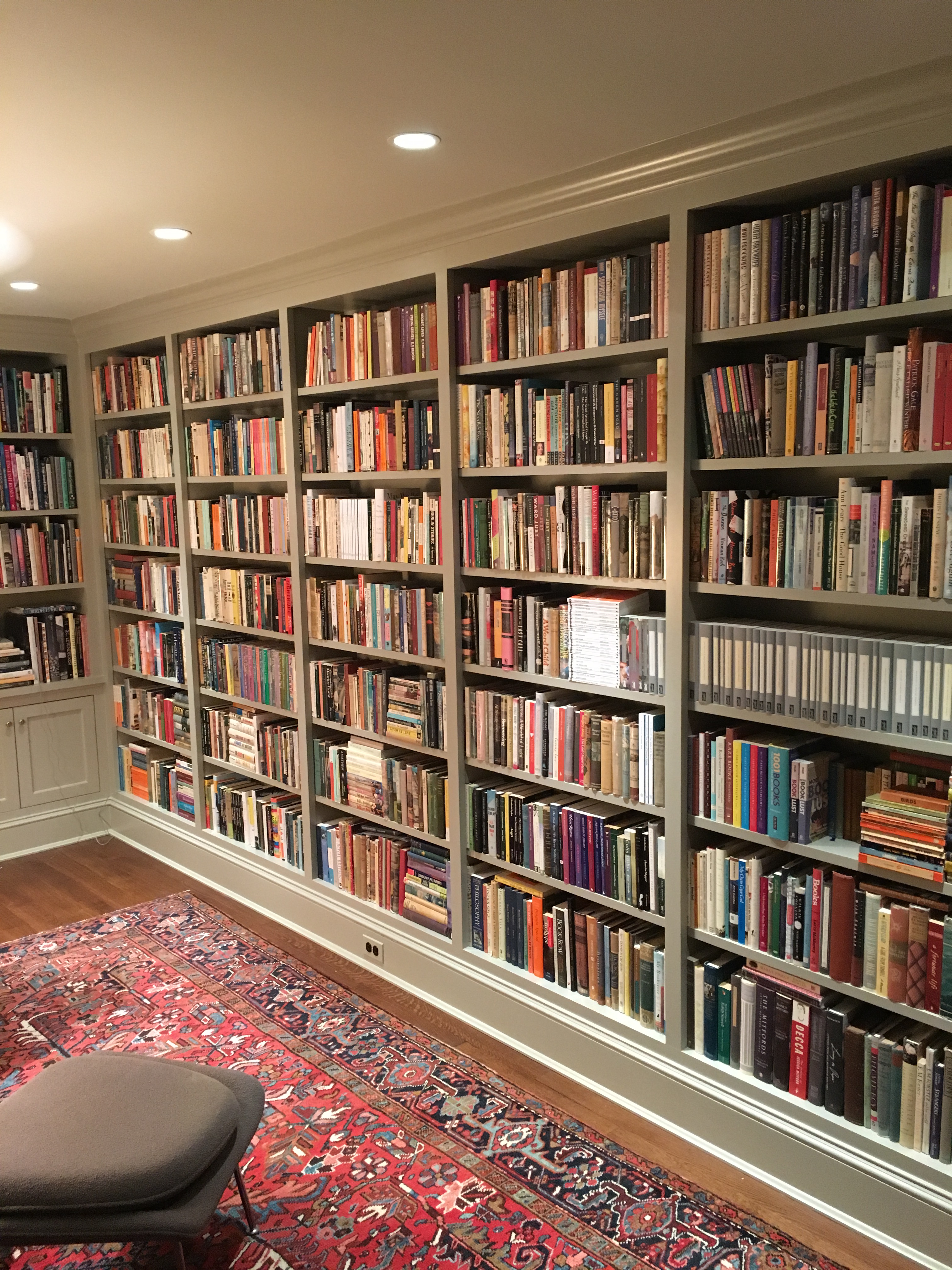
All tidy. Kind of clears my mind and puts me into the mood to read. I could imagine taking all of those pretty grey Persephones and putting them in a guest bedroom. That would free up more than a shelf.

Cather Quarterly


I’m one quarter/three months into my year long re-read of all of Willa Cather’s novels. Since she wrote 12 of them, I am reading one each month in chronological order of publication date. With the exception of The Professor’s House which I have read three or four times, I don’t really remember anything that happens in any of her other novels. Many of them because I read them 20 years ago and the others because I have a hard time remembering anything I have read.

January : Alexander’s Bridge

Published in 1912, Alexander’s Bridge is a short work about a successful bridge engineer who is struggling to decide what to do about his wife in Boston and his mistress in London. The moment at which Cather decides to tell Bartleby Alexander’s story is one fraught with mild regret, inertia, complacency, and a desire for something to change. He’s in a spot where his life is less about potential and more about trying to figure out how to live the rest of his life. In the end, events overtake the possibility of him making his own decision about his future.

I’ve been doing a lot of research on Ancestry.com recently (one of the reasons I haven’t read or blogged much lately, it’s addictive) and am often struck by how little the historical record can tell us about our ancestors. It’s been fascinating to find the names and vital statistics about the hundreds of people whose amorous endeavors led to my existence, but there is so much more I want to know–and can never know. Records–pieces of paper–get lost, destroyed, mislabeled, and go undiscovered, and major details or entire people disappear. This doesn’t have much to do with Alexander’s Bridge, except that at the end there is a piece of paper, a critical piece of paper, that has the potential to change everything or nothing.

February : O Pioneers!

Willa Cather wrote about may things, but it is her novels of the the great plains for which she is best known. Published in 1913, O Pioneers! is a seminal telling of the northern European immigrant experience on the American plains. But! Before I lose you, it is also highly readable and highly enjoyable. It’s one of those “important” books that just happens to be a damn good read. What makes O Pioneers! particularly brilliant is that it is just a given that the prime force of the book is a woman. Cather doesn’t need to hit us over the head with the fact that women settled the plains as much as men did, she simply presents us with a character that many of us who grew up in, or near, rural life would recognize immediately.

If you are wondering where to begin with Cather, O Pioneers! would not be a bad choice. Of course I still have 9 more novels to re-read, but I still feel comfortable making that assertion.

March : The Song of the Lark

The second of Cather’s so-called Great Plains novels (sandwiched between O Pioneers! and  My Ántonia) The Song of the Lark is grounded in the great plains but it takes Thea Kronberg off to Chicago, Germany, and New York where she becomes a celebrated opera singer. There is much that is enjoyable about this novel, but it would have benefited from some judicious editorial pruning. It also leaves me wondering if Cather meant to leave the impression that Thea was, after all, still a creature of the plains, or if she had become so changed by her life in the east that she had become not just a shell of her former self, but also a shell of human being. I think Cather may have been trying to do more of the former, but I can’t help but feel like she had become more of the latter.

In some ways, I feel like Cather may have lost her way with the narrative, or perhaps she changed her mind. Halfway through the novel Thea takes a break from her hectic life in Chicago to rest and recharge on a ranch in Arizona. There she comes to the conclusion that there is nothing about her life in Chicago that fills her subconscious in the way her childhood on the prairie does, or even her time she spends visiting the southwest. She goes on to account how the shards of ancient Native American pottery she finds–utilitarian vessels for food and water, are nonetheless decorated–represent an attempt to capture the joy and sorrow in life as much as they are for storing physical sustenance. It seemed this was to be Thea’s leitmotif as well, but in the end it seemed to me that her art, while providing great joy for her fans and for those close to her, provided her with no spiritual sustenance. Cather presents Thea as a bit too close to the stereotype of the operatic diva that it is hard to make any connection between Thea’s past and current life. This could be an interesting theme to explore, but Cather’s portrayal of Thea becomes as one-dimensional as the character herself. In earlier sections of the book I understood who Thea was, or at least had a more rounded sense of her as a person. Once she left Arizona and started her career ascent, Cather has so much happening off stage (if you will) it is hard to believe in who she has become.

This is the first novel in which Cather takes us to the southwest. I will have much more to say about her treatment of it after re-reading some of her other novels, but suffice it to say I find Cather’s writing about the southwest evocative, beautiful, and deeply spiritual.

shelf by shelf : from Shute to jumble o’small books

We are  now entering territory where my fiction alphabet-by-author order breaks down temporarily to accommodate a few stacks of mass market paperbacks and assorted small books. Things are going to get even funkier once we start running into my non-fiction, but I am trying not to think of that yet. There is perhaps a jumble analogy to be made since my reading for February and March has turned into a jumble of unfinished books. I have about five different titles that are close to being finished and 3 or 4 that I do not intend to finish. Such a disappointment after my rockstar January. I need to get things moving again.  It’s also been too darn long since I posted anything here. Things have been hectic to say the least.

Without further delay, I give you Shelf 24.

SHELF TWENTY-FOUR: 46 books, 21 unread, 25 read, 54% complete

Shute, Nevil – Mazaran
Shute, Nevil – Stephen Morris (completed)
Shute, Nevil – Beyond the Black Stump (completed)
Shute, Nevil – A Town Like Alice (completed)
Shute, Nevil – The Chequer Board (completed)
Shute, Nevil – Pastoral (completed)
Shute, Nevil – In the Wet (completed)
Shute, Nevil – Ordeal (completed)
Shute, Nevil – The Breaking Wave (completed)
Shute, Nevil – The Far Country (completed)
Shute, Nevil – An Old Captivity (completed)
Shute, Nevil – Round the Bend (completed)
Shute, Nevil – The Legacy
Shute, Nevil – Lonely Road
As promised in the last installment, here are a bunch more Nevil Shutes. I think In the Wet is one of my favorites. A flash forward look at the Queen and her consort being flown around the commonwealth to avoid anti-monarchy unrest in 1980s England. The story focuses on the Australian pilot who flies them. So many fascinating things in this book. I also really like Ordeal (or What Happened to the Corbetts  in the UK) which follows a young family as they try to avoid contagion in a pre-war look at WWII England. The only one I have come close to not enjoying is An Old Captivity.

Sinclair, May – Life and Death of Harriett Frean
Sinclair, May – The Three Sisters
Sinclair, May – Mary Olivier: A Life

Trollope, Anthony – Lady Anna
Trollope, Anthony – The Vicar of Bullhampton (completed)
Trollope, Anthony – Sir Henry Hotspur of Humblethwaite
Trollope, Anthony – The Belton Estate
Trollope, Anthony – An Autobiography
I love finding these Oxford World Library editions of Trollope. I’d love to own all of them but don’t want to look into how many there are for fear of doing just that.

Blackmore, R.D.  – Lorna Doone

Brown, George Douglas – The House with the Green Shutters

Disraeli, Benjamin – Sybil

Benson, S. Vere – The Observer’s Book of Birds
I bought this bird guide from 1972 because  it is little and because it has lovely illustrations in it.

MacInnes, Helen – While Still We Live

Trollope, Anthony – Can You Forgive Her? (completed)
I’m not going to pull out the front stack of books because that would be too much work to list everything in back, but this one is peeking through so I include it here.

Garbutt, P. E. – How the Underground Works
I love anything to do with the London Underground and couldn’t pass up this little guy from 1963.

White, E.B. – This is New York (completed)

Gide, Andre – Lafadio’s Adventure (completed)
Gide, Andre – Strait is the Gait (completed)
Gide, Andre – If It Die
Gide, Andre – The Immoralist (completed)
I read all of these long before I bought these copies. I couldn’t resist the vintage Vintage paperbacks.

Camus, Albert – The Stranger (completed)

Forster, E.M. – Howards End (completed)
Forster, E.M. – The Longest Journey (completed)
Forster, E.M. – A Room with a View (completed)
I’ve read and seen Howards End and A Room with a View countless times. I think I’ve read The Longest Journey twice and haven’t really thought too much of it. I might need to give it another go.

Stendhal – The Charterhouse of Parma

Stevenson, D.E. – The Blue Sapphire (completed)
Stevenson, D.E. – The Musgraves (completed)

Household, Geoffrey – Red Anger (completed)
Not as good as Rogue Male, but good, vintage, spy fiction.

Warner, Rex – The Professor

Bainbridge, Beryl – Injury Time

Plomer, William – At Home

Orwell, George – Coming Up for Air (completed)
Orwell writes really good novels and I really enjoyed this one.

Next time: random non-fiction about authors/books

I need a painting for my library

At some point I want to replace the painting that is currently hanging above the fireplace in my library. The work that’s up there now is kind of fun, but it gets a bit lost in the room. It is a bit too small. As I sit here looking at it now, I really do like it.  It’s called “Peach Trees” by Doris DeWitt Pogue. It appears to have been painted in Alabama in 1949. (If you’d like to see what I am talking about and to see the setting for the painting you click here. The painting appears in the “before” pictures of the library.)

I’m always on the look out for a replacement. I doubt I could afford this painting by Swiss artist Ferdinand Hodler even if the Los Angeles County Museum of Art was willing to sell it.

The Disillusioned One, 1892 by Ferdinand Hodler. Los Angeles County Museum of Art.

It just seems appropriate for a contemplative room like a library. If Trollope and Brookner had had a baby together he might have looked like this. For me the somber quality of the figure is offset by the lightness of the setting and the sprigs of green popping up at his feet. As if to point out that no matter the fate of man, life is eternal.

A used bookstore I didn’t like

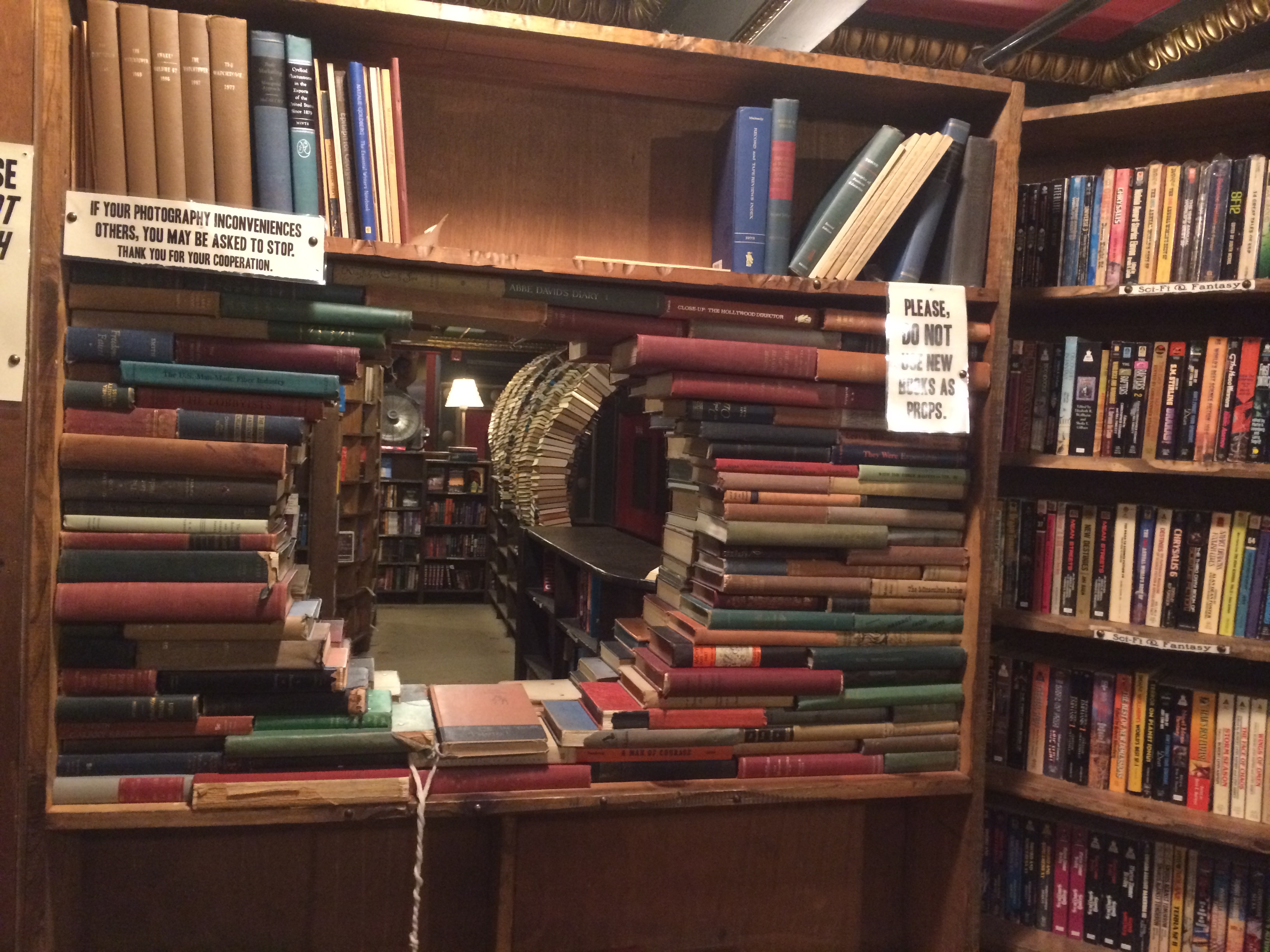
img_2534On our trip to another city last month,  I was quite excited to check out what appeared to be a ginormous used bookstore. I even saw a short documentary about the owner that I found quite admirable.

From almost the minute I entered I didn’t like it. I think it has done a good job providing the general public with books they want to buy, but for someone like me who wants to root around and find some unpopular, unheard of novels, it didn’t offer much.

I’m not going to name the bookstore, but I am going to tell you what I didn’t like.

img_2536

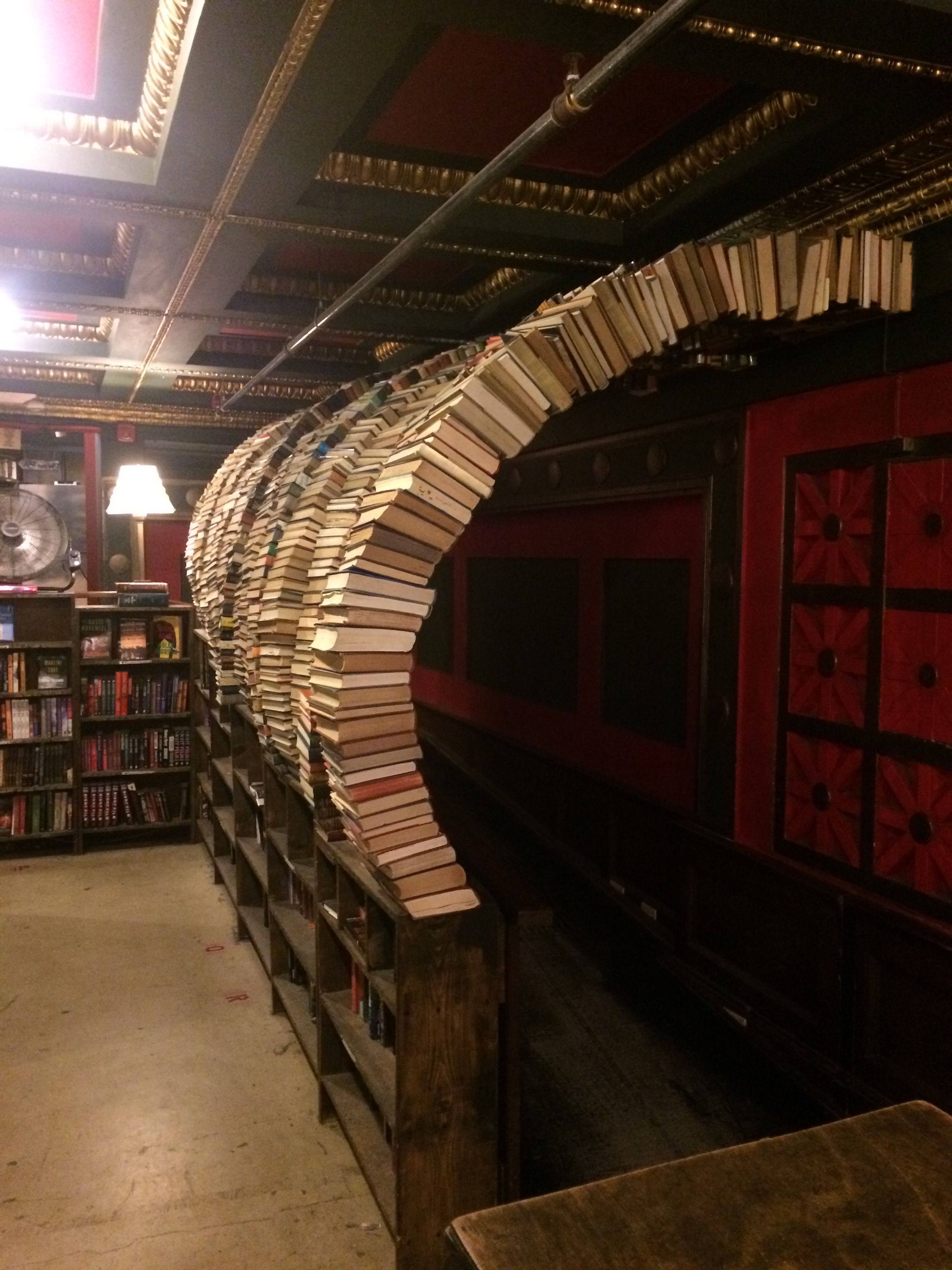
img_2538Too much book “art”. I don’t like seeing books abused, particularly when I feel like that kind of books I am looking for are the ones that don’t make it to the sale shelves.

Too many local looky-lous who seemed to consider it a part of their Saturday night outing, the fact that it was a bookstore was neither here nor there to them. Lots of 20-somethings taking their pictures next to the book “art”.

The classics were separated from the general fiction, further diminishing the chance that I might find something from mid-century by lesser known novelists. All the classics were, of course, the big boys (sic). And among the general fiction there was no chance of finding an esoteric little tidbit. It was one of those things where I seemed to know every title on the shelves. It shouldn’t be that way.

img_2542
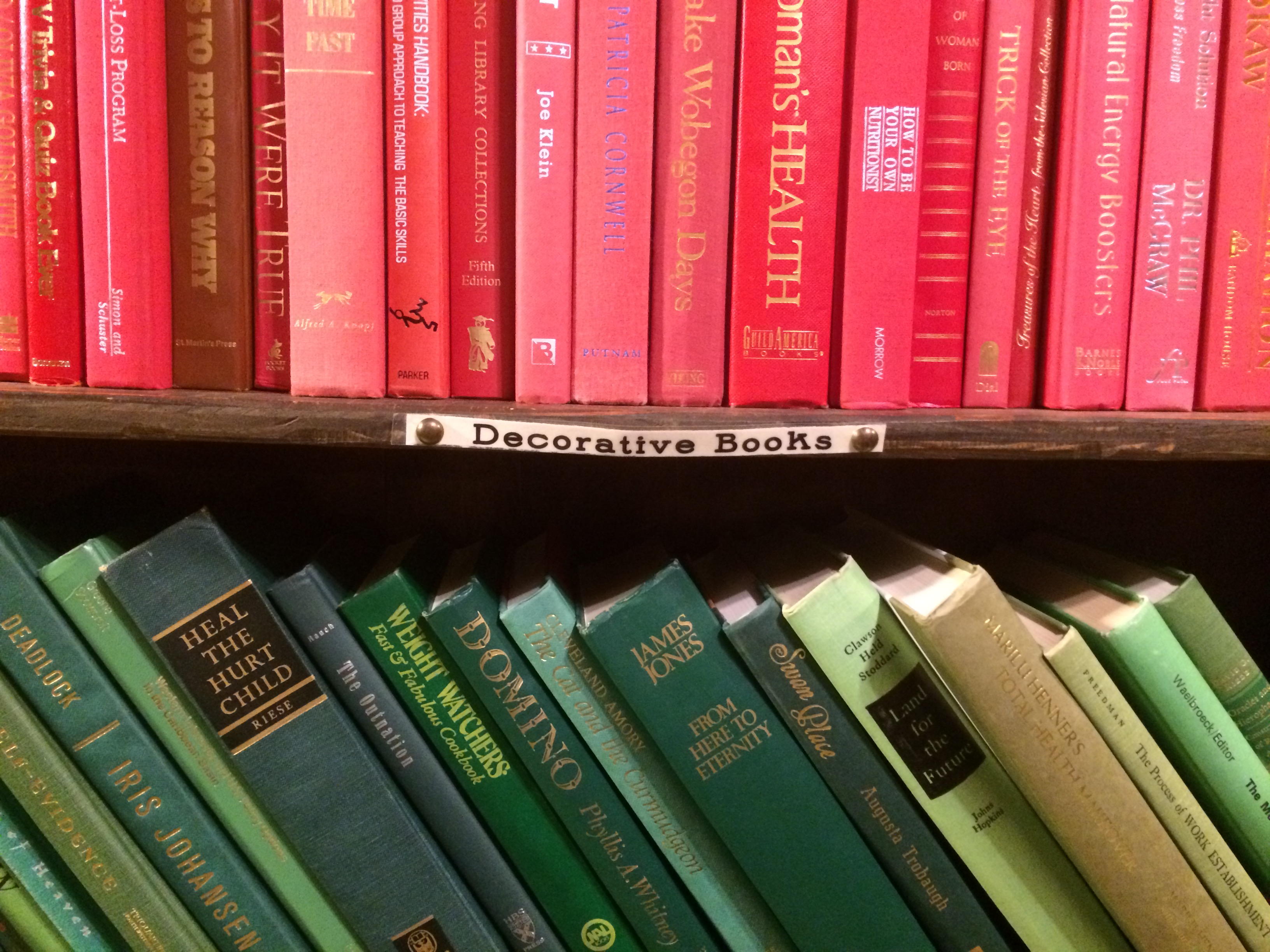
I actually found a Dorothy Canfield Fisher book in this section. That kind of sums up my problem with the place. Because the fiction section was too full of well known authors and books, the decorative section was the only one I found interesting enough to comb through.

There was nothing about the atmosphere that encouraged serious browsing as well. The lighting was either too low or too harsh, the music was annoying and loud…I know I sound like a grumpy old man. It is certainly a place that other people love, but for the die hard book nerd, not so much.

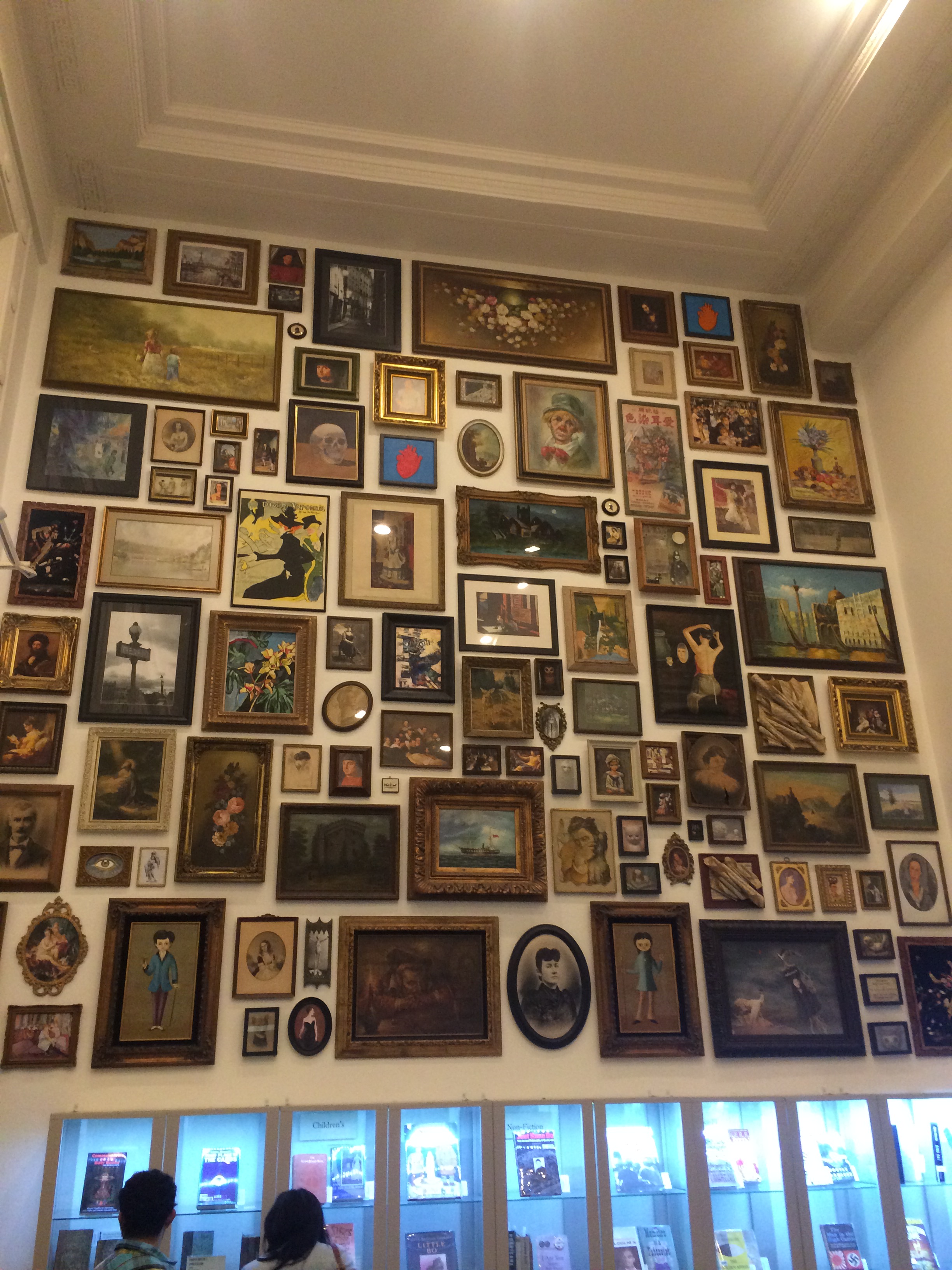
This wall in the rare book room was about the only thing I found pleasant.
This wall in the rare book room was about the only thing I found to be pleasant.

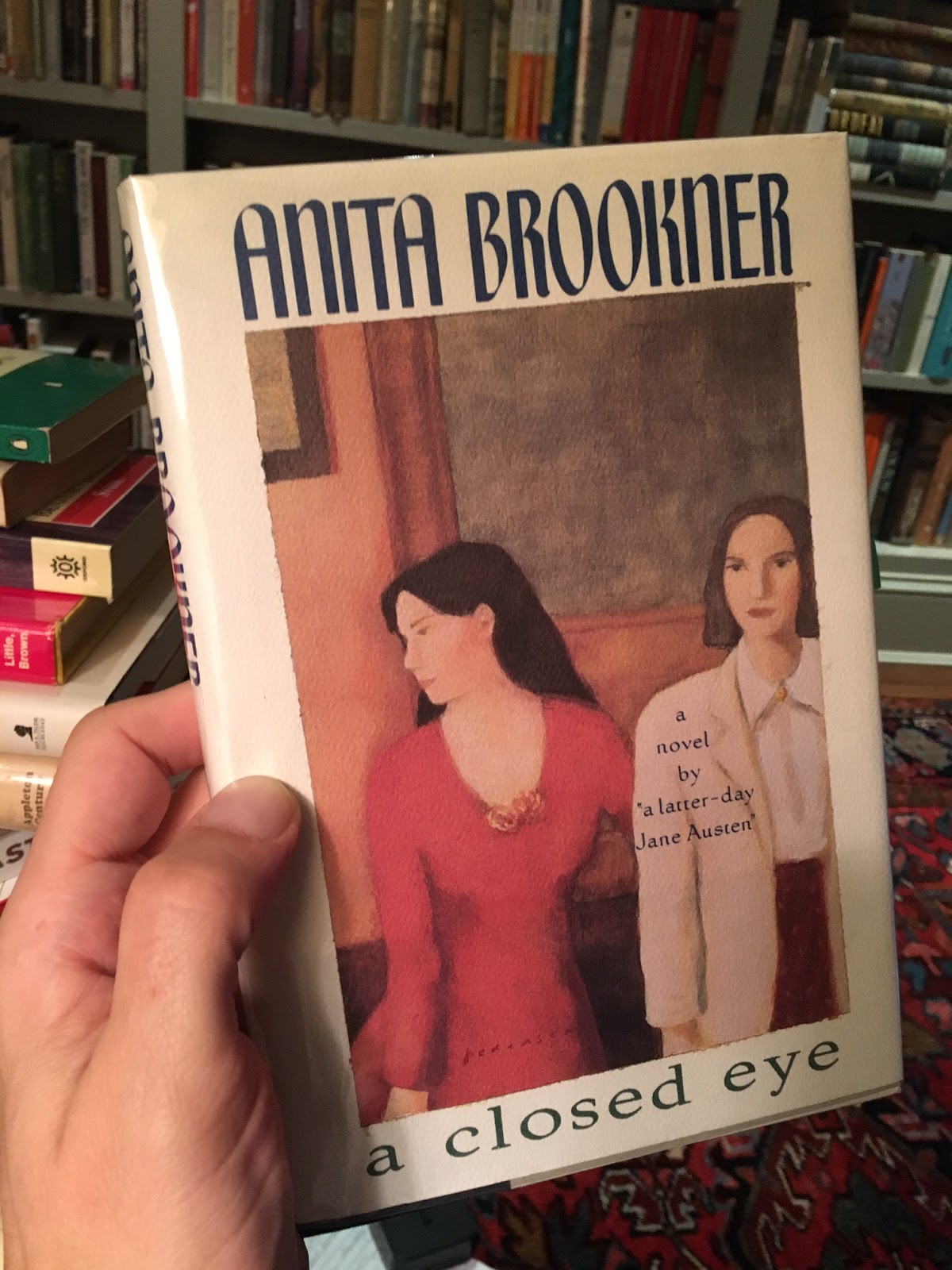
A Closed Eye

After  reading this at the very end of 2016 and having just spent some time working on this review, I was shocked to realize that it was only as far back as 2011 that I read it for the first time. I was even more shocked to see that I wrote about it then as well. Kind of interesting to see the difference between then and now.
[Number 11 in my chronological re-read of Brookner’s 24 novels.]

Harriet Lytton, a recent widow in self-imposed exile in Switzerland, exhorts Lizzie Peckham, the daughter of her childhood friend, and ersatz friend of her own daughter Immy, to visit her in Switzerland. Why Harriet chooses Lizzie to help her mitigate her lonely life in Switzerland, and how Harriet got to this lonely state in the first place, is laid out as the timeline goes back to before Harriet was born.

The daughter of a vivacious, rather driven mother and a father left nervous by his experiences in World War II, Harriet is born with a prominent birthmark on her face. The birthmark not only informs how Harriet feels about her self, her relationships, and her place in the world, but it’s also the motivation for Merle, Harriet’s mother, to gently, but firmly push her into a marriage with a much older man. Harriet finds herself married to a man she doesn’t really love and doesn’t even really like much, but the birth of her perfect, blemishless, daughter Imogen ends up being the focus of her life . As Immy grows older, more independent, and frankly, brattier, Harriet begins to escape the tedium of her marriage by thinking about the possibility of an affair with Jack Peckham. The husband of her childhood friend Tessa, Jack is a TV news correspondent who represents all the danger, and excitement, and passion missing from Harriet’s life.

In the meantime, the relationship between Harriet’s Immy and Tessa’s daughter Lizzie is never what Harriet thought it should be, but Harriet never figures this out. She is blind to how much the two girls dislike each other. Having been raised as the perfect child–the one who redeems Harriet’s life, Immy ends up acting like someone who was treated as perfect. She becomes insufferable and spoiled. Lizzie on the other hand becomes bookish and quiet and old beyond her years. In a way Harriet and Tessa ended up with the wrong children and all may have benefited from a parent swap. Interestingly, re-reading Brookner’s novels chronologically as I am, this is not the first time we see this notion of children born to the wrong parents in her work. The two sets of parents in Latecomers also each have have an only child who appears to be better suited to the other couple. It makes me wonder if Brookner felt she had been born into the wrong family.

And then, rather oddly for Brookner, there are a few spoilers. Without giving these spoilers away, one event that shapes the story fairly early on, and thus, isn’t so much of a spoiler, is that Tessa dies young leaving Lizzie adrift and Jack, the subject of Harriet’s seduction fantasies. But then the spoiler of spoilers happens that cements Harriet’s future. Don’t get me wrong, for those of you used to plot, this spoiler won’t shock you much when you come across it, but for those who have read a lot of Brookner, it’s pretty surprising.

The net result is a life of low expectations that are nevertheless unmet. To paraphrase Gertrude Stein, those of you who don’t mind that won’t mind that.

The jacket flap from my U.S. edition referred to the novel as a story of three generations of women, but I really think it is more accurately thought of as Harriet’s story. Her mother Merle is fairly well fleshed out, but Immy remains pretty opaque even when we know is going on in her life. And all that we do learn about Merle and Immy is not really independent of their association with their daughter/mother. Brookner created a literary work that revolves around Harriet but Harriet’s “real” life most certainly does not revolve around her.

Jinxed by Penelope Lively?

Martin Godwin for the Guardian
Photo of Penelope Lively by Martin Godwin for the Guardian

A chunk of Penelope Lively’s memoir Dancing Fish and Ammonites deals with the challenges of being over 80 years old. In addition to advanced aches and pains, Lively writes about how the rest of society deals with the elderly, and how it feels like the world is leaving one behind.

As if jinxed by Lively’s memoir, yesterday I felt like I was 47 going on 80. I decided to take advantage of John being out of town to go have a nice long dig through ‘the annex’ at  a local used bookshop. I was stunned, however, when I showed up and the formerly chaotic annex had been sorted and organized and priced. Previously the annex was a large space with tall shelves with three rows of books on each shelf, absolutely no order whatsoever, and a pricing scheme that put all paperbacks at $2 and all hardcovers at $4. And it was a glorious. The thing I loved best was not the prices, but the fact that the books were so not sorted that there was often treasures lurking for those of us who like  unwanted, forgotten, probably never very popular books that aren’t even all that pretty to look at. When it sunk in that the chaotic mess was a thing of the past I got deeply sad. Not only was this fun (for me) activity now impossible, but it became clear that there would no room in the newly organized shelves for those books that I love to find. They recognize the classics, and the modern classics, and the popular, but the possibility of coming across an R.C. Sherriff, or a Cecil Roberts, or a D.E. Stevenson or even lesser known authors than this esoteric bunch was all but zero. The staff was completely incapable of understanding what I was looking for and pointed me to Victorian-era books no one wants to read but that have pretty spines. And they pointed me to the rare book room. And they pointed me towards the fiction section. It flashed before my eyes that all those books I hope to stumble across would end up as pulp, or as props at a furniture store, or sold as books by the foot to decorators.

I didn’t leave empty handed, it was a bookstore after all, but I did leave feeling like a little bookish part of me had been dulled and a tad depressed. Flashing forward a hundred years I decided to drown my sorrows in Dairy Queen at a nearby mall and thought I would take the opportunity to upgrade my smart phone. I was first a little annoyed by the fact that shopping malls no longer seem to believe in directories or garbage cans. Both were few and far between. Then I get to the Apple store and the 12-year old working there made me feel about 500 years old. I could feel the old man shame creep into my face as I gave him my Hotmail address. I might as well have told him my phone number was KLondike 5-3452. When we discovered that my 8,000 digit Verizon password is not one I have memorized, he suggested I go to the Verizon kiosk and upgrade my phone there. At Verizon, the 16-year old working there made me feel not only old but really dumb. Do they have to talk that fast? Do they have to assume that everyone knows everything about everything about telephony? I might as well have offered him a Werther’s Original as I stuck a used Kleenex into the sleeve of my cardigan.

Perhaps I shouldn’t use the average age of the typical mall employee as a reference point for my own place in the world (don’t get me started on my misadventure in the food court or my failed attempt to buy running shoes at the Foot Locker). As I thought about it later, one of the things I found troubling was the fact that in none of these interactions were any of the people engaging with me aware of anything about me. They all misunderstood or didn’t hear what I was saying. They couldn’t recognize anything emanating from me: hope, friendliness, confusion, frustration, resignation. I’m not trying to make a comment on the state of customer service or the youth of today, or anything like that (that would make me sound like a cranky old guy). But I really do feel like got a glimpse of what life is going to be like when I really do get to old age.

To cap the day off, I had a bit of a nightmare last night. I don’t remember what I was dreaming, but it was one of those situations where my mind wakes up before my body does. Where I am aware that my body is asleep and that I want to wake up but as much as I try and call out (scream) or move my body, my vocal chords and my body won’t respond quickly enough. If it goes on too long it begins to feel like being buried alive. As I was struggling to make my limbs move and my voice audible, I kept thinking that surely John, lying next to me, would wake me from my disturbed dream–a comforting thought in my panic. When I finally did wake up with a shout I realized that I was in bed alone. Remember, John is out of town. As I stumbled to the bathroom I was relieved to be awake, but also haunted by the notion that isolation, both literal and figurative can be a big part of old age. Invisible during the day and trapped in a nightmare at night.

Dancing Fish and Ammonites by Penelope Lively
There is nothing in Lively’s memoir of old age that is as depressing as what I have written above. Lively is a delightful writer who puts a spin on her past, present, and shortish future that is humorous, enlightening, and comforting. Like much of her fiction, this memoir dabbles in the vagaries of memory, personal history, History with a capital H, and includes a the musings of a highly literate, creative, thoughtful mind. She makes me wish I were her friend. I will forgive the fact that she writes that she once enjoyed Pym’s novels, but now can’t stand them.

Judgment Day by Penelope Lively
One of my reading resolutions for the year was to read every month an author bio/memoir/diary/etc. and then follow it with one of their novels. There were only 2.5 days left of January when I remembered this was one of my resolutions and grabbed an unread Lively off my shelves. Judgment Day is basically a slice in time of village life. A group of lives that intersect in mundane and profound ways. Not only does the cast include the interesting-to-me newcomer to the village archetype, but it also includes one of my favorite situations: the closed off/hardened heart open/melted by unforeseen circumstances. I enjoyed every minute of the book and got emotionally caught up in the characters’ lives. And on top of that, it made me want to be a better person–a little more giving and forgiving.

shelf by shelf : from Schine to Shute

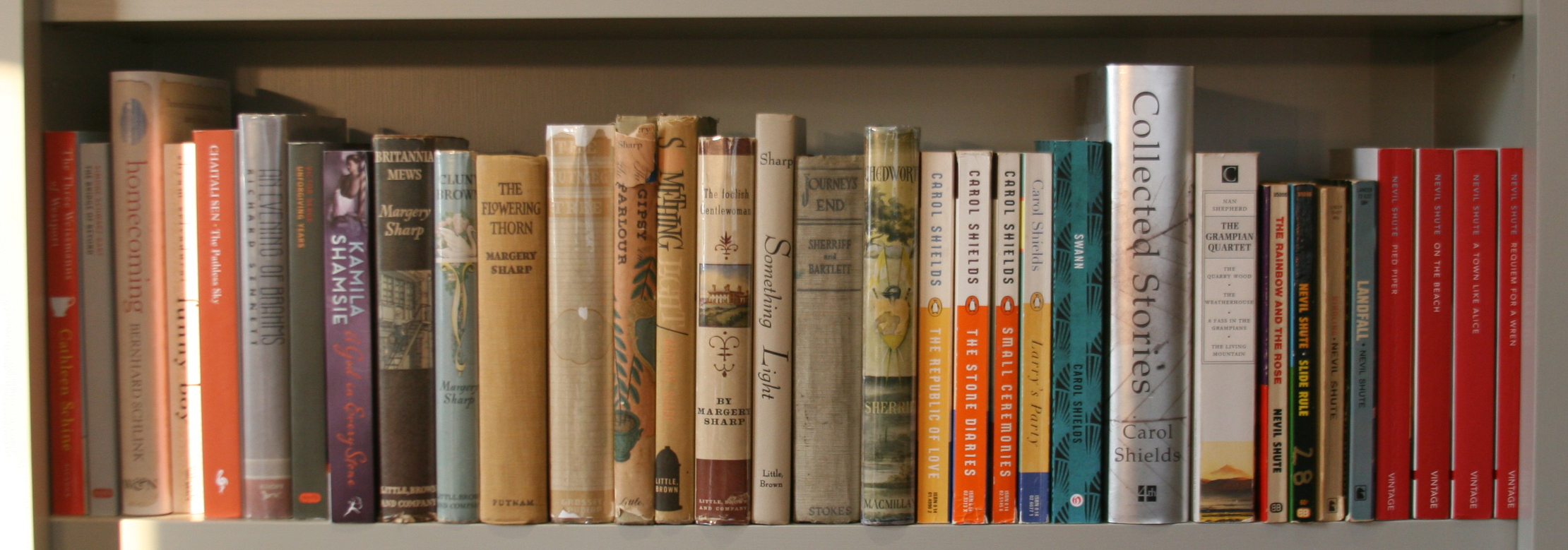
The shuh’s (think of the sh sound) really represent in the fabulous author category. This installment includes one of my favorite authors (Shute), the author of two of my favorite  books (Sherriff), an author who wrote wonderful books and died too young (Shields), and another who I think is totally charming despite loving one of her novels and disliking the other one that I read, but whom I still have high hopes for (Sharp). Not to mention Schlink who not only sounds like a shuh, but who writes amazingly good novels.

Having said that, you all SHould definitely read some of my favorites on this page. If you need help where to start drop me a comment.

shelf-23
Click to enlarge

SHELF TWENTY-THREE: 32 books, 16 unread, 16 read, 50% complete

Schine, Cathleen – The Three Weissmanns of Westport
Nancy Pearl “told” me to read Schine. So far I haven’t been able to get into it. Fingers crossed.

Schwarz-Bart, Simone – The Bridge of Beyond
Somehow this one has disappeared from my shelf and I don’t know why. I am pretty sure I didn’t weed it out, so it must be in a pile somewhere in the house.

Schlink, Bernhard – Homecoming (completed)
I  find Schlink’s novels (the two that I have read) to be solid, engrossing, good reads, that offer a lot of food for thought. Both this and The Reader deal with the moral and intellectual aftermath of Nazi Germany.

Selvadurai, Shyam – Funny Boy (completed)
I read this a million years ago and loved it. A gay coming of age story in Sri Lanka. Also enjoyed his novel Cinnamon Gardens.

Sen, Chaitali – The Pathless Sky

Sennett, Richard – An Evening of Brahms (completed)
Not only did I love this mix of sociology, history, and cello pedagogy, but it gets high marks for depicting the  milieu of classical music in an intelligent, natural way. That is hard to find in fiction.

Serge, Victor – Unforgiving Years

Shamsie, Kamila – A God in Every Stone
I think this was shortlisted for the Bailey’s Prize.

Sharp, Margery – Brittania Mews
Sharp, Margery – Cluny Brown (completed)
Sharp, Margery – The Flowering Thorn
Sharp, Margery – The Nutmeg Tree
Sharp, Margery – The Gipsy in the Parlour
Sharp, Margery – Something Light (completed)
Sharp, Margery – The Foolish Gentlewoman
I took a chance on buying some lovely copies of Sharp years ago when we were in Maine. Turned out I loved Cluny Brown and so have continued to buy her books. I see here I even have two copies of Something Light which I found quite boring.

Sherriff, R.C. and Vernon Bartlett – Journey’s End
Sherriff, R.C. – Chedworth
I love, love, love the two Sherriff reissued by Persephone that I have read (A Fortnight in September and The Hopkin’s Manuscript) and hope these two are even half as good.

Shields, Carol – The Republic of Love (completed)
Shields, Carol – The Stone Diaries (completed)
Shields, Carol – Small Ceremonies (completed)
Shields, Carol – Larry’s Party (completed)
Shields, Carol – Swann (completed)
Shields, Carol – Collected Stories
I am a big fan of Carol Shields and have read all of her novels. The one that gets the most praise, The Stone Diaries, is not my favorite, but still very enjoyable. I hope to read her story collection this year as part of one of my reading resolutions for the year.

Shepherd, Nan – The Grampian Quartet
I got this from a generous reader/blogger, but I don’t remember who it was!

Shute, Nevil – The Rainbow and the Rose (completed)
Shute, Nevil – Slide Rule
Shute, Nevil – Kindling (aka Ruined City) (completed)
Shute, Nevil – Landfall
Shute, Nevil – Pied Piper (completed)
Shute, Nevil – On the Beach (completed)
Shute, Nevil – A Town Like Alice (completed)
Shute, Nevil – Requiem for a Wren (aka The Breaking Wave)(completed)
Nevil Shute is easily one of my top five favorite authors of all time. His writing is not sophisticated but he is a great storyteller. The next installment of Shelf by Shelf will have lots more Shute, so I won’t say too much about him here.

The four red-spine Vintage paperbacks at the end are a good place to start if you haven’t read him. I would say On the Beach is the best one to start with. Not only was it an amazing response to the threat of nuclear destruction but it is a page turner with lots of heart and emotion. I first read it in high school and I literally SOBBED for the final 30 pages. Granted it was the Reagan 80s and we all thought we were going to be nuked, but still. A Town Like Alice is the stunning story of a group of Britons caught in southeast Asia during World War II under Japanese occupation and then the story moves to post-war Australia. Pied Piper is the story of an Englishman caught in Europe at the outbreak of WWII and finds himself leading a group of children to safety. Probably the lightest of the four. Requiem for a Wren is perhaps the  least compelling of the four, but still a damn good story.

I’ve read many of these twice and also listened to audio versions. They make really great listening, however, some of the language is not something you want to have blaring out your car window when waiting at a stop sign. More on that in the next installment.

NEXT TIME: Shute to confusion (This will make sense when you see it.)

shelf-2

Author sparks controversy at this year’s Hoggies

hoggieLOS ANGELES – The awards for best reads of 2016 were awarded last night by the Academy of Reading Arts and Sciences during a live telecast from Dorothy Chandler pavilion in Los Angeles.

As usual, this year’s ceremony brought out the usual mix of gowns and glamour as the world’s literati arrived to recognize the achievement of the books that most moved, enthralled, and entertained over the past year. Thomas Otto, president of the Academy noted how many of this year’s contenders were actually published in the past five years. “This truly is unpresidented [sic] in the history of the Hoggies.”

The normally joyous occasion was thrown into controversy early in the evening when Sinclair Lewis came back from the dead to excoriate the mostly American audience for what he sees as rank stupidity over not having learned the lessons of literature and history. Lewis, whose seminal novel Main Street was re-read by the Academy in 2016, showed in a two-hour slide presentation a sample of the thousands of novels that he claims could  have kept the electoral nightmare from playing out in the US this year. Lewis said “If only more people picked up a darn novel from time to time.” Lewis finished his remarks by chiding the audience: “The boys in the Zenith Rotary or down at the BPOE* lodge may think there’s some sort of strength in stupidity, jingoism, and know-nothingness, but their approval is no gauge of success.”

Among last night’s winners:

BEST NOVEL – FEMALE Station Eleven by Emily St. John Mandel

BEST NOVEL – MALE Being Dead by Jim Crace

BEST AUDIO RECORDING Excellent Women by Barbara Pym

BEST RE-READ – FEMALE The Driver’s Seat by Muriel Spark

BEST RE-READ – MALE Coral Glynn by Peter Cameron

BEST IRREVERENTLY FUNNY FICTION Marry Me by Dan Rhodes

BEST THOUGHTFUL, INTERESTINGLY TOLD, SLIGHTLY ANITA BROOKNERISH NOVEL The Spare Room by Helen Garner [The funny thing is this category existed last year.  The Academy was pleased it read a book in 2016 that fit the bill.]

BEST SHORT STORIES The Safety of Objects by A.M. Homes

BEST CRIME/THRILLER NOVEL The Day of the Jackal by Frederick Forsyth

BEST, SLIGHTLY SAPPY, BUT TOTALLY ENJOYABLE AND UPLIFTING NOVEL – The Unlikely Pilgrimage of Harold Fry by Rachel Joyce

WORST PIECE OF PANDERING, SAPPY BULLSHIT – The Summer Before the War by Helen Simonson [This could have been a tie with Rachel Joyce’s sequel to Harold Fry, but that annoyed the Academy so much it didn’t read much beyond the first chapter.]

BEST FOR MAKING SOMETHING FABULOUS BORING Four Seasons in Rome by Anthony Doerr

BEST NOVELS BY NEW-TO-THE-ACADMEY AUTHORS

Euphoria by Lily King
Satin Island by Tom McCarthy
Hotels of North America by Rick Moody
The Expatriates by Janice Y. K. Lee
At Hawthorne Time by Melissa Harrison

BEST PENELOPE – Penelope Lively for Cleopatra’s Sister [The only Penelope the Academy read in 2016.]

LIFETIME ACHIEVEMENT AWARDS – (two awards given) Eric Ambler and Nevil Shute

[*Benevolent and Protective Order of Elks of the United States of America (BPOE)]

Crazy as fudge for 2017

I'm only using this picture because I love it. It doesn't have much to do with this post.
I’m only using this picture because I love it. It doesn’t have much to do with this post.

We all know how I come up with or join challenges and then promptly forget about them. I am slightly better at following reading resolutions, but this year I am in the mood to do some crazy resolutions that are more like challenges that I will never finish. If I had any doubt about doing some stupid stuff, WildmooBooks pushed me over the edge. Here are some of my contenders with the easier ones towards the top.

Read Civil to Strangers by Barbara Pym
I love Pym to death and I believe Civil to Strangers is the only book of hers I have yet to read. (I told you I was starting with the easy ones.)

Read 104 books
I squeaked in just under the wire with 104 books this year. I thought the equivalent of two a week was a good challenge. It was, and will be again in 2017.

Re-read one Brookner novel each quarter
I think I am up to 11 in my chronological re-read of Anita Brookner’s 24 novels. (I still have one to review from the end of 2016.) In general I love re-reading her books, but I am keen to finish my gazetteer of London place names that appear in her work. At this proposed rate I could finish it in just over three years.

Read at least one unread book from each of my fiction shelves
Sometime during 2017 I will finish chronicling my 35 shelves of books in by ‘shelf by shelf’ feature. Of those shelves, about 28 of them are fiction. My goal is to read one unread book from each of those fiction shelves. This might turn out to be the most fun of all my goals for the year.

Read all of Willa Cather’s 12 novels over 12 months
She wrote 12, there are 12 months in the year. Easy as a damn peach. I’ve read most of her novels, but her magnum opi (opuses?) O, PioneersMy Antonia, and Death Comes for the Archbishop, were read a long time ago and I’ve been wanting to revisit them for some time now.

Read at least one short story collection on my shelves
I have several worthy contenders on my shelves, but I never seem to make the time for them. Maybe some of them are too big.

Carol Shields (the one I most want to get to)
Katherine Mansfield,
William Maxwell
Somerset Maugham
Doris Lessing
Willa Cather
Jean Stafford
Muriel Spark
Evelyn Waugh

Pair a novel with a biographical work about a different author each month
This could get trickier for me as I can get bogged down when I dip into non-fiction. I think I would prefer memoir over bios, but we will see what we can see. I’m not going to assign months just yet, but I think I know who my twelve authors are going to be. Pay close attention to some of the cheating overlapping with other challenges. Note that none of these authors is new to me, and I actually have bios/memoirs/letters for each one of them already on my shelves.

Anita Brookner
Willa Cather
Margaret Drabble
Dorothy Canfield Fisher
Penelope Fitzgerald
Marge Piercy
Barbara Pym
May Sarton
Muriel Spark
Fanny Trollope
Rebecca West
Edith Wharton

Follow Nonsuch Book down a Clarissa rabbit hole
Nonsuch Book and some others are going to be reading Samuel Richardson’s Clarissa “throughout the year, each letter from this epistolary behemoth on its noted date.” I’ve seen others do this online previously and I like the idea of it without knowing anything more about the book itself. Happily I own a copy, but I won’t be reunited with it until mid-month, so I will already be behind.