 Dang. I just went through the list. It seems like it is going to be a good decade, but so many books by authors I love (and many cozy reads), it was actually rather boring to annotate the list. Maybe you all have suggestions which of these gems I should read.
As usual, the full TBR can be found at the bottom of the post.
[For those who don’t know, I am participating in A Century of Books this year which requires me to read one book from each year from 1919 through 2018.]
1930
As We Were – E.F. Benson
The Deepening Stream – Dorothy Canfield
The Shutter of Snow – Emily Holmes Coleman
The Weatherhouse – Nan Shepherd
Journey’s End – R.C. Sherriff and Vernon Bartlett
Miss Mole – E.H. Young
I’m probably going to go for the Sherriff. I was so excited to find this volume as his books are hard to find here in the US, but I’ve been sitting on it for a long time. I have so enjoyed (loved) The Fortnight in September and The Hopkin’s Manuscript, I think I was afraid to read another Sherriff in case it wasn’t good. And this one has a co-author. Those always make a bit wary.
1931
Friends and Relations – Elizabeth Bowen
Mystery in the Channel – Freeman Wills Crofts
Poor Caroline – Winifred Holtby
Simpson – Edward Sackville-West
This one is a total question mark. I have no idea which of these rise to the top when the time comes.
1932
As We Are – E.F. Benson
Secret Lives – E.F. Benson
The Pure and the Impure – Colette
Marriage of Hermione – Richmal Crompton
Portrait of a Family – Richmal Crompton
Orient Express – Graham Greene
Down the Garden Path – Beverly Nichols
Lonely Road – Nevil Shute
Death Under Sail – C.P. Snow
The Gods Arrive – Edith Wharton
One Way of Love – Gamel Woolsey
Jenny Wren – E.H. Young
This could be a really good year. I mean I could read my way through this entire year and be pretty happy. This is the opposite of 1931, all of these jump out at me.
1933
Bonfire – Dorothy Canfield
The Holiday – Richmal Crompton
A Thatched Roof – Beverly Nichols
A Pass in the Grampians – Nan Shepherd
High Rising – Angela Thirkell
Frost in May – Antonia White
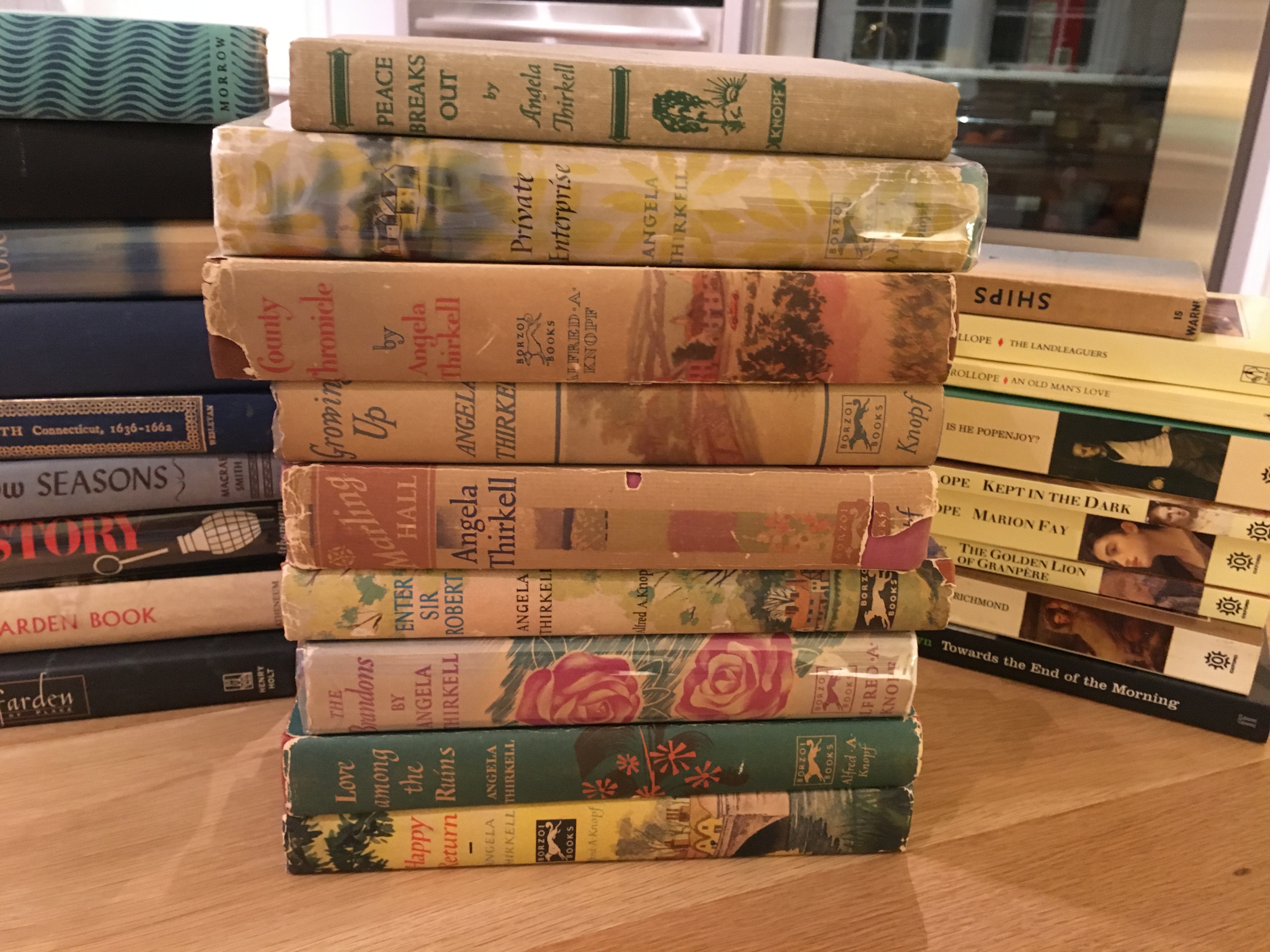
This may be the earliest Thirkell I have, so that one may win the race.
1934
Luminous Isle – Eliot Bliss
The 12.30 from Croydon – Freeman Wills Crofts
Chedsy Place – Richmal Crompton
A London Child of the 1870s – Molly Hughes
A Pin to See the Peep Show – F. Tennyson Jesse
Devoted Ladies – Mary Keane
Rumour of Heaven – Beatrix Lehmann
Work of Art – Sinclair Lewis
Going Abroad – Rose Macaulay
The Flowering Thorn – Margery Sharp
The Search – C.P. Snow
The Curate’s Wife – E.H. Young
An obscure Sinclair Lewis. That’s probably going to be the winner. I’ve read most of his novels and I’ve owned this one for a long time. I feel like Stuck in a Book recently posted something about A Pin to See the Peep Show, and what about that title. Hmm.
1935
Untouchable – Mulk Raj
England Made Me – Graham Greene
O These Men, These Men! – Angela Thirkell
My guess is a book I wrote with that title would not be similar in anyway to the one Thirkell wrote.
1936
The Dark Frontier – Eric Ambler
Caroline – Richmal Crompton
The Old Man’s Birthday – Richmal Crompton
Innocent Summer – Frances Frost
None Turn Back – Storm Jameson
Mary Lavelle – Kate O’Brien
Turn, Magic Wheel – Dawn Powell
Greengates – R.C. Sherriff
Summer Will Show – Sylvia Townsend Warner
I really want to say Ambler on this one but I’ve had 3 or 4 Dawn Powells on my shelves for a very long time. I think it is probably time to get her a go. Even though I have other of her books (is that grammatical?) I like starting with an author’s earliest books as possible.
1937
John – Irene Baird
Friend of the Rich – E.F. Benson
Janet – E.F. Benson
The Unwanted – E.F. Benson
There Are Four Seasons – Richmal Crompton
Alas, Poor Lady – Rachel Ferguson
The Nutmeg Tree – Margery Sharp
Journey by Moonlight – Antal Szerb
Summer Half – Angela Thirkell
Hunt the Slipper – Violet Trefusis
Boy, the 30s really are a cozy-fest.
1938
I’m Not Complaining – Ruth Adam
Cause for Alarm – Eric Ambler
Journeying Wave – Richmal Crompton
Brighton Rock – Graham Greene
In Hazard – Richard Hughes
Lions and Shadows – Christopher Isherwood
Single Hound – May Sarton
The Professor – Rex Warner
If I was adventurous I would choose In Hazard. I bought it solely for its cover.
1939
Seasoned Timber – Dorothy Canfield
Merlin Bay – Richmal Crompton
The Morning Is Near Us – Susan Glaspell
Manja – Anna Gmeyner
Party Going – Henry Green
The Confidential Agent – Graham Greene
The Lawless Road – Graham Greene
The Brandons – Angela Thirkell
Lark Rise – Flora Thompson
For the whole list:





 hogglestock