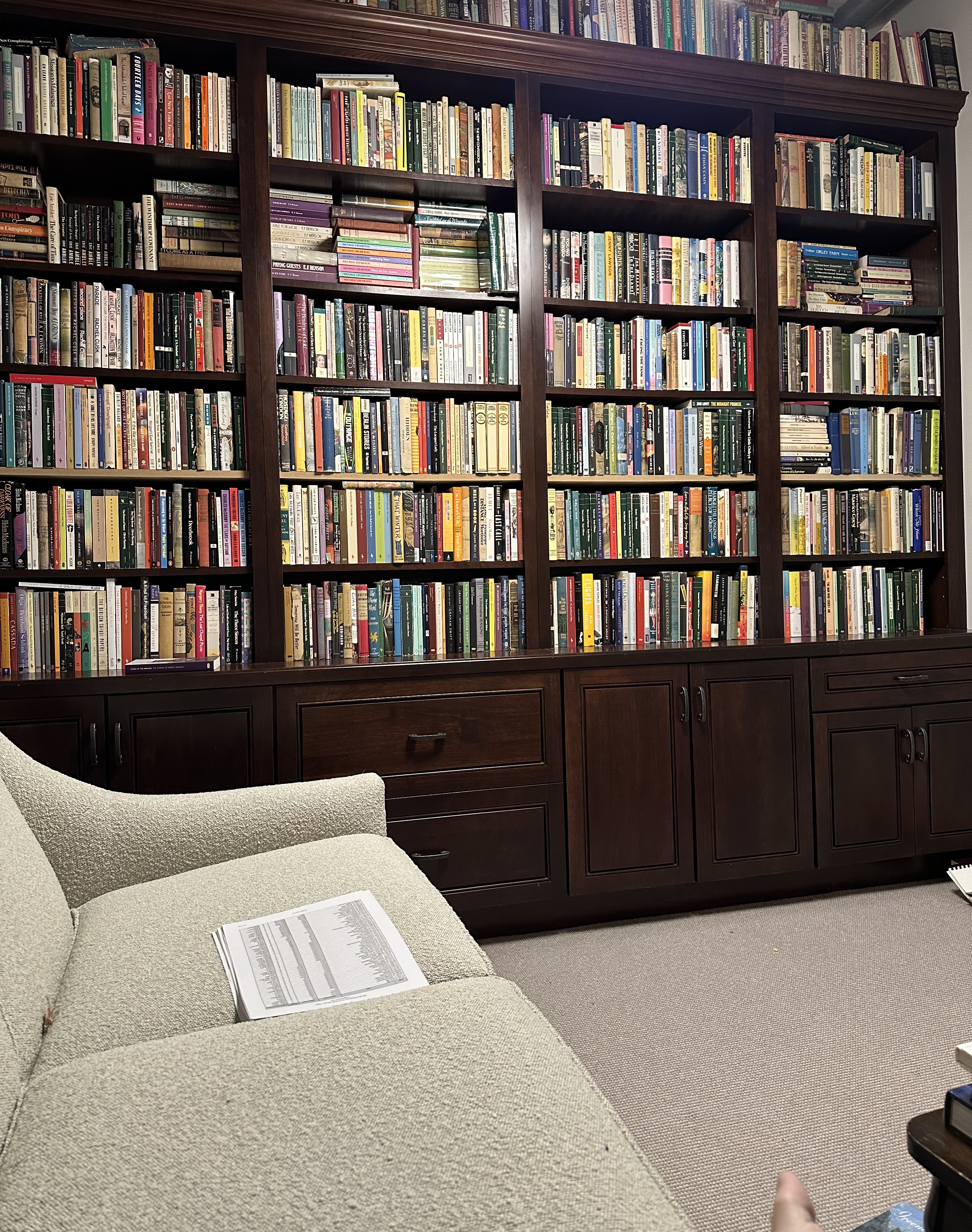
7 concerts 6 cities 3 weeks

As regular readers know, each spring I build a spreadsheet with all the repertoire for about 66 orchestras in the U.S. and Canada in order to figure out where I want to go to hear music. I don’t care so much about conductors, and while some orchestras are clearly better than others, my main interest is in hearing pieces that don’t get played very often. So I get around.

For 22 years I lived in DC and regularly went to the NSO (let’s send them some good vibes at the moment) and the Baltimore Symphony Orchestra, and would sometimes visit my home state of Minnesota for a weekend doubleheader with the Minnesota Orchestra and Saint Paul Chamber Orchestra. Now that I am back living in Minnesota (send us some good vibes at the moment), I get to hear the MO and SPCO on the regular (about 22 and 11 concerts respectively for those two).

Since the “end” of Covid when I started travelling for rep in earnest, I have traveled to Boston, Buffalo, Calgary, Cincinnati, Cleveland, Detroit, Montreal, Nashville, New York, Philadelphia, and Phoenix. (I do some overseas travel for music as well, but that is the topic for another time.) If you didn’t figure it out from the title, in the past three weeks I have seen seven concerts in six cities, which added Salt Lake City and Louisville as well as returns to New York and Cleveland.

When I crunched the data for the 25/26 season, there were two programs of largely American music that really caught my eye. Both of them were must dos. Only problem is that they were the same weekend in two cities nowhere near each other.

First Stop: Salt Lake City
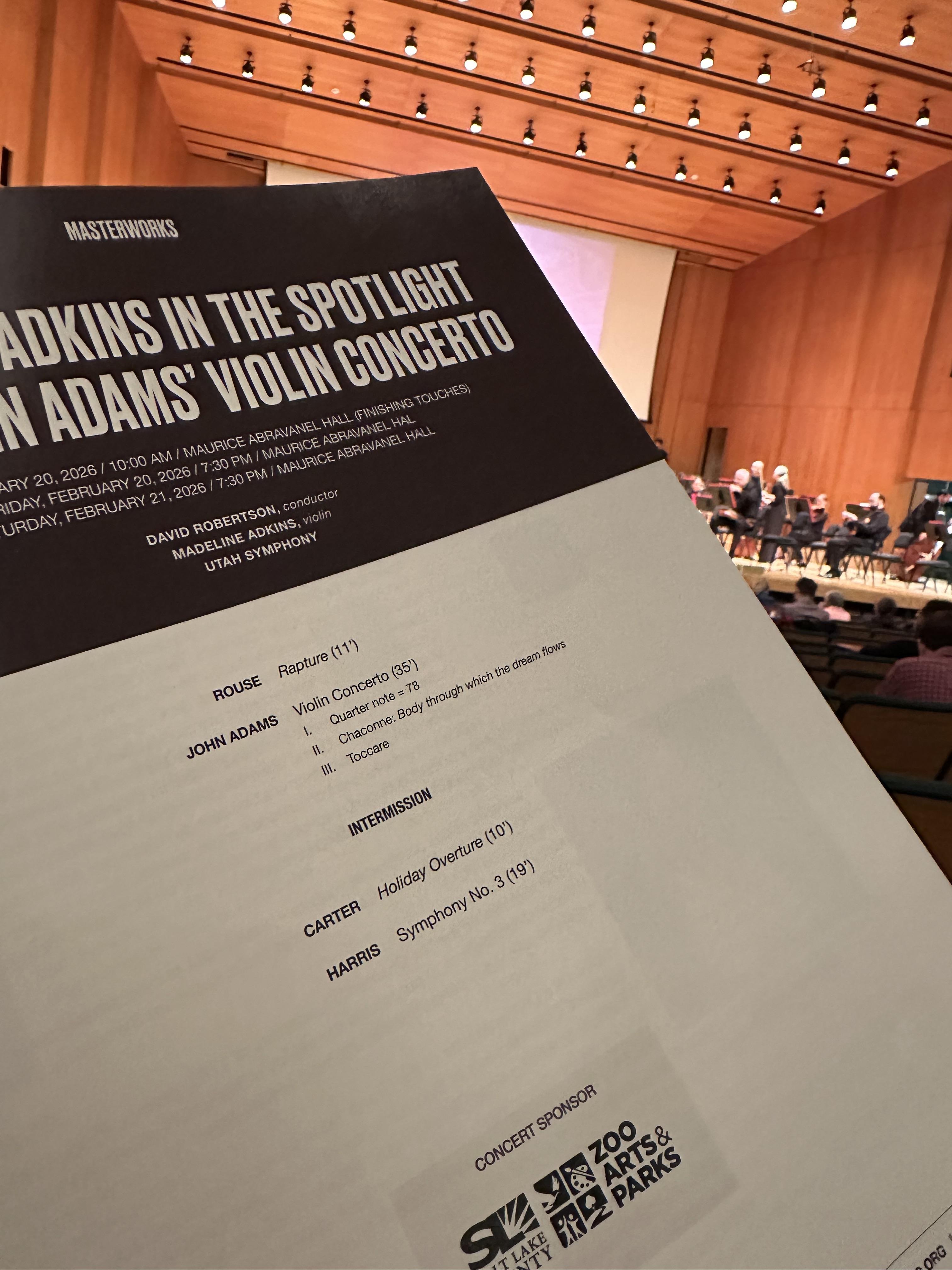
This was a corker of a program. All American and all new to me. Rouse’s Rapture was transcendentally beautiful, my favorite thing on the program. (And I have since noticed Philadelphia has it planned for 26/27.) I liked the Adams Violin Concerto more in recording than in person. I think I was too worried about whether the audience around me was enjoying it. If that is not the stupidest thing ever. Carter and Harris are almost never on programs. It was great to hear these pieces live. I must admit, for as much as I love this ‘off the beaten path’ rep and wish more orchestras had this courage, the hall on this particular Friday night was barely half full. I’m just glad I didn’t look behind me until intermission.

Running to Louisville
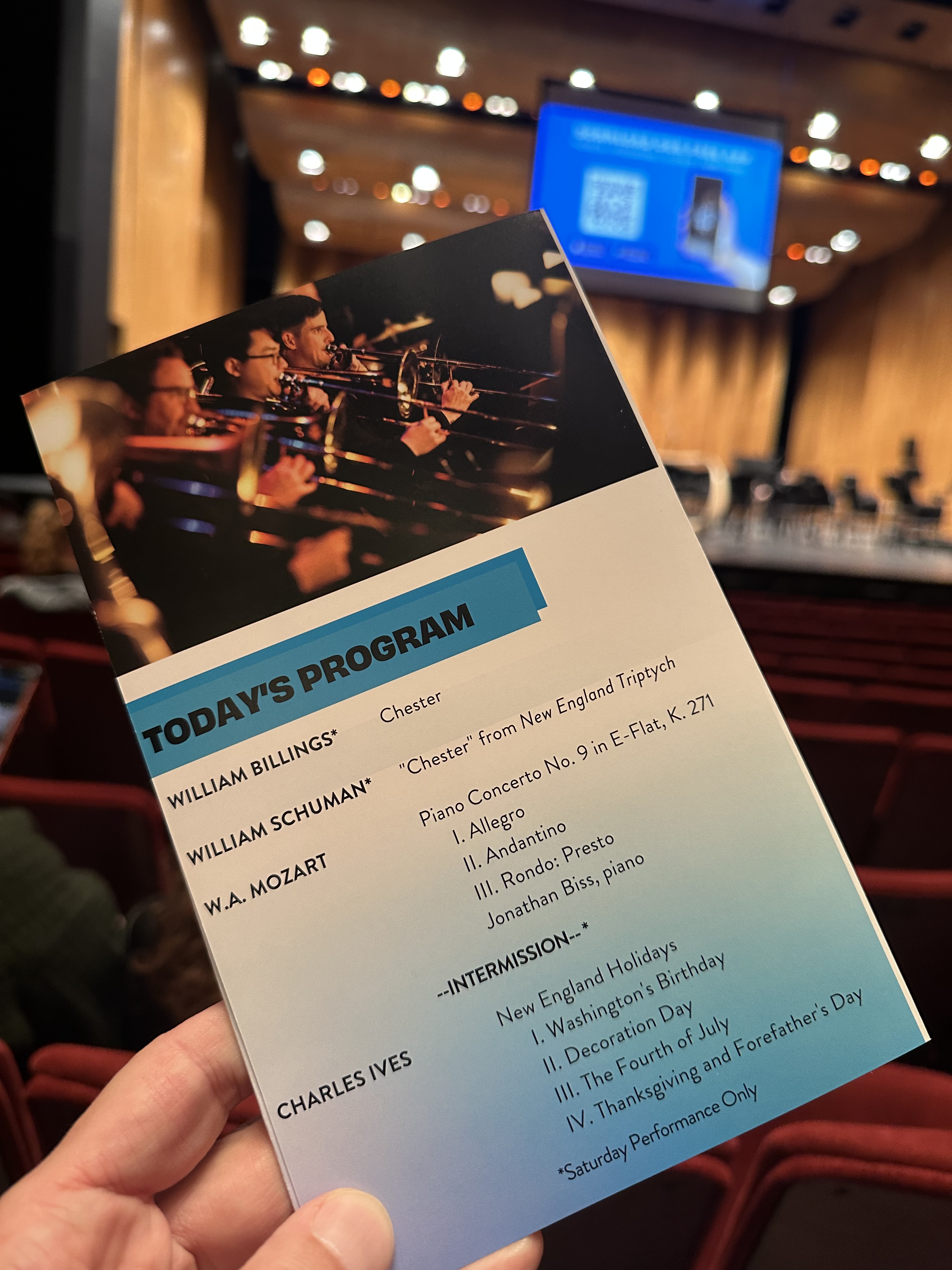
After not enough sleep, I got on an early flight to Cincinnati so I could drive 90 minutes just in time for my next must-hear concert with the Louisville Orchestra under Teddy Abrams. Happily, Louisville was either much more in the mood for American music or that Mozart Piano Concerto was a big draw. The concert started off with the University of Louisville Cardinal Singers performing William Billings arrangement of Chester which was the inspiration for the William Schuman piece in the second slot. It was great seeing the young singers open the concert with a song that was popular in during the Revolutionary War. I loved the Schuman piece that followed and got a bit fidgety during the Mozart. I recognize the greatness of Mozart, blah, blah, blah, but I find it incredibly tedious to sit through at a concert. Plus I was excited for the main event after the intermission.

For those of you who don’t know a thing about Charles Ives (1874-1954), he was an insurance executive who just happened to turn out to be the godfather of American classical music. Over a hundred years after most of his music was written, it is remarkably fresh. I happen to be a bit of an Ives fan (the Alcotts movment from his Concord Sonata is perhaps my favorite piece of music ever written) and the New England Holidays symphony on this program is perhaps the Ives’y-est thing he wrote. It is bananas. Layers and layers of overlapping ideas and song fragments and more than a little bit of humor.

One of the most amazing things about Ives on this particular night happened when the chorus came in for the final five minutes or so of the piece. As the fourth movement progressed, I kept wondering when the choir was going to return to the stage. Scanning, waiting, wondering, where were they? Then the conductor essentially started a countdown with three fingers and I think to myself “where the heck are they?!”

And then two young singers about four seats from me stood up and started singing. My immediate thought was that college-aged singers in isolated pairs scattered around the hall was going to be a disaster. But holy shit, I was wrong. The kids did brilliantly and the very surprised audience was surrounded by some pretty glorious singing adding an ethereal and absolutely immersive finale. I kid you not that I had to choke back tears. It is something I would love to experience again.

A St.Paul surprise
After crossing the country for concerts on Friday and Saturday nights, I was back in Minneapolis by 8:00 AM on Sunday. And then I realized I had a subscription ticket for a St. Paul Chamber Orchestra that afternoon. Happily I rallied, because it was a pretty spectacular way to finish out the weekend. Now, this was decidedly a program I would not travel for, but quite appreciated when it’s played in my own backyard. Selections from Handel’s Water Music, Bach Orchestral Suite No. 4, and Beethoven’s Symphony No. 4. The often conductorless orchestra was led by Richard Egarr who doubled on the harpsichord on the Handel and the Bach.

And let me tell you, the SPCO really laid that shit out. They absolutely dazzled. It was a bit of a palate cleanser after the previous two nights. The Handel is something I loved as a teen but had never heard it live. Bach is someone who I have a hard time sitting through in concert (much like the Mozart reference earlier), but I found it to be a bit of a revelation. The SPCO was joyous and precise and just alive. The Beethoven was also a delight from beginning to end.

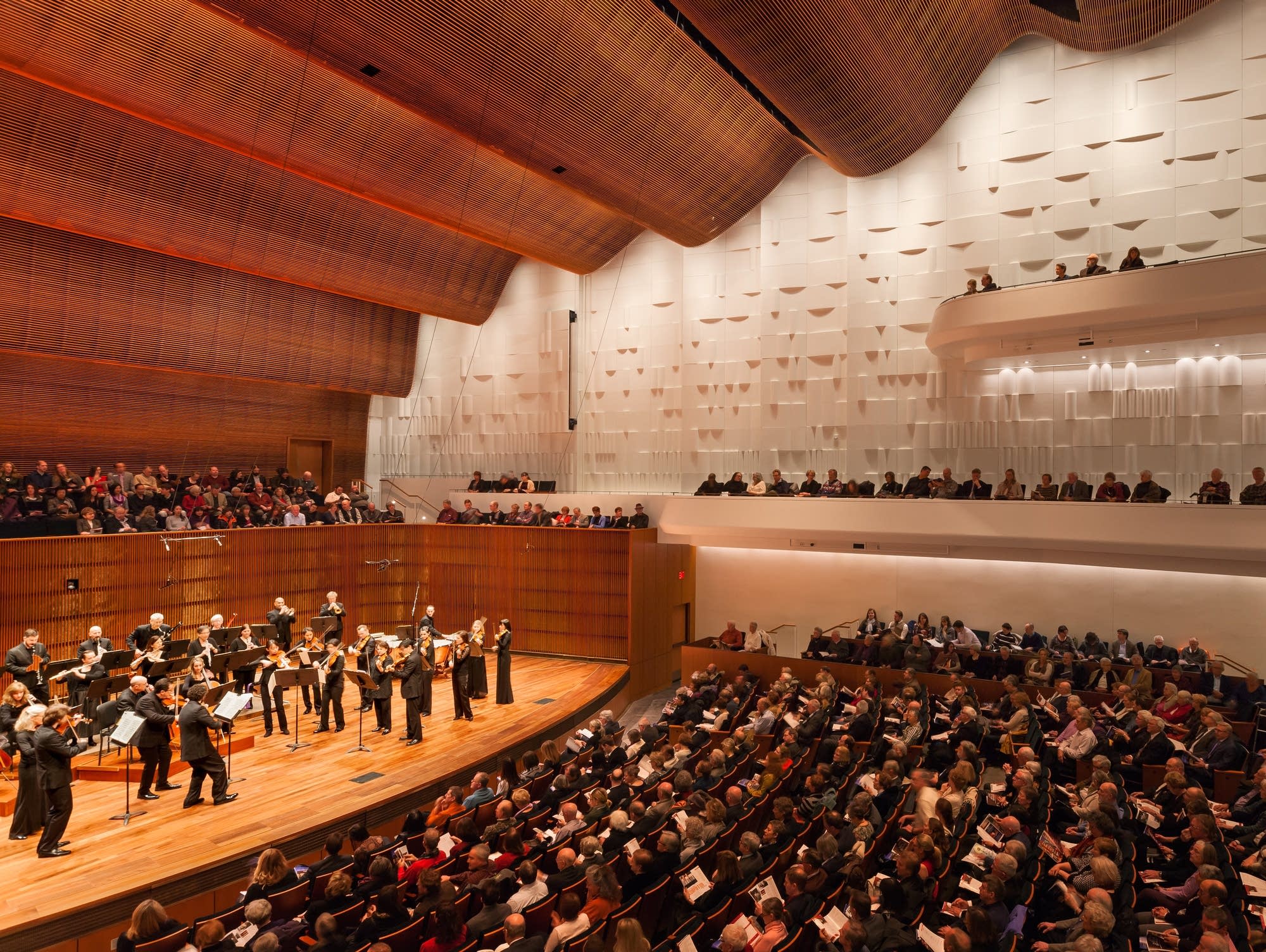
I should note, the concert was not at their lovely purpose-built hall in St. Paul (pictured above) but rather at one of the many other area venues they play at regularly. It just so happened to be at the University of Minnesota School of Music’s Tedd Mann Concert Hall. The venue, inside and out, is nothing to look at. Institutional design at it’s most bland. However, the acoustics in the hall are amazing, particularly for this kind of concert. The whole experience made me happy I can call the SPCO one of my hometown bands.

Phamily in Phoenix

A few days later I hopped on a plane to visit my parents who live in the western suburbs of Phoenix. Last season I heard the Phoenix Symphony play a great Hovhaness Symphony No. 2, I decided to try and squeeze in a concert with them on this trip. (You can see me above taking light rail from my airport hotel to the concert. Public transit. In Phoenix. Very handy.)
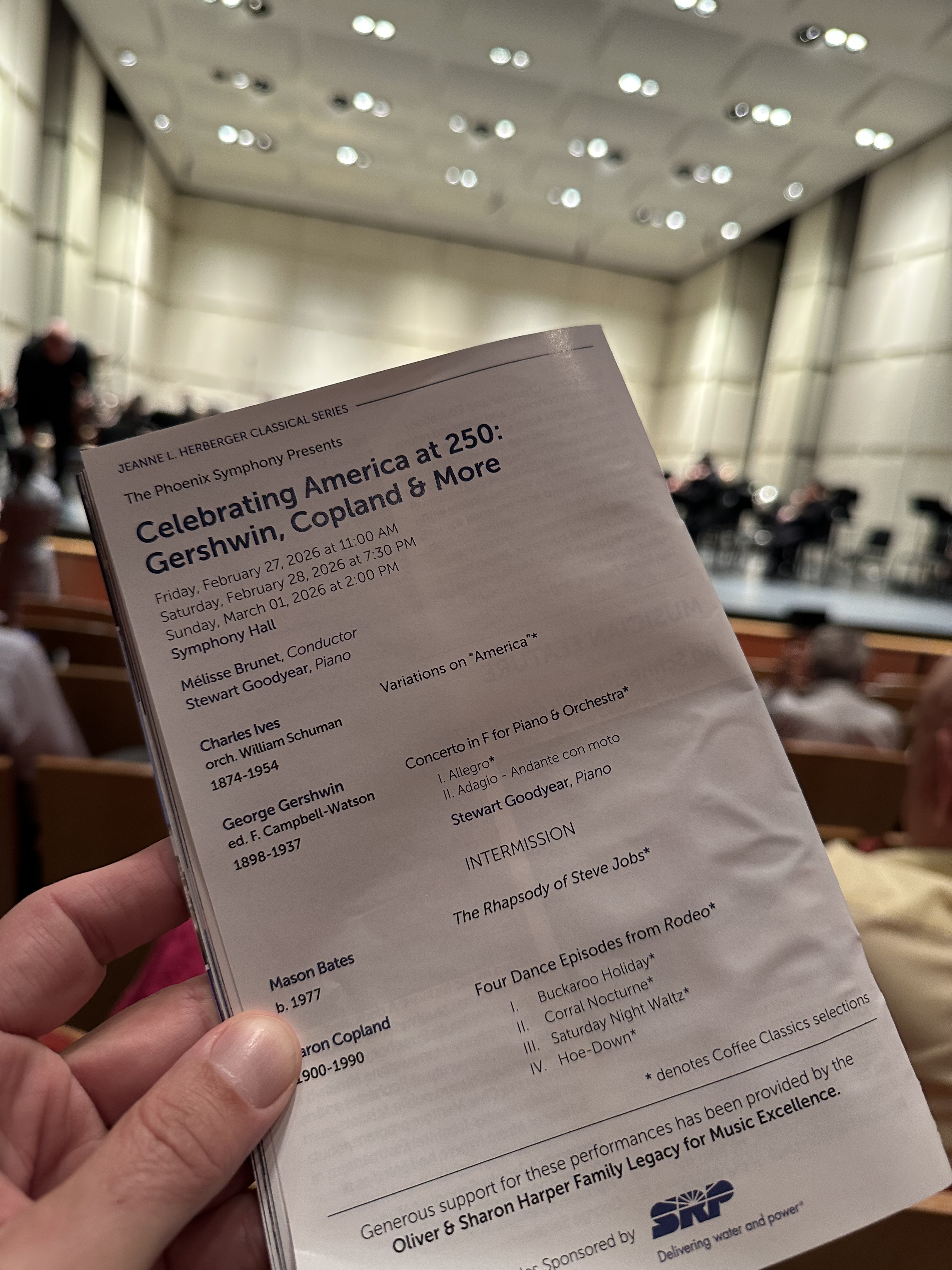
You won’t be surprised to know that the Ives was my favorite part of this concert. Originally written for organ (when Ives was 17) this orchestration by William Schuman is brilliant. Makes you wonder if you will ever like the original version again. The Gershwin Piano Concerto was brilliantly played by Stewart Goodyear, but I’m not sure why they they only did two movements. I’ve heard other things by Mason Bates that I’ve liked but this Rhapsody of Steve Jobs doesn’t do much for me. The Copland was, of course, wonderful, but I do sometimes think that all of Copland maybe sounds too much like Copland.

New York Philharmonic – Tuesday Edition
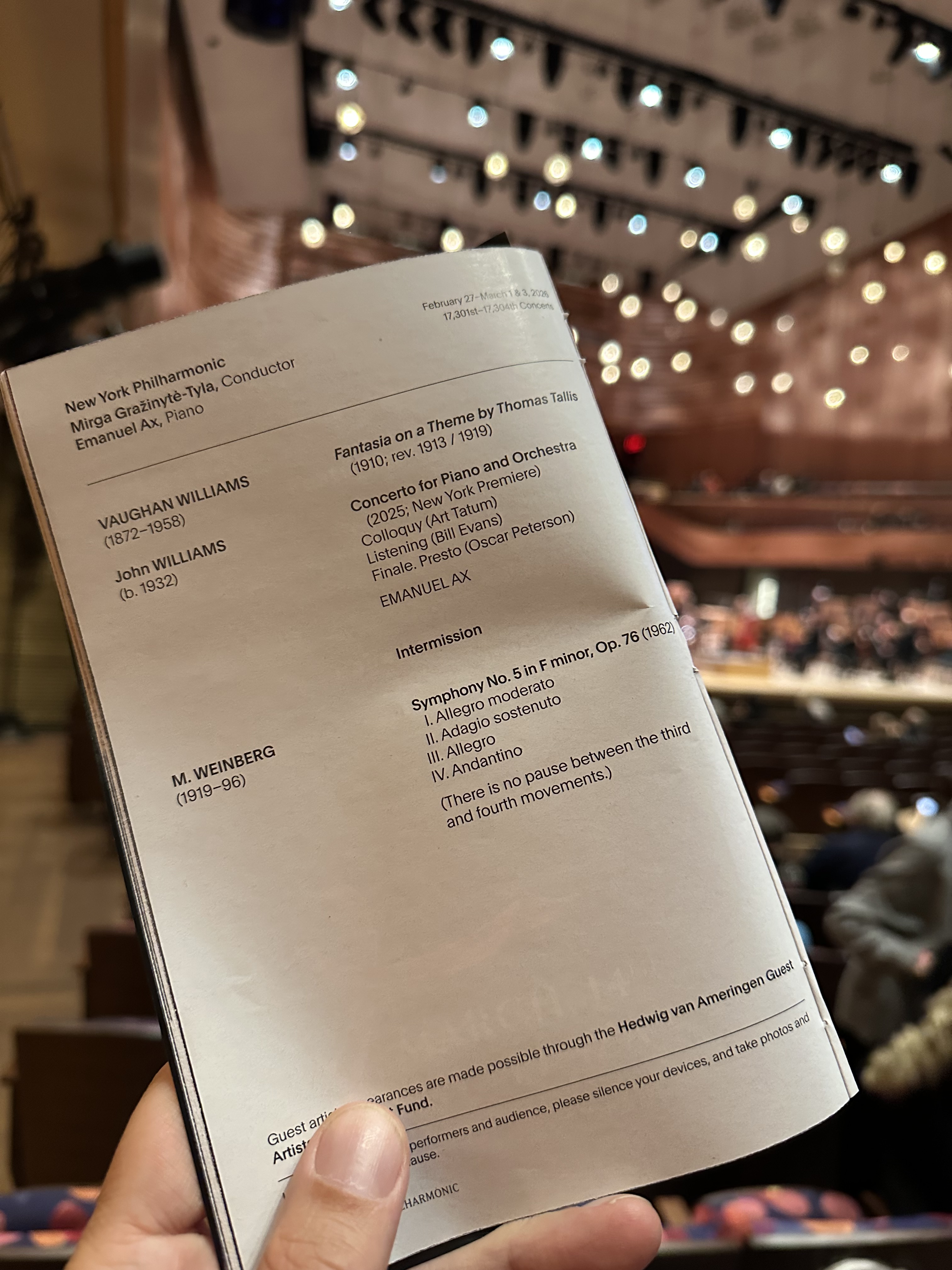
Couple days after returning from Phoenix I find myself in New York for two different concerts both conducted by Mirga Gražinytė-Tyla. The first was on a Tuesday night and started off with a ravishing performance of Vaughan Williams’ Fantasia on a Theme by Thomas Tallis. Such a glorious, moving piece of music, especially with the small chamber group set way back on the stage in dialog with the much larger string section of the full orchestra.

I think the VW is a hard one to follow. It’s a flawless expression of beauty. And then a Piano Concerto by John Williams. I was kind of looking forward to something fun and cinematic. Alas, it had none of the Williams flash, and it didn’t make much of an impression. Seeing Emanuel Ax also made me think that a lot of old people need to enjoy their retirement. Nothing wrong with his playing, but I’m tired of old people in every field who won’t retire and let successive generations have their shot. Of course I am an older Gen Xer who at 56 is realizing that by the time the boomers finally give up the reins we will all be on the cusp of retiring–or dying.

Whenever there is a full symphony by a lesser known/played composer I am likely to consider traveling for it. Even if I know nothing about it. And so Weinberg’s Symphony No. 5 was the impetus for this trip. Definitely worth the trip if not exactly a highlight of my season.

New York Philharmonic – Thursday Edition
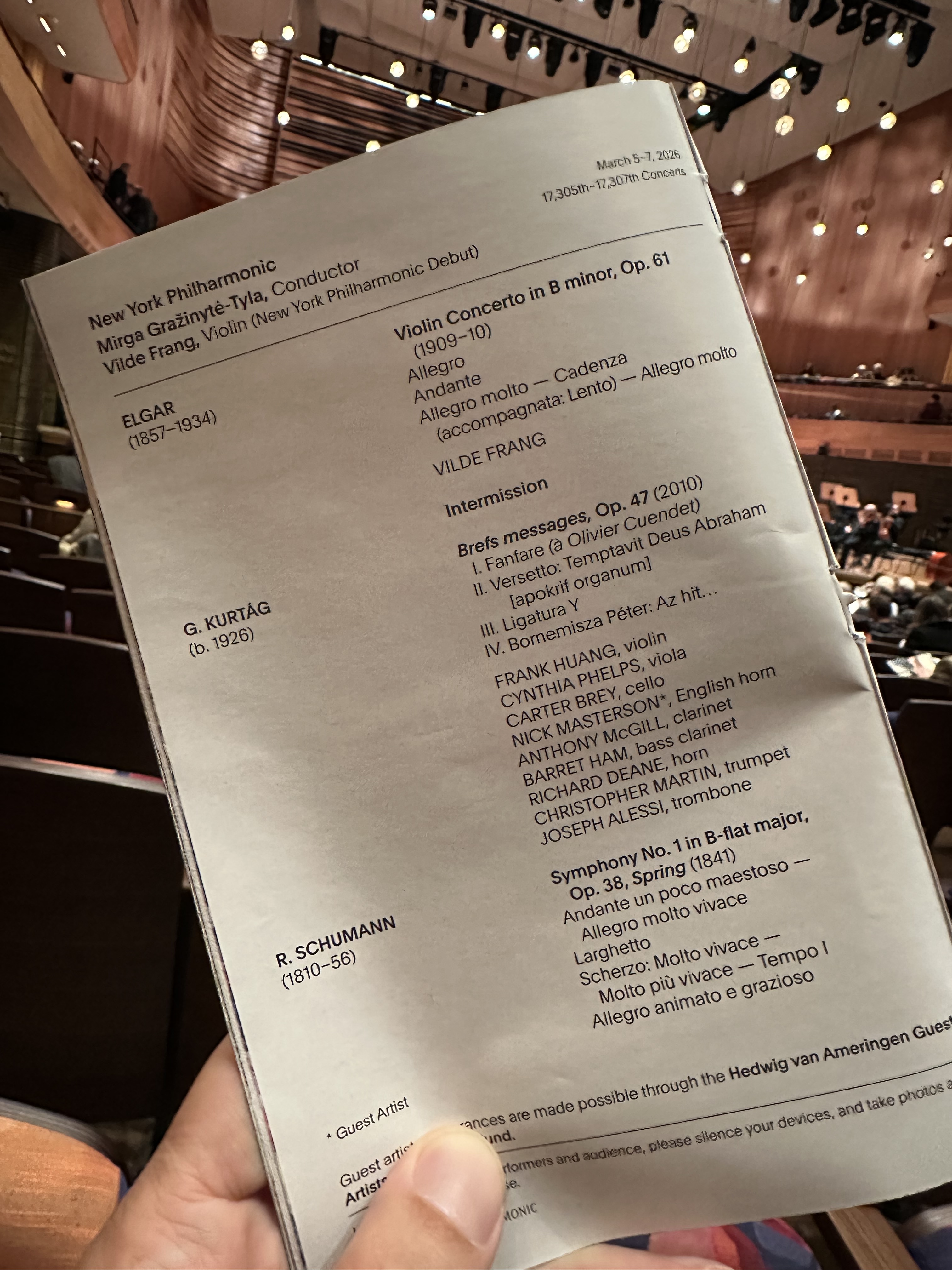
Most orchestras don’t play Tuesday concerts so the fact that I could hear a different program in NY separated by only one day it was a little hard to say no. And the fact that they were doing Elgar’s Violin Concerto sealed the deal. I had never heard it live and I must say, as much as I love Elgar, recordings of the piece never really did much for me. After having heard this amazing performance by the Norwegian violinist Vilde Frang in person, I’m now hooked. What an epic piece. The Kurtag falls into what Dave Hurwitz might call the bleep bloop school of composition. I’m all for “modern” music but this I don’t need to hear again. (You may note the composer is 100 years old!) The Schumann could have been a palate cleanser, but it started off a bit sloppy and was just so/so.

Cleveland is an astounding gem of an orchestra
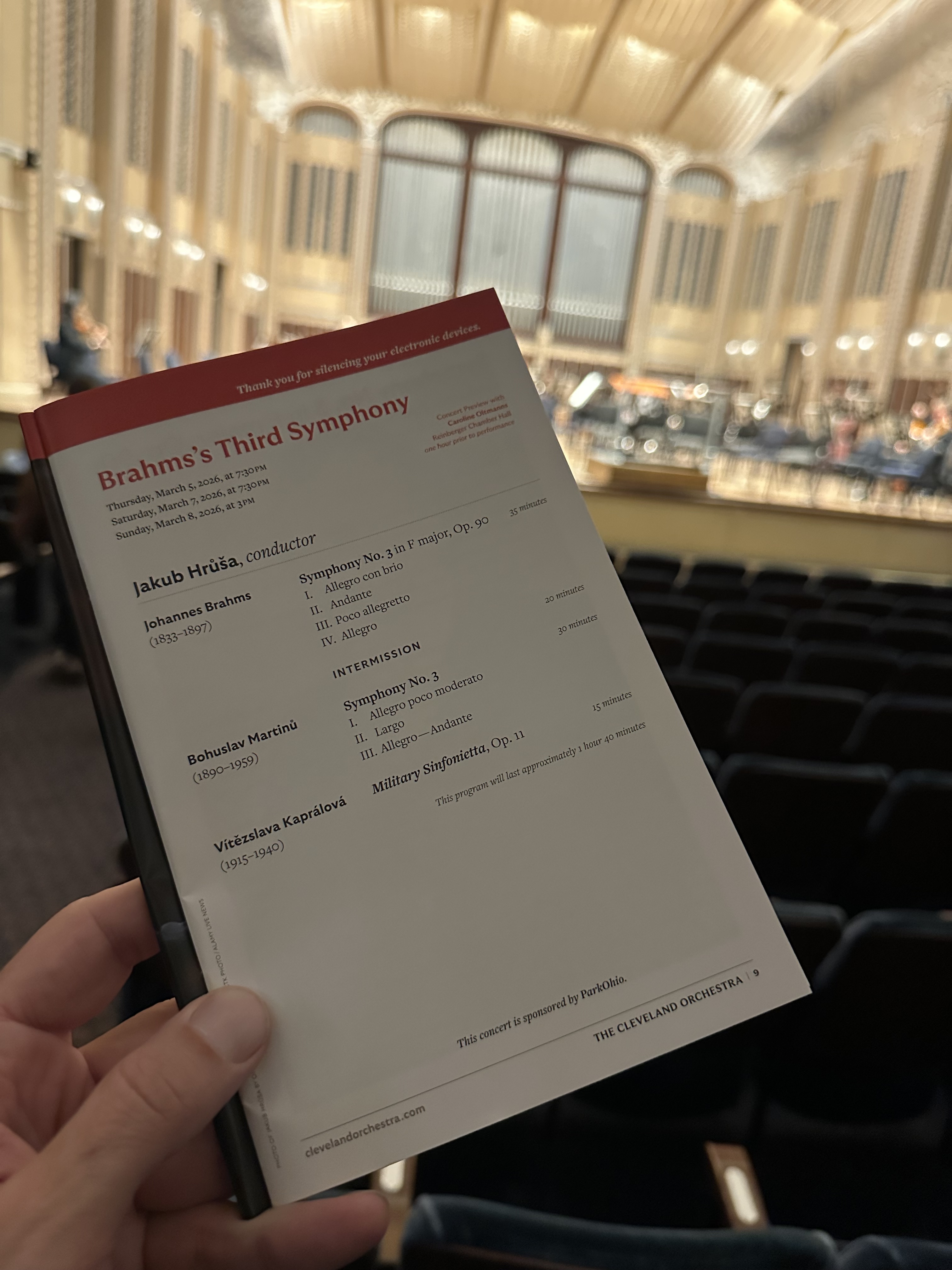
This was my sixth time hearing the Cleveland Orchestra at Severance Hall, in addition to hearing them at the Royal Albert Hall and the Kennedy Center. I am nowhere near being an expert on the relative quality of orchestras, but when you know you know. As soon as they started playing the Brahms, I was astounded once again at how good they are. Although I have heard a ton of very fine orchestras, there is something about Cleveland (and Boston and Berlin) that transcends all the others. Instead of the US Big Five, I think there should be the Top Two and then the rest can just fight it out for the next tier. (It has been a long time since I’ve heard Chicago, so maybe it would be a Top Three…?)

Never that excited about Brahms, Cleveland made me a believer. What a gorgeous performance. The Martinů was the main reason for the trip and was well worth it. The icing on the cake was the rousing closer by Vítězslava Kaprálová, a prolific Czech composer who died when she was only 25. The Military Sinfonietta was written around the time Hitler was annexing the Sudetenland, Kaprálová said that the piece “depicts the psychological need to defend that which is most sacred to the nation.” As an exhausted Minnesotan, all I can say to that is Amen sister.

These un-Christian times

Faith leaders demonstrate against ICE tactics, in the departures area of Terminal 1 of the Minneapolis–Saint Paul International Airport, Friday, Jan. 23, 2026, in St. Paul, Minn. (RNS photo/Jack Jenkins)

Aside from weddings and funerals, I haven’t really gone to church in about 30 years. This morning, despite my non-belief (yes, I’m still going to hell), I felt a strong need to be part of a loving community and took myself off to Hennepin Avenue United Methodist Church.

It was the warm, welcoming, consoling hug that I needed. A congregation unafraid to fight for what is right and just and moral. It was rage and anguish fashioned into love and a firm resolve to help end the occupation and support our neighbors. Among the clergy who spoke was Karen Larson, a Presbyterian minister who told her story of being arrested for civil disobedience at the Minneapolis airport in -22 degrees on Friday morning. (Read more about clergy organizing here.)

As I sat in the pew and wept for Alex Pretti, Renee Good, George Floyd and the state of our country, my own resolve crystalized into what I need to do support my community and help save our democracy. The latter may sound a bit melodramatic, but the moment many of us have predicted is here. This is not happening to Minnesota, this is happening to the whole country. Whatever they get away with in Minneapolis will just be the start of what they do in other parts of the country. This is the moment all of us need to stand up for what is right and just and moral. And dare I say, constitutional.

We all have things we can do.

  • No matter what state you are in, call your Congressional delegation, red or blue, and let them know how you feel.
  • Be vocal with your independent and Republican friends and family. Sometimes I think in an effort to respect varying opinions we stay quiet while all the oxygen is sucked out of the room by the lying liars. I’m not suggesting you get into arguments with MAGA turds, you will never win those, but don’t let their bullshit go unchallenged in front of others.
  • There are plenty of organizations here in Minnesota that can use your help. Check out the donation links on the Stand with Minnesota website.
  • In your own community, look for immigrant support groups, defense funds, the ACLU, and others that are fighting the good fight and give them your time and/or money.

You don’t have to believe in the divinity of Jesus to be a decent, caring, moral human being. And belief doesn’t automatically make you any of those things. I wish more “Christians” understood that.

Getting moody about my library

Since I moved back to Minneapolis in August 2024 my books have been smooshed into a den in the condo I’m renting. I was lucky to find a rental that had that much book storage, not sure what I would have done if that had not been the case.

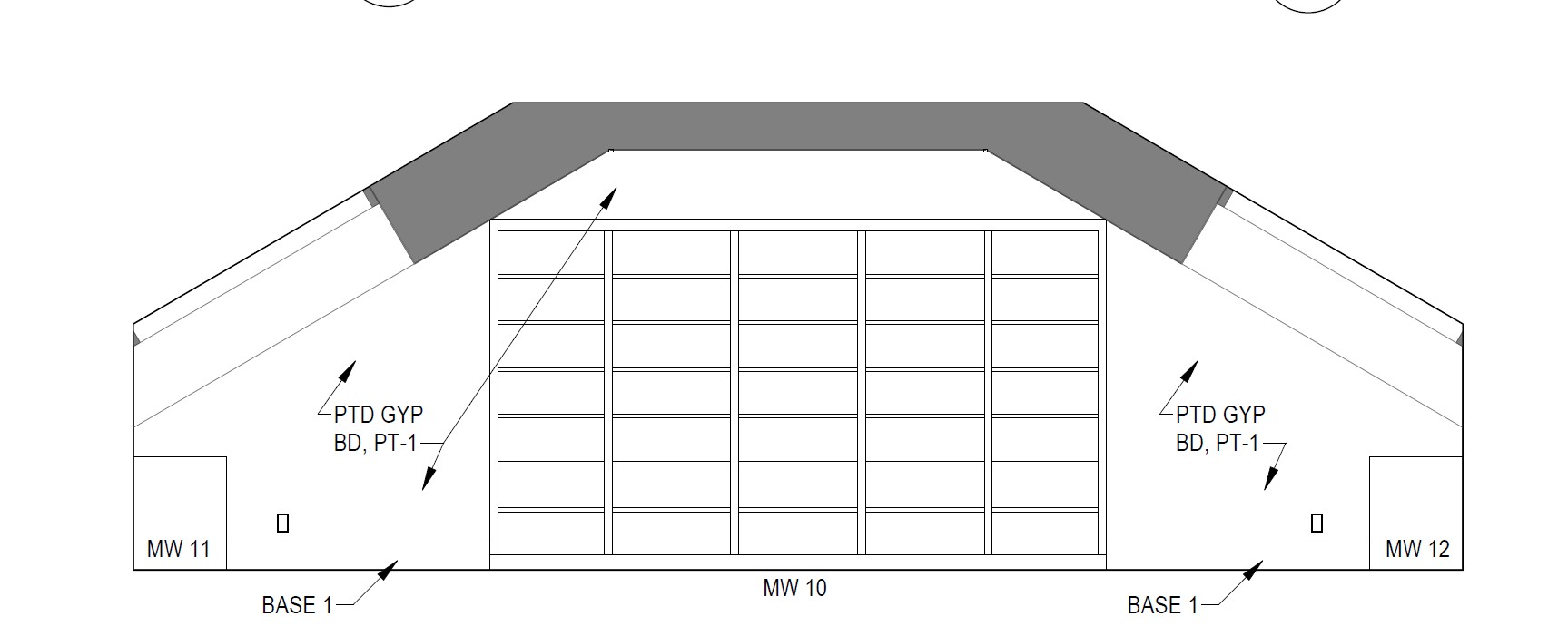
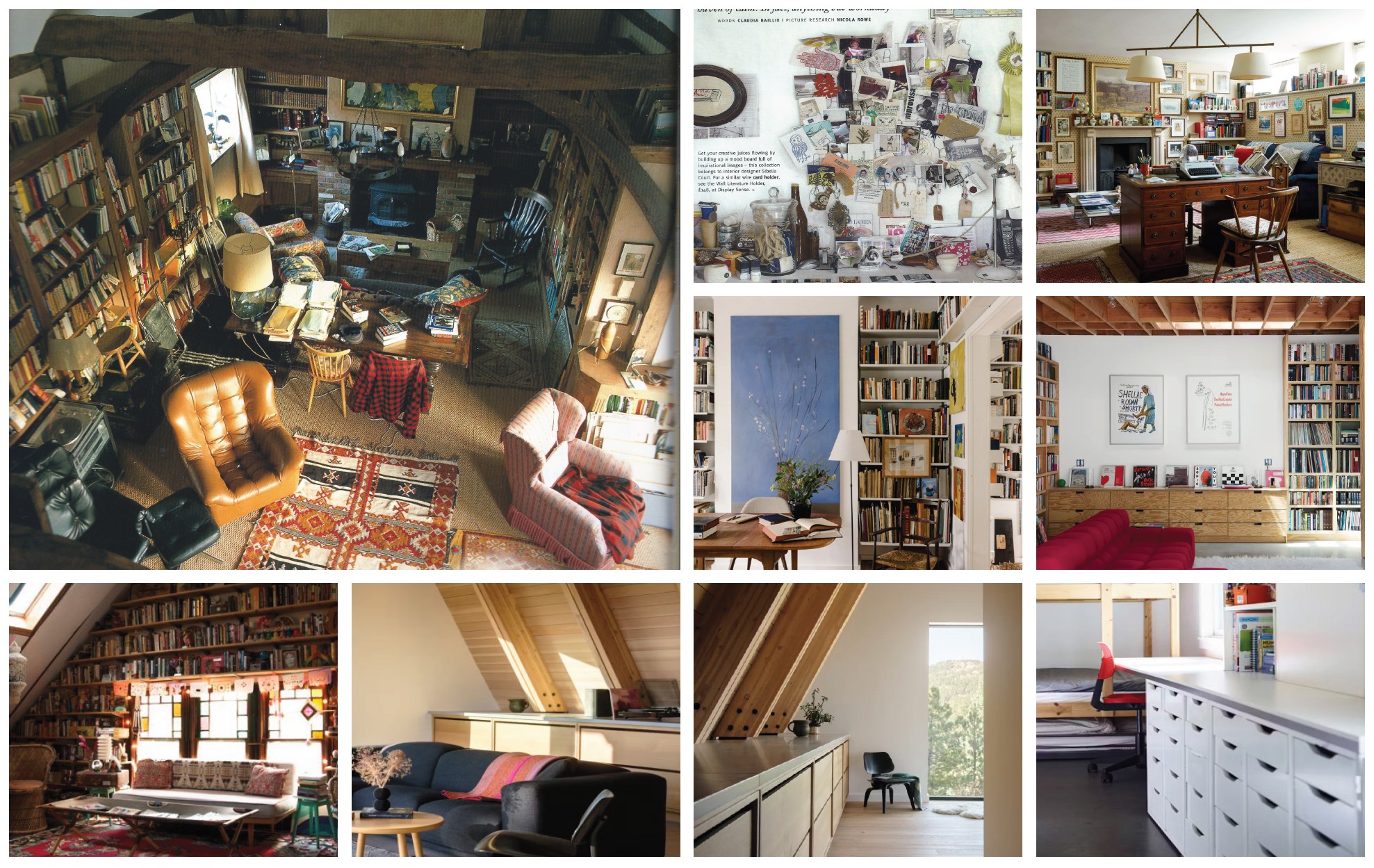
Way back in April of this year, I found a townhouse to buy that is just two blocks from where I am currently living. I really love this neighborhood so I considered it a huge score. After hiring an architect to help me turn it into something that suits my needs and aesthetics, I pulled together the mood board above to help explain to her what I wanted to do with the “attic” space at the top of the house. The overall vibe is meant to be cosy and cluttered and the perfect room for reading, puzzling, listening to my CDs (yes I still buy them), and watching TV. The previous owners were using the space for a bedroom and had a Murphy bed up there and two clothes closets. Those have all been torn out and I will be replacing with a big chunk of bookshelves on the gable end and various kinds of shelves and storage on the bits where the ceiling slants down on the front and the back. The storage units will have a vibe similar to the white painted drawers in the lower right corner, but they will be tucked under the eaves like the two middle bottom photos.

(Regular readers will recognize the big image in the upper left which I blogged about earlier this year.)

That’s 13 feet (3.9m) wide, so about 91 linear feet (27.3m) for books. Initially, I was going to have the shelves go all the way to the edges similar to the gable end shelves in the lower left of the mood board, but when I decided to add bookshelves to the living room (see below) I thought I could pull back a bit up in the attic. Did I mention the attic has four skylights so the room is quite bright even on a gray day?

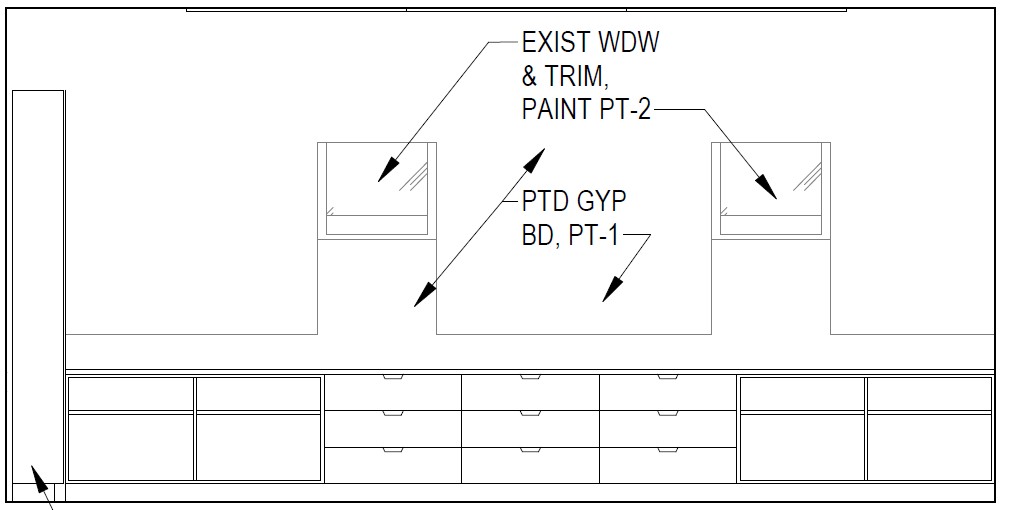
With the wall of books to the left, this shows the elevation of the back wall. Larger shelves for larger books and nine drawers custom-sized for my CD storage. With these cabinets shorter than counter height, you can see how low the ceiling slopes down on this side.

On the opposite wall you can see the configuration of drawers that will be near my desk. Since this drawing I have added more of those shallow drawers so I can treat them a bit like flat files for art and ephemera.

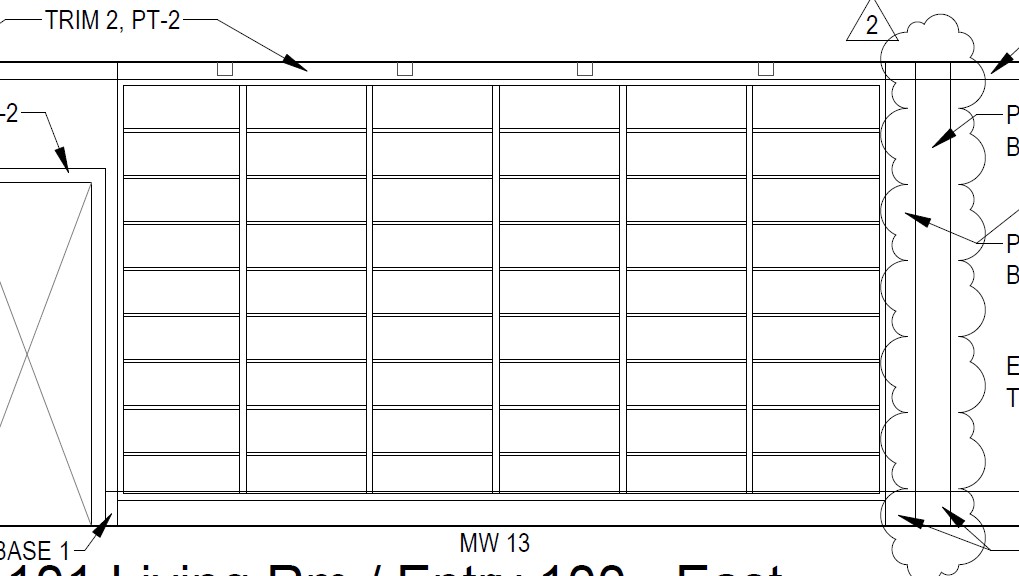
The bit in the bubble is the wall of bookshelves. Furniture layout is conceptual. The sofa is the one currently in my living room. It is low and deep and perfect for napping, I mean reading. The round table is the one I had in my kitchen in DC and will be perfect for laying out larger books for closer study and for jigsaw puzzling. My guess is I’m going to spend a lot of time in this room.

As I worked with my architect, the design for the living room on the main floor was starting to seem like it was going to end up being a museum room. You know, one of those spaces that looks good but no one ever uses. While I was feeling that way I stumbled across this image and decided to add books to my living room. Not only would this warm up the living room and make it a place I would spend more time, but it would also more than double my bookshelf capacity.

You can’t really see it in this elevation, but there was a long niche in the living room that I decided to fill with bookshelves. This adds 135 linear feet (40.5m) for books. I’m toying with the idea of having one whole row be dedicated to various objets, bric-a-brac, and bibelots, but even taking that out of circulation, I will still have tons of room for books.

For years I’ve pared books back and given so, so many away. Now I have room for all of those and then some. I’m already thinking of book buying projects I might undertake once I move in March. If I can wait that long…

Reading for two

In January I take a bucket-list trip to Chilean Patagonia. I’m going with a good friend I’ve known since college days. Our friendship was forged in the early 1990s, period adaptations galore (Forster, Austen, Wharton…), book talk, the New Yorker, and no internet.

Having not dissimilar tastes in books and deciding to not check any luggage, I am in charge of making sure we have enough reading material. Over the course of 12 days we will be spending eight of them in the middle of nowhere and have made a pact to stay as disconnected as possible from our phones and the outside world.

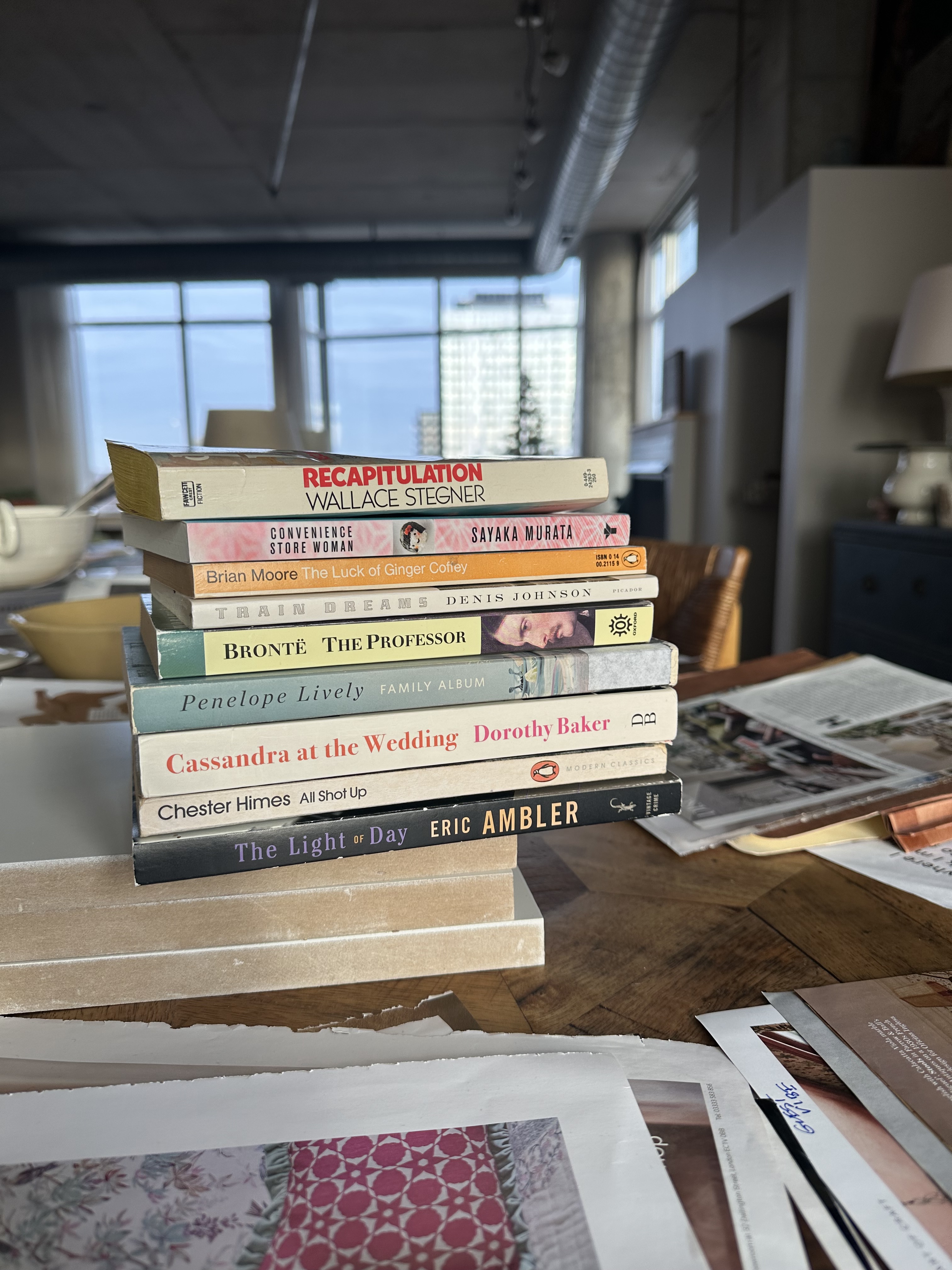
This stack should hold us. We are also bringing recent back issues of The New Yorker and The Atlantic to fill in the gaps.

Recapitulation by Wallace Stegner – In general I like Stegner’s work and I think I first read him in the early ’90s, so this one feels appropriate. It also helped that I had a mass market edition that I can leave behind to lighten the load.

Convenience Store Woman by Sayaka Murata – I got a few pages into this one a few years ago but for some reason put it down. My friend lived in Japan for a couple of years so this seemed like a good choice for something on the contemporary side.

The Luck of Ginger Coffey by Brian Moore – I recently sent Moore’s The Doctor’s Wife to my friend and she loved it as much as I did. Not sure this one will strike the same chords for us, but it will be fun to see what the versatile author does in this novel.

Train Dreams by Denis Johnson – Every one of these 116 pages is brilliant. I’m not interested in seeing the adaptation, but I am interested in a reread and would love to have someone to chat with about it.

The Professor by Charlotte Bronte – One always needs something 19th century on vacation and this one harkens back to our days watching the Austen-a-week adaptations that we went to religiously in the ’90s. Austen is overrepresented in that space, so mixing it up with one of the Brontes.

Family Album by Penelope Lively – My favorite literary Penelope never disappoints.

Cassandra at the Wedding by Dorothy Baker – Nancy Pearl says reader reaction to this novel is a litmus test for whether she is likely to get along with someone.

All Shot Up by Chester Himes – I haven’t read Himes and this one was described by Newsweek as “Pungent, violent and mordantly funny” Doesn’t really seem to apply to anything else in the stack.

The Light of the Day by Eric Ambler – A favorite of mine and I have an extra copy so I am comfortable taking it south of the Equator.

The end (of the year) is nigh

I will probably finish at least one more book in the next 11 days, but given how bad I have been about posting anything here I am going to write this post while the iron is hot.

A rather slow reading year for sure. At 27 books read, that’s one more than my abysmal total of 26 in 2024. I have to go back to the 1990s to find a year with such low numbers. I don’t necessarily want to try for trip digits again. The four years I managed to crack 100 (110, 110, 104, and 122) were notable for not really enjoying the reads as much as I should have. But there is a lot of distance between 27 and 122. I think 2026 is to go back to my goal in 2004 which was to read at least 52 books in a year.

But enough about numbers. What were my top five titles for 2025? (You can look here for all the books I read in 2025.) Not surprisingly most of what I read and most of what I liked could all be considered vintage reading. But anyone who knows me knows I am stuck in the past.

The Doctor’s Wife by Brian Moore was probably the book I loved most this year. Back in 2005 I didn’t really get on too well with Moore’s The Lonely Passion of Judith Hearne but I gave him another chance in 2022 with The Great Victorian Collection which was quirky to say the least and ended up enjoying it quite a bit. So it was a delightful surprise when I settled into The Doctor’s Wife. Published in 1976 it focuses on an Irish woman who goes to visit a friend in France only to turn everything in her life on it’s ear. I loved every damn minute of it. I love a story where the protagonist busts through expectations in search of happiness. Easily my favorite kind of book. It also has me rethinking my earlier experience with Judith Hearne and am planning a reread to see what I may have missed the first time.

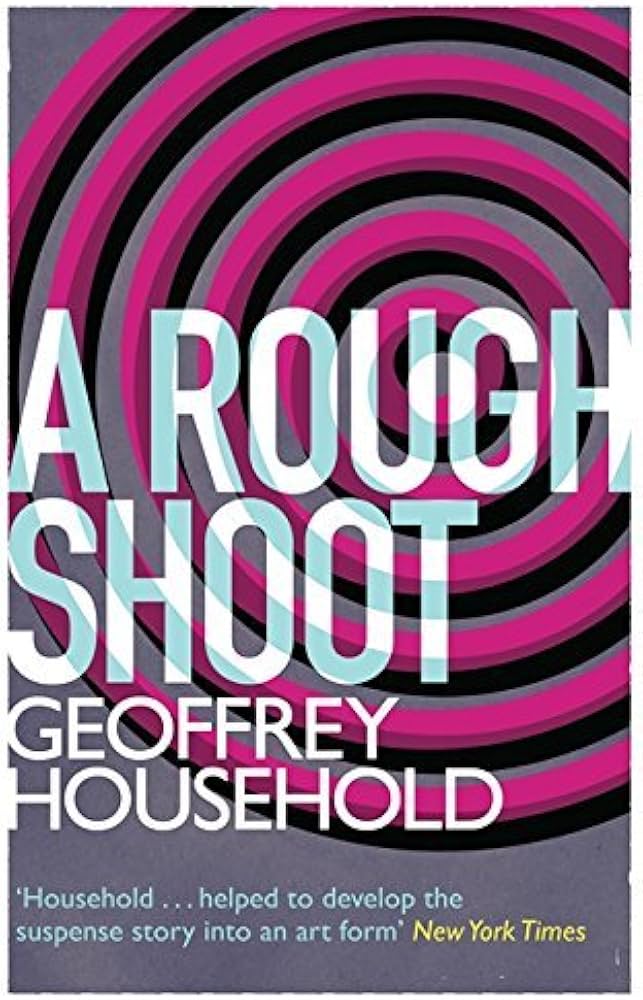
Many of you will recognize Geoffrey Household because of the NYRB Classics edition of Rogue Male. That was certainly my introduction to his work. From my experience so far, Household’s work consists primarily of vintage British spy thrillers. Of course they weren’t vintage when he wrote them, but they are delightfully old fashioned. A Rough Shoot, published in 1951, requires a bit of a leap at the beginning when everyday guy Roger Taine accidentally kills a guy hiding in a hedgerow and then another leap when the action moves from evading his crime to the center of a plot to bring fascism to the UK. Fast paced and short. I could read a million of these. (Incidentally, this was turned into a film written by Eric Ambler, a writer I love and have waxed rhapsodic about on myriad occasions.)

This past year a new bookstore has opened just three blocks from my new place in Minneapolis. Half cafe/half books, the stock is a little Gen Z for my tastes, but I did stumble across this McNally Editions copy of Ex-Wife by Ursula Parrott. I knew nothing about it and ended up enjoying it immensely. Published in 1929, this book has it all, open marriage, divorce, abortion, casual sex, and all sorts. Quite a bit more tragic than The Doctor’s Wife, it still fits my sweet-spot for people finding agency in their own lives.

If you like Mapp and Lucia, you will like Paying Guests. Published in 1929 it may in fact have been the result of Benson coasting of the success of the Lucia series. But for fans this is a good thing. Instead of Major Benjy, there is Colonel Chase obsessed with his pedometer. Instead of a hanging committee refusing Lucia and Georgie’s little daubs there is a self-mounted solo exhibition that goes from failure to triumph. Throw in Christian Science, rubbers of bridge, and a lot of gossip and you get the picture. One caveat, unless you love bridge, there is an entire chapter you can skip.

Finally, something published this century! Mark Haber’s Saint Sebastian’s Abyss published in 2022 focuses on an art historian who has made his life’s work studying and writing about a single painting who is on his way from New York to Berlin to visit his ailing once best friend and colleague who also made his career studying and writing about the same painting. Stylistically, the writing has some charming quirks that could have easily caused me to set the book aside. In recent years I have almost entirely eschewed such creativity for more straightforward prose. I’m a literalist at heart but it felt good to read something that demanded ambiguity and suspension of disbelief. There is also a lot of repetition in the text that feels almost poetic and reinforces the singular nature of the careers of these two scholars obsessed with what I’m assuming is a fictional work of Dutch Renaissance art by Count Hugo Beckenbauer. It is only 130 pages but it is the kind of book you want to discuss with others who have read it.
Playing the next city game

When I sit in front of my TV, I watch a lot of YouTube. Besides classical music, 1940s educational films, mundane court proceedings, dashcam videos and other odd avenues of exploration, I watch a lot of aviation related content. This kind programming can go lots of different directions including a whole community of content creators who are true AV geeks who go on some truly crazy flights just to explore a plane type, an esoteric route, or unusual airlines, among other things.

One such creator who I watch with some frequency is Noel Philips, a British man living in Houston, who posted a rather fascinating video about 10 months ago, but which I just stumbled across this past weekend. In that video, he chooses the cheapest flight out of his home airport on a given day (in this case it’s Guatemala via Fort Lauderdale) then when he gets to that location, he goes online to Skyscanner and figures out the cheapest flight leaving the next day and then goes there, repeating the process each time he lands. He sets certain rules for himself so he doesn’t backtrack or doesn’t get “stuck” somewhere, but otherwise he really is rolling the dice each day.

I was fascinated by this idea and am hatching ideas to do this at some point. Perhaps when I retire, but maybe sooner. Take a longish vacation with no plan until the day I go. One big difference for me is that I want to spend at least a day or two in each location rather than just overnight like Philips does.

Since I can’t take this kind of crazy trip anytime soon, I decided to go to Skyscanner tonight and pretend I was leaving tomorrow. The results were kind of fascinating. Since Philips’ actual trip took him south of the border and all through Central and South America, I wanted to see where else I could go, so I stuck with the US and Canada and once in Canada decided to hop over to Europe.

Except for the transoceanic flights, almost no flight on my itinerary was over $100. I allowed myself about two days in each location and kept playing until I hit my birthday in mid-August.

Leaving Minneapolis tomorrow this is what my North America itinerary looks like choosing only the cheapest flight from each city:
Denver, CO
Portland, OR
Cincinnati, OH
Houston, TX
Calgary, Alberta

Calgary, Alberta

In Denver I could visit the Clyfford Still Museum, Portland is one of my favorite cities, Cincinnati is great with one of my favorite bookshops, Houston would have me at the Menil Collection, and Calgary is totally new to me.

Once out of the US, I only allowed myself one destination in a given country and no repeating countries. The cheapest flight out of Calgary outside North America was London which kicked off my European leg sojourn. (And if I could survive Ryan Air, it was only $18 to go from London to Frankfurt…)

Riga, Latvia

London, England
Frankfurt, Germany
Sofia, Bulgaria (new to me)
Corfu, Greece (new to me)
Turin, Italy (a city I quite like)
Prague, Czechia (haven’t been there in 25 years)
Brussels, Belgium
Stockholm, Sweden (new to me)
Tallinn, Estonia (new to me)
Riga, Latvia (new to me)
Oslo, Norway (new to me)
Copenhagen, Denmark (new to me)

Let me tell you, one could spend a lot of playing this game in Europe, especially if you allowed for repeating countries if not cities. Still, at this point I thought maybe I would shoot for Asia which led me from Copenhagen to Beijing.

Jeju, South Korea

With the exception of Bangkok, all of these destinations in Asia where new to me.
Beijing, China
Jeju, South Korea
Taipei, Taiwan
Manila, Philippines
Kuala Lumpur, Malaysia
Singapore
Bangkok, Thailand
Phnom Penh, Cambodia
Ho Chi Minh City, Vietnam
Denpasar, Indonesia

And then, up popped Australia. Darwin was the cheapest, but I thought the choices out of Darwin might be somewhat limited, so I went for the next cheapest which was Perth.

Perth, Australia
Doha, Qatar
Muscat, Oman
Abu Dhabi, UAE
Yerevan, Armenia (I had to avoid some political hotspots)

Larnaca, Cyprus

Larnaca, Cyprus
Vienna, Austria
Dubrovnik, Croatia
Basel, Switzerland
Budapest, Hungary
Bucharest, Romania

Which then landed me in Istanbul on my birthday in August. Of course much of this itinerary, once it hits Asia and the Middle East becomes a little intolerable for me heat wise in the summer. So maybe in real life I would have to make other choices/rules.

I think I have found a new way to waste time.

Make this library famous

Tonight I was doing Google image searches for inspo pictures for my new home library. (More on the new home in the coming months.) I was surprised to find that one of my favorite images, either doesn’t exist online or is very hard to find. It’s a single picture adorning the introduction of At Home with Books by Estelle Ellis, Caroline Seebohm, and Christopher Simon Sykes. I’ve had the book for ages and this particular image is one my favorite bookish rooms in the world.

So, always one to right an online oversight (see also Pym cover artist Jackie Schuman), I decided to scan the image and post it here so others might track it down one day whether they mean to or not. This is the library of historian Sir Alistair Allan Horne CBE FRSL (1925-2017). I’m assuming the photo credit goes to Christopher Simon Sykes as he is given overall credit for the photos in the book. (By the way, this fabulous book is pretty available at very reasonable prices online.)

Not only do I love this room for its books and bookshelves, but I love the large table/desk, the many comfy places to sit, the fireplace, and the hi-fi. My mind is already twirling about including a hi-fi in my new li(brary).

So click away. Make this library famous.

2024 in books: a slow reading year

It has been a long time since I have read so few books in one year. In addition to the measly 28 books I finished in 2024 I did not finish maybe an additional 10 or so. Even pushing that number up to 38 would have been one of the slowest years on record since my 20s.

The following things may have been part of the problem:

  • I spent longer on books that I eventually abandoned than I would have in past.
  • I decided on June 3rd to sell my house in DC and move to Minneapolis. This diverted both mental and physical focus from reading.
  • Once I moved to Minneapolis in August I found myself with a social life. (Mission accomplished.)

I’m not beating myself up for my poor performance, but it’s not something I would like to repeat in 2025. It’s already feeling like a more readerly year.

2024 sent me even further back into the wayback machine than previous years. I’ve always been prone to read older fiction. Then Tr*mp came along in 2016 and I wanted to read stuff that existed before anyone knew who he was. Then Covid happened and the perpetual snowday feeling of almost a year and half of lockdown had me craving old fashioned cozy even more than ever. Then John died and that had me searching for more comfort. And now fuckface is back in power. Will I ever read a new book ever again? Hard to know.

There were also a lot of rereads in 2024. Out of the 28 books I read, 17 of them were rereads. That is a little bananas.

Newest Book (published in 1987!)

Favorite First Read

Favorite Rereads

Smooshing my library

As I think most regular readers will know, I sold my house in DC and moved my butt back to Minneapolis, a place I haven’t lived in for 24 years. At some point I will do a post about that, but suffice it to say for now, I love pretty much everything about my new life.

I was lucky enough to find a condo to rent that has a den that actually has some built-in shelves. But, as the pictures you are about to see will show, I don’t have near enough room for my collection of books. I hear some of you saying “Time to weed your collection.” But I have cut as far to the bone as I am willing to go. I have about 800 unread novels. No way I’m getting rid of any of those. About 10 years ago, I greatly pared back the novels that I have read–I limit myself to keeping only those I think I may read again. No matter how much I may have liked something, if I don’t think I will read it again, it goes.

Where everything used to go.

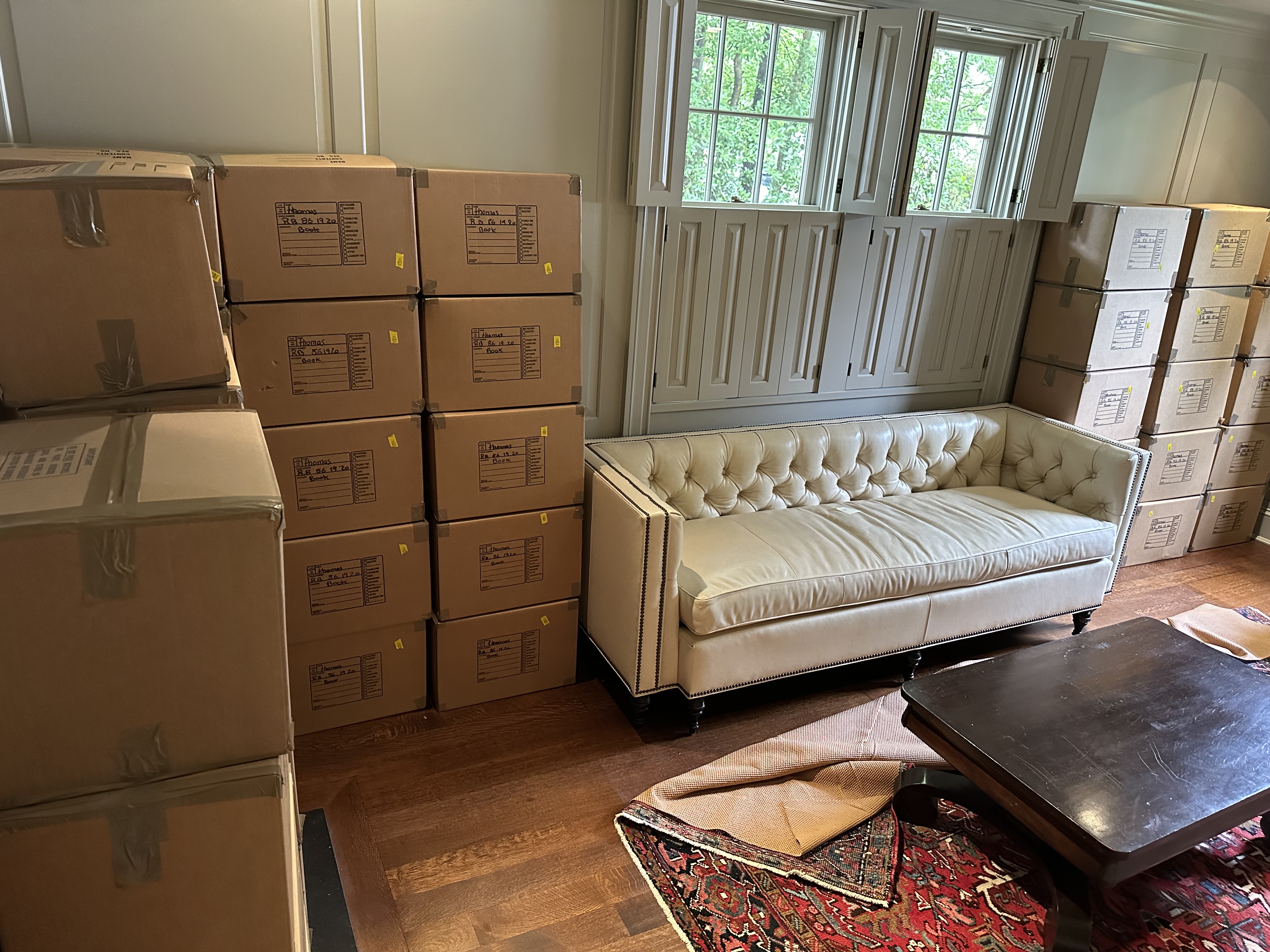
49 boxes ready to move half way across the country.

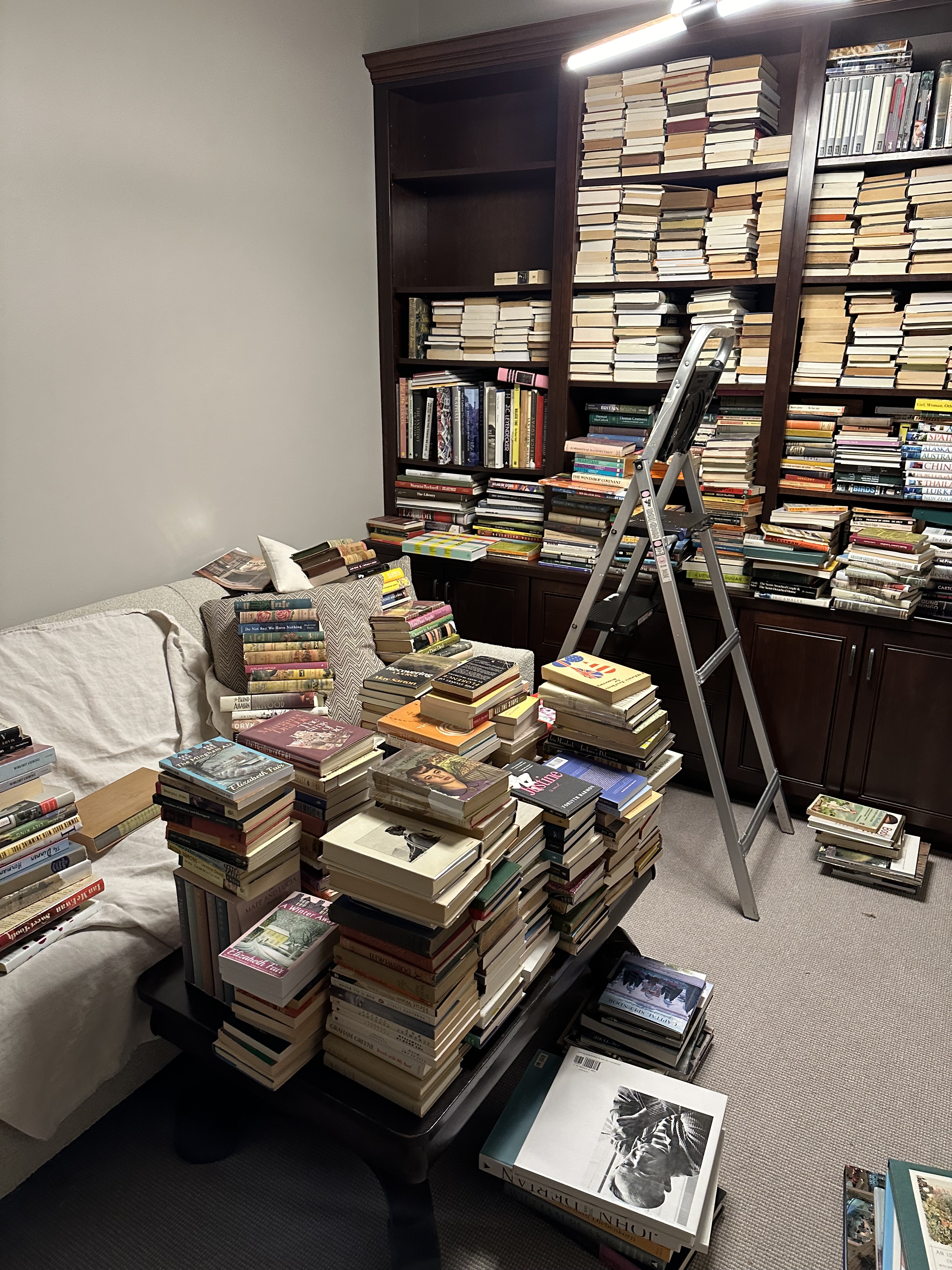
The reality of not having near enough room starting to set in.

I gave up trying to be methodical. I just wanted to get the boxes out of the house, so I was just shoving books wherever there was room.

Stacking them on the shelves with short edges out was necessary to get as many off the floor as possible.

Nothing in any kind of order.

I decided to get as many of the novels that I have already read out of the way by shoving them way up here. Accessible only by ladder, disheveled at best, and not in any order.

I increased capacity by adding one additional shelf to each stack. You can see that one of the rows is just plain old MDF. What you see on the main part of the shelves are all the novels I have yet to read. There are additional novels that I’ve already read tucked away in those somewhat useless cabinets.

Most of my non-fiction unceremoniously stacked in a corner of my coat closet.

Now my non-fiction collection is a bunch of books that I don’t necessarily plan to read. Rather, I tend to use them more as reference books when I want to dip into a topic. My non-fiction consists largely of books about the UK, literary stuff, books on books, some on musicians and composers, and other odd bits. And when it comes to those books I feel without them I don’t have a library, I just have books. These are the volumes that you might peruse when you go to a real library, but are unlikely to check out. Volumes that provide some serendipitous delights or interesting tidbits. Books to open when you want to be bookish but don’t have the presence of mind to sit down and read. I imagine these books in a big old room with a large table, a big dictionary or atlas on a stand, and maybe a globe nearby. You know, a library.

That’s what makes it so hard to see them stacked up like this. Not very easy to gaze at them and randomly pick up one that catches my eye. And don’t even ask me where my Trollope Gazetteer went to. Still, it could be a lot worse. It’s also clarified for me how much book room I want and need when I buy a house or condo eventually.

The best of humanity

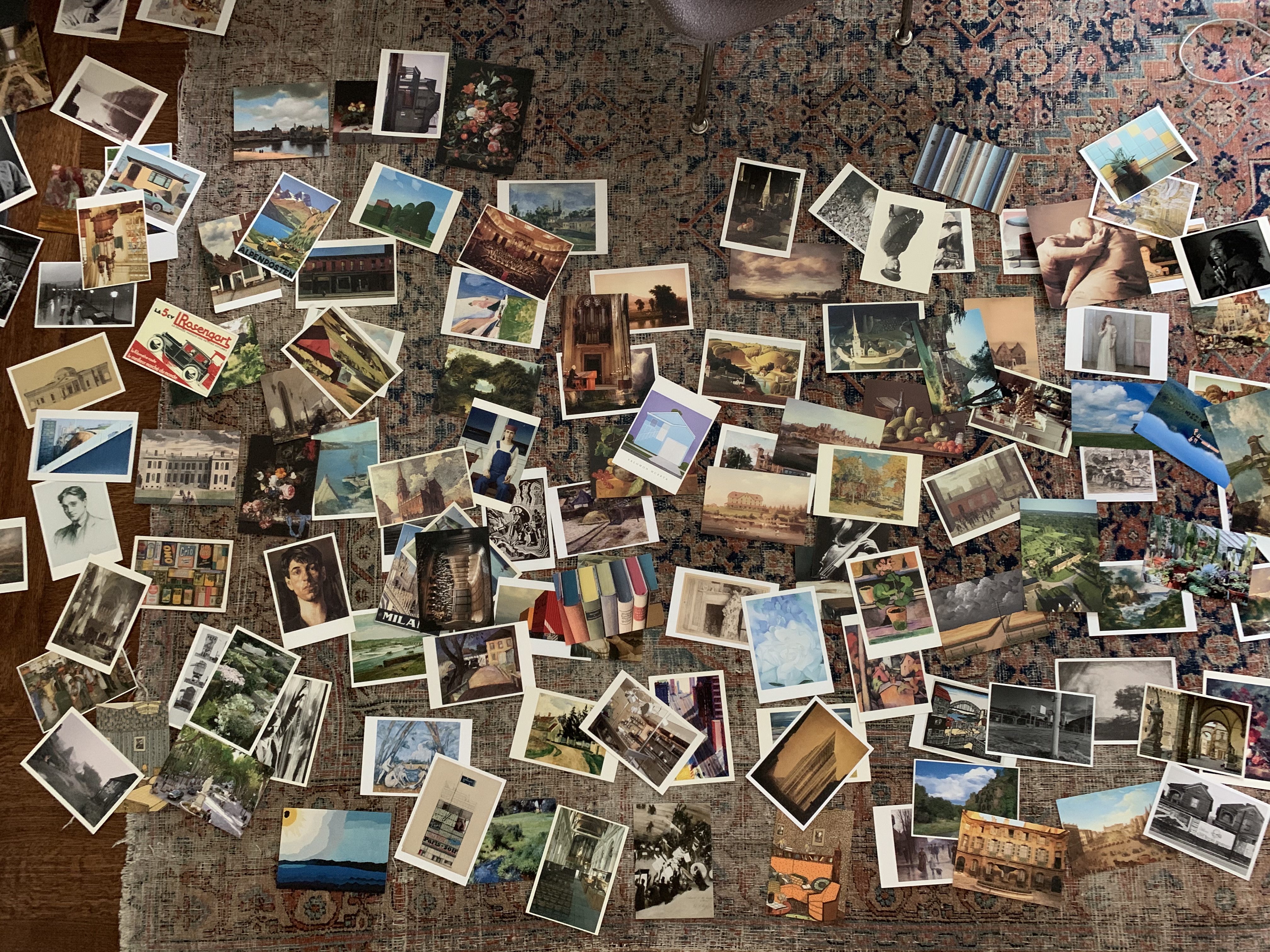
Back in August 2020, during the depths of Covid lockdown, I decided to plaster my office wall with postcards I had collected since the late 1980s. I called it my Wall of Humanity, reminding me of all the glorious things out in the world that I would hopefully see again one day.

Now that I have sold my house and am moving to Minneapolis (hmm, I guess I haven’t mentioned that in this forum have I? More on that in the coming weeks.) it was time to dismantle the Wall of Humanity. As I started to do that today I was a little overcome with emotion. Not only did many of these cards remind me of so many wonderful experiences with John (on what would have been his 61st birthday) but they also reminded me of the wonderful time John and I had during lockdown.

I thought maybe I would arrange them on the floor first.

Normally John traveled for work about fifty percent of the time and Covid lockdown was almost two years of uninterrupted time together. And it was amazing. We were lucky enough to have our jobs, our house, our dog. It was like two years of snow days. Yes, we worked during the day, and both were quite busy at that. But there were lunches on the porch with Lucy, watching purple finches build a nest nearby. Instead of leaving the office at 7:00 or being out of town, John would emerge from his basement office closer to five and the evening would begin. And we loved it. We were convinced from the experience that retirement together was going to be a lot of fun. We never ran out of things to talk about.

So today while I took these postcards down, in many ways happy to be embarking on my new adventures in the next month or so, I was overcome with memories of those golden days. It was like the scenes in Brideshead Revisited when Charles stayed at Brideshead for the first time during the long vac. It wasn’t entirely sad, but it wasn’t entirely happy either. On top of that there were the memories that each card evoked, not just in my 20 years with John, but also the ones collected earlier in my youth and all the hopes and aspirations associated with those.

As the white space on the wall started to overtake the mosaic that had been there for almost four years, I began to transition from the past to how I was going to keep these moments with me as I move into my future. Both practically (maybe a rotating display in my new place?) and emotionally (perhaps time to jettison another layer of grief and focus on what’s left of my life?). But that makes my current emotional state sound more fraught than it is. Yes, I still experience loss and grief on a regular basis, but the overall trajectory of my days bends towards hope and excitement.

Glad to have this stack of memories.