Shelves that fill up faster than you can build them

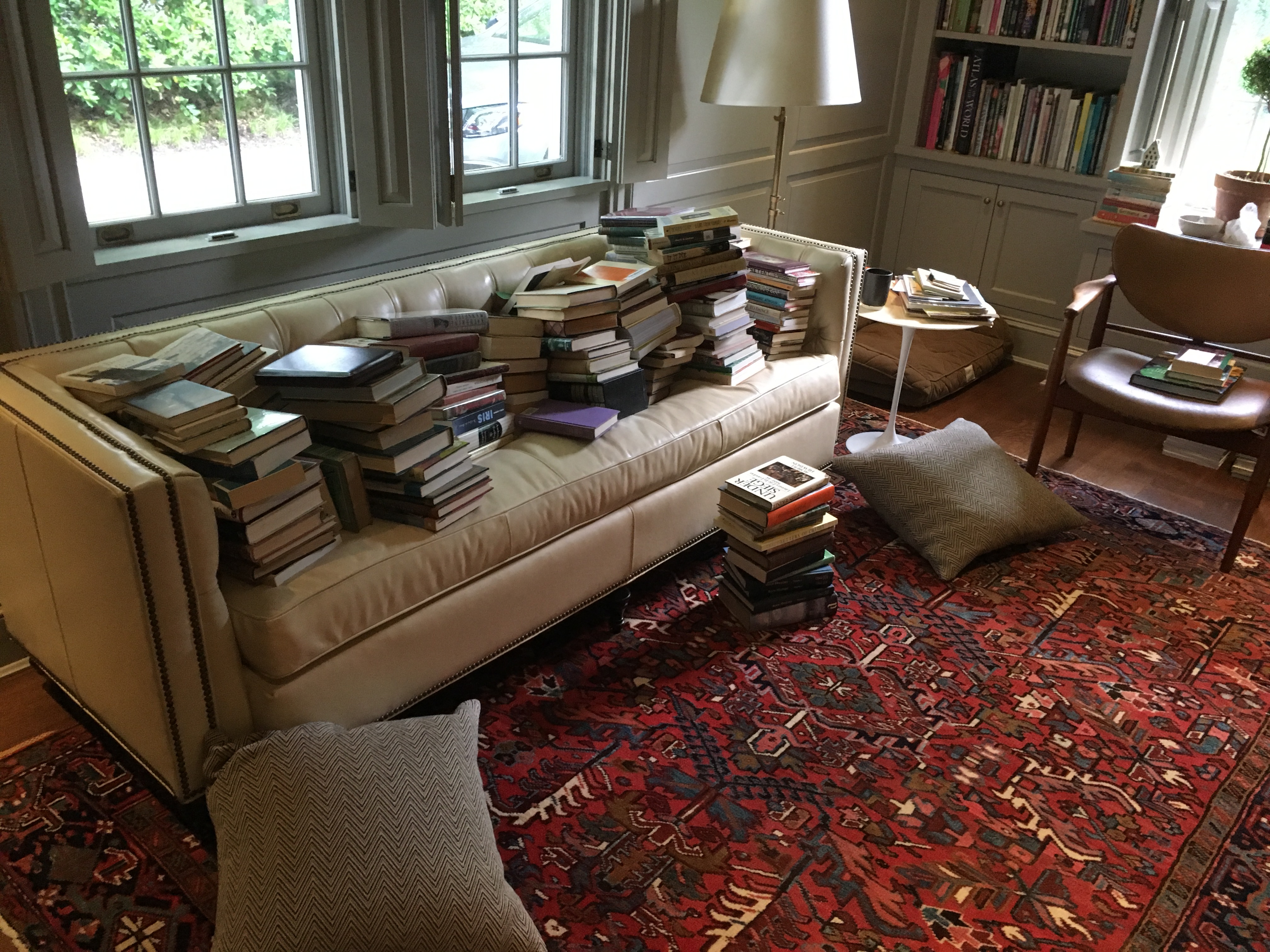
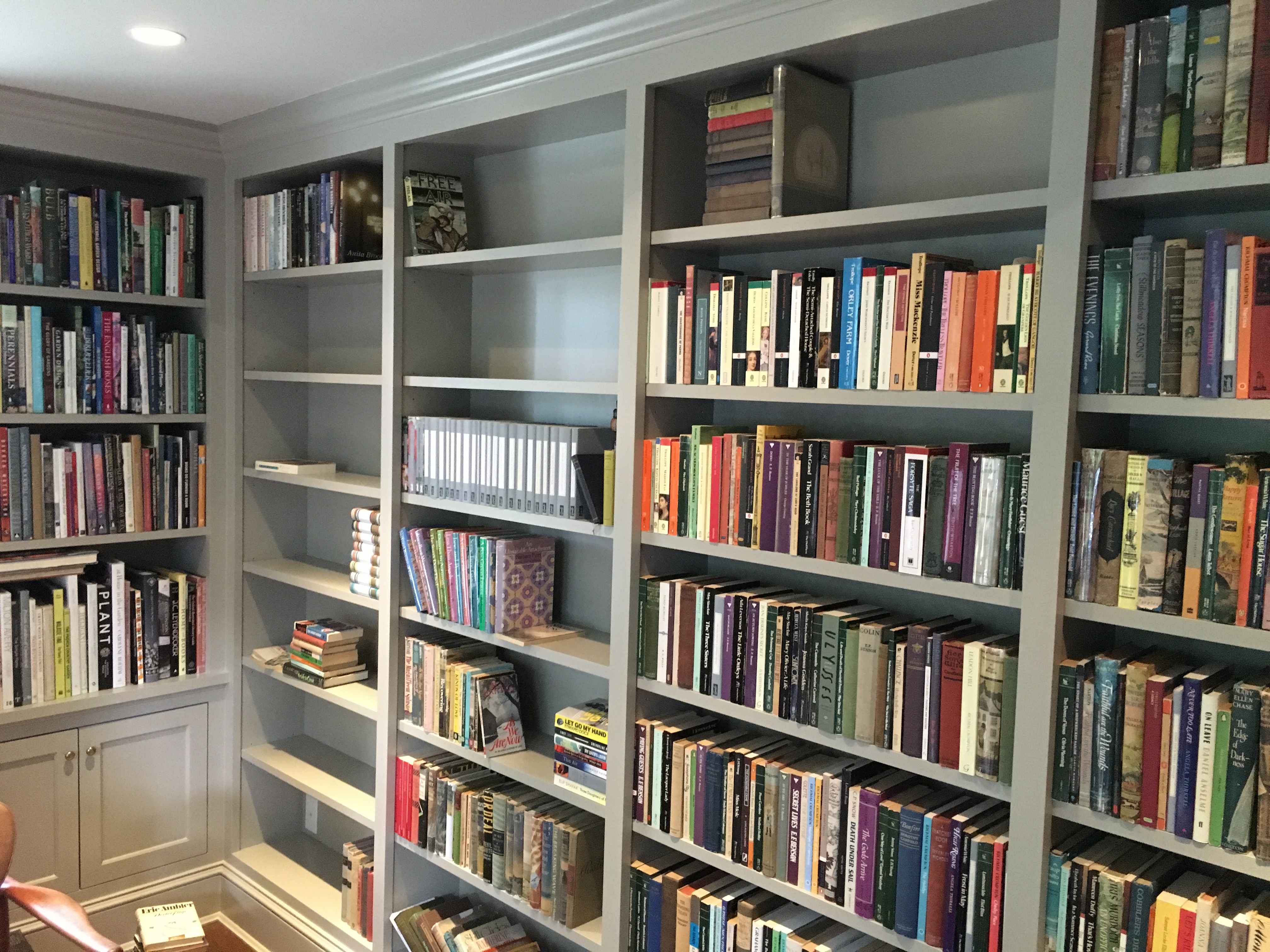
I love having books stacked up on the floor of my library. John doesn’t. What I didn’t realize when we decided to have some additional shelving built in the basement was that he was going to then consider floor stacks to be a thing of the past. Oh well. I guess we will cross that bridge when we come to it. For now, with my new shelves, I have some open space.

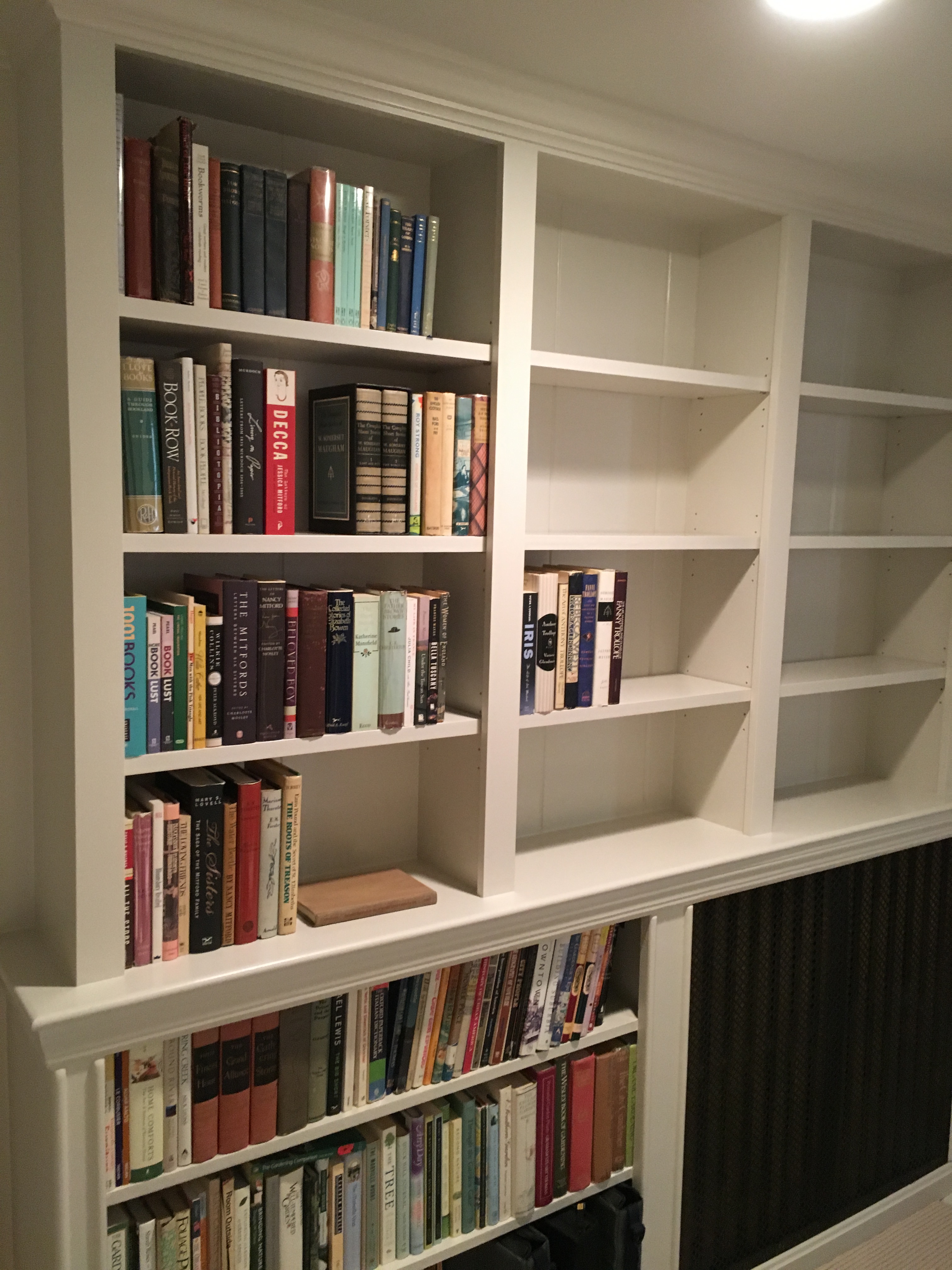
The bottom part of this unit was in the house when we moved in. Half of it is devoted to a radiator and the other half has some of my urban planning books, a small portion of John’s gardening books, guide books, CDs and some other odds and ends. The top part of the unit is brand spanking new.
The geometry and layout of the basement is funky enough that the three over two of the new configuration isn’t as jarring as it could be.
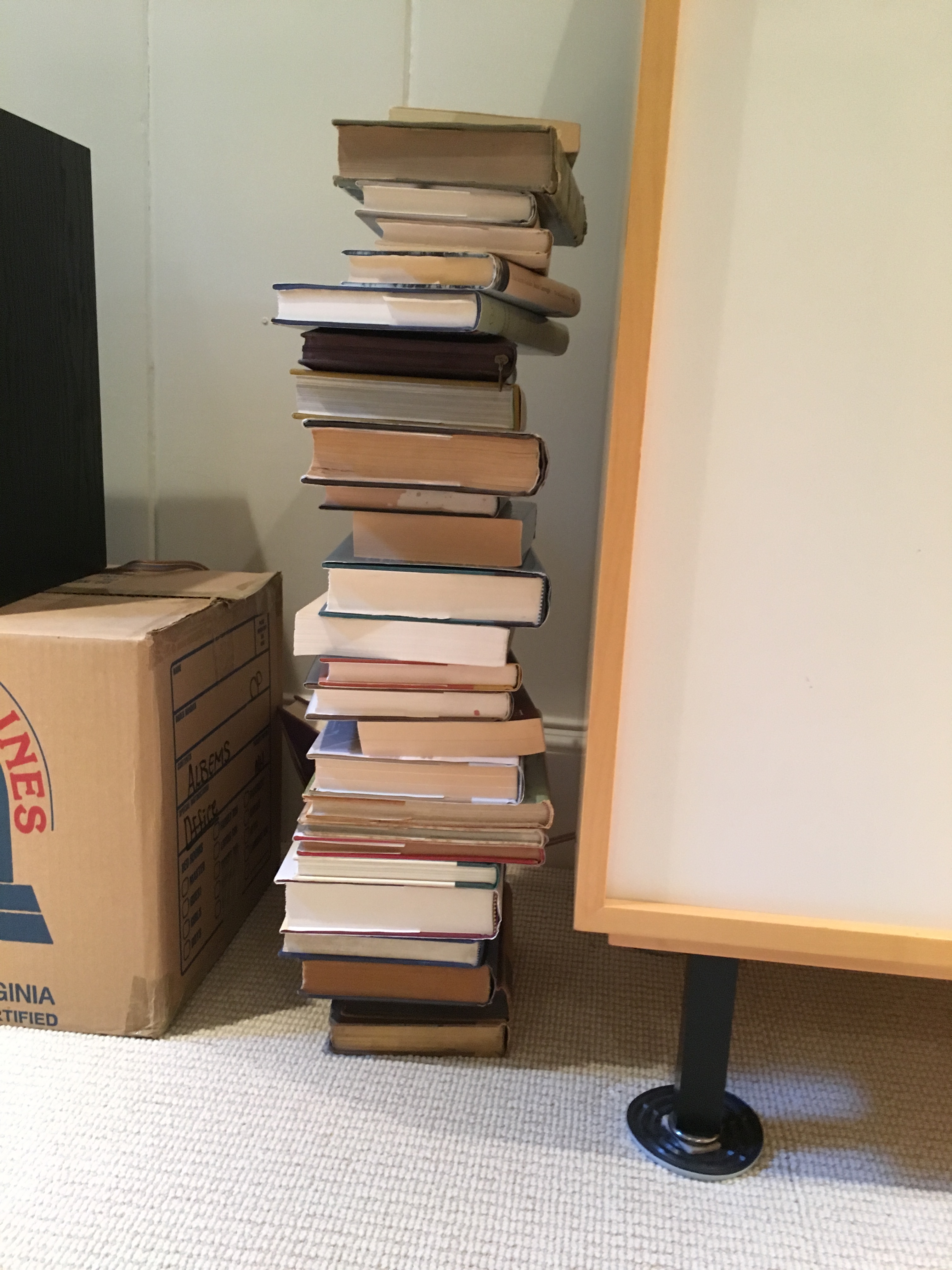
Surely this could get taller without falling over? Little hard to look at any of them though.
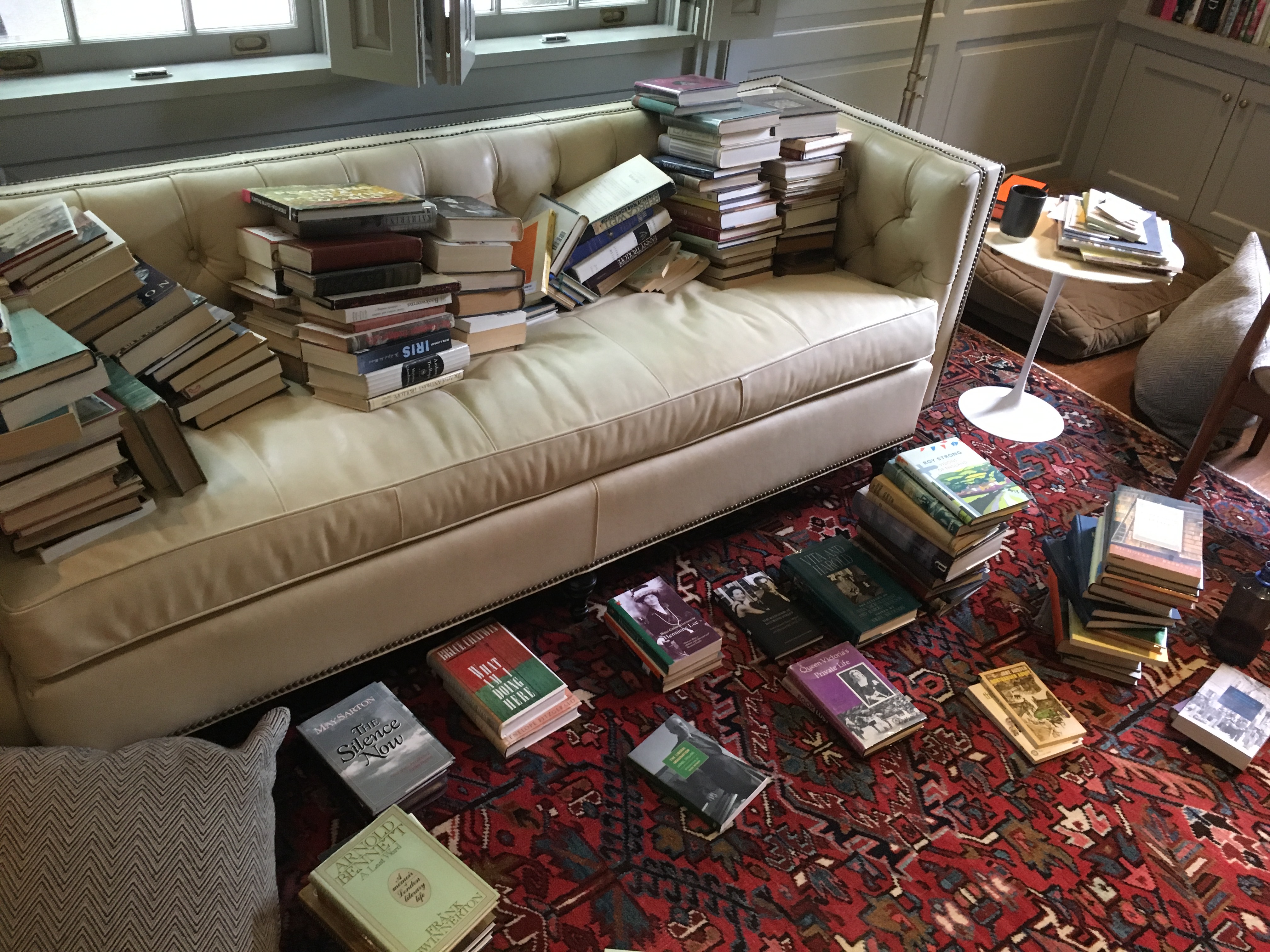
More orphaned books from the library that needed a place to go. The majority of the books that were to go on the shelves are non-fiction. Author memoirs and bios and books on books, books on royalty and the UK, etc.
So I got this far in the process of loading the shelves when I realized I didn’t like how things were going. The problem is that most of these non-fiction and short story collections are things that I am unlikely to read from cover-to-cover. They are the types of books I want to dip into now and again. It seemed to me that if they were down in the basement, that kind of serendipitous browsing was highly unlikely.
So this is what I did: I moved the fiction that I have already read down to the basement. After many years of culling I am down to books that I truly believe I will read again, but I don’t need to see them on a regular basis. Even this, however, presented a problem. The new shelves didn’t have enough space to hold everything. My OCD brain needed criteria for leaving some of that already read fiction upstairs. So I decided to leave those books by authors whose work I have a lot of. So all my 24 Brookners and my Shutes and Sartons and a few others stayed up in the library.
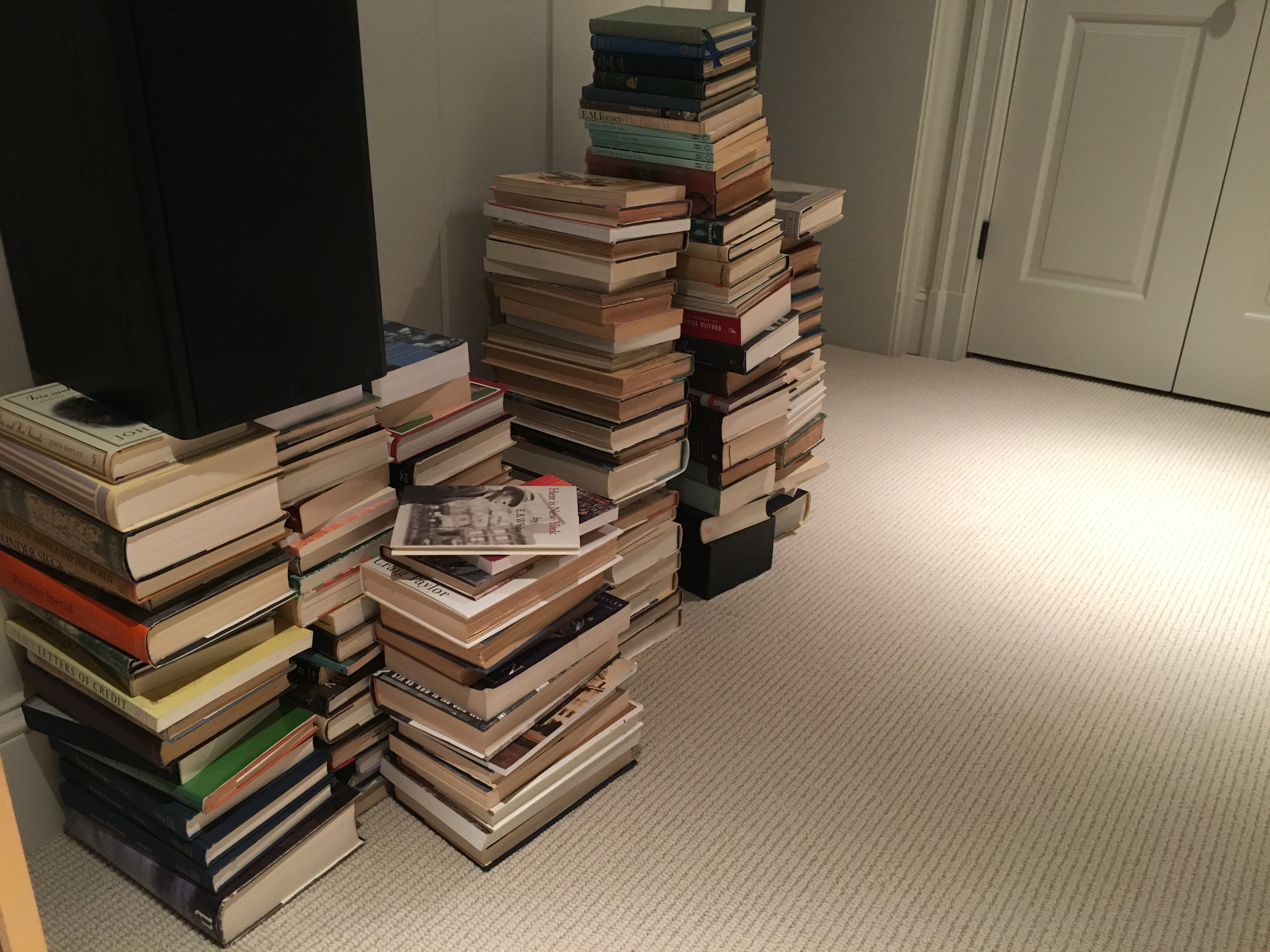
This is what it looked like when I got the non-fiction, my reference library, up to the library. It was at this point that John needed some smelling salts.
Things got worse before they got better. Most of what you see towards the right is my chronological TBR shelves. the emptyish area on the left contains my author and publisher fiction that I have read that didn’t make the trip down to the basement.
Organizing my non-fiction was not the easiest thing to do. There was enough crossover between categories that all attempts to have an iron-clad classification system were pretty frustrating. I wanted all my volumes of letters in one place, but then I had the urge to have letters of one author next to their memoir or bio or some other author-related volumes. And then the volume of Gustav Mahler’s letters. I wanted to put them with my books on music. Did books on the Bloomsbury Set go with my books on books or with my books on England? In the end I did a very rough job of organizing them. No doubt another rainy Saturday will take care of that.
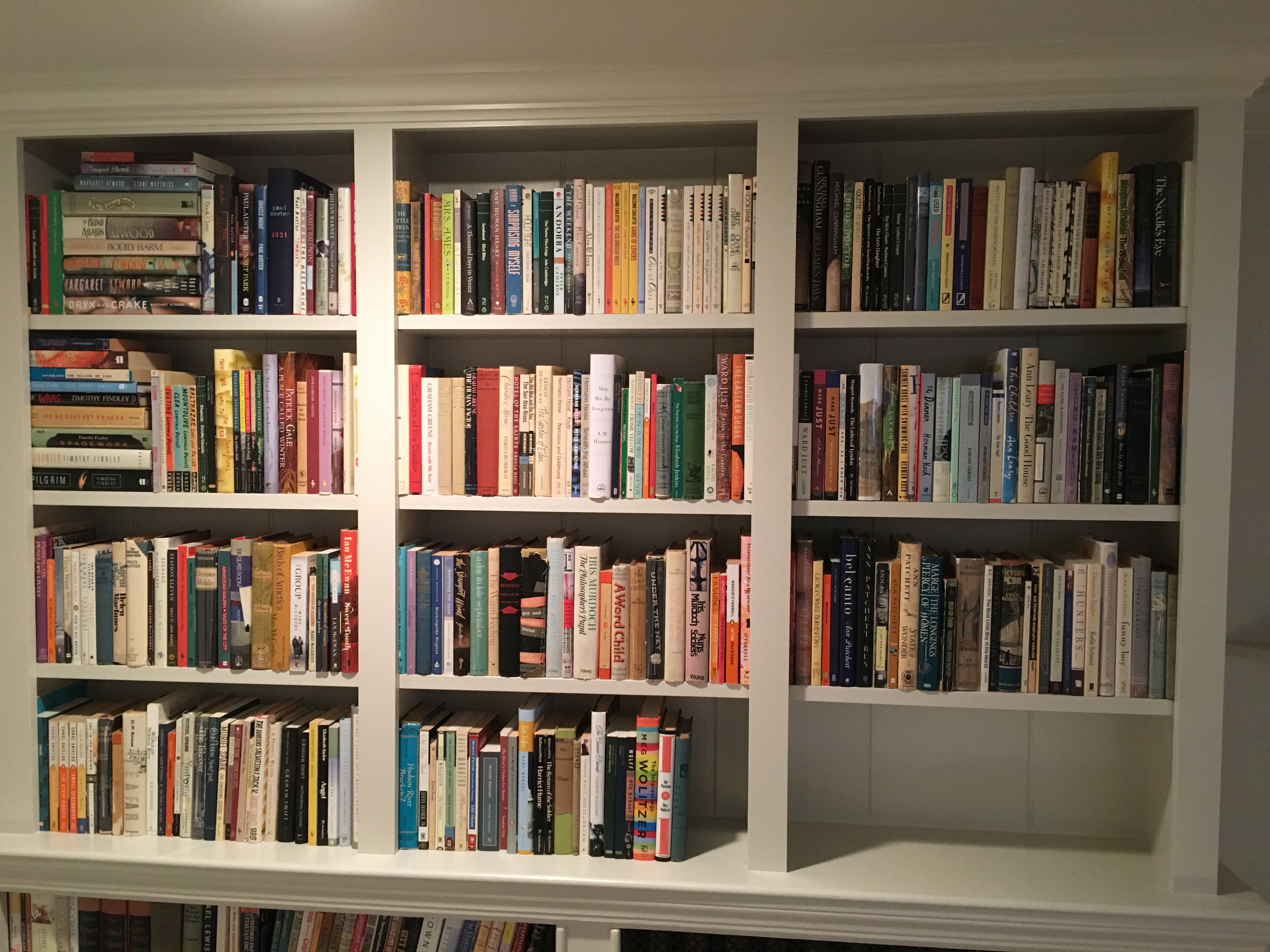
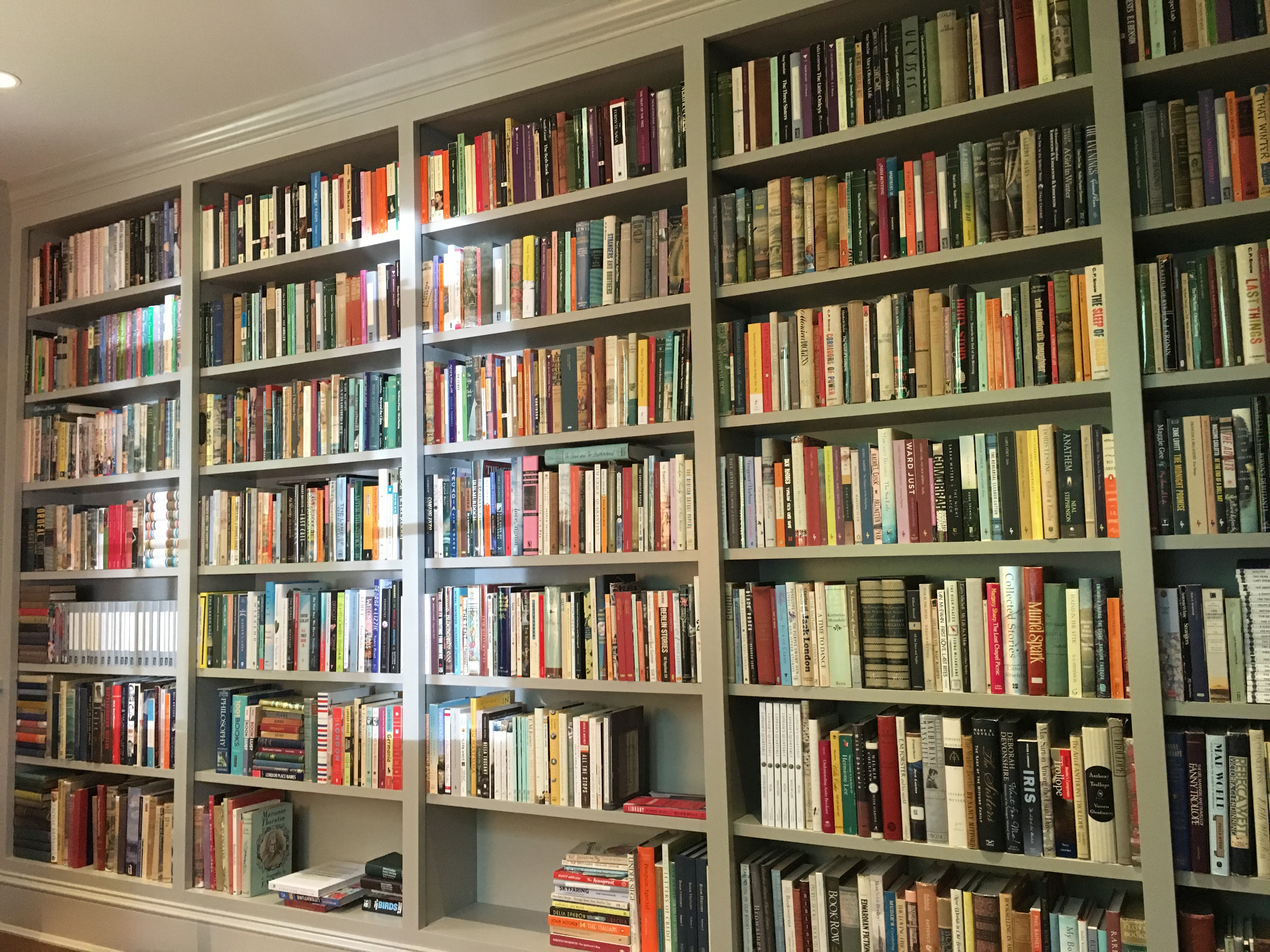
And here is the final mishmash. Books I have read that didn’t go downstairs take up the top five shelves on the left-most bay. The top four shelves of the four right-most shelves contain my TBR in chronological order. Row five has a bit of that as well as my short story collections. The rest is all of my higgedly piggledy non-fiction that I am happy to have back in the library. You never know when I will want to look at my 1950 Street Atlas of London. Or maybe I need to peek into one of the two bios I have of Fanny Trollope. Nice to have it all close at hand. For shelf voyeurs, this photo enlarges pretty nicely if you click on it. And just look at all of that empty space.

TJ Booker


There has been  a lot of talk lately about the Golden Booker. In celebration of 50 years of the Booker Prize they have decided to take what a panel of judges considers to be the best Booker winner from each decade and pit them against each other. I’m not paying too much attention to who they have picked for the short list. I’ve read a fair number of Booker short-listed books, but not that many winners and I doubt I would agree with the panel anyway.

And here is what I don’t get, the first award was given out in 1969, so why are they celebrating 50 in 2018? I’m as old as the Booker Prize and I will be damned if I am going to call myself 50 even one second prior to my birthday in 2019.

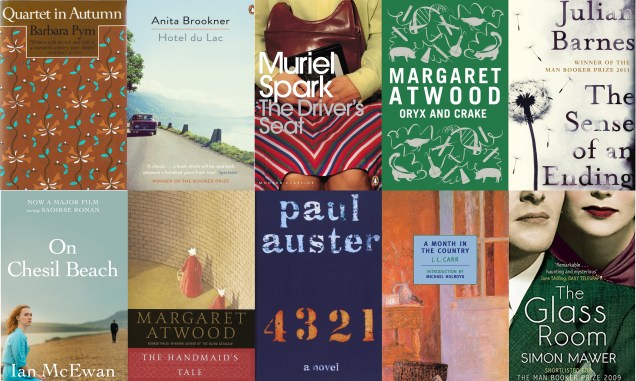
What I have compiled below is a top 10 list of all of the Booker short-listed novels I have read.  Since my list is made up not just of winners but of short-listers, I’ve noted in brackets if a short-lister was also a winner.

Top 10

1. Quartet in Autumn by Barbara Pym 1977
2. On Chesil Beach by Ian McEwan 2007
3. The Sense of an Ending by Julian Barnes 2011 [winner]
4. Oryx and Crake by Margaret Atwood 2003
5. The Driver’s Seat by Muriel Spark 1970 (Lost Booker)
6. The Handmaid’s Tale by Margaret Atwood 1986
7. Hotel du Lac by Anita Brookner 1984 [winner]
8. 4 3 2 1 by Paul Auster 2017
9. A Month in the Country by J.L. Carr 1980
10. The Glass Room by Simon Mawer 2009

Huh. This list surprises me as much as it may surprise you. Pym is in the top spot because I find her writing to be the result of literary alchemy. Others can write well, but she has a quality, an underlying sparkle and shimmer that all the other fine writers that follow cannot match–even though they may actually be better writers. Both On Chesil Beach and The Sense of an Ending really hit me in an emotional way. When I first created this top 10 list I was surprised how high up I put the Barnes, especially as  it knocked out some real heavyweights in the Hogglestock Pantheon. The two Atwoods and The Driver’s Seat are clever in a way that none of the others in the top 10 are. A Month in the Country is such a perfect little gem it is hard to believe it is as recent as it is. 4 3 2 1 and The Glass Room are both just amazing story telling. In the case of Mawer I feel The Glass Room really outshines his other fiction.

quite enjoyable

Bruno’s Dream by Iris Murdoch 1970
Heat and Dust
by Ruth Prawer Jhabvala 1975 [winner]
The Road to Lichfield by Penelope Lively 1977
The Sea, The Sea by Iris Murdoch 1978 [winner]
The Bookshop by Penelope Fitzgerald 1978
Offshore by Penelope Fitzgerald 1979 [winner]
According to Mark by Penelope Lively 1984
Moon Tiger by Penelope Lively 1987 [winner]
The Gate of Angels by Penelope Fitzgerald 1990
The Stone Diaries by Carol Shields 1993
Grace Notes by Bernard MacLaverty 1997
Disgrace by J.M. Coetzee 1999 [winner]
Unless by Carol Shields 2002
Satin Island by Tom McCarthy 2015

There is no way that any Penelope Fitzgerald, Penelope Lively, or Carol Shields would ever fall below the Quite Enjoyable category.

enjoyable

The Nice and the Good by Iris Murdoch 1969
The Public Image by Muriel Spark 1969
A Bend in the River by V.S. Naipaul 1979
Midnight’s Children by Salman Rushdie 1981 [winner]
The Comfort of Strangers by Ian McEwan 1981
Small World by David Lodge 1984
Nice Work by David Lodge 1988
The Remains of the Day by Kazuo Ishiguro 1989 [winner]
Cat’s Eye by Margaret Atwood 1989
Amsterdam by Ian McEwan 1998 [winner]
Headlong by Michael Frayn 1999
The Blind Assassin by Margaret Atwood 2000 [winner]
Never Let Me Go by Kazuo Ishiguro 2005
Swimming Home by Deborah Levy 2012
A Spool of Blue Thread by Anne Tyler 2015

enjoyable adjacent

In a Free State by V.S. Naipaul 1971 [winner]
The Folding Star
by Alan Hollinghurst 1994
Brick Lane by Monica Ali 2003
The Sea
by John Banville 2005 [winner]
Exit West by Mohsin Hamid 2017

Meh

Oscar and Lucinda by Peter Carey 1988 [winner]
Utz by Bruce Chatwin 1988
The English Patient by Michael Ondaatje 1992 [winner]
Remembering Babylon by David Malouf 1993 [winner]
The God of Small Things by Arundhati Roy 1997 [winner]
In the Country of Men by Hisham Matar 2006
Eileen by Otessa Moshfegh 2016
Lincoln in the Bardo by George Saunders 2017 [winner]
Autumn by Ali Smith 2017

Unless I missed it, it kills me that Bruce Chatwin’s On the Black Hill was never shortlisted. One of my favorite books and far better than Utz. I started off really enjoying Oscar and Lucinda but then it got very boring for me. I pretended to enjoy The English Patient back when I first read it (prior to film being made) but I think in retrospect I would probably hate it.

painful / tedious

The Line of Beauty by Alan Hollinghurst 2004 [winner]
How to Be Both
by Ali Smith 2014
A Little Life by Hanya Yanagihara 2015

It’s a mystery why April was thrilling

April was kind of a weird reading month for me. The three books I liked best were mysteries/thrillers, which is not normally my cup of tea. Actually, I probably should stop saying that because it has become clear to me over the past couple of years that as long as it is the right kind of mystery/thriller, I actually pretty much love them. It just needs to be somewhat old fashion, low to no blood, Europe helps, extra points for papers, archives, books, details, etc. You get the picture.

Here’s my month of April in order of most enjoyable to least enjoyable.

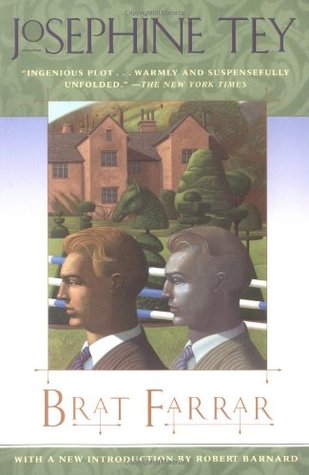
Brat Farrar by Josephine Tey
People who like older mysteries are always telling me how much they like Josephine Tey and how good Brat Farrar is. Well they were right. Having this one under my belt I feel like Tey will be a resource for me in future. Kind of the antidote to Carlotto (see below).

Doctor Frigo by Eric Ambler
Ambler never disappoints. Published in 1974, this time Ambler’s perfect political thriller takes place in Central America rather than central Asia or central Europe. Ernesto (Dr. Frigo) is enlisted to help install the next leader of his country, who also happens to be a man who was responsible for killing Ernesto’s father some years previously.

The Goodbye Kiss by Massimo Carlotto
Except for the Europe part, Carlotto’s hardboiled crime novels don’t really fit the parameters I described above. And they are so damn sexist. The way he treats women is just appalling. I don’t know how a non-misogynist could write this kind of stuff. Having said that, I really enjoy reading Carlotto’s books. I just wish he didn’t have to be such an asshole.

A Day in Late September by Merle Miller
An American writer (or was he a painter? I forget, it’s been a month) is back in the US and hopes to take his teenage son back with him to Europe. But first he has to convince his ex-wife and her highly competent and wealthy husband. He also needs to convince his mistress that she needs to finally break with her husband. In doing so we are introduced to a reserved but secretly scandalous, 1950s, east coast social circle. It was my Merle Miller tweet that had Nancy Pearl tweeting me and even offer to send me a book. (You may recall she wrote about him in her first Book Lust volume.)

The Odd Angry Shot by William Nagle
A Vietnam War combat tale told from an Australian point of view. Nagle really makes you feel the heat and smell the stink.

Let Go My Hand by Edward Docx
A son, and eventually his two half brothers take their dying father to Switzerland where he wants to check out on his own terms. Road-trip, family drama, memoir. Good but not great.

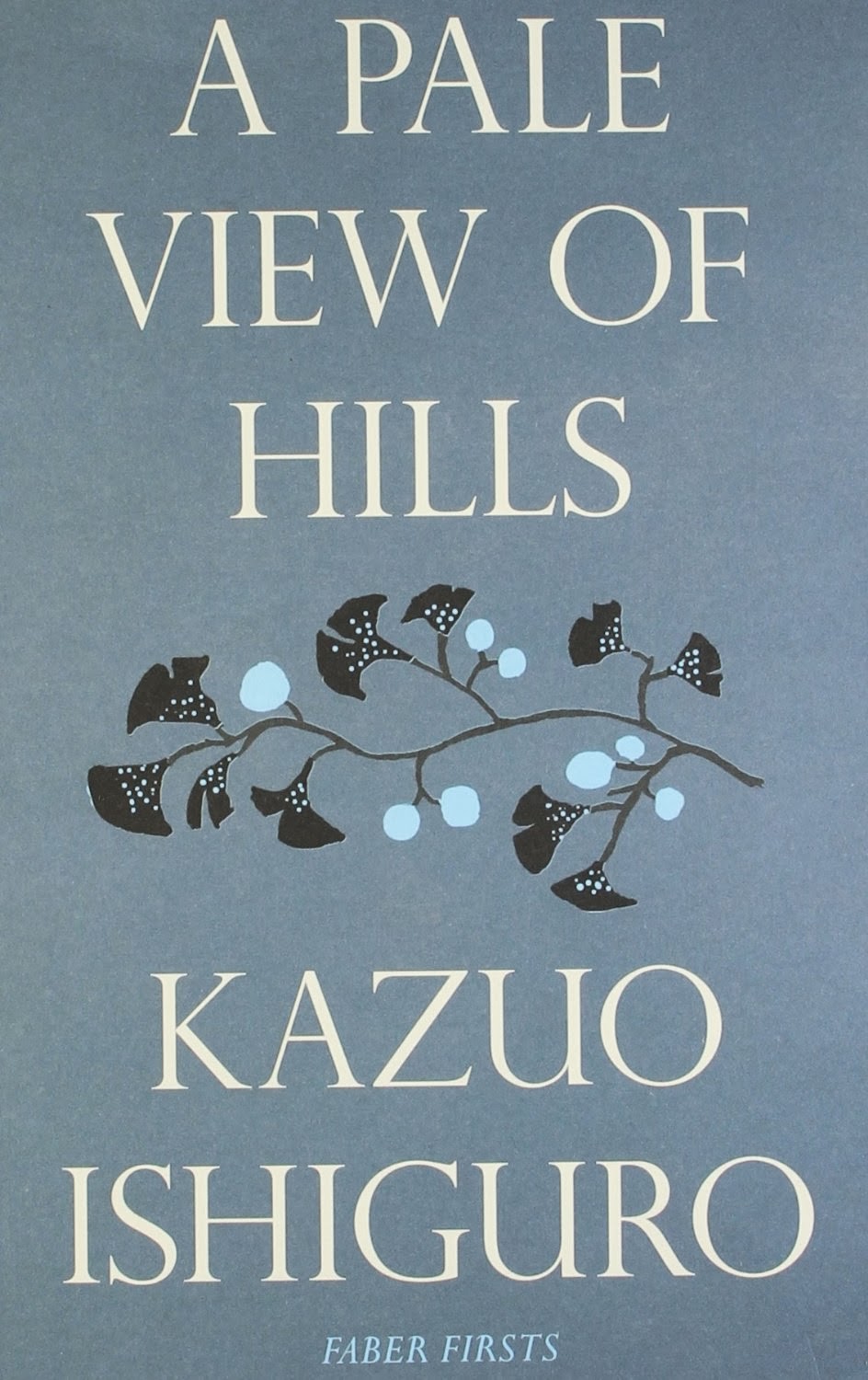
A Pale View of the Hills by Kazuo Ishiguro
I gave up this book a few years ago and only kept it because I liked the cover. I was set to send it on its way when I thought maybe I would give it a go. At first I was kind of enjoying it and couldn’t understand why I had given up on it previously. Overall it wasn’t bad, I just found it kind of boring. I think I may be done with Ishiguro. I liked The Remains of the Day as a film but found the novel a soporific. Never Let Me Go was interesting, the Buried Giant one doesn’t interest me much. It’s nice to let go of an author. Makes time for others.


Enjoying the wide open space outside my comfort zone

I first read and loved Stoner by John Williams back in 2010. Not long after that I bought his two other novels in print, Butcher’s Crossing and Augustus. The former is more or less a literary Western (I may have made that up) and the latter is a depiction of Augustan Rome. Whereas Stoner, an academic novel, is well within my reading comfort zone, the other two are well outside of it. That is why it has taken me eight years to get around to Butcher’s Crossing despite having heard from trusted readers that it is a great book.

The story centers on Will Andrews, a Harvard boy who decides he wants to head west and participate in a buffalo hunt. It’s unclear what motivated him to leave Cambridge for the western frontier but he quickly sets to bankrolling a buffalo hunt under the direction of grizzled hunter Miller who engages one-handed, drunken, Christian Charley Hoge and skinner Fred Schneider to complete the hunting party. They go off into the mountains of Colorado to find a herd of buffalo the size of which had not been seen in many years. But Miller is convinced it is out there despite the fact that he hasn’t been out that direction for about nine years.

What happens when they go looking for that herd is devastating and beautiful.

Devastating because Miller is hellbent on killing the entire herd. Every. Single. Buffalo. Over 4,000 of them. Devastating because the Anglo hunters only want the buffalo hides, unlike the  Native Americans who used every part of the animal to stay alive and killed in sustainable numbers. And Devastating because life can be bleak and short. (The modest rebound of the native bison populations is the only thing that kept me from totally losing it over the senseless and unsustainable slaughter. Because of over hunting and disease spread by cattle, the number of bison in North America went as low as 540 in the 19th century, but came back to a level of about 530,000 today, with about 15,000 of them being truly wild.)

But Butcher’s Crossing is also beautiful because Williams paints a picture of the truly wild west were few humans had trod prior to that time. It is as irresistible as it is hard to imagine, a broad valley in the foothills of the Rockies that is full of buffalo and coyotes with no imprint of humans anywhere. And really fascinating to me, a sky with no planes and no satellites, and the industrializing world at such a distance as to have no impact whatsoever. It reminds me of some of Willa Cather’s descriptions of the southwest, which included the presence of long gone native tribes, but were also evocative of an unimaginable, quiet isolation. The notion of weather and nature and time that has no association with humans. I keep harping on the no humans part because I find the absence of them comforting.

And then there is the Jack Londonesque sense of adventure and danger. Some of the things they endured, the ways they coped, and the results (which I will not divulge), are just as unfathomable to me as virgin territory. And like Jack London, John Williams writes well enough about outdoor adventures to draw in even the most committed city slicker.

Butcher’s Crossing is one of those novels that proves that good writing and good storytelling can overcome any aversion I  may have to a particular topic or genre.