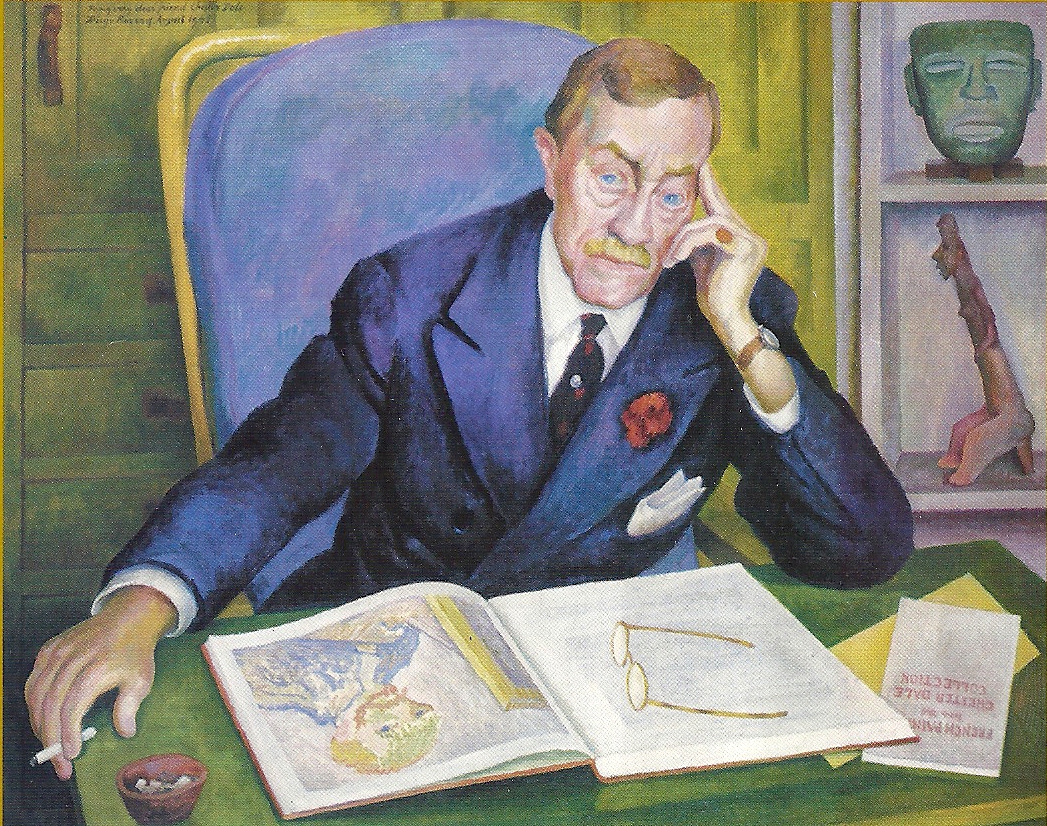
Sunday Painting: Chester Dale by Diego Rivera

   
A few weeks ago I went to the National Gallery of Art here in Washington. It is truly spectacular in so many ways. In addition to the beautiful buildings and amazing collection, the NGA benefits from the fact that it is not as popular with visitors (I am guessing) as the Smithsonian is. And likewise it is far less congested than the Met in NYC or the Nat Gal in London. It makes for a wonderful experience.

Anyhoo, my office is a mere four minute walk from the the NGA but I hadn’t been there for some time. I took a look at the Canaletto exhibit but had more fun perusing the permanent collection. Sad for me and my Sunday Painting feature is the fact that the NGA, like so many other museums around the world, no longer has the acres and acres postcards that it used to. This is especially annoying for me as I tend to like works that aren’t necessarily the most popular. So the chances of finding postcards of the pieces that I like the most is getting slimmer and slimmer. I guess I need to combat this with the digital camera and paper and pencil for writing down names to look up later online.

One of the exhibits they currently have going on is highlights of The Chester Dale Collection, a collection of about 300 hundred works mainly from the 19th and 20th centuries.  There are many marquee paintings in this collection, but the one I was quite taken with was this portrait of the tycoon painted by Mexican artist Diego Rivera. Would you have guessed that this was a Rivera? I sure didn’t.

Chester Dale, 1945
Diego Rivera (1886-1957)
National Gallery of Art, Washington

Book Review: They Were Sisters by Dorothy Whipple


Aaaaargh!

My review of They Were Sisters disappeared in the Great Blogger Annoyance of 2011. If Blogger gets around to restoring things that were lost during their “fix” you will get to read the review. But I am not sure I have the mental energy to recreate it.

I will leave you with two thoughts from the lost review:

1. This is the kind of book that makes you miss your train stop.

2. I think this is now my favorite Whipple.

Persephone just noted today on Facebook that the film of They Were Sisters is now out on DVD. Huzzah.

Book Review: The Fortnight in September by R.C. Sherriff


I know it has been said before here and elsewhere, but where in the world would we be without Persephone? After finishing The Thin Man, I felt a real reading funk coming on. Worse then nothing jumping out at me, I began to think about playing solitaire on the computer. I knew I needed to find something that was sure to please. And what pleases me more reliably than Persephone? I almost picked a Whipple, the ultimate sure thing, but then I spotted this Sherriff sitting on the shelf. I thoroughly enjoyed his apocalyptic novel The Hopkins Manuscript so I was curious to see what Sherriff would have to say about a family taking their holiday by the seaside.
I have read other blogger reviews of The Fortnight in September here and there over the past year or so, and the one theme in those reviews that sticks in my mind is that nothing much happens in the novel. It is true that The Fortnight in September is not plot driven, but the chronicle of the Stevens family’s two-week holiday is wonderfully wrought, with lots of humor and poignancy.
Written in 1931, it is a bit of a snapshot social history of a suburban London family barely over the cusp of the middle class. In addition to Mr. and Mrs. Stevens there is 20-year old Mary, 17-year old Dick and little Ernie who is maybe a good seven years younger than Dick. (I don’t recall if his age is mentioned.) The family has been going on their holiday to the same house in Bognor for 20 years and are first encountered as they prepare for their annual trip.
It is in these opening chapters that I felt a kindred spirit in Mr. Stevens. He is nothing if not organized and detail oriented. These can be good qualities but they can also go too far. It shouldn’t be surprising to my regular readers that my own mild OCD can be both bane and boon. Sometimes wanting everything in its place means missed opportunities and unnecessary stress. Thankfully for me, I have taken great steps in learning how to weed out what I should be worried about and what I shouldn’t worry about. (Thankfully for Mr. Stevens and the social and gender mores of his time, his family never question or challenge his need to have everything in its place.) Like Mr. Stevens, my mind will go into overdrive thinking of all the things that could go wrong and all the things that need to happen to ensure that nothing does. That fact that I can find humor in these passages rather than stressing out is testament to what a little therapy can do.
I tend to get a little nervous on travel days. I have no fears of flying or anything like that, but I do worry about all the little things–most completely out of my control–that could wreak havoc on my travel plans. I also share Mr. Stevens inability to trust information given by just about anyone. When facing down the challenge of getting from one platform to another at Clapham Junction:
Mr. Stevens did not like relying upon the word of one ticket collector and always preferred to take a consensus opinion from as many officials as possible.
And in another passage that could have been lifted right out of my brain, Mr. Stevens contemplates the crowd on the platform:

The crowd was certainly a big one: much bigger than last year, and Mr. Stevens could not help feeling a little worried…With a smile to his wife he added “some are bound to be for another train,”–but in his heart of hearts he was afraid they were all for theirs.

Although this kind of worry has happened many times in my life, I remember very clearly a time in 1989 when I was headed to the Tate Gallery. When I got off the Tube (at Pimlico?) I was convinced that everyone getting off the train was also headed to the Tate and that I needed to hurry to beat the crowd. Of course what really happened is that no one who got off that train headed to the Tate. Not to mention that the Tate is a big place and could have handled a whole train load of visitors without much impact on my experience.
On a less worrisome, but no less obsessive note, I also share a trait with Ernie, the youngest of the Stevens children. His way to puzzle out a situation rarely includes asking someone who may know the answer. Rather he lets his imagination fill in the blanks. While his father spends his time worrying about the potential for things to go wrong, Ernie wonders about the ticket agent at the station:

For years he had wondered how they got the man through that tiny opening from which he served the tickets. Was he pushed in as a baby–or built in at a later period of his life?


He had received a shock of disappointment when the romance he had built round this wistful prisoner was shattered by Dick, who one day pointed out the very ordinary side door. The Railway Company had dropped a little in his estimation.

Once the Stevens family arrive in Bognor they all start to decompress with the worst of their worries eventually falling away. During the course of the holiday, each of the family, with the possible exception of Ernie, work through a personal issue or two on their own. For those of us who are used to social, educational, and economic mobility in our own lives, it is sometimes hard to fathom what it would have been like to have our life opportunities as limited as they were for the Stevens’. Yet there is something comforting about their limited world view. Maybe I am romanticizing their lives a little too much, but I think there is some perspective to be gained by appreciating the small pleasures in life. Mrs. Stevens doesn’t like the seaside much. She goes along because her family enjoys it. But she does look forward to those two weeks when she can have a quiet hour to herself each evening as she sips her “medicinal” sherry–something she would never do the other 50 weeks of the year. And Mr. Stevens doesn’t have much hope of advancing beyond being a clerk but at least he has those two weeks where he can breathe in the fresh sea air and go on long solitary rambles in the nearby countryside. When I think about all that I have had the opportunity to do in my 41 years, the Stevens’ life could seem quite depressing. But then I think about how excited I get each day to spend time with John and truly enjoy our life together and I realize that despite all my yearning for more, I really do appreciate the small things in life. Of course it is always good to be reminded of that.

The more the memory of the book bounces around in my head the more I appreciate what R.C. Sherriff pulled off in The Fortnight in September. Although it is a charming tale of a family on holiday it has so many more layers to appreciate: brilliantly, but quietly quirky and likable characters, a fascinating look into days long past, and a rather touching exploration of life’s priorities. Even among Persephone fans I think this one deserves more attention.
Book Review: The Thin Man by Dashiell Hammet

 
I don’t normally read much in the way of mysteries or crime fiction. I tend to find them a little too rat-a-tat-tat from one plot point to another. Granted, sometimes that kind of formula can be rather comforting to my linear way of thinking, but not too often. What I never find comforting, however, is that so many (most?) crime fiction is about murder. I am not so squeamish that I can’t abide reading about murder or other morally repugnant events, but most mysteries treat murder so nonchalantly it makes me wonder a bit.

Knowing that The Thin Man is a bit of a classic, I satisfied my desire to own a classic green Penguin by picking this up when we were in London in November. The book is the first written by Hammet starring the husband and wife team of Nick and Nora Charles. A dynamic duo who don’t let a page go by without having a cocktail. The book reads like an old black and white Hollywood film which is why I put the film version at the top of my Netflix queue. You know the kind of thing, speakeasies, gangsters, dames, and people named Studsey. The thing that attracted me was less the “glamour” of this world than the now archaic way of communicating–both verbally and technologically–and the effort to gather information. This was not the world of crime databases and Internet searches but rather good old fashioned gum shoe detective work. And don’t even think about civil liberties. Search warrant? Who needs it?

Although I did enjoy reading The Thin Man, I was a bit surprised that the many twists and turns melted down in the final five or so pages to a denouement that only barely tracked with the action of the preceding 178 pages. It is not that one should be able to predict the outcome of a detective story, but I certainly would have appreciated seeing Nick make some of the connections along the way rather than having everything miraculously explained all at once in the final minutes like some live action version of Scooby-Doo.

To paraphrase Gertrude Stein: for those that like this kind of thing, this is the kind of thing they will like.

Heaven: The Last Copy Fiction Depository

     
This article about the Montana Last Copy Fiction Depository makes me want to go to Billings and sneak into the basement of the library.  This is the place where they send last copies of fiction that no one wants to check out. You know, those books that we LOVE to read. The article even mentions Elizabeth von Arnim’s Elizabeth and her German Garden.
Like most great things in the world, this one might disappear.

IABD: Guest Review of The Bay of Angels


72 days and counting…

…for those of you planning on reading an Anita Brookner novel before International Anita Brookner Day on July 16th.

A few weeks ago I published a review of Anita Brookner’s Incidents in the Rue Laugier by Erich Mayer, father of Brookner scholar Peta Mayer. Now I have the pleasure of posting a review of Brookner’s The Bay of Angels by Peta’s mother Wendy Mayer. As with her husband’s contribution, Wendy’s review puts my own pedestrian reviews to shame.

The Bay of Angels is Anita Brookners’s twentieth novel; it was published in 2001, twenty years after her first novel. If it had not been written by Brookner, it would have likely been simply identified as a ‘coming of age’ novel, or an exploration of the ‘generation gap’ rather than the tender, thoughtful evocation of a warm and close relationship between a mother and daughter. As the narrator, it is the daughter’s voice that charts the experience of growth and change in their lives.
In The Choice of Hercules, British philosopher A. C. Grayling discusses the notion of friendship between a parent and child:
Friendship is the ultimate aim of parenting too, for the mark of success here must ultimately be to produce independent adults capable of managing themselves in life.  A mark of success in this would be the development of genuine friendship between parent and grown-up offspring.
Brookner’s novel covers this terrain, contrasting the varied approaches to life of the different generations, but as the responsibility for family decisions inevitably shift from the mother, Anne, to the daughter, Zoe, the need to express these differences becomes apparent. The opening pages review the calm pleasure of their early lives together after the mother’s premature widowhood. Zoe enjoys school, her friends and the atmosphere of calm in the flat they live in when she returns home. She is aware that her mother may be lonely, but they both share the pleasure of reading. The tranquility of the flat is occasionally disturbed by visits from ‘the girls’, women married to distant cousins of Zoe’s father. Zoe does not refer to Anne as anything other than ‘my mother’ until page twenty, reflecting how Zoe views Anne – her identity is delineated by her role as a mother.
The Bay of Angels explores the developments in the relationship between the women as they grow up and age. In doing so, Brookner draws out the different approaches to responsibility taken by individuals operating in diverse social environments. As an adult, Zoe’s horizons widen and change, but even while experiencing these differences, the bond between mother and daughter survives and remains strong.
Characteristically, Brookner also skilfully explores the impact of ostensible minutiae on people’s lives in The Bay of Angels. Nobody but Brookner could so effectively utilise an obsession with plastic shopping bags to communicate a sense of these women’s identities, of rushed dishevelment and disempowerment. She builds very real characters as she establishes the inner differences between people, their insecurities and embarrassments that form a part of everyone’s lives.
In The Bay of Angels, Brookner beautifully creates and explores the development of a genuine friendship between a parent and her adult offspring. Such a background provides Zoe with the tools to manage her own life satisfactorily. It is not a book about a prototypical ‘hocky mom’ and her progeny, but rather a description of the different pains and pleasures suffered and enjoyed during the lives both of her protagonists and her readers, and it thus brings to life Grayling’s ‘mark of success’ in parenting.
   

Sunday Painting: A Centenary Portrait by John Wonnacott

   
This seemed an appropriate entry for my Sunday Painting feature this week. An absolutely gigantic portrait of the Royal Family painted in 2000 to celebrate the 100th birthday of Elizabeth the Queen Mother. I don’t think I saw this in person, but I seemed to buy the postcard nevertheless. I am not sure if it shows in this image, but you can see lines on the postcard where the various canvases come together to make this 119 foot by 81 foot painting.

The Royal Family: A Centenary Portrait
Prince William of Wales; HM The Queen; HM Queen Elizabeth The Queen Mother;
The Prince Philip, Duke of Edinburgh; Prince Henry of Wales; HRH The Prince of Wales
John Wonnacott (b. 1940)
National Portrait Gallery (London)

There is a lot I could say about the wedding this past week and all of the endless prattle pro and con that was everywhere. But I will limit myself to just a few observations. When Charles and Diana got married in 1981, I was in the early stages of my Anglophilia. As much as it may still rankle the old guard, I became a huge fan of the Royal Family mainly due to Diana’s arrival on the scene. My enthusiasm knew no bounds. Thankfully Charles and Diana got married during the summer so I could get up at 3:00 am to watch the wedding and not have to worry about going to school.

So, flash forward to 2011. Although I am still fascinated by trappings of royalty, I am no longer the rabid fan I used to be. As a result I have paid very little attention to William and Kate over the years and I was still pretty ambivalent about them going into Friday’s ceremony. But when I saw the moment when Kate took her place next to to William in the Abbey and he so clearly told her that she looked beautiful, I got a little teary. Unlike the foreshadowing stiffness of C&D, William and Kate looked so comfortable and happy with each other. Let’s all cross our fingers.

Other thoughts:

  • I loved the maple trees that lined the nave of the Abbey.
  • Kate truly looked radiant and beautiful.
  • I think Harry might be starting his very own bald spot.
  • The Princesses Beatrice and Eugenie not only looked ridiculous, but they made the mistake of calling too much attention to themselves at someone else’s wedding.
  • The music was a bit of a snooze. Too much Parry.
  • Were those three Paris Hilton clones Earl Spencer’s daughters?
  • Prince Albert’s fiancee was impeccably dressed.
  • Lady Sarah Chatto looked fantastic and her outfit (by Jasper Conran I think) made her look so much like her late mother, Princess Margaret.