Book Reviews: Stiff Upper Lip and All That


Henrietta’s War
Joyce Dennis

The Guernsey Literary and Potato Peel Pie Society
Mary Ann Shaffer and Annie Barrows

I didn’t consciously plan to read these two books in quick succession, yet both of them are epistolary novels about coping with the trials and tribulations of World War II in the United Kingdom. In Henrietta’s War, the action takes place in 1941 in a small Devonshire village and is told through a series of letters from Henrietta to her childhood friend Robert who is serving in the British army. In the case of The Guernsey Literary and Potato Peel Pie Society, the action takes place in 1946 and is described in a series of letters between Juliet Ashton, a journalist living in London, her friends and colleagues, and a group of folks who lived through the Nazi-occupation of Guernsey, a British territory in the Channel Islands just off the coast of France.

Henrietta’s War has been much reviewed in the blogosphere by a generally adoring fan base. While I thoroughly enjoyed it, it didn’t necessarily sweep me off my feet. Perhaps I had read too much hype before I finally got to read it. In any case I won’t spend much time talking about it so you might want to check out reviews by Stuck-in-a-Book, Cornflower, Paperback Reader, Read Warbler, and Frisbee, to name just a few of the great reviews of the book.

TGLPPS has also been reviewed by a great number of folks like Savidge Reads, Letters from a Hill Farm, and Bibliophile by the Sea. But I found this book so delightful that I feel the need to wax rhapsodic about it. I love the book for several reasons. First, the characters come together over their love of literature and they “meet” through their letters. Shaffer and Barrows essentially create a scenario that is not unlike the communities of folks who blog about books and get to know each other by trading literary likes and dislikes on the Internet. The only real difference is that in 1946 the medium was ink, paper, stamps, and the Royal Mail. Which, frankly is another reason I love this book so much, I absolutely love letters. Back in high school I had about 30 pen-pals and I miss the day when people would put pen (or even typewriter) to paper.

The subject matter is also fascinating. I have an undergraduate degree in history, but I am not much of a fan of historical fiction. I am not sure if TGLPPPS would fall into the category of historical fiction, probably not, but it does a great job of describing what life was like in Nazi-occupied Guernsey. In 2005 Masterpiece Theater showed a fantastic British drama called Island at War, a fictional account of life in the occupied Channel Islands. The storylines are completely different, but the historical detail in Island at War and TGLPPPS complement each other rather well. And both of them make me want to visit the Channel Islands.

Another reason to love TGLPPPS is that it is a joy to read. I loved the characters, I loved the plot lines, and I loved the humor. And Shaffer and Barrows are quite deft at weaving the reality of Nazi atrocities into the story without minimizing them or being pedantic.

Occasionally, but not often, the language seems a tad too modern for the 1946 correspondence. But it is just a little whiff here and there, overall it seems very appropriate to the era. I was, however, quite disappointed with the introduction of what I think is a rather pointless reference to one of the character’s homosexuality. The information doesn’t really add anything to the story, unless the authors were just trying to prove that homosexuals existed during World War II. But what was truly jarring to me was the very unrealistic way in which the characters talk about the subject. The dialogue doesn’t ring true for one second. In fact it was so stylistically and historically incongruous it was like having a Sousaphone player toot his way across stage through the middle of a Mozart string quartet.

Having said that, the book is wonderful and everyone should read it.

My only other quibble with both Henrietta’s War and TGLPPPS is one that I have with most epistolary novels. When people write letters they almost never include actual dialogue. In a letter (or email) one may write something like “Then he told me to shut-up and I told him to go to hell.” But it is unlikely that someone would write you a letter like this: “Shut-up!” he yelled. “Oh yeah, well you can go to hell!” I replied shaking my fist. And so on. Most people just don’t write that way. One of my all time favorite authors, Carol Shields wrote an epistolary novel with Blanche Howard called A Celibate Season that was so full of quoted dialogue that I had a hard time suspending my disbelief. On the other hand 84, Charing Cross Road which is a series of actual letters written by author Helene Hanff that tell a wonderful story and is entirely free of quoted dialogue. In my opinion that is the way it should be. Otherwise epistolary novels are just lazy ways to describe settings or advance plots without needing to be clever enough to connect it all together. A bit of an overgeneralization, I know, but for OCD types like me, it just seems wrong.

How Cute is This?

UPDATE: Major League Baseball is worried that a 9 second video of a dad and his daughter at a Phillies game might bring joy to someone’s life without them getting a cut in the action. So they had the video removed from YouTube. Rather than delete this post, I decided to update it by saying MLB sucks.

The Devil Doesn’t Seem So Keen On Prada


If you like fashion, or the movie The Devil Wears Prada, you will love the documentary The September Issue. It follows around Anna Wintour and her staff as they put together the giant September issue of Vogue. It is fascinating to get a peak into that world and see how they do what they do. Perhaps the most interesting thing is that that world looks and feels a lot like the one created in The Devil Wears Prada. Plus it is visually interesting. The 89 minutes fly by far too quickly.

But enough of all that, what’s on TV?


With all this travel and book blogging lately some of you may think that I have forgotten how to watch TV. Fear not my friends. My love of good and bad TV is alive and well. The TiVo was humming away during the 16 days we were out of town so there has been a lot of catch up viewing over the past week. And being that it is still the summer season, reality TV takes up the lion’s share of my time. In fact, only one scripted show even makes an appearance on this list

Entourage
This dramedy on HBO continues to entertain. All of the characters seem to be on an upswing lately which I like much better than when things are going poorly. Turtle has definitely lost weight since last season. But you know, the show is so darn short. I think they could easily fill an hour or at least 45 minutes, heck how about a full 30 minutes. It seems like once you subtract out opening and closing credits the show is only 2o minutes. That may be fine for broadcast TV, but I want more from HBO.

Real Estate Intervention
Ah, the overinflated DC housing market is finally waking up to reality. Each week Mike Aubrey is the truth talking real estate agent that tries to set the record straight for desperate but clueless house sellers who think it is their god-given right to make money on their house, rather than just live in it. Mike is a breath of fresh air.

Project Runway
Finally, the creme of the reality crop is back on the air. After a legal battle between Bravo and Lifetime, the show is back on and as good as ever. I am not sure I like the move to LA over NYC, but it seems okay enough. Although it does appear harder for some judges to make it to the tapings. Michael Kors has been missing a few times, and the usually ever present Nina Garcia has even missed a show. But other than that the show continues to be a fantastic look at the creative process. I think the contestants are much better across the board this season. There are fewer, perhaps even none of the “I don’t sew” or “I don’t sketch” types this time around. And it is harder to decide who should go home because the bads just are as bad as they have been in past seasons.

Top Chef
The food version of Project Runway, it too has a much more consistent caliber of talent this season. Usually by the first episode you can pick who are going to end up in the top three. This time it is a little harder. Although if I were a betting man I would put it on the two brothers and the woman who works for Eric Ripert.

Real Housewives of Atlanta
Where in the hell do these women get their money? On the other housewife shows (excluding New Jersey, I didn’t really watch it and I am afraid to ask where they get their money) you can kind of see where they money comes from. On the Atlanta show, not so much. Newcomer Kandi is the outlier. You know where she gets her money, she is a grammy-winning singer/songwriter who used to be in the group Xscape and still writes for big names. She also seems like the only one in the bunch who has some manners and isn’t a big ol’ b****. So when completely talentless Kim or NeNe compare themselves to Kandi? Or in NeNe’s case try to question Kandi’s talent. Give me a break NeNe, the woman has gotten rich and won a grammy on her talent. What was it you do again? And Kim, has added a Bently to her Escalade, is dripping in diamonds, has an assistant and a nanny…and she pays for it how? Do her giant boobs generate electricity that she sells back to the power grid? Sheree, despite her financial situation, is still as clueless as ever and seems to spend money like crazy. Lisa sometimes seems sane, but usually not for long.
What is wrong with these women is what is wrong with this country. A bunch of shallow, self-involved, overspending people screaming about respect and disrespect while they clearly have no idea what either word means. Wouldn’t miss an episode.

Flipping Out
Everyone’s favorite OCD house flipper is back on. Except the housing market is in the toilet so he can’t flip at the moment and is doing renovation work. He continues to drive his friends and staff crazy, and he overreacts about many things. And no doubt, in real life he must be a huge challenge to be around. But at the base of it all he actually seems like a genuinely nice, upstanding guy. If you can tolerate his aggressive sense of humor and need to control everything.

House Hunters International
The international version of House Hunters is tolerable in a way that the original show is not thanks to the foreign locations. The show’s formula and host can be just as annoying as the original program but it is fun to see what’s for sale in Umbria, Bali, and New Zealand (to name a few) rather than the cookie cutter houses they seem to focus on in the US version. There was one beautiful, huge, Parisian style apartment in Buenos Aires for $175,000 that made me want to move to the Southern Hemisphere. And then we look at the house listings in DC and just get depressed.

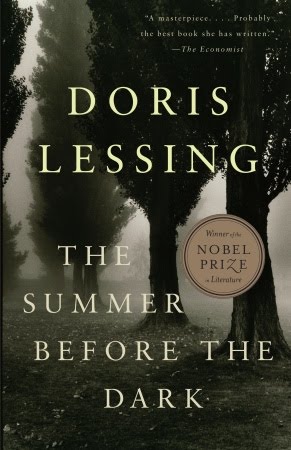
Book Review: Doris Lessing Teaches Me a Lesson?


The Summer Before The Dark
Doris Lessing

In 2007 Doris Lessing won the Nobel Prize for literature, but until this month I had never read anything by her. I knew that she has written The Golden Notebook, but I didn’t know anything about it or Lessing. So when I came across a cheap pulp edition of The Summer Before The Dark, I thought it was time to acquaint myself with the Nobel laureate and it would be a good book to take with me on our vacation.

Written in 1973, The Summer Before The Dark is the story of Kate Brown, a married, empty-nester in her mid-forties. She finds herself alone for the summer as husband and kids scatter to pursue various interests. On short notice she is drafted to assist a friend of her husband who needs a translator for a month-long conference he is holding in London. Kate quickly proves adept at the work, makes herself invaluable to the organization without even trying, and gets paid a salary almost as big as her doctor husband after years of being a housewife.

Kate’s sudden and unexpected success in the workplace made me think that this was going to be a particular kind of story of positive transformation. A “housewife discovers hidden talents and surprises everyone” kind of story. And frankly, this is one of my favorite kind of tales. But alas, Kate’s transformation turns out to be much more torturous and complicated than that.

After helping organize a conference in Istanbul, she finds herself traveling through Spain with an American man about ten years her junior. Hoping to avoid the touristy parts of southern Spain, the American keeps pushing them inland only to end up seriously ill. Kate does her best to make do with the complicated situation but her facility in French, Italian, and Portuguese are of minimal help to her in rural Spain. And traveling with a man who isn’t her husband puts her at silent odds with the people in the small village.

As Kate begins to show signs of the same unknown malady as her traveling companion, she makes her way back to England where she checks herself into a Bloomsbury hotel rather than a hospital. Although never dangerously ill, she has a physical and mental meltdown that leaves her incapable of functioning for some weeks. Eventually she rents a room in a flat occupied by Maureen, an angst-ridden twenty-something who is confused about her own freedom and whether or not to get married. While she is living with Maureen, Kate makes her way back to a degree of normalcy and the book ends with certain amount of hope if not outright resolution.

One of the themes I found particularly interesting, because of my proclivity to whine about my own existence, was the way Lessing juxtaposes comfortable middle class life with others in the world who struggle merely to live. Kate works for a non-governmental organization that focuses on global food policy and she is startled by how much she and others in the organization are paid and how much money is put into conferences that might be of little value. Especially troubling to her when compared to economic conditions of the communities that they serve.

Similarly she sees her own issues relative to the natives she runs into in rural Spain, where they have not learned to overcome their moral qualms about the behavior of the rich tourists. The social mores in the small inland village in which she is stranded are at odds with her own life and her choices she has made and the situation leaves Kate feeling isolated. She compares her own freedom with that of the women in the village where there is “not a woman or girl in this place who was within a hundred years of such freedom.”

Perhaps it isn’t a major theme of the book but I identified with what I saw as Kate’s recognition of the self-indulgent nature of upper middle class ennui. It is akin to the moments on MyPorch where my idea of thoughtful introspection and self-awareness gets boiled down by my father (Ernie in Peoria) to self-pity or whining. He is not as blunt as that, but he is essentially right. Privilege breeds whining. The fewer real obstacles one has in life, the more petty the complaints are. I thankfully don’t have to battle illness, or worry where my next meal is going to come from, or worry about being killed by a missile, or not having safe drinking water. I get to sit at a computer and worry about whether or not my life’s dreams will be realized today or tomorrow.

One of Kate’s upper middle class struggles is finding out who she is now that she is no longer defined by her children’s wants and needs. When you think of the struggles in the world, this is ultimately a self-indulgent worry. But things in life are relative and it is hard to keep a healthy perspective. One of the things that struck me is that I am almost Kate’s age, but I haven’t raised a family and I have been free to pursue just about every avenue of interest that has popped into my head. The only task in my adult life has been to raise myself. My angst about where my life has been and where it is going seems even more self-indulgent when viewed through the prism of those who have children to care for. Am I trying to say that I should just shut up and quit complaining? Not really. I think it is too much to ask anyone to try and live too far outside of their own existence. And my existence is that of a middle class, childless, coupled, white, gay male in the richest country on Earth. I think a little more balance, keeping things in perspective, perhaps putting a little more of my altruistic tendencies into action, are important things for me to keep in mind. For someone like me who seems incapable of ever being able to decide what I want out of life, perhaps the only things that make the inexorable march toward the grave manageable is the quality of my relationships and the actual process of living. After all, the only finish line in life is death, so I’d better enjoy the run.