Reading for two

In January I take a bucket-list trip to Chilean Patagonia. I’m going with a good friend I’ve known since college days. Our friendship was forged in the early 1990s, period adaptations galore (Forster, Austen, Wharton…), book talk, the New Yorker, and no internet.

Having not dissimilar tastes in books and deciding to not check any luggage, I am in charge of making sure we have enough reading material. Over the course of 12 days we will be spending eight of them in the middle of nowhere and have made a pact to stay as disconnected as possible from our phones and the outside world.

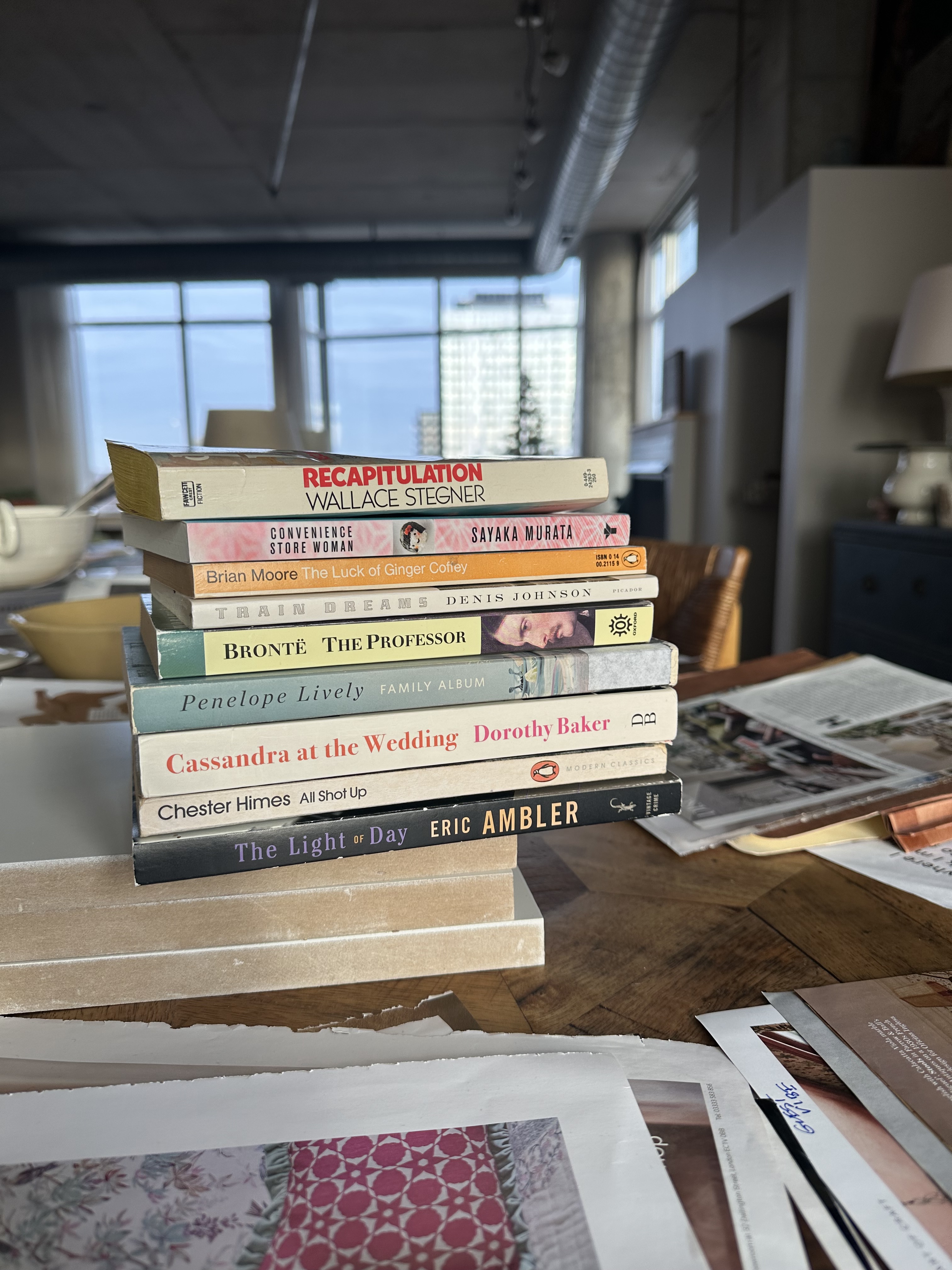
This stack should hold us. We are also bringing recent back issues of The New Yorker and The Atlantic to fill in the gaps.

Recapitulation by Wallace Stegner – In general I like Stegner’s work and I think I first read him in the early ’90s, so this one feels appropriate. It also helped that I had a mass market edition that I can leave behind to lighten the load.

Convenience Store Woman by Sayaka Murata – I got a few pages into this one a few years ago but for some reason put it down. My friend lived in Japan for a couple of years so this seemed like a good choice for something on the contemporary side.

The Luck of Ginger Coffey by Brian Moore – I recently sent Moore’s The Doctor’s Wife to my friend and she loved it as much as I did. Not sure this one will strike the same chords for us, but it will be fun to see what the versatile author does in this novel.

Train Dreams by Denis Johnson – Every one of these 116 pages is brilliant. I’m not interested in seeing the adaptation, but I am interested in a reread and would love to have someone to chat with about it.

The Professor by Charlotte Bronte – One always needs something 19th century on vacation and this one harkens back to our days watching the Austen-a-week adaptations that we went to religiously in the ’90s. Austen is overrepresented in that space, so mixing it up with one of the Brontes.

Family Album by Penelope Lively – My favorite literary Penelope never disappoints.

Cassandra at the Wedding by Dorothy Baker – Nancy Pearl says reader reaction to this novel is a litmus test for whether she is likely to get along with someone.

All Shot Up by Chester Himes – I haven’t read Himes and this one was described by Newsweek as “Pungent, violent and mordantly funny” Doesn’t really seem to apply to anything else in the stack.

The Light of the Day by Eric Ambler – A favorite of mine and I have an extra copy so I am comfortable taking it south of the Equator.

The end (of the year) is nigh

I will probably finish at least one more book in the next 11 days, but given how bad I have been about posting anything here I am going to write this post while the iron is hot.

A rather slow reading year for sure. At 27 books read, that’s one more than my abysmal total of 26 in 2024. I have to go back to the 1990s to find a year with such low numbers. I don’t necessarily want to try for trip digits again. The four years I managed to crack 100 (110, 110, 104, and 122) were notable for not really enjoying the reads as much as I should have. But there is a lot of distance between 27 and 122. I think 2026 is to go back to my goal in 2004 which was to read at least 52 books in a year.

But enough about numbers. What were my top five titles for 2025? (You can look here for all the books I read in 2025.) Not surprisingly most of what I read and most of what I liked could all be considered vintage reading. But anyone who knows me knows I am stuck in the past.

The Doctor’s Wife by Brian Moore was probably the book I loved most this year. Back in 2005 I didn’t really get on too well with Moore’s The Lonely Passion of Judith Hearne but I gave him another chance in 2022 with The Great Victorian Collection which was quirky to say the least and ended up enjoying it quite a bit. So it was a delightful surprise when I settled into The Doctor’s Wife. Published in 1976 it focuses on an Irish woman who goes to visit a friend in France only to turn everything in her life on it’s ear. I loved every damn minute of it. I love a story where the protagonist busts through expectations in search of happiness. Easily my favorite kind of book. It also has me rethinking my earlier experience with Judith Hearne and am planning a reread to see what I may have missed the first time.

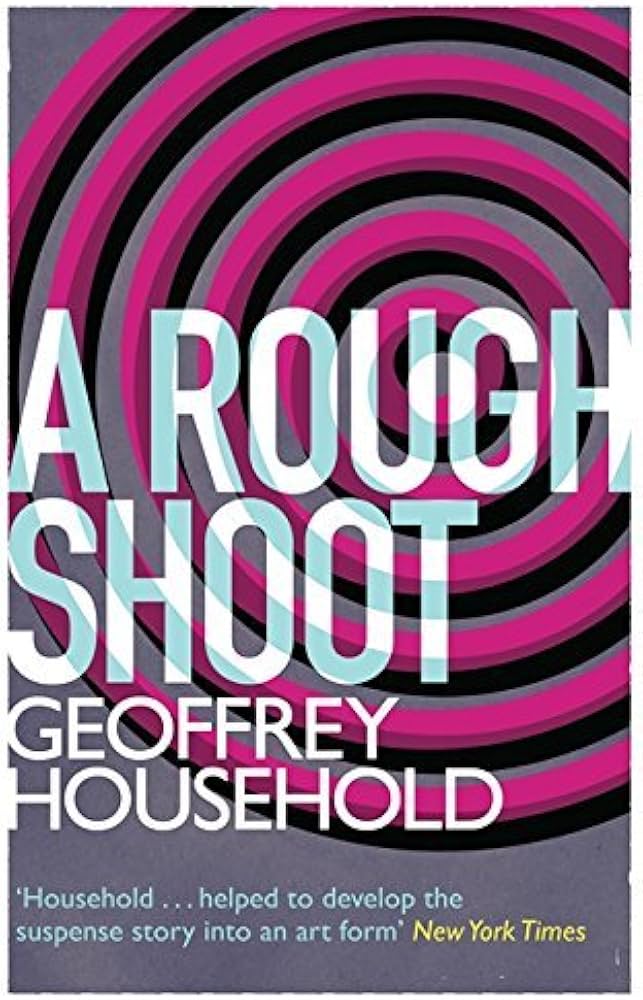
Many of you will recognize Geoffrey Household because of the NYRB Classics edition of Rogue Male. That was certainly my introduction to his work. From my experience so far, Household’s work consists primarily of vintage British spy thrillers. Of course they weren’t vintage when he wrote them, but they are delightfully old fashioned. A Rough Shoot, published in 1951, requires a bit of a leap at the beginning when everyday guy Roger Taine accidentally kills a guy hiding in a hedgerow and then another leap when the action moves from evading his crime to the center of a plot to bring fascism to the UK. Fast paced and short. I could read a million of these. (Incidentally, this was turned into a film written by Eric Ambler, a writer I love and have waxed rhapsodic about on myriad occasions.)

This past year a new bookstore has opened just three blocks from my new place in Minneapolis. Half cafe/half books, the stock is a little Gen Z for my tastes, but I did stumble across this McNally Editions copy of Ex-Wife by Ursula Parrott. I knew nothing about it and ended up enjoying it immensely. Published in 1929, this book has it all, open marriage, divorce, abortion, casual sex, and all sorts. Quite a bit more tragic than The Doctor’s Wife, it still fits my sweet-spot for people finding agency in their own lives.

If you like Mapp and Lucia, you will like Paying Guests. Published in 1929 it may in fact have been the result of Benson coasting of the success of the Lucia series. But for fans this is a good thing. Instead of Major Benjy, there is Colonel Chase obsessed with his pedometer. Instead of a hanging committee refusing Lucia and Georgie’s little daubs there is a self-mounted solo exhibition that goes from failure to triumph. Throw in Christian Science, rubbers of bridge, and a lot of gossip and you get the picture. One caveat, unless you love bridge, there is an entire chapter you can skip.

Finally, something published this century! Mark Haber’s Saint Sebastian’s Abyss published in 2022 focuses on an art historian who has made his life’s work studying and writing about a single painting who is on his way from New York to Berlin to visit his ailing once best friend and colleague who also made his career studying and writing about the same painting. Stylistically, the writing has some charming quirks that could have easily caused me to set the book aside. In recent years I have almost entirely eschewed such creativity for more straightforward prose. I’m a literalist at heart but it felt good to read something that demanded ambiguity and suspension of disbelief. There is also a lot of repetition in the text that feels almost poetic and reinforces the singular nature of the careers of these two scholars obsessed with what I’m assuming is a fictional work of Dutch Renaissance art by Count Hugo Beckenbauer. It is only 130 pages but it is the kind of book you want to discuss with others who have read it.

Smooshing my library

As I think most regular readers will know, I sold my house in DC and moved my butt back to Minneapolis, a place I haven’t lived in for 24 years. At some point I will do a post about that, but suffice it to say for now, I love pretty much everything about my new life.

I was lucky enough to find a condo to rent that has a den that actually has some built-in shelves. But, as the pictures you are about to see will show, I don’t have near enough room for my collection of books. I hear some of you saying “Time to weed your collection.” But I have cut as far to the bone as I am willing to go. I have about 800 unread novels. No way I’m getting rid of any of those. About 10 years ago, I greatly pared back the novels that I have read–I limit myself to keeping only those I think I may read again. No matter how much I may have liked something, if I don’t think I will read it again, it goes.

Where everything used to go.

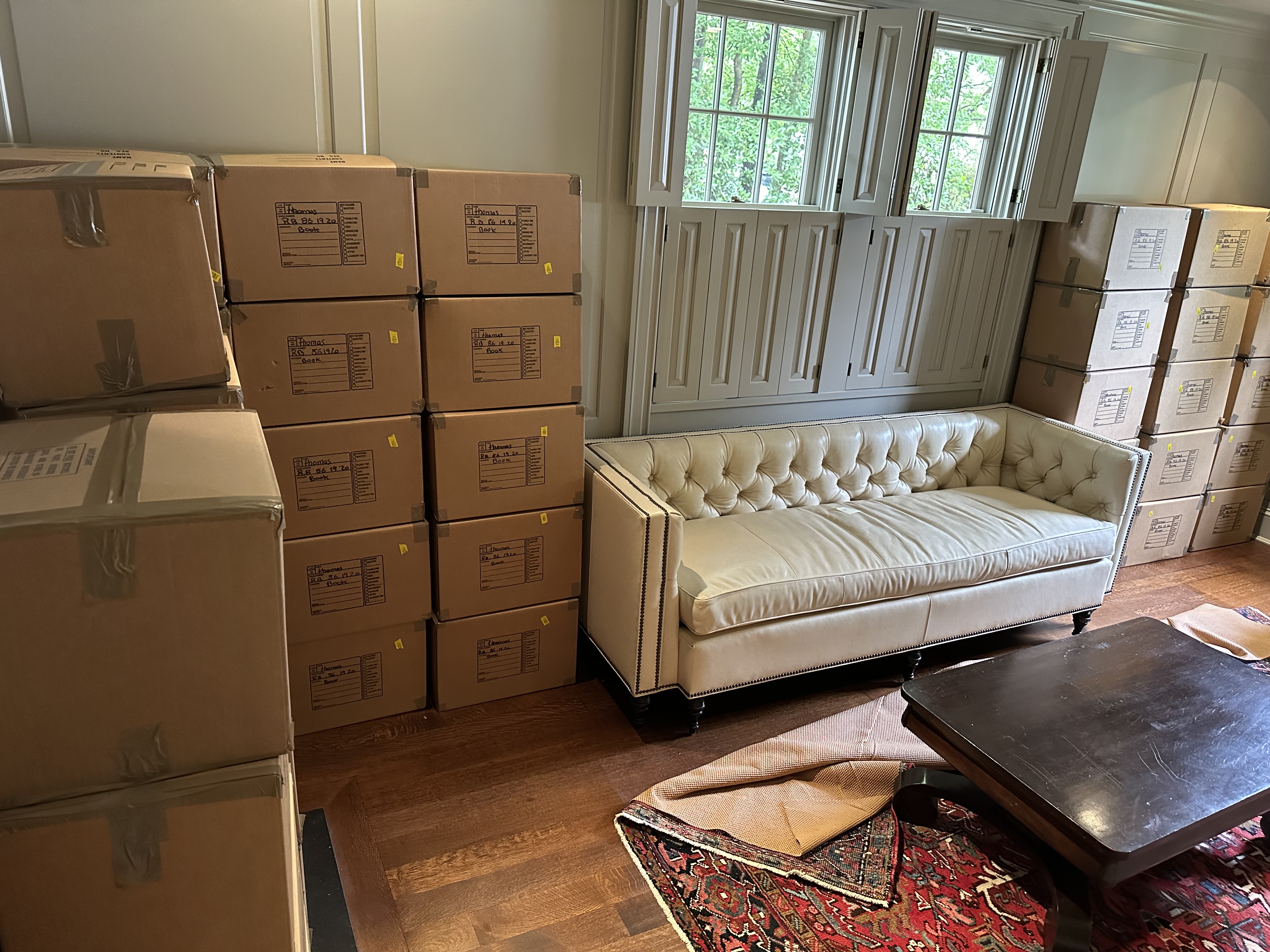
49 boxes ready to move half way across the country.

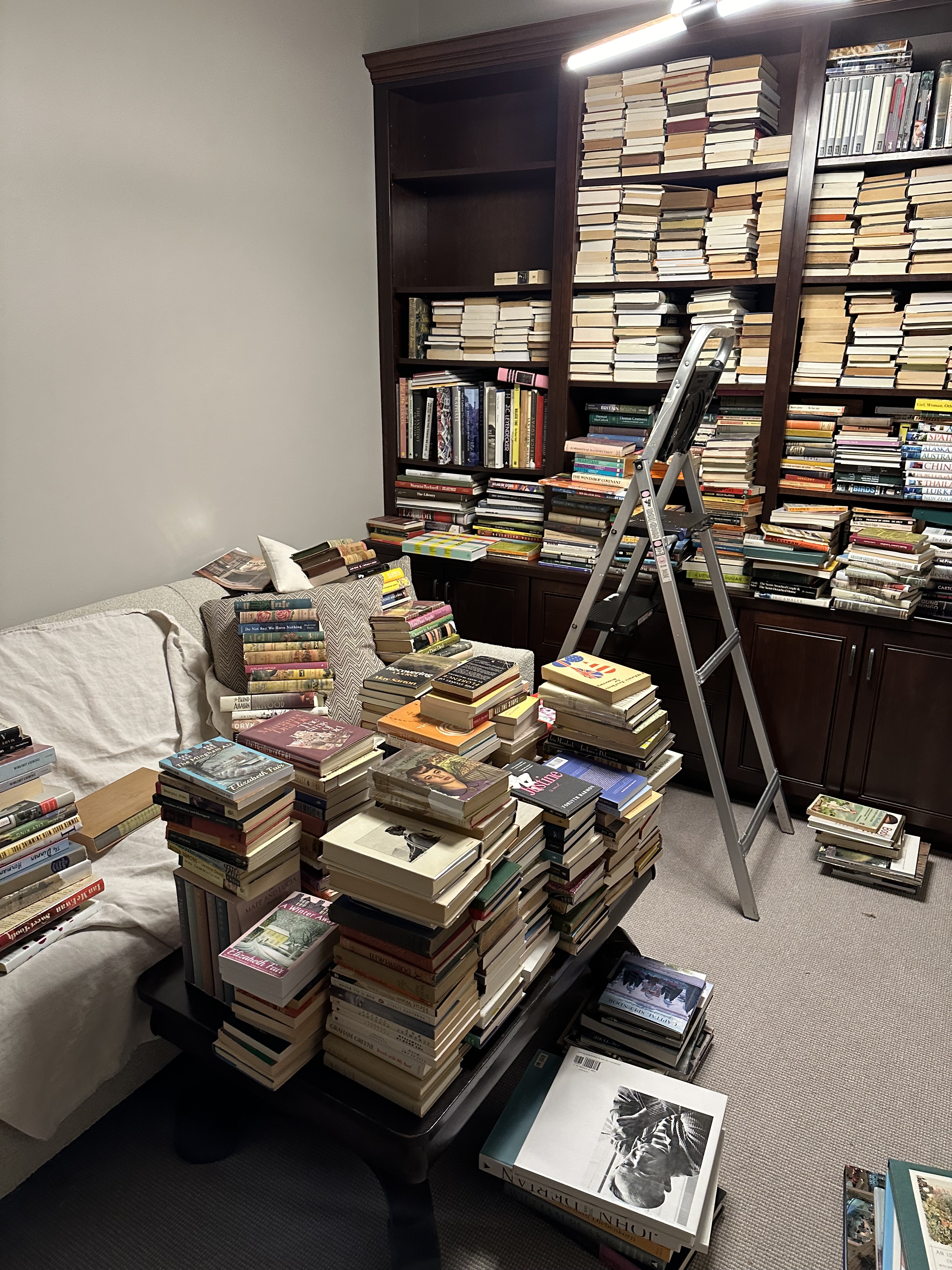
The reality of not having near enough room starting to set in.

I gave up trying to be methodical. I just wanted to get the boxes out of the house, so I was just shoving books wherever there was room.

Stacking them on the shelves with short edges out was necessary to get as many off the floor as possible.

Nothing in any kind of order.

I decided to get as many of the novels that I have already read out of the way by shoving them way up here. Accessible only by ladder, disheveled at best, and not in any order.

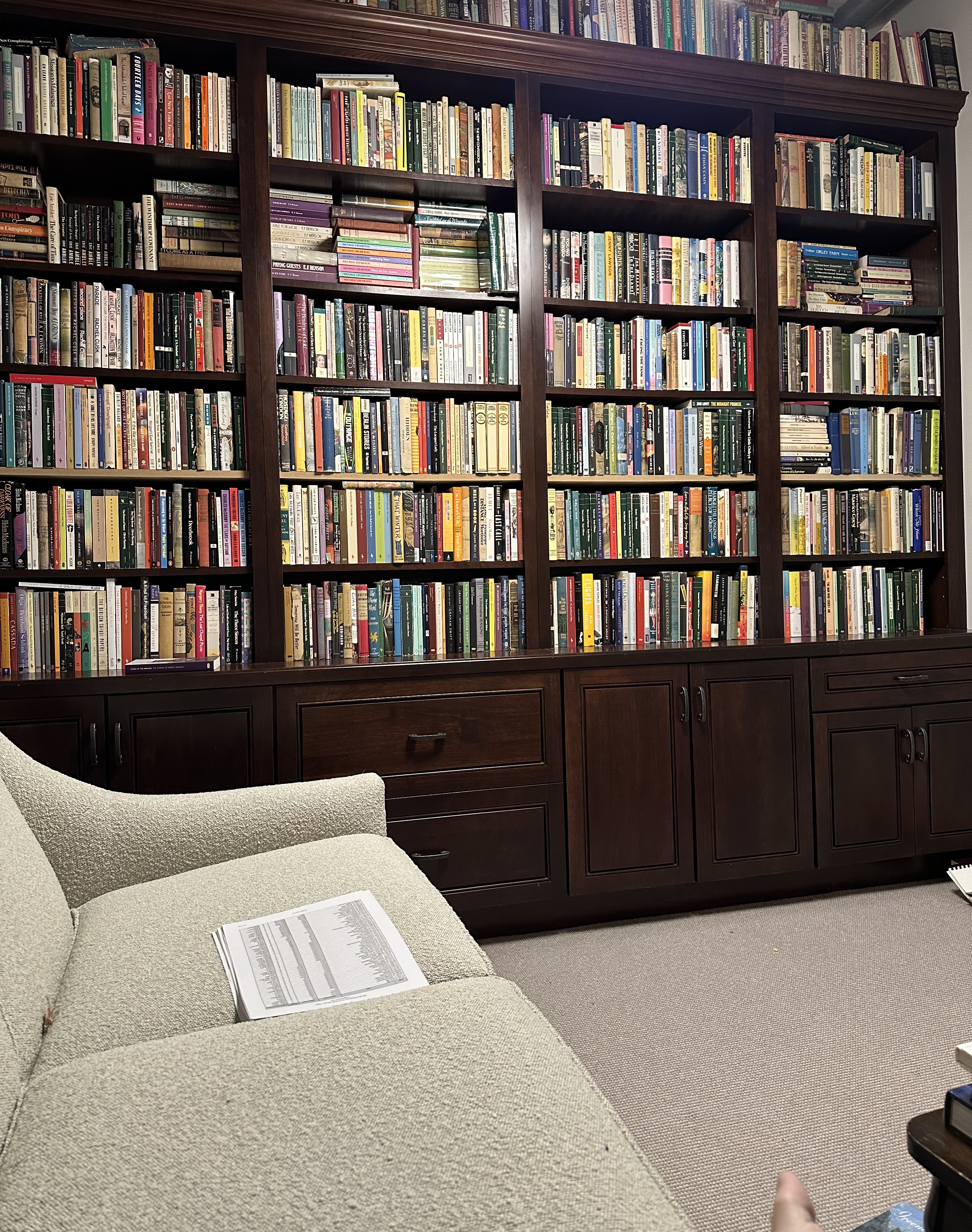
I increased capacity by adding one additional shelf to each stack. You can see that one of the rows is just plain old MDF. What you see on the main part of the shelves are all the novels I have yet to read. There are additional novels that I’ve already read tucked away in those somewhat useless cabinets.

Most of my non-fiction unceremoniously stacked in a corner of my coat closet.

Now my non-fiction collection is a bunch of books that I don’t necessarily plan to read. Rather, I tend to use them more as reference books when I want to dip into a topic. My non-fiction consists largely of books about the UK, literary stuff, books on books, some on musicians and composers, and other odd bits. And when it comes to those books I feel without them I don’t have a library, I just have books. These are the volumes that you might peruse when you go to a real library, but are unlikely to check out. Volumes that provide some serendipitous delights or interesting tidbits. Books to open when you want to be bookish but don’t have the presence of mind to sit down and read. I imagine these books in a big old room with a large table, a big dictionary or atlas on a stand, and maybe a globe nearby. You know, a library.

That’s what makes it so hard to see them stacked up like this. Not very easy to gaze at them and randomly pick up one that catches my eye. And don’t even ask me where my Trollope Gazetteer went to. Still, it could be a lot worse. It’s also clarified for me how much book room I want and need when I buy a house or condo eventually.