In January I take a bucket-list trip to Chilean Patagonia. I’m going with a good friend I’ve known since college days. Our friendship was forged in the early 1990s, period adaptations galore (Forster, Austen, Wharton…), book talk, the New Yorker, and no internet.
Having not dissimilar tastes in books and deciding to not check any luggage, I am in charge of making sure we have enough reading material. Over the course of 12 days we will be spending eight of them in the middle of nowhere and have made a pact to stay as disconnected as possible from our phones and the outside world.
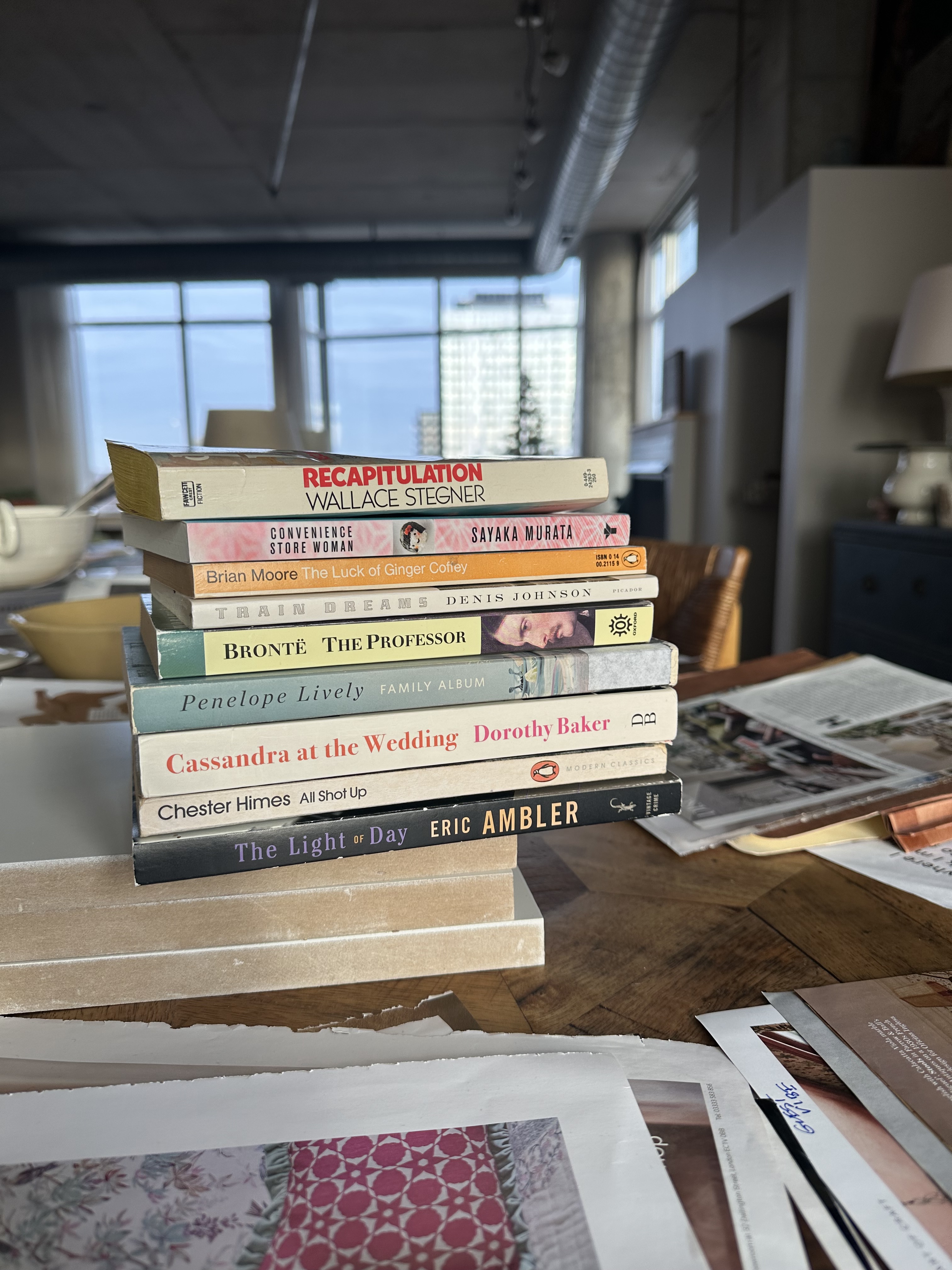
This stack should hold us. We are also bringing recent back issues of The New Yorker and The Atlantic to fill in the gaps.
Recapitulation by Wallace Stegner – In general I like Stegner’s work and I think I first read him in the early ’90s, so this one feels appropriate. It also helped that I had a mass market edition that I can leave behind to lighten the load.
Convenience Store Woman by Sayaka Murata – I got a few pages into this one a few years ago but for some reason put it down. My friend lived in Japan for a couple of years so this seemed like a good choice for something on the contemporary side.
The Luck of Ginger Coffey by Brian Moore – I recently sent Moore’s The Doctor’s Wife to my friend and she loved it as much as I did. Not sure this one will strike the same chords for us, but it will be fun to see what the versatile author does in this novel.
Train Dreams by Denis Johnson – Every one of these 116 pages is brilliant. I’m not interested in seeing the adaptation, but I am interested in a reread and would love to have someone to chat with about it.
The Professor by Charlotte Bronte – One always needs something 19th century on vacation and this one harkens back to our days watching the Austen-a-week adaptations that we went to religiously in the ’90s. Austen is overrepresented in that space, so mixing it up with one of the Brontes.
Family Album by Penelope Lively – My favorite literary Penelope never disappoints.
Cassandra at the Wedding by Dorothy Baker – Nancy Pearl says reader reaction to this novel is a litmus test for whether she is likely to get along with someone.
All Shot Up by Chester Himes – I haven’t read Himes and this one was described by Newsweek as “Pungent, violent and mordantly funny” Doesn’t really seem to apply to anything else in the stack.
The Light of the Day by Eric Ambler – A favorite of mine and I have an extra copy so I am comfortable taking it south of the Equator.



 hogglestock