Book Review: The Carlyles at Home by Thea Holme


I just found out thanks to the Google that the Carlyles’ home on Cheyne Row in Chelsea is actually open to the public. The bad news is it appears to close for the season at the end of October so I won’t be able to visit it while I am in London. That is a bummer because the house is easily the third main character in Thea Holme’s social historical look at the life of Thomas and Jane Carlyle’s life in their Chelsea home from 1834 to Jane’s death in 1866. Turns out Thea Holme’s husband Stanford was the curator of the house museum and they actually lived in the house in the 1960s. Not surprising then that she decided to write this book.

I started reading The Carlyles at Home during the readathon, but all the descriptions of home improvements kept my mind wandering to all the things that we needed to do to our place. I also couldn’t really read it before going to sleep either for that same reason.

There is lots of domestic minutiae for those of us that like that sort of thing. The Carlyles at Home is a primer on daily life in the mid-19th century. Almost a behind the scenes look at all those costume dramas we love to read and watch. Food (limited selection, always leading to indigestion), gardening (Jane liked flowers, Carlyle like fruits), home improvement (seemed to be constantly making changes to their home), finances (misers with unsteady but overall decent income), and servants (always hard to find and keep).

I love books that deal with incomes and expenditures and this one includes a whole chapter on money. I had to do a little online research to understand the difference between pounds, shillings, and pennies. After so many years of not really understanding it is nice to finally know that there were 12 pennies to the shilling and 20 shillings to the pound. And that a price of 1/7/6 would mean that something cost a pound, seven shillings and 6 pennies. But don’t try and convert those pennies into modern pennies because the old pennies were  not of equal value to the new pennies that were ushered in upon decimalization in 1971.

And speaking of money. Remember how annoyed I was by the fact that the Provincial Lady was not very organized or good with money? Well Jane Carlyle would be just the person to put her in her place. She is the personification of competence in domestic housekeeping. And Jane’s skills and abilities went well beyond what most women were allowed to do at the time. She was an executive ahead of her time.

After reading The Carlyles at Home, I am even more interested in reading Phyllis Rose’s Parallel Lives which looks at the married lives of five Victorian couples including the Carlyles. I am curious to read a less romanticized view of the couple. For Thomas Carlyle just seemed like a bit of a baby and a bully. He was constantly complaining, and it was Jane’s lot to make everything perfect for him. A pretty impossible task.

One of the more amusing stories about Jane was the crisis she faced at the prospect at having to attend an aristocratic ball décolletée. The fashion at the time was that even the most modest of ladies during the day would bare their shoulders and (ahem) bosoms by night. For 49-year old Jane this proved to be almost too much. She was fairly forced into it by Carlyle who declared that true propriety required conforming to the fashion of others. (That is some message for all you parents trying to get your children to dress with some sense of modesty.) In the end Jane became entranced by how well she looked in the dress once she saw herself in it in the candlelight.
  
This is social history that doesn’t necessarily feel like non-fiction. You will find lots of quotes interspersed but you won’t find any citations so it doesn’t really have an academic feel.

This book is perfect for anyone who wants to understand the daily life of a middle class Victorian couple or anyone who likes reading about domestic details. Or both.
  

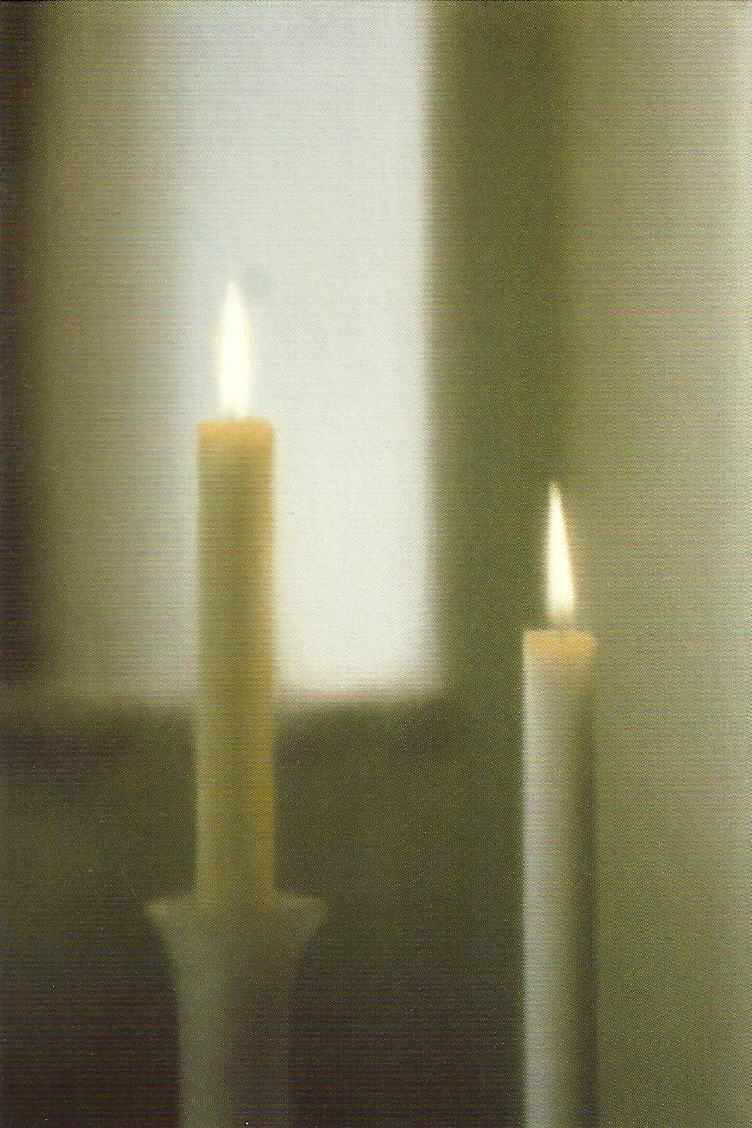
Sunday Painting: Four by Gerhard Richter

  
For those not so interested in art (say it ain’t so) you might be more interested in:

My review of The Provincial Lady in London by E.M. Delafield
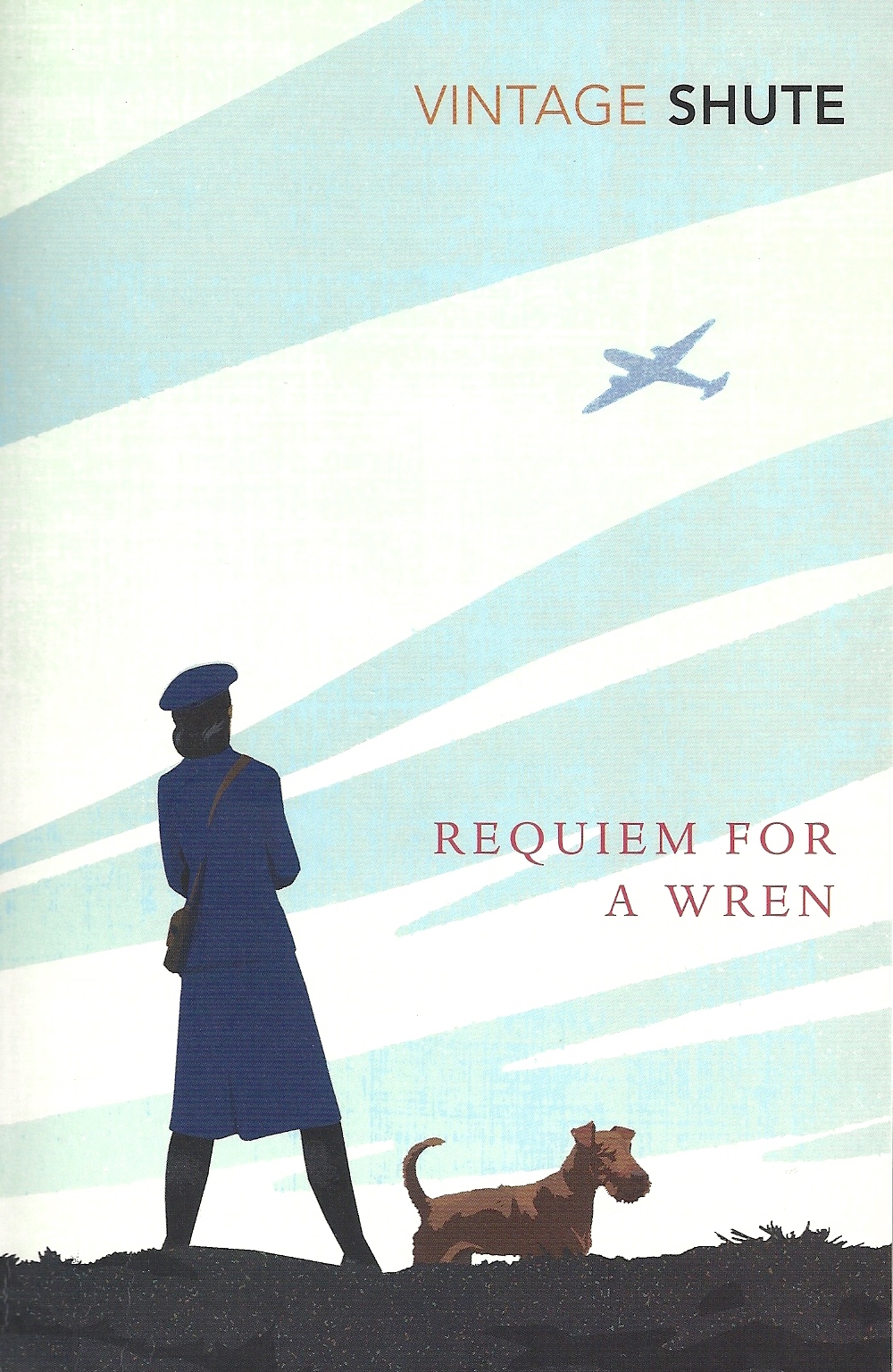
My review of Requiem for a Wren by Nevil Shute
A particularly popular post on what might constitute American cozy.

Now, on to the paintings. The brilliant German painter Gerhard Richter has an amazing range of technique and style. The first one below shows his amazing abilities in photo realism. The other three are from what I refer to as his fuzzy photo realist period.

Lesende  (Reader)
San Francisco Museum of Modern Art

Woman Descending the Staircase
The Art Institute of Chicago

Blumen
Carre d’Art-Musee d’Art contemporain de Nimes

Zwei Kerzen

Book Review: The Provincial Lady in London by E.M. Delafield


Illustrations by Arthur Watts

For me the Provincial Lady books are true cozy, comfort reads. And I am a fan of the two that I have read thus far. But a large part of the humor found in these books comes out of the disheveled nature of the Provincial Lady’s lifestyle. And it is that very thing that tends to aggravate my mild OCD. I constantly want to fix her life. I want to balance her checkbook, prioritize her housekeeping tasks, manage her social calendar, and show her a million and one ways she can economize.

And once my mind starts to overwhelm my willing suspension of disbelief, all hell breaks loose. Once I give in to organizing her world I start to question her life choices, and then I end up feeling a little exasperated. Not surprisingly given the title, in this volume the Provincial Lady goes to London. She rents a flat for herself so she can work on her next book, which she never seems to get around to. Caught up in way too many seemingly unpleasant social situations, she doesn’t ever seem to get around to writing anything. And in that sentence is a world of hurt for someone with a brain like mine.

  1. She needs to set a writing schedule to ensure she has time to maintain her professional commitments.
  2. She needs to realize that a more effective work schedule would allow her to earn the money she needs to cover her costs.
  3. She needs to stop being a social suppliant. By taking control of her social life and saying no in the right way and at the right times she would not only preserve more time for her work and things she would prefer to do, but she would also gain a bit of the upper hand–especially since her successful book has increased her social value. A few declined invitations would only add to her social allure, and over time increase her demand allowing her to pick and choose the social occasions that she might actually enjoy.
  4. Did she really think that busy, distracting, expensive, London was the place to write?

Do you see how pernicious my mind is? The whole point of these Provincial Lady books is to delight in the ditzy chaos of her life. And I do delight in them, but I am also rewriting the script of her life as I chuckle.

And what’s up with her marriage? They seem about as happy together as two strangers waiting for the same bus.

Although my mind works overtime reading these books, I do actually enjoy them. One thing Delafield does particularly brilliantly is the way in which she manages to make the books feel like real diaries. As I have noted in the past:

The diary entries brilliantly capture the episodic, shorthanded cadence so typical of how one thinks about things. Not always in lovely complete sentences, but short bursts of thought, like thousands of brain synapses firing directly onto the page. There is much that made me chuckle in this book. And of course I love a good bit of domestic detail and this book does not disappoint on that account.


Book Review: Requiem for a Wren by Nevil Shute

       
Regular readers will know that I am a big fan of Nevil Shute. He is a fantastic storyteller whose penchant for manly man adventures is balanced by his penchant for including strong female characters. Despite the fact that British born Shute only spent the last 10 years of his life living in Australia, his many books with Australian themes or settings place him in many minds in the pantheon of Australian writers. A somewhat forgotten or overlooked writer since his death in 1960, Shute has been getting a bit of attention in the blogsphere in recent years thanks to Vintage Classics reissuing four of his novels with fantastic new covers. And most recently the Riverside Readers book group read his nuclear Armageddon blockbuster On the Beach. You can see what Simon, Polly, Sakura, and Kim thought about that book on their blogs.

Since I find Shute’s novels to be unputdownable, I thought reading one of them would be a great choice for last weekend’s 24-hour readathon. So I picked up Requiem for a Wren which was the only Shute on my shelves that I hadn’t read. In it, we find Alan Duncan returning home to his parents’ farm in Australia after spending several post-WW II years in London. Right off the bat he, and the reader, are informed that his parents’ parlourmaid has just killed herself. I can’t say much more than that without spoiling some of the mysteries that swirl through the book. There were many aspects of this story that I found compelling and the novel drew me in as quickly as I expected, but overall I was disappointed with Requiem for a Wren. It felt like the more compelling outer story was, in the end, just a shell for Shute’s interest in writing about WW II which took up the majority of the literary real estate and comprised the inner, story within a story. Shute often frames his novels this way and it usually doesn’t give me any pause whatsoever. But in the case of Requiem I just don’t think I was in the mood for the shift.

Oddly enough, one of Shute’s biggest failings is one of the things I love about his work. As I have noted previously, and as Kim notes in her review of On the Beach, Shute’s writing cannot be called elegant. In Kim’s words:

Shute also tends to write in a fairly stilted manner, using phrases that seem ridiculous — “The breakfast came upon the table” — and referring to characters by their nationality or occupation — “The Australian”, “The scientist”, “The Commander” — which grate with constant repetition.

He certainly takes a similar approach in Requiem. The writing can be corny sometimes and feel a bit like a 1940s film with everyone talking in a rapid, clipped manner where every word is focused on moving the storyline forward. It can make for some one dimensional characters. But the odd thing is, I love this about Shute’s book.

Now that I have dissed both Shute’s prose writing  in general and the narrative structure of Requiem specifically, you may be thinking that I wouldn’t recommend this book. Not quite. As I have said I love Shute’s quirky prose and many of you would be happy to overlook it in favor of compelling story telling. And the story within a story structure of this particular novel wasn’t problematic, I just wasn’t in the mood for the inner story–I wanted more of the outer story. The only thing that should stop you from reading this book is reading another Shute novel. If you go back to this link, you can get a sense of which of his other novels you would find interesting. But if Requiem is the only Shute at hand, you shouldn’t be disappointed.

Is there such a thing as American cozy?


As the weather has gone delightfully chilly and I snuggle up in the library in my pajamas with candles burning and music playing, my thoughts turn to cozy. Many of you kindred spirits who read My Porch share my interest in the occasional cozy read. You know what that means, something that is comforting and enjoyable to read. It, doesn’t mean they are always happy books, and it certainly doesn’t mean that they are necessarily light weight either. But they do induce a certain amount of calm. They feel like friends or a literary snuggle.

Of course definitions of cozy can be pretty broad and varied. I can think of many different authors that could be considered cozy

Fundamentally Cozy
E.F. Bensen
E.M. Delafield
Joyce Dennis
Paul Gallico
P.G. Wodehouse (?)

Complex Cozy
Anita Brookner
Barbara Pym
Most things from Persephone

Youthful Cozy
Anne of Green Gables
Heidi
The Secret Garden

Old Fashion Cozy
Jane Austen
Anthony Trollope
Perhaps Wilkie Collins and even Dickens for those that like him

With the exception of L.M. Montgomery’s Anne of Green Gables series (Canadian) and Heidi (Swiss) my idea of cozy is decidedly British. (I should be spelling it ‘cosy’ I guess, but the My Porch Manual of Style won’t allow it.)

American Cozy
Hmm…what about…no…maybe…mmm not really. What could be considered American Cozy? Is there American Cozy?

Let me try again…

Maybe Laura Engalls Wilder?
May Sarton could be complex cozy, especially her journals.
I know Miss Read fans would put her on the list. UPDATE: D’oh! Michelle Ann pointed out that Miss Read is English. What was I thinking?! I have read about four of her books. Maybe it is because American blogger Book Psmith is so into them. But she is also into Wodehouse and he sure isn’t American. Sheesh. I guess my brain melted a bit.

There is some temptation to overlap with chick-lit, but while those may be highly enjoyable, I don’t think I would put them in the cozy camp.

Books on books can be hugely cozy. In fact Helene Hanff’s 84, Charing Cross Road is like the Empress of Cozy. But, although Hanff was an American and half the book takes place in America, the focus seems a little too Anglocentric to truly be American Cozy. Anne Fadiman’s Ex Libris could though.

Dorothy Canfield Fisher’s The Home Maker is definitely American Cozy. Of course it took British publisher Persephone to revive this gem.

I think I could put American food writer Ruth Reichl on the cozy list. Her three volumes of memoirs are delightfully cozy. Just make sure you have something delicious to eat near to hand.

Edith Wharton would fall into the Traditional American Cozy, and to some degree Henry James as well. I think a case could be made for Willa Cather as well.

But all this feels a bit like stretching. Is the cozy read uniquely British? Which authors or books would you consider to be American Cozy?

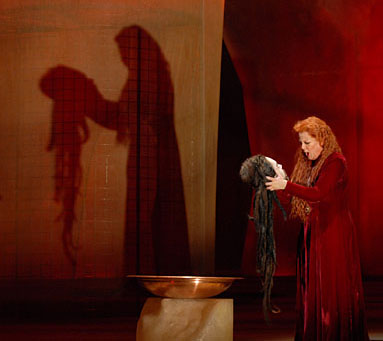
Salome could use some therapy.

  
Let’s just say that Salome is troubled child in a broken, abusive family situation. Here she is holding the head of John the Baptist right before she makes out with it. The severed head was a present from her stepfather. Salome had requested the head as a reward for stripping naked for her stepfather (Herod) while her mother watched.


Deborah Voigt as Salome


I went to the Washington National Opera tonight to hear Voigt sing the role in this Strauss opera based on the play by Oscar Wilde. I have heard Voigt sing on several ocassions in other places but this was her first time singing with the WNO.  Her she is when she is not playing a twisted necrophiliac.

Deborah Voigt
Photo copyright Dario Acosta

And she was fantastic tonight. I once drove for five hours to West Virginia to hear her sing. Based on tonight, I would do it again. Such a voice.

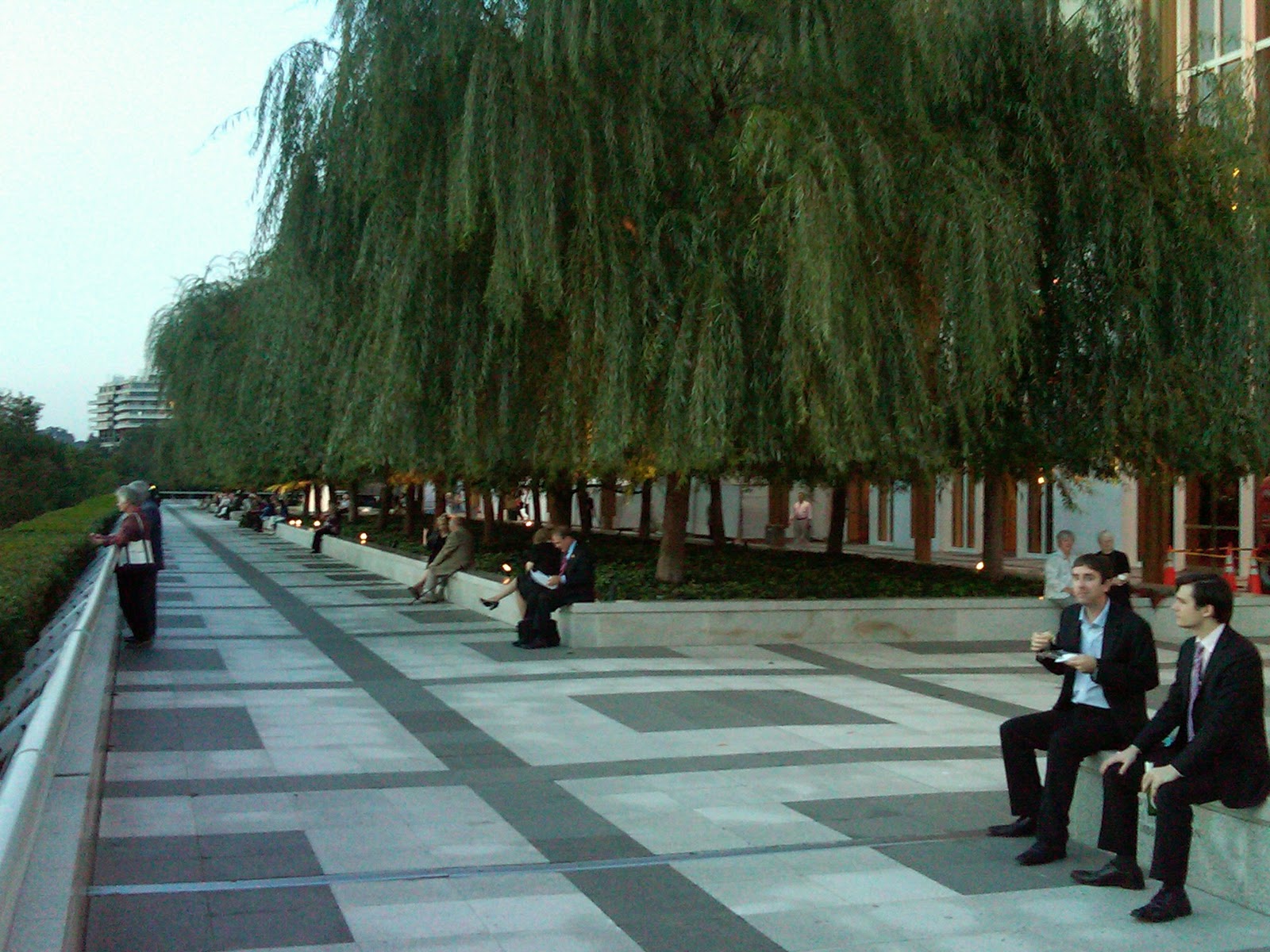
The performance was at the Kennedy Center which is a presidential memorial in the guise of a performing arts center. These are fairly bad photos I took on my phone. They mainly show the views from the terraces.

That’s the Washington Monument in the distance
and the Peace Institute in the right of the mid-ground.

Looking up the Potomac toward Georgetown.
That is the National Cathedral you see up on St. Alban’s Hill.

Lincoln Memorial from the roof terrace.

The lower terrace.

This giant bust of Kennedy is kind of growing on me.
When I first saw it in 1993 I thought it looked like chopped liver
and kept looking for a giant cracker.
  

Book Review (with preface): The Position by Meg Wolitzer


(This is not the edition I have.
I just liked it better)

 Preface on Labeling Fiction
I would love to come up with a short phrase that would adequately describe this kind of novel. Categorization is not always helpful when describing fiction. It can unfairly pigeon-hole a book or an author’s entire body of work. Or it can knock a book off of someones TBR because it falls into a category that a potential read thinks she doesn’t enjoy. Still, despite the pitfalls I want to find a phrase or label that would sum up this genre.

In the past I have referred to it as “smart chick-lit” but I never felt comfortable with that. Chick-lit limits the scope of Wolitzer’s novels and audience too much. Not wanting to get into WW III over my oversimplification, but I think true chick-lit is strictly of the boy meets girl, complications ensue, variety of novel. And none of the three Wolitzer novels I have thus far read fall into that category. I know there have been conversations out in the blogosphere about gender and fiction recently. Teresa at Shelf Love explored it well, but wasn’t necessarily interested in slapping a title on this kind of fiction.

Maybe it would be helpful if I described what I think this category of book is all about. Usually written by a woman but not always. Focus tends to be about relationships. And it is definitely commercial rather than literary fiction. Teresa teases that out in her post: commercial fiction, no matter how well written deals with issues at the surface and doesn’t make the reader look too deep to find meaning. It always uses a light touch, and I think, more often than not, uses humor or at least makes you chuckle once or twice.

So: relationship-oriented, commercial fiction, often with a splash of humor that may or may not be written by a woman. Oh, and they are usually a easy to read. Hmm. That doesn’t really get me closer to my pithy descriptive phrase does it?

Let me try another tack. Which authors do I think fall into this, as yet, un-describable category?

Mary Gordon
Nick Hornby (I wouldn’t have thought of him, but Teresa was right to include him.)
Wally Lamb
Elinor Lipman
Armistad Maupin
Claire Messud (She tries to write literary fiction, but I think she fails.)
Marge Piercy
Joanna Trollope
Meg Wolitzer

No doubt, even among the authors I have read, there are many others than I list here. And there are some who sit on the line that could be included depending on how much you squinted.

Still no closer to having a label for this kind of fiction. Maybe I should talk about The Position.

The Review
The spoiler-free way to sum up this plot. In 1975, Roz and Paul Mellow write a sex manual the becomes a wild success making them celebrities and sexual gurus. The book is full of illustrations of the husband and wife in various sexual positions including the one they invent: “Electric Forgiveness”. What makes all this more interesting and complicated than it sounds is that the suburban couple have four children ranging in age from about 6 to 15 at the time the book is published. And they find the book. And it changes them.

The action doesn’t stay in the 1970s for long. It flashes forward to present day (roughly 2003) quite quickly. Not surprisingly, almost 30 years later, the kids and the parents have issues. To say the least. After the initial chapter, Wolitzer tells the tales of what has become of each of the six Mellows, allowing plenty of space for each character to reveal him- or herself. She includes plenty of humor and drama and characters who are, for the most part, entirely believable. Wolitzer is not as successful in intertwining into all this the post-9/11, traumatic midpoint of George W. Bush’s disastrous foreign policy. One can easily overlook these bits that feel tacked on. But I am less forgiving of the fact that a gay Republican character, even when having a crisis of faith about the direction of the party, doesn’t even mention the incredibly divisive and hate-filled, anti-gay Republican agenda which was at its most venomous leading up to the 2004 elections.

Quibbles aside, The Position, as with all fiction in this category, was an easy and enjoyable read, and really helped my page count during the 24-hour readathon this weekend. If you haven’t tried Wolitzer yet, I like her novel The Wife the best.

Which authors do you think fall into this category? And what should we call it?
  

Readathon: And then we came to the end…*


Minutes read since last update
254 out of 570

Pages read since last update
199 of Requiem for a Wren by Nevil Shute

Books completed
Requiem for a Wren by Nevil Shute

Distractions
Sleepiness

OVERALL MINUTES READ
816 out of 1,390

OVERALL PAGES READ
631

OVERALL BOOKS COMPLETED
2.33

Donation to The Trevor Project based on my page count
631 x 0.05 = 31.55

Donation to The Trevor Project based on Ash’s page count at English Major’s Junk Food
She hasn’t done her final post yet but it looks like her page count will be similar to mine…

Thoughts
I technically have 39 minutes to go but having just finished a book and being quite sleepy, I think I am done reading until I have a bit of a nap.

I think the readathon was very good at pushing aside TV (didn’t watch any) and the Internet (spent very little time online) in favor of reading. But for the likes of me with my need for sleep and other unavoidable distractions it really should be a 12-hour readathon. In the end I did just over 13.5 hours of reading in a 24-hour period. Then again 3.5 of those 13.5 hours was after a night’s sleep, so my reading time over a 12-hour period wouldn’t be 12 hours. Still, it would help me focus on reading.

Finally, as I have mentioned before I think I felt like I would have been more interested in variety, bouncing from book to book. But in the end my need to complete things outweighed my interest in variety. So I only really read from three books, finsihing two and getting a third of the way through the third.

Would definitely do it again, if only so I won’t feel left out.

Next Steps
Catch up with all my favorite blogs and comments made on My Porch over the past 24-hours. And then more reading this afternoon. Yay.

(*Hat tip to Joshua Ferris’ brilliant first novel.)
 

Readathon: Last post until tomorrow morning

  
Minutes read since last update
95 out of 120

Pages read since last update
2 pages in The Carlyles at Home by Thea Holme
51 pages in Requiem for a Wren by Nevil Shute

Distractions
None

Thoughts
When I picked up the Carlyle book again I was totally enjoying it as I did early today. The only problem was that it included way too much about home improvements which kept me thinking about all of the stuff that needs to be done around here. I found my mind drifting way too much.

Odd little coincidence, the Carlyles live on Cheyne Walk and in the first 20 or so pages of Requiem for a Wren they mention a house on Cheyne Walk. Crazy, no?

Next Steps
More Requiem for a Wren until sleep hits me. I plan to get up early. We will see if I actually do.