Many of you are already fans of Caustic Cover Critic. But this latest post about really bad e-book covers for public domain lit is hilarious and maddening. Here is just one to whet your appetite.

Many of you are already fans of Caustic Cover Critic. But this latest post about really bad e-book covers for public domain lit is hilarious and maddening. Here is just one to whet your appetite.
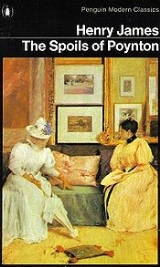
It isn’t often (ever?) that I post bad book reviews. Well, that isn’t true, many of my book reviews are bad…but it isn’t often I post a review of a bad book. (ha) And I might be overstating the case to say that The Spoils of Poynton is a bad book. No doubt it is chock full of redeeming value that I am too dense, or was too bored and confused to understand.
The gist of the story is that mother doesn’t like son’s choice of fiancee. Mom is afraid the vulgar young thing won’t properly venerate the art and collectibles that she (the mom) has spent her adult life collecting. Mom steals everything and puts it in her dowager house. Mom enlists young woman of limited means to help split them up. Young woman is too principled to do so despite falling in love with son who also seems to fall in love with her. Son ends up marrying fiancee who he now seems to hate, once mom returns all items. House full of returned treasure burns to the ground.
I assume that somewhere in this tale about a worshipful, singular, fixation on material goods there is a moral, but Henry James’ use of language is so convoluted at times that I was never more than 80% sure I knew what was going on. There were times while reading this when I felt like reading Shakespeare would have been less taxing and far more rewarding.
Still, I give it a 5 (out of 10) on my rating scale which equals “ambivalent” because there was some pleasure in the formal Victorian details. I plan to read more Henry James. He wrote too much to ignore. And I didn’t hate Washington Square or Portrait of a Lady.
I bought this book for the Penguin cover. And it was only 50 cents.

 A few other reviews:

Before I read Wilkie Collins’ The Woman in White I would probably never have picked up this book even though it was only a dollar at Book for America. Then again I would have never picked up The Woman in White either. Most times I have very strong feelings about the kind of books that I think I like. This usually works in my favor as I end up not wasting time on books that I really don’t enjoy. But occasionally I am persuaded that I really should give a particular book or author a chance. It has happened over the years with books like A Prayer for Owen Meany (Irving), The Andromeda Strain (Crichton), Deliverance (Dickey), and thanks to the evangelism of Simon at Savidge Reads, The Woman in White. In all of these cases, I managed to drop my tendency toward obstinacy just long enough to discover some really great reads.
Like The Woman in White, Braddon’s Lady Audley’s Secret is a sensation novel where the normal strictures of Victorian social mores are used to frame a plot full of scandalous, sensational, comings and goings. Imagine all the proper, detailed trappings of a Trollope, but replace a purloined cheque with a bigamous, murderous, lying, mad woman and you start to get the drift of Lady Audley.
Because there is so much detailed plot in most sensation novels it is somewhat useless to try and convey the plot in a review. One could probably outline these plots very easily, filling up a page with a bulleted list of succinct plot points but that would remove all the fun of letters, messengers, and secret compartments; to-ing and fro-ing from town to town, train station to station; and of course interviewing all manner of characters who hold some little piece of a massive, mysterious, puzzle.
Lady Audley’s Secret is the kind of mystery where you know pretty early on the truth behind the mystery–at least at a broad level. But you read along wondering by what means it is all going to unravel and be revealed. And many little surprises pop up along the way that keep you on your toes.
My third Sensation novel, I would put Lady Audley’s Secret behind The Woman in White, but ahead of Collins’ The Dead Secret.

I am currently reading a fantastic, and often reviewed, Booker Prize shortlisted novel. But I came across this whopper of a sentence.
“The Germans themselves doesn’t know either.”
Am I crazy? I know I am no expert in grammar, but I am pretty sure this is wrong.
When I first started doing my own book “reviews” on My Porch the intention was simply to put something down in writing so I would remember what I read. I got tired of coming across titles on my list of books read that left me scratching my head trying to remember what in the world they were about. So over the last couple of years I have reviewed pretty much every book that I have finished. I have no set formula for the reviews and many don’t even include plot summaries. Some are insightful, but most are fairly superficial descriptions of my experience with a particular book. Hopefully enough to jog my memory years down the road when I am trying to remember a particular book, but beyond that I don’t really have any aspirations for these musings.
You would think with such a loose review format that I wouldn’t care too much about what I reviewed and what I didn’t review. But my obsessive tendencies make it difficult for me to not review every book I finish. However, sometimes I just can’t pull my brain together enough to come close to anything that would pass for a review.
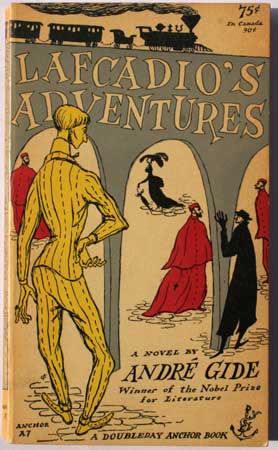
And so it is this week. I have two books to review that I really enjoyed: Lafcadio’s Adventures by Andre Gide and Isabel’s Bed by Elinor Lipman, but I just don’t feel like writing about them.

Regular readers will know that I love Elinor Lipman. The Inn at Lake Devine is one of my favorite books. And then there are couple other novels of hers that I really enjoyed, and few I found just okay. Isabel’s Bed falls short of being a favorite and kind of falls kind of at the bottom of those that I really enjoyed. Interesting and fun and full of twists, it just wasn’t as clever as My Latest Grievance or Ladie’s Man. But when comparing Elinor Lipman to Elinor Lipman she can’t lose right.
Struggling writer Harriet Mahoney is dropped by her boyfriend of 12 years. You know the type, won’t commit but finds himself married just months after he breaks up with you. She goes off to live on Cape Cod to be a ghost writer for Isabel who was in bed with her older, rich lover when his jealous, crazed wife shoots and kills him. Intelligent chicklit with enough 1990s detail to make you want to put on stirrup pants and an over sized sweater and then cinch it.


You can read merely to pass the time, or you can read with an overt urgency, but eventually you will read against the clock.
Simon – Harold Bloom, How to Read, and Why (2000)
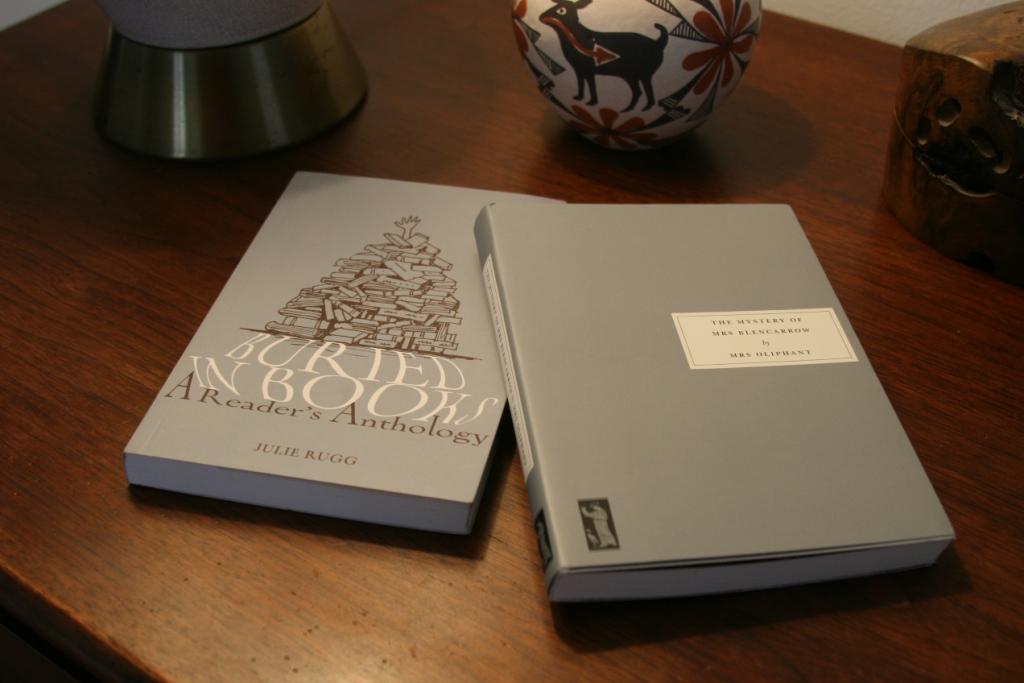
So reads the final entry in a fantastic new book I got from Simon, my Persephone Secret Santa. The book, Buried in Print by Julie Rugg is a collection of “literary extracts, quotations and bon mots concerning every aspect of bookish behavior.” It is the perfect volume for bibliophiles to dip into when a spare moment pops up. One is tempted to keep it in the littlest room in the house, but I have too much respect for books to do that.
And it is fitting that I should stumble across this particular quote given my recent fascination with what I might choose to read as I sat waiting for the world to end. Those of you who who did not assiduously read my review of The Hopkins Manuscript may have missed that discussion. (If you were sitting down to your final night on earth, you had said goodbye to everyone, you knew the earth was ending, which book would you pick up to read?)
And of course, for so many of us book bloggers, so much of what we do in some way has to do with reading against the clock. We join challenges, read-a-thons, read-alongs. We create lists of things to finish. We count the number of books we read in a certain time period. We join in reading weeks (e.g., Persephone, NYRB, Virago). We always seem to have our eye on the clock and we never seem to have enough time to read.
I would be remiss in not noting the actual Persephone that young Simon, dressed as Father Christmas and acting in the guise of my Persephone Secret Santa gave me: The Mystery of Mrs Blencarrow by Mrs Oliphant. I almost bought this one when I was in London in November so I was glad to get it. And also glad to have a shorter novel of Mrs Oliphant. I have been somewhat daunted by a very thick volume of hers, the title of which escapes me at the moment. And finally happy that I had both the Mrs Oliphant and Buried in Books in my nightstand so they fall within the TBR dare between now and April 1st. (See another time related reading goal!)
Thanks Simon. Your guided tour of Washington DC awaits.
 |
| Alameda Gran Torino (1974) Robert Bechtle, b 1932 San Francisco Museum of Modern Art |

 hogglestock