This could be very big


I first read The Song of Names by Norman Lebrecht in 2004 which was a few years before I started blogging, so I’ve never been able to really plug it. I’ve mentioned it a few times in passing and written a word or two about Lebrecht’s other fantastic novel The Game of Opposites, but I haven’t really laid out why more people should read this book.

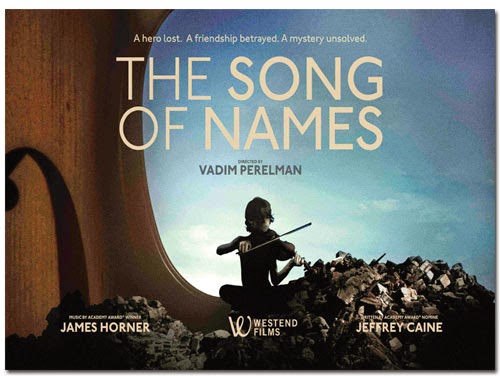
To be sure the book did not go unnoticed when it was published and it won the Whitbread Prize in 2003. But I’ve never run into anyone in real life or in blogging life who has read it. Well that all may change soon. I was getting ready to write about my re-read of the book and I came across an image of a poster for a movie adaptation. And not just any movie but one starring Ben Kingsley and John Malkovich. A little more digging didn’t produce a release date but it did produce listings showing Anthony Hopkins and Dustin Hoffman in the lead roles. As someone who thinks a lot about having my favorite books turned into films, all this made my head spin. With these actors lined up-whichever pair ends up being right–this doesn’t look to be some small release that will be consigned to DVD. If I had my choice I think I would mix the two up and have Kingsley and Hopkins. I worry a bit about the two American actors. Not because they aren’t good actors, but because I don’t want any of the characters turning into Americans. Maybe Malkovich and Hoffman are the ones lined up to play Dovidl, the Polish Jew in the novel.

But I am getting ahead of myself. My intention in writing this post was to talk about the book, not a movie. As I mentioned earlier, I first read this book in 2004 and it has been one that I have recommended every chance I got. But with the passage of time I began to wonder if I should keep doing so. Was it as good as I remembered? I just finished listening to the audio version of the book last week and I can confirm that I still love the book, but more importantly, I can confirm that it is a really good book. I love it because Lebrecht, a classical music critic, writes extremely well about the classical music world, something most novelists cannot do. But more than that, The Song of Names can stand on its own and one doesn’t have to be entranced with classical music to enjoy it.

For those who need a little plot to stay interested…young Polish Jew violin prodigy is left in London to live with a concert promoter and his family during World War II. The promoter’s son becomes his bosom buddy and they live like brothers until the day of Dovidl’s Royal Albert Hall debut when he and his violin disappear for almost 50 years.

Besides being a good book and interesting story, for those who do like classical music gossip with a slightly bitchy and bitter edge, this book is for you. Whether its publishing, recording, concerts, conductors, players, or the music itself, Lebrecht comes up with the goods and isn’t afraid to poke the giants of the classical music world. I loved these gossipy bits. There is also one scene early in the book where he laments not just the dumbing down of the classical music world but British civilization itself. And Lebrecht seems to be one of those lefty snobs of which I count myself. Populist in politics but personally and culturally elitist. And he is so good at being snarky. (Never too much in this novel, but his Twitter feed and blog can sometimes be a bit much. Do critics ever tone it down?)

Listening to the audio book not only reacquainted me with a book I already new that I loved, but I think it may be one of my most enjoyable audio book experiences I’ve had so far. At first I found Simon Prebble a little too driven in his reading. It seemed like someone was poking him in the back. But it actually kind of worked, and his accents were very believable and made one forget he wasn’t actually different people. The only complaint I have is his mispronunciation of a single instance of the name Gianni. Italian is so easy to pronounce but so many people have real trouble with the “gia” combo. Don’t even get me started on the terrible reader who butchered Baldwin’s Giovanni’s Room on audiobook. Overall there were many times as I listened when I took note of how well Prebble read the book.

Don’t wait for the film to come out. Go find the book or audio book and give it a go. If for no other reason, you will have the inside scoop when the blockbuster film comes out.

God knows I love Trollope, but Phineas bores me

 
I’ve read the Barsetshire series and loved them–although the final volume could have used a better editor. And I’ve read 4 or 4 stand alones like Dr. Wortle’s School and Three Clerks and loved those as well. I’ve even read four of the six Palliser novels, and that is where things started to go wrong. I liked Can You Forgive Her?  But then Phineas Finn bored the sox off of me. I enjoyed The Eustace Diamonds for sure, but thought it a little one note. And then Phineas Redux, hmm, now I’m not even sure I have read that one yet. So I guess I have only read the first three.

So why do I bring this up now? When I started listening to audiobooks on my new commute I loved listening to Timothy West read Trollope and decided to listen to the Pallisers again in hopes of juicing me up to read the rest of them. Well, I enjoyed listening to Can You Forgive Her?, but Phineas Finn in audiobook is boring me as much as it did in print. It’s making me think I want to give up on the Pallisers entirely. A little sad perhaps, but it frees me up to listen to the Barsetshire series which I know I will enjoy and it will give me a chance to pick up one of the many non-Palliser Trollope novels I have on my shelves that I have been neglecting because of my intent to finish off the Palliser novels first.

Also exciting is that I don’t have to listen to 21 more hours of Phineas.

Ti is more than a drink with jam and bread


The title is apropos of nothing other than my desire for a Sound of Music pun.

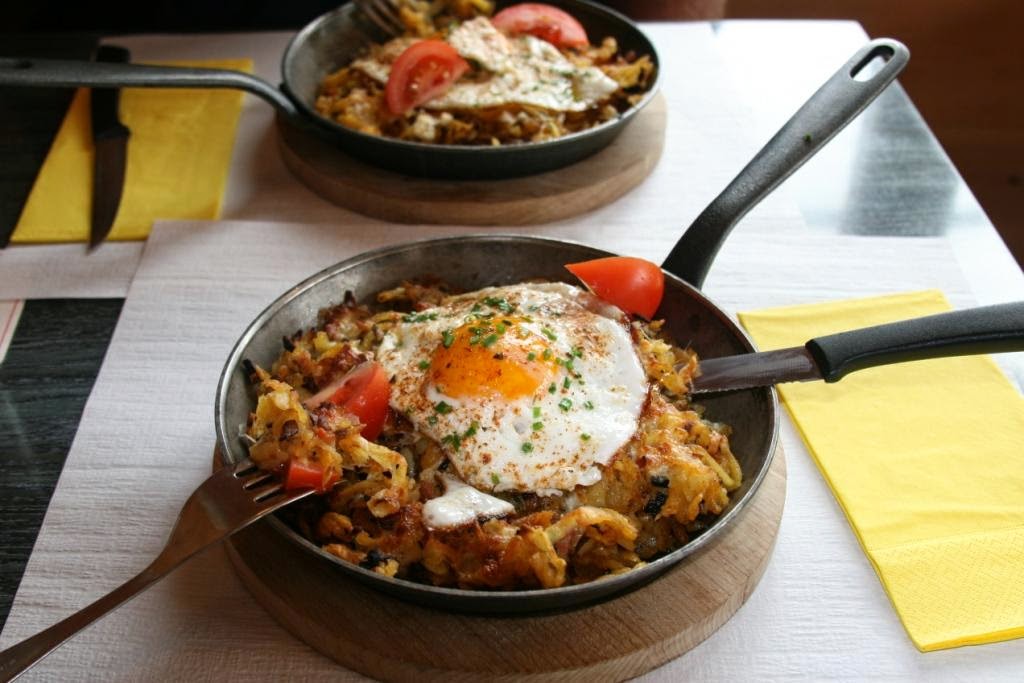
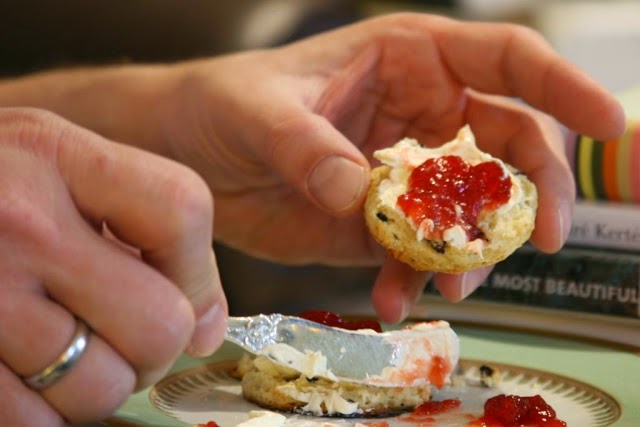
What follows is a little lighthearted ribbing of book blogger Ti who mentioned in a comment on Lucy’s Forever Home that she couldn’t recall me doing a food-related post. Well she is right in the sense that I am no Ruth Reichl (whose memoirs you MUST read if you like food and/or cooking) and this ain’t Gourmet magazine (RIP). But, I have posted about food once or twice over the years. In fact one of my earliest posts way back in 2006 was about food. And it is one of my most clicked on posts, probably the title pulls people in.

It is true that I am not one of those people who has an Instagram account where I post pictures of every meal I have ever eaten, but I do love to cook and bake. I first took a cooking class in the 4th grade during summer school, not just because I liked to cook, but because as a kid I was always hungry and the prospect of getting to eat what we made was too much for me to pass up. When I was in grad school at Cornell one of the best things I did was take “Culinary Arts for Non-Majors”. That class was awesome layered with awesome. I thought I was a pretty good cook before that but it gave me a lot more confidence in my abilities and taught me how to mix things up a bit when it comes to modifying recipes.
Tips on how to cook breakfast radishes we saw in the Loire Valley in 2009.
One of my favorite meals of all time because of the company, the location, and the food. Again in the Loire Valley. And John did a particularly good job of capturing it on film. Click on the link for more.
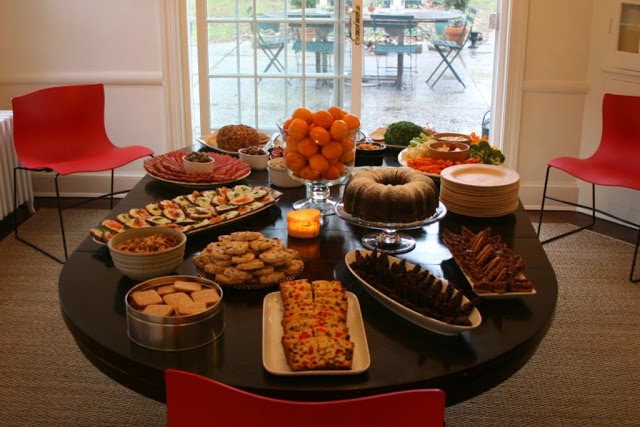
Christmas 2009 was all about food.

My niece helping me bake brownies (albeit from a box–the best kind).

The summer of the successful CSA share. (I make that distinction, because the following year I was terrible at using or even picking up our CSA produce.)
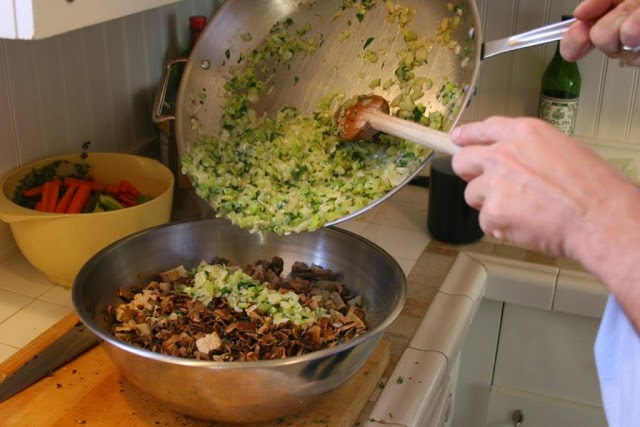
Sauteeing aromatics is perhaps one of my favorite things to do. Here I am getting the stuffing ready for Thanksgiving 2012.
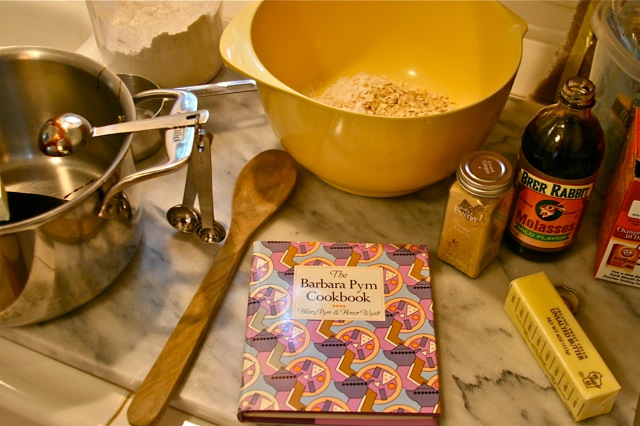
A literary connection: baking from the Barbara Pym Cookbook.
A healthy salad in Sedona.
I post many more food related photos on Facebook but still not crazy amounts. But hopefully I have given Ti something to chew on.

Simon won’t let me talk about audio books

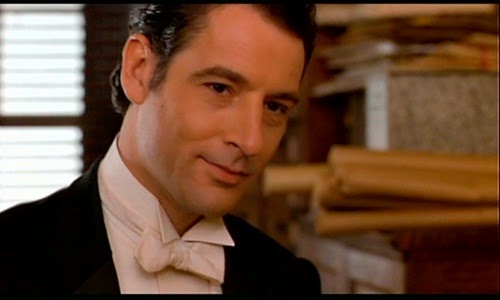
Jeremy Northam. See number 6.

I keep bringing up audiobooks on The Readers, but I don’t think Simon really wants to talk about them. I can understand. Before I became a convert I didn’t want to talk (or hear) about them either.

1. I’m counting them on my books read list for the year. I used to think this was totally cheating. But now that I am listening to books on my driving commute since I can no longer read on a mass transit commute, it feels like a much more equivalent activity than I ever would have thought. Plus one still spends a lot of time with an audiobook. 40 hours for a Trollope. One still goes through the ups and downs of the story and feels the emotions of it. And in some ways I think I am even more aware of the prose than I am when I read.

2. I’m still only choosing books that I have already read. In general they are books I read and liked years ago and would like to revisit them without taking away from reading other books for the first time. This has proven quite ineresting.

3. I need plot and/or material details much more in audiobooks than in regular books. Abstract concepts or thoughts are a little too hard to follow when driving. I’m dying to listen to all the Brookner novels I have downloaded, but the car isn’t the right place for them.

4. So far, children’s dialog in audio books is dreadful. The readers voicing the children make me want to reach in the book and slap the kids silly. They all sound so whiny and annoying. Then again I felt that when I read Pied Piper and What Happened to the Corbetts as well, so maybe it has more to do with the way Nevil Shute writes kids.

5. IF YOU ARE GOING TO RECORD GIOVANNI’S ROOM BY JAMES BALDWIN YOU BETTER BE ABLE TO PRONOUNCE ‘GIOVANNI’ AND BASIC FRENCH. AND, IF YOU INSIST ON RECORDING IT EVEN WITH YOUR TERRIBLE PRONUNCIATION, COULD YOU AT LEAST BE CONSISTENT IN YOUR MISTAKES. I HAVEN’T HEARD ‘MONSIEUR’ PRONOUNCED THAT WAY SINCE I WAS IN MY 11TH GRADE BEGINNING FRENCH CLASS.

6. Our Man in Havana
Graham Greene wrote some unbelievably good books. And OMIH is not a bad book, but you have to be ready for a few scenes that are of the “Who’s on First” type of farce. I laughed like crazy at the famous Abbott and Costello routine when I was a kid, but as an adult that kind of farce makes my teeth itch. I first read this book back in 1997 and quite enjoyed listening to it recently on audio book. But the heavy farce scenes were even more annoying on audio than on the page. I largely liked Jeremy Northam’s narration, not sure all his accents were very solid, but Northam can whisper in my ear any day. The worst part about this audio book was the use of bad faux-salsa music between chapters.

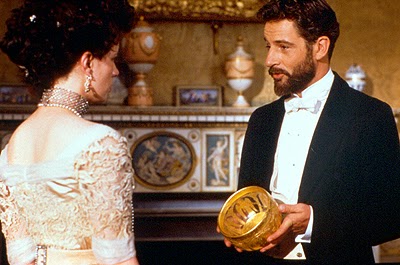
The only thing more handsome than Jeremy Northam is Jeremy Northam with a beard.
Here he is in The Golden Bowl.

I won’t be buying these Penguins

[I was so good about posting regularly in January, but then I got busy and ran out of ideas. Haven’t quite snapped out of the rut, but working on it.]

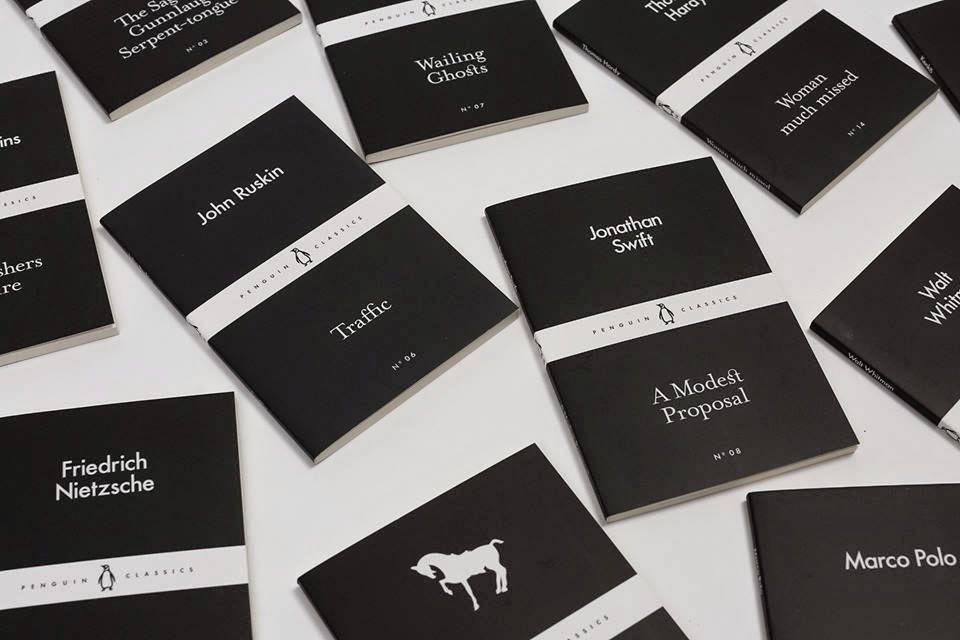
Regular readers know that I am a sucker for a matched Penguin set. In the past I have gone to great lengths and expense to collect them. I bought the English Journeys series, the Great Love series, and most infamously all 100 volumes of the Great Ideas series. And then when push came to shove I got rid of all of them selling them for pennies on the dollar. Still, I can be sorely tempted when I see a nice matching set, which is why I am grateful that Penguin’s latest release isn’t much of a temptation for me. Even though the design of them hearkens back to the early, uniform, glory days of Penguin, I find them uncompelling–almost ugly.

The main reason I dislike them is the use of the serif font for the titles. I’m not universally opposed to a serif font, and I actually kind of like this one, I just think it looks a bit anemic against all that black. It also doesn’t help that the somewhat dainty titles sit below the the bolder sans serif font used for the authors. makes it feel a little top heavy. If the titles had been placed on top I think the serif font would have worked better. Also, without measuring them, it looks as if the white band is centered top to bottom and then both the author’s name and the title are centered in their respective parts of the black space. It’s oddly discomfiting visually. Again, without measuring them, on the original orange and white covers, it appears that the top orange panel is slightly shorter than the white panel and the lower orange panel. This just feels better I think. The centered-ness of this new set makes it feel oddly out of balance.

If you are like me and can pour over graphic design, good and bad, for hours despite being no expert or having any graphics art training, you should check out this website that compares logo redesigns. If you do a search on “penguin” on their site, you will find more than a few that relate to Penguin logos.

Parsing Sarah Palin (I promise this isn’t political, it’s grammatical)

 
This is not a take down of Sarah Palin, and it isn’t a defense of Sarah Palin. It’s more of an observation about the speech she gave recently in Iowa. It was pretty much panned from all points of the political spectrum and one of the biggest criticisms has been her (not new) trouble with the English language. There are plenty of reasons why people are piling on at the moment, but there is something about recent criticism that I find slightly disingenuous. This is the part of the speech that seems to be getting the most buzz:

It’s too big to succeed, so we can afford no retreads. Or nothing will change, with the same people and the same policies that got us into this status quo. Another Latin word, status quo. And it stands for, man, the middle class, every day Americans are really gettin’ taken for a ride. That’s status quo. And GOP leaders, by the way, uh, you know, the man can only ride ya’ when your back is bent, so strengthen it. Then the man can’t ride ya’, America won’t be taken for a ride because so much is at stake.

Folks on the left and right have been pointing to this as completely incomprehensible. It really isn’t. If we can understand Faulkner and Joyce and William Burroughs why do we act like we can’t understand Palin? And for anyone who has even the faintest understanding of Palin’s political views understanding Palin’s speech is a whole lot easier than understanding the lions of the English speaking literary world.

So let’s take that “paragraph” phrase by phrase (keeping in mind I make no claims about the veracity of any of it or whether or not I agree):

It’s too big to succeed
Our government is too big to be effective.

so we can afford no retreads
We can’t keep doing the same thing.

Or nothing will change, with the same people and the same policies that got us into this status quo. 
Again, we can’t keep doing the same thing.

Another Latin word, status quo. And it stands for, man, the middle class, every day Americans are really gettin’ taken for a ride. That’s status quo.
The system is rigged against the middle class.

And GOP leaders, by the way, uh, you know, the man can only ride ya’ when your back is bent
Telling GOP leaders that if they had resolve, the man (aka big government/Democrats) couldn’t take advantage of them.

so strengthen it. Then the man can’t ride ya’,
An exhortation to strengthen their resolve.

America won’t be taken for a ride because so much is at stake.
We won’t let this happen because too much is at stake.

This might be the most political thing I will say: Sarah Palin isn’t the only American whose grammar and syntax sound like this. And I’m not talking ideology or even intelligence. We hear it in wedding toasts, we hear it in sales pitches, we hear it in man-on-the street TV interviews. I’m not suggesting the world should be a grammatical free for all. Let’s just quit pretending that we don’t understand it.

Why can’t the translators get to work on Herman Koch?

I was going to write about Herman Koch in a Bits and Bobs post but as I started to write I realized I had more to say about his work than would fit either in a bit or in a bob. Koch is a Dutch writer and actor and so far only two his six novels have been translated into English. Hopefully his recent success and a possible Cate Blanchette adaptation of The Dinner will bring his back catalog into the English speaking world.

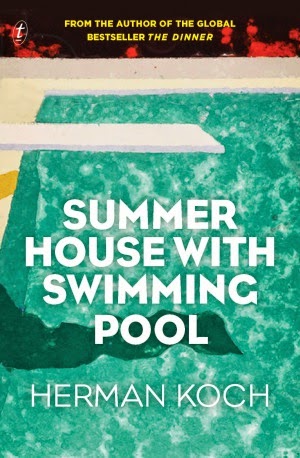
When Simon Savidge visited Washington back in August he put The Dinner in my hands while we were browsing a bookstore. I was slightly dubious about this since he had also given me a copy of Gone Girl which I was somewhat loathe to read and the cover blurb on The Dinner was by Gillian Flynn. But I did buy it and read it and it turns out I kind of loved it. So much so that soon after I read it I was in a bookshop and bought his latest Summer House with Swimming Pool in hardcover without hesitation. I ended up liking that one even more than The Dinner. Based on those two novels he has been added to my must buy list. Not many authors end up on that list.

The Dinner
One of the things that intrigued me about The Dinner is that the entirety of the novel takes place over a single meal. Turns out there are many flashbacks that take the reader away from the dinner table but the book does feel like it takes place over one long meal. There is something very interesting about the arc of the plot and the arc of emotion all happening over dinner.

In the book, Paul Lohman and his soon-to-be Prime Minister brother and their wives have dinner in a high-end restaurant in Amsterdam. It is almost impossible to say much about this book without giving too much away. In fact the only thing I can really say is that by the end of the book you will have had moments of hating almost every character that passes through the pages.

In my mind, the restaurant De Kas was the setting for The Dinner. Having eaten here for a special occasion a few years ago, it popped into my head and never popped out. According to at least one source, this was the basis for the setting of the novel.

Summer House with Swimming Pool
Since I am a Johnny-come-lately to Herman Koch I had a peek at some reviews of his work in the esteemed mainstream press. Among other things, this exercise reminded me why I don’t read professional book reviews. Even when they are positive they always seem to me like they are written by authors bitter that they have to write reviews to help eke out a living writing. The benefit of reading these reviews was that they shook loose in my brain how I feel about Koch’s writing. His books have commercial appeal (i.e., they are readable) but I think they provide deeper psychological insight and observations than most commercial fiction. I think Koch is clever without ever seeming like he is trying to be clever. His books don’t feel like they have been workshopped to death in some MFA program. 


Like The Dinner, Summer House with Swimming Pool includes a medical premise that is factually incorrect. And it isn’t some small technical detail, but a great big whopping medical impossibility that seemed immediately wrong. Although these instances of taking poetic license with medical science gave me a bit of cerebral indigestion (how’s that for a medical mixed-metaphor?) they did not bother me. In fact, after some thought, I think they even added to my enjoyment of the books. Koch could have come up with a much more plausible way of making Dr. Marc Schlosser more maniacally unethical than he already was, but instead he chose to go for the impossible. Or was he sloppy? I don’t think so. I think he knew he was making a mistake and just willed us all to go along with it. Doing so allowed me a freedom I don’t normally experience. I have chronicled more than once how factual errors in fiction can make my head explode. (I’m looking at you Julia Glass.) But there is something so over the top about Koch’s mistakes that I kind of enjoy how bold they are. Kind of like Peter Cameron’s book Andorra which I loved. He put the real land-locked country of Andorra on the Mediterranean 200 km from where it actually exists.  I think the threshold for me is, get the small, mundane details correct and I will give you a wide berth if you want to twist reality. In the case of Koch’s books I felt liberated to let fiction be fiction, and in the case of Dr. Schlosser I enjoyed how Koch played with that line between good and evil.  It isn’t a fine line, its a bloody great thick line in most cases, but sometimes it gets crossed without notice. Not every evil menace is Adolf Hitler. Sometimes it is the trusted family doctor or the quiet cat owner next door.

Another reason I think Summer House with Swimming Pool and The Dinner work is that one can never trust Koch. Not his characters, not his plots, not his scenes, and not his “facts”. They are like like Rorschach tests, the reader see what she wants to see. In my case I see how seemingly good people can cross that wide line between good and evil and am thankful that I never even get close to the line.


Context is everything

The other day when I was snuggled up in bed reading while the rain pattered on the roof, I came across a line that made me laugh with delight. So much so, I Tweeted the line and posted it on Facebook.

Far-off on the hill a sheep coughed.

After I posted it on Facebook and said that it was the best line ever, my friend Barry–in fact the same friend who I mentioned in my last post–wrote: “Are you being sarcastic? It sounds to me like a line written by a 10-year old who has hopes of becoming a novelist.”

When I saw this response I was a bit taken aback. Barry was right, but the author who wrote the line is one I revere and the book I was reading was one that I really liked. Although the line struck me as funny when I first read it, it didn’t strike me as bad writing. But out of context I can’t blame my friend.

In context I think the line works, and while still funny, doesn’t seem like bad writing. In fact, it reminds me of when John and stayed in a farmhouse in the Cotswolds and we enjoyed listening to the sheep bleating on the distant hillsides each evening. I don’t remember any of them coughing, but that’s not to say they didn’t. Here is the full context, the scene is a large, remote country house in Ireland in the early 1950s.

Sally came up from the dark kitchen stairs into the house, empty, still, and flooded with sunlight. Charles and Violet had gone out of course; Violet would be in the walled garden examining the ruins of the roses with Cammaert [the gardener]. With something like relief, with a tremor of fear, Sally thought, I’m all alone here. She stood on the threshold of the library as if waiting for some decision which would take her inside, to her grandfather’s desk. Far-off on the hill a sheep coughed.

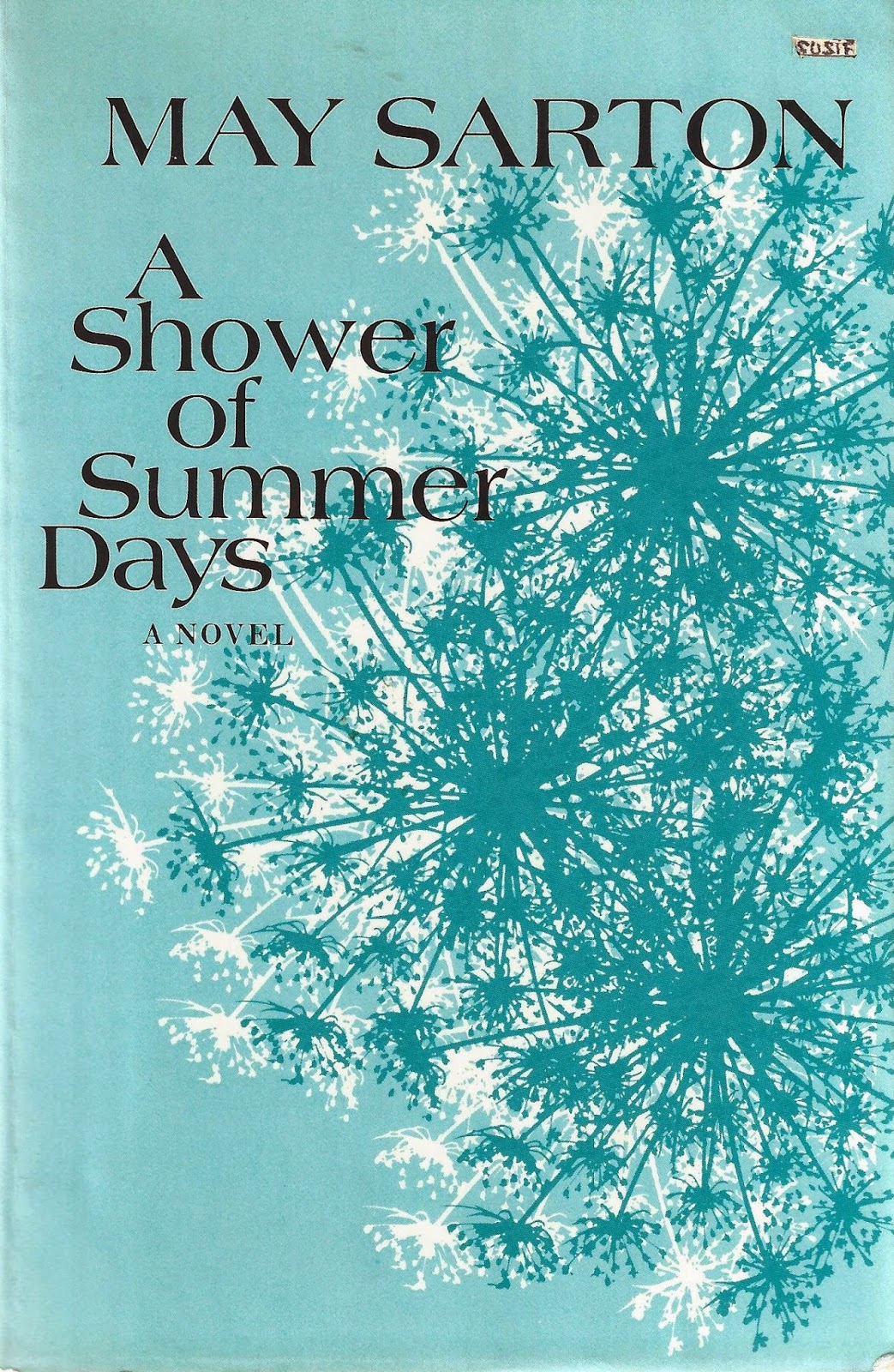
What do you think? Bad writing? Okay, but not great? Middle brow? 1950s chick lit? Does it matter? The writer is my beloved May Sarton and the novel is A Shower of Summer Days. Her work pleases me so much and this novel ranks in the upper middle range of all the novels of hers that I have read.

But what about the book?

Violet and Charles, a 50-something couple returns to the wife’s ancestral home in Ireland after Charles is pushed out of his industrialist position in Burma. Soon after they return Violet’s estranged sister who lives in America sends Sally, her college-age daughter, over to stay with them in the hopes she forgets about her actor boyfriend.

I can’t say too much more without giving too much away. I will say that I think that there is a gay subtext that comes really close to pushing through in a few places that would make the novel make more sense than the more abstract issues Sarton focuses on. The subtext is independent of the quasi-Lesbianic idol worship that Sally has for Violet. Or is it? I don’t really know. But I do think if Sarton had felt more comfortable being open about the subtext the story might have made more sense. Without doing so meant that much of the book’s climax and resolution was based on some fairly opaque conclusions that I am not sure someone as literal-minded as I am can be happy with. This would seem like a fairly big flaw, but I still enjoyed the book quite a bit.

Imagine if these shoes were books

Back in November I came across this story about a shoe store that was frozen in time. Somewhere in the U.S. a family inherited a building that just happened to have a shoe store in it that hadn’t been touched since the 1960s.

In true Internet style the story appears to have been a retread (sorry) of something that happened at least a year earlier, but the pictures are real enough.

I was mesmerized by the photos and shared them on Facebook with a caption about how I wish it had been a bookstore frozen in time. A friend who is a reader but not a book junkie commented that he didn’t think a bookstore would be as interesting as the shoe store. It was only when I started to write a response that I began to really think about how cool a bookstore frozen in time could be. Let’s just assume the discovered shoe store was from 1963. Based on some of the truly old fashioned shoes and a lack of more modish stuff I think the store must have been early 60s. So let’s say 1963. Imagine what you could have found in a bookstore frozen in time in 1963.
It was in the U.S., so there probably weren’t many vintage Penguins.
But there probably would have been more than a few Signet Classics paperbacks.
Although these are probably older than the 1960s, there may have been a few Vintage paperbacks on the shelves as well.

But what about some books that were actually newly published in 1963?

After doing A Century of Books, the 1960s was not exactly my favorite decade. If you factor out D.E. Stevenson and Margaret Drabble, I didn’t have much luck with the 60s. Especially if you consider that the loathsome Catch-22 and A Clockwork Orange were likely on those shelves. I probably would better appreciate a store frozen in time a decade or two earlier. What would be your dream year?

Doing everything on this list might make me crazy

 
All of these are sane on their own, but taken together? Might be a little nuts.

1. Blog at least once a week. I really got off track last year. Granted, I did the blog about our house project (which I haven’t updated in a while), but I didn’t have a job until mid-September so that ain’t no damn excuse. (grammar police look the other way) In some ways not posting very much on My Porch last year made me feel a little disconnected from the online reading world.

2. Read 100 books. I’ve done it a few times before but last year was not such a good year. I had tons of time on my hands. Too much I guess. I only made it into the low 60s. And as of the 9th day of 2015 I’ve only got one under my belt. I better get busy.

3. Keep up with my blog reading. Oy, I’ve been bad about this recently. By the time I get around to catching up there are so many posts to look at I ended up shutting down and ignoring way too many interesting posts.

4. I’m stealing this one from Simon Savidge who noted on episode 116 of The Readers that he plans to look at no screens after 10 pm. That means no TV, no computer, no phone, no iPad, etc. I’m not sure if he plans to do it on the weekends as well, but I am going to limit my limit to Sunday through Thursday nights. So far I have managed to do this but it takes being a little conscientious for sure. When I am about to press play on something on the DVR I have to look at the time to see if it will finish by 10. So far, so good.

[I interrupt this list to note that I just went to Google something about reading challenges for 2015 and came across a blogger who is, I’m sure a lovely person, but has a blog so cloyingly annoying (clannoying?) that I feel compelled (but will not) leave a snarky comment on her blog. Consider this editorial aside to be a sort of safety valve in that regard.]

5. Read all of Anthony Powell’s 12-book, 4-volume series The Dance to the Music of Time. Annabel is bound and determined to do it this year and I am going to try and join her. The most challenging bit is that I don’t feel compelled to read them yet. You know how you can have something on your shelves for years and then one day you just feel like it is the right time to give it a go? I feel that in my head right now, but I don’t feel it in my gut. Stay tuned.

6. I think I have have participated in James’ TBR dare ever year that he has done it, save one. And I was late in signing up, but since I haven’t broken any of the rules yet, I figure I still qualify. This one may turn out to be easier to do this year since I am now reunited with all of my books unpacked and in one place and so I have a lot of unread books to choose from. More than enough to keep me happy.

7. Go to a movie once a month. This may sound easy, but, much to John’s chagrin I don’t see many movies these days. For the 11 months we lived in our temporary apartment we lived only 3 blocks from a multi-plex and we only went once.

8. Finish sending Amanda the rest of those Penguin post cards I started sending a year ago. I thought for sure I would send all 100 over a year, but I still have about 30 or 40 yet to send. Now that we are settled back into our house, I might find that easier to achieve.

The pile of postcards last January. I really should take an updated photo with at least half the stack gone.

The box and first post arrived in Georgia last January.

9. Participate in at least one of the two Dewey’s Read-a-thon weekends. I’m not a fan of all the cheerleading and memes and such, but I still love the event and the wide range bloggers who participate.

….looking back at the list, and thinking of no other items to add I’m beginning to think I may actually accomplish all of these. The only one I am doubtful of is the Powell.