What I am not reading

I took along Sinclair Lewis’ novel It Can’t Happen Here on the plane to Austin, Texas this weekend. But I  think I may have left it on the plane. I  can’t say I am too upset. I am a huge fan of Sinclair Lewis, but  this one wasn’t really doin’ it for me. He published the novel in 1935 and he imagines an anti-semetic fascist on the left winning the Democratic nomination over FDR. For those that think this sounds familar might be thinking of Philip Roth’s The Plot Against America which had a similar set-up (published fifty some years after the Lewis book, this is the only Roth book I actually like). I  think the lack of subtlety is what made me get kind of bored with this Lewis novel.

So, losing this particular book did not upset me much.

I highly recommend Sinclair Lewis. Just not this title. Go for one of his truly great books like Main Street, Arrowsmith, Dodsworth, or Babbitt.

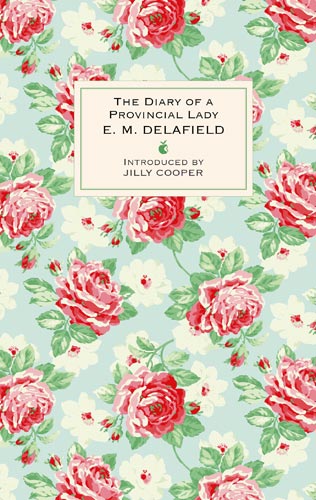
Book Review: The Diary of a Provincial Lady by E.M. Delafield


The Diary of Provincial Lady
E.M. Delafield

So many folks have read, reviewed, and loved this one, that I am not sure what I can add. It is the first time I have read anything by E.M. Delafield and I certainly enjoyed it. Written entirely in diary form, Delafield chronicles the life of this provincial lady (do we ever learn her name?) in a way that humorously describes all the little details that add up to a life. The diary entries brilliantly capture the episodic, shorthanded cadence so typical of how one thinks about things. Not always in lovely complete sentences, but short bursts of thought, like thousands of brain synapses firing directly onto the page. There is much that made me chuckle in this book. And of course I love a good bit of domestic detail and this book does not disappoint on that account.

The Diary of a Provincial Lady has all the hallmarks of the upper middle-class (lower upper-class?) in 1930s Britain where appearances trump everything from budget to happiness. And the inevitable shortage of servants and overdrawn bank account. One of the more amusing reoccurring themes is the tendency to talk about things one knows nothing about: exhibitions not seen, places not visited, and most of all books not read.

Am asked what I think of Harriet Hume but am unable to say, as I have not read it. Have a depressed feeling that this is going to be another case of Orlando about which was perfectly able to talk most intelligently until I read it, and found myself unfortunately unable to understand any of it.

Although I enjoyed reading this very much, there was a huge part of my middle-class, American, OCD brain that kept wanting to “fix” what was wrong in the lady’s life. First, her inability to remove herself from social situations that are unpleasant. The constant struggle to impress Lady B, the friends who invite themselves over to stay for a few nights, etc. Just say no dammit. Then her inability to live within her means. It is no different than the legions of people today who live a life of economic lies. Buying things and going into debt for a lifestyle that can’t be supported. Here is an idea, take Robin out of school, put him in the local grammar, get rid of Mademoiselle and take care of your daughter yourself, (and maybe let her go to school as well so that she doesn’t end up unable to make her own living one day) and quit wasting money on bulbs and bulb supplies. Little things add up and you can’t afford it. And for goodness sakes take that 500 pound windfall and pay off as many of your creditors as possible, why should the hard work of tradespeople go uncompensated just to support you in your lofty lazy life?

BUT, I know this is not in the spirit of the book and I shouldn’t really apply today’s reality to yesterday’s fiction, but therapy can only do so much to cure me of wanting to fix people.

Looking for a light, fun, Anglophilic romp of a read? This one is for you.
 

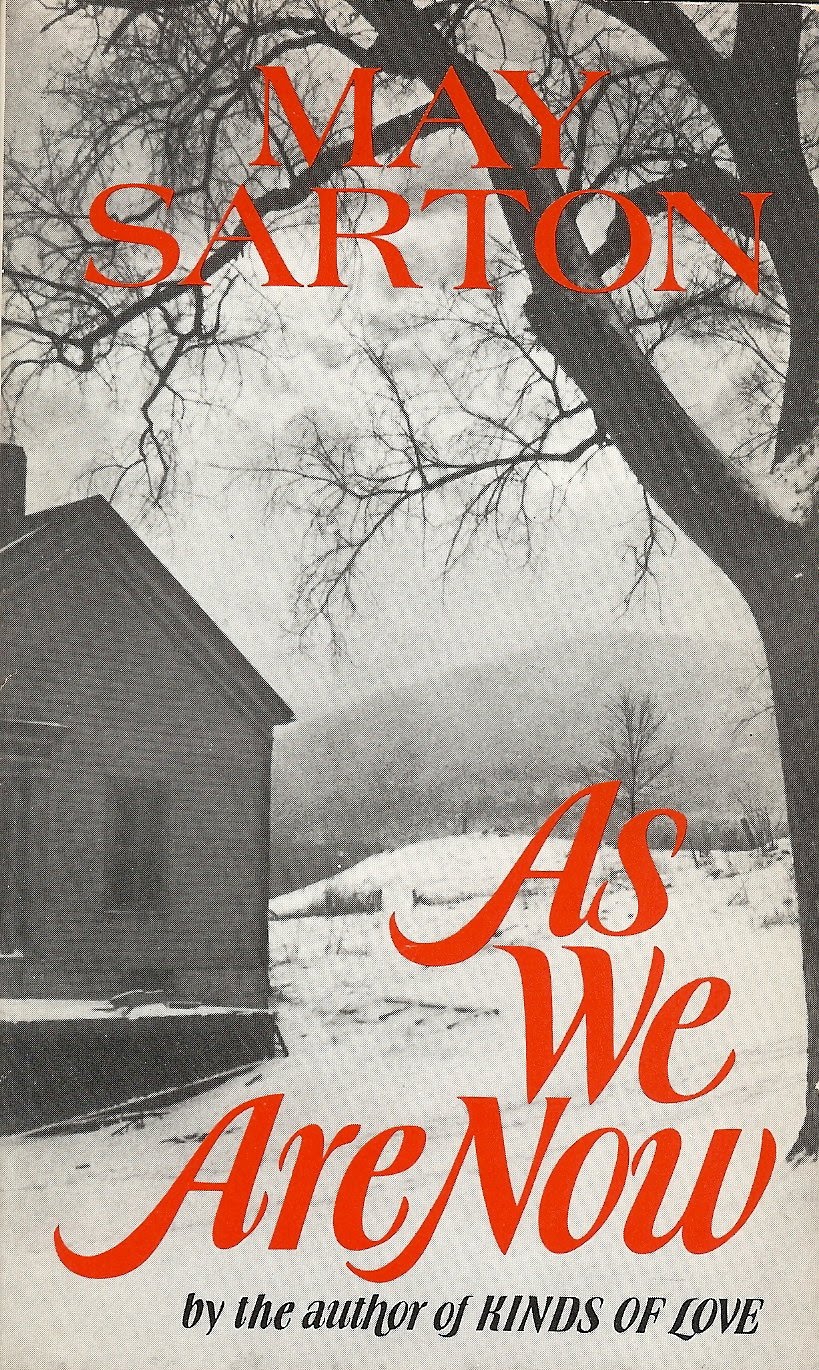
Book Review: As We Are Now by May Sarton


As We Are Now
May Sarton

This short book takes the form of a journal written by Caro Spencer, a retired 76-year old teacher who has suffered a heart attack and has been put in an old folks’ home. It is a chronicle of one woman’s attempt to stay sane, engaged, and human in an atmosphere that is devoid of the comforts of home and the associations and artifacts that one builds up over a lifetime. Unmarried and without children Caro’s only link to the outside world is her 80-year old brother and his much younger wife who tried having Caro live with them after her heart attack but the experience proved to be an unhappy one for all involved. A situation Caro later realizes wasn’t so bad.

Although there is a blazing streak of defiance and an occasional description of joy, As We Are Now is devastatingly sad. Caro’s journal not only describes the poor living conditions that lack humanity but it also reflects the gradual slip of Caro’s mental state. The small joys she experiences during visits from the local Methodist minister and his high school age daughter are more than swallowed up by the Caro’s sad living conditions and the hateful treatment shown by Harriet and Rose, the mother-daughter team who run the home.

Perhaps one of the most tragic aspects of Caro’s situation is that after 76 years of living, forging her way as a single woman with a career, and living life in full, she finds herself not only alone and without any of the associations that made up her life, but also effectively stripped of her identity by her keepers. The home is located in a rural area about 100 miles from where she lived so she has very little opportunity for interaction with others. And she finds that the life of her mind, so well developed over the years is not enough to sustain her sanity. She not only misses her house and her books, but more importantly she misses physical sensation. Fresh air and sunlight are sometimes available to her but clean smelling laundry, good food, the smell of flowers all become increasingly harder to come by. The touch of another living thing is what seems most absent in Caro’s life. Pansy, the house cat is one of the few things left to her.
In some ways, As We Are Now is a primer on how to better treat old people facing the end of their life in an institutionalized setting. The basics of physical surroundings and physical care are fairly easy to remedy given a little thought but would probably only add to the already astronomical cost of long term elder care. What is more difficult is figuring out how to interact emotionally and intellectually with old folks that doesn’t make light of their condition with phrases like “Oh, you will outlive us all” or some other nonsensical thing that we say when we don’t know what to say. Caro wants to hear about the lives of others and what is going on in the world, but when it comes to her condition and her inevitable decline, she doesn’t want someone with a false cheery world, she just wants someone to listen and to believe what she says.

She has round golden eyes. I have been told categorically that she must not get up on the bed. But occasionally she manages to sneak in late at night and climb up, first curling into a tight ball, then later, when I stroke her, uncurling to lie full length, upside down, sometimes with one paw over her nose. It is hard to express the joy it gives me to stroke this little creature and feel the purrs begin in her throat. Those nights I sleep well, a lively sleep rather than a deathly sleep. It makes all the difference!

It sounds like a depressing read, and in many ways it is. But there is much to think about in these 127 pages and it is sadly beautiful. Writer, poet, and teacher, Sarton published eleven of her own journals over her lifetime including one after she had a stroke and one in her 80th year of life before dying of breast cancer. Although I have read and loved some of her earlier journals like Plant Dreaming Deep, I haven’t read any from her later years. It will be interesting to compare them to this fictionalized account of Caro’s written in 1973 a good thirteen years before Sarton’s stroke and some twenty-two years before her death.

This won’t be for everyone. But well worth the read.
  

Today Leontyne Price Turned 83

 
Here is the diva in her early days. Sorry I don’t have a date on this recording of “O Patrica Mia” from the opera Aida by Verdi.

In 1978 at the White House singing “Ride on, King Jesus”

Here she is in 1982 at age 55 singing “Chi il bel sogno” from Puccini’s La Rondine.

And here she is in 2001 at age 74 singing God Bless America. I say God Bless Leontyne Price.

Would you believe most of her beautiful voice is still there in 2008 at age 81?

I love a drinks cart/table

 
My better half found this post on Habitually Chic a blog that he frequents. I am not much of a drinker. Pretty much red wine with a meal is about the extent of my interest in alcohol unless it is some frothy, girl-drink served poolside. But I LOVE drinks carts/tables. Not only as aesthetic fetishes but also because of what they imply: hospitality.

Habitually Chic has many more images where this came from.

Two Awards and the Tale of a Naughty Blogger

 
First the two awards:

Too long ago, Amanda over at The Blog Jar gave me this award:

Which I only remembered because recently Matt at A Guy’s Moleskine Notebook gave me this award:

Now, the Tale of the Naughty Blogger:

I never followed up on the responsibilities of winning an award with Amanda months ago, and I can tell already I am probably never going to get around to living up to the expectations of Matt’s award. My reasons could probably be summarized in one word (laziness), but they also have more than a casual relationship with my twin quirks (mental defects) of not wanting anyone to tell me what to do, and fear of rejection. So rather than play by the rules of the respective awards, I am just going to tell you what I like about each Awarder. This means I am not going to tag others for either award (that is where the fear of rejection comes in…). The tagging part also troubles me because there are sooo many blogs that I love I don’t like choosing and from time to time I do recognize other blogs on My Porch in relation to a specific topic.

Amanda at The Blog Jar
Not only do I love Amanda because she reads interesting fiction with a focus on the classics, but also because she really tells it like it is. On books and on life you always get an honest take on things with a lot of natural, unforced humor. I also find her enthusiasm for life—even when things aren’t going perfectly for her—refreshing. And she has creativity in her bones. Here is the bridal bouquet she made for herself for her recent wedding:

I know it is easy in the blogosphere to assign probably inaccurate personalities to people you have never met, but Amanda strikes me as someone who I would love to sit and have a cocoa with (I hate coffee) and we would end up laughing our heads off.

Matt at A Guy’s Moleskine Notebook
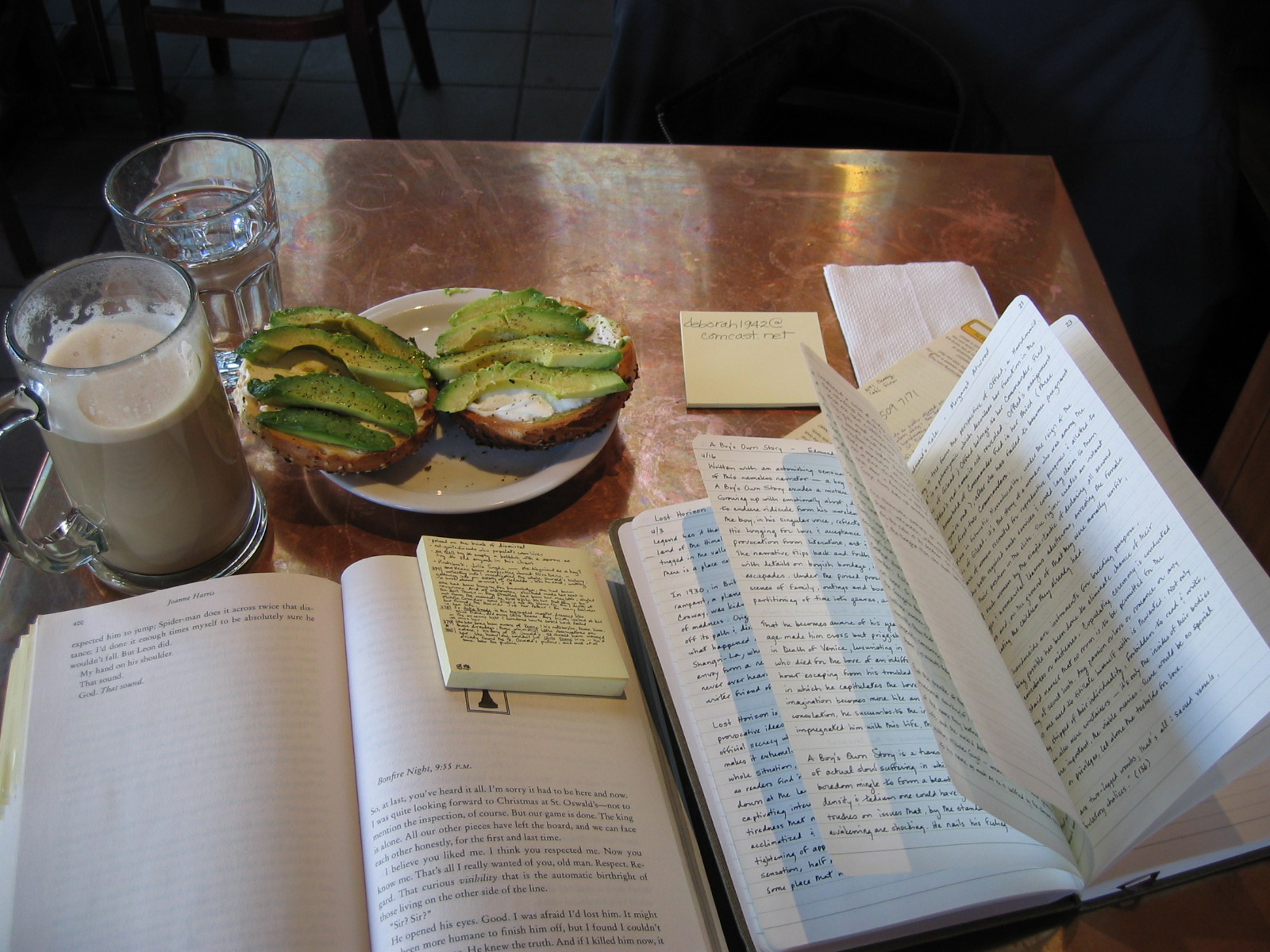
Right off the bat I was drawn to Matt’s blog because I love Moleskine notebooks of every shape and size. I think I probably have about seven of them around here. In fact, I can see three of them from where I am sitting right now. I have this dream that I will fill them with interesting and artistic things. The only problem is that these days most of my interesting things are memorialized on this blog or in some other digital form. And I have terrible handwriting so it feels like I am defiling the lovely Moleskine products. Matt on the other hand has amazing handwriting (and that avocado sandwich looks good as well):

Beyond the title of Matt’s blog I am impressed with its organization and his book review rating system: [Read/Skim/Toss] and [Buy/Borrow]. But none of that would matter if I didn’t enjoy his point of view and the fact that we have some reading interests in common including Forster, Waugh, Isherwood and GLBT fiction, which, frankly for me at least is really just G. I’ve read a bit of L in my life but I have never read any B or T that I know of. Many of the popular G he has been reading lately is stuff I read a long time ago, so it is great to get reacquainted with them. And then of course there is classic G which Forster, Waugh, and Isherwood would all fit into to various degrees. (I think Waugh’s uber-Catholicism was a big ol’ pile of repressed homosexuality, but that is a topic for another post.)

So hopefully my Awarders Matt and Amanda won’t mind that this Awardee couldn’t play by the rules.

Book Review: A Way of Life, Like any Other by Darcy O’Brien


A Way of Life, Like Any Other
Darcy O’Brien

Writer and sometimes college professor Darcy O’Brien was the son of movie stars George O’Brien (whose films span from silent pictures in the 20s to 1964) and Marguerite Churchill (who was John Wayne’s first leading lady). Don’t worry, I had never heard of them either until I looked them up on Wikipedia. And speaking of Wikipedia, raise your hand if you think this phrase is missing a comma:

…the couple had a son, Darcy O’Brien in 1939 who would become a successful writer and a daughter, Orin O’Brien who…

When I first read it I thought it was a clever way to say that Darcy O’Brien had had a sex change.

At any rate, back to the book. A Way of Life, Like Any Other is an autobiographical and funny novel of a kid trying to cope with faded movie star parents who have become caricatures of faded movie stars. Eccentric, sometimes bitter sometimes nostalgic husks of their former selves. For their son (whose name I entirely forget at the moment, maybe the reader is never told), is a childhood and adolescence of riches and rags and back to riches before returning again to rags just in time to go off to college. Intertwined with the broken family’s economic fortunes are his serial monogamist divorcee mother’s alcoholic and mercurial behavior, and his father’s unrequited love for his ex-wife channeled into constant fest of nostalgia, ever-increasing devotion to his Catholicism, and a flirtation with the John Birch Society which is to politics what the Flat Earth Society is to science. The dysfunction in the family reminded me a bit of a more benign version of Augusten Burroughs’ memoirs. Except that O’Brien’s novel is much more a piece of literature than Burroughs’ David Sedaris-like regurgitation of his childhood. Plus O’Brien isn’t gay, which I only mention now because his attempts at wooing females and his quest to get laid are pretty comic.

(And by the way, my husband tells me that the Slim Aarons cover photo of C.Z. Guest is in Palm Beach, not Los Angeles.)

Book Review: What’s to Become of the Boy by Heinrich Böll

What’s to Become of the Boy or: Something to Do with Books
Heinrich Böll

A few years ago I read The Lost Honour of Katharina Blum by Heinrich Böll and really enjoyed it. Both the story and the style of writing really appealed to me. I followed that up sometime later with his book The Clown which I liked but not as much as Katharina. So when I was combing through a second hand bookstore in Pennsylvania right after Thanksgiving and came across this short memoir of Böll’s childhood I snapped it up immediately.

Böll was the first German to win the Nobel Prize for literature since Thomas Mann won it in 1929. His childhood in a liberal Catholic, pacifist family in pre-WWII Cologne provides the backdrop for this memoir. The book follows Böll as he and his family deal with the ever-more invasiveness of the Nazi Party in their daily lives. It also shows the ways in which the angst and joys of a bookish adolescent still manage to exert themselves in spite of the family’s near poverty and the fascist trajectory of Germany at the time. He is a boy whose future is not only clouded by the oncoming war but also by his vague notions of wanting to do “something with books”. But he does have his priorities straight. In an atmosphere where books were burned not just for political reason but also for fuel, he regularly used his scarce spending money toward the purchase of books.

Overall Böll’s memoir was only mildly interesting. Too many of the many German cultural references in the book were unknown to me which made it difficult to really get into the groove of the story. If you are going to read Böll, and I recommend you do, try The Lost Honour of Katharina Blum.

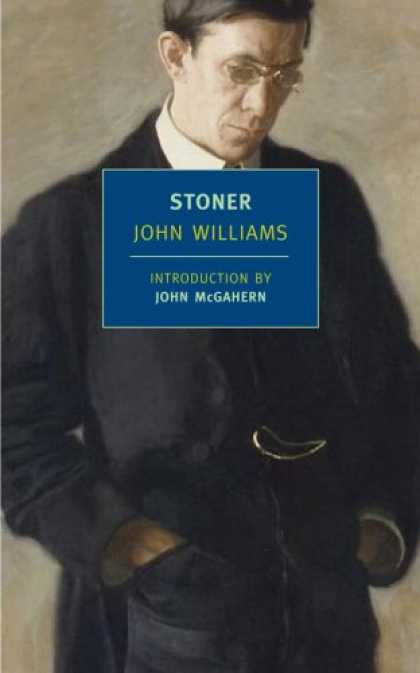
Book Review: Stoner by John Williams

Stoner
John Williams

Our hero, William Stoner grew up dirt-poor on a farm about 40 miles from Columbia, Missouri. In 1910, at the age of 19, he is sent off to the state University in Columbia to study agriculture. Two years into his studies, however, he discovers literature and decides to give up studying agriculture in favor of becoming a scholar. In due course he earns his Ph.D., stays on at his university as instructor, becomes an assistant professor, and teaches there for forty years until he retires and soon after dies.

There are so many themes in this book worth exploring, it is hard to know which ones to focus on or even mention here. Perhaps the first one that becomes apparent is Stoner’s challenges in living in two worlds. His poor parents, with no education beyond the 6th grade, know nothing of his intention to study literature and not return to the farm until he finally confesses to them after his undergraduate commencement. And for about six years of his education he lives with distant relations remaining caught between his old and new lives as he earns his keep by working on their farm.

He became conscious of himself in a way that he had not done before. Sometimes he looked at himself in a mirror, at the long face with its thatch of dry brown hair, and touched his sharp cheekbones; he saw the thin wrists that protruded inches out of his coat sleeves; and he wondered if he appeared as ludicrous to others as he did to himself.

By the time he finishes his degrees and begins teaching he is fairly well-acclimated to his new world. The novel is not really about Stoner being a fish out of water. In fact his years of study are somewhat compressed in the overall arc of the narrative. The novel also deals with his troubled marriage. His wife waging a forty year war on her husband who she seems to hate, often using their daughter as a weapon against him. It is hard to know exactly what is going on with his wife, but she certainly seems bipolar to me. Many of the challenges in their relationship are exacerbated by their inability to communicate anything that is important. Imagine the paralysis of communication that takes place in Ian McEwan’s brilliant book On Chesil Beach and dial it back about forty years with all the associated differences in social and sexual mores and you start to get the idea.

Equally engaging was Stoner’s life at the University and the political intrigue and fighting that seems to be unavoidable in the hierarchy of an academic department. It is true that I love a book with an academic setting, but I am not sure I have ever been pulled into that milieu in such an emotional way. There is one scene in the book where Stoner fairly and firmly confronts a student and a colleague during oral exams that had me so wound up that my heart was literally racing. And the fact that Stoner wins the battle but ultimately looses the war makes it even more heart wrenching.

There is certainly joy in Stoner’s life, including a well-deserved love affair, but overall his life sometimes seems like more of a trial then anything. In an interview, author Williams, however, warns against taking this view of Stoner.

A lot of people who have read the novel think that Stoner had such a sad and bad life. I think he had a very good life. He had a better life than most people do, certainly. He was doing what he wanted to do, he had some feeling for what he was doing, he had some sense of the importance of the job he was doing. He was a witness to values that are important…

It is hard for me to do justice to this book given my limited ability in literary criticism, but it really is a great book both in style and content and is definitely worth a read.