This was taken at Christmas, but I just came across it on a flash drive and couldn’t resist…

This was taken at Christmas, but I just came across it on a flash drive and couldn’t resist…
 |
| Mozart trying to write something that will make everyone forget about Eine Kleine Nachtmusik. (Tom Hulce playing Mozart in the brilliant film Amadeus.) |
Too much of a good thing can be a very bad thing. The following is my list of music that I think has been overplayed and/or overmarketed to the point of being painful to me. It doesn’t mean they are bad, it just means I never want to hear them again.
Actually, when it comes to the classical music, if I can suspend my aversion, I can still appreciate them, especially if they are performed well. Except for Eine Kleine, that one I just plain hate.
What’s on your list?

Regular readers of My Porch know that I haven’t been able to muster the strength for an actual book review in quite some time. Today’s post about The Takeover by Muriel Spark, will be no exception. So it is time for one of my famous (infamous?) bullet list reviews.
And you know I can never resist a character who likes a list, and never more so then when index cards or typewriters are involved:
Later, in Maggie’s room, they counted the coins and made a list. It was Mary’s idea to make a list. She made lists of everything. A good part of her mornings was spent on list-making. She had lists for entertaining and for shopping. She listed her clothes, her expenditure and her correspondence. She kept lists of her books and music and furniture. She wrote them by hand, then typed them later in alphabetical or chronological order according as might be called for. Sometimes she made a card index when the subject was complex, such as the winter season’s dinner parties, whom she had dined with and whom she had asked, what she had worn and when.

Knowing next to nothing about Muriel Spark’s life, I decided to see what I could come up with on Ancestry.com. The service is not cheap but I think they still have free temporary memberships so you can play around if you want. I use it for work as well as personal research, so the expense makes sense for me. Anyhoo, there isn’t much that comes up on Ancestry.com for Spark. I did, however, find an arrival record for March 20, 1944. Even more curious, I went to Wikipedia and came across this:
“On 3 September 1937 she married Sidney Oswald Spark, and soon followed him to Rhodesia (now Zimbabwe). Their son Robin was born in July 1938. Within months she discovered that her husband was manic depressive and prone to violent outbursts. In 1940 Muriel left Sidney and Robin. She returned to the United Kingdom in early 1944, taking residence at the Helena Club in London; years later the club would be her inspiration for the fictional May of Teck Club in The Girls of Slender Means.”
So the arrival record, appears to document Spark’s return to England after she left her husband and son in Rhodesia. You might want to read her entry in Wikipedia if you don’t know her story. Frankly, after reading it, I think a little less of her as a human. Not knowing the whole story, it seems like she abandoned her son and then disowned him later in life and made sure none of her estate went to him upon her death.
 |
| On March 20, 1944 the Empress of Scotland of the Canadian Pacific Line arrived in Liverpool from Durban (Cape Town), South Africa. |
 |
| This is a photo of the page on which the 26 year old Muriel Spark is listed. |
 |
Three lines from the top you can see Spark’s details. The c/o address in Edinburgh must be her father.
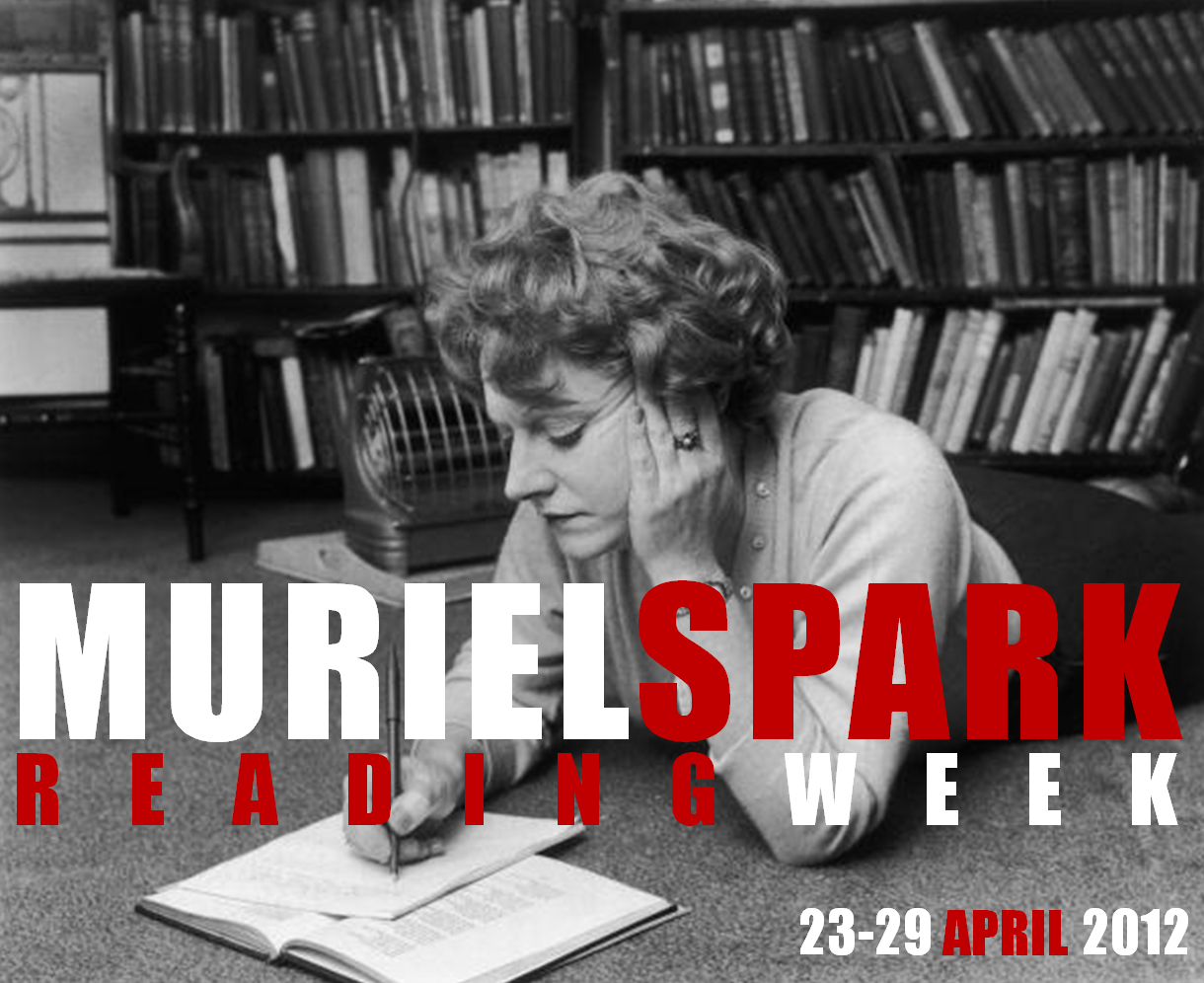 |
Wasn’t sure what to post today for Muriel Spark reading week until I saw Simon’s post about Spark book covers. It made me go to my shelves and pull down all the Sparks I own to take a look at their covers. Out of the thirteen I own (which aren’t actually the same as the thirteen that I have read) most of them have really bad covers. In some instances there are covers that I don’t particularly like, but they at least capture something about the book or author that makes them seem just right.
I decided to do a side-by-side comparison. (After you are done looking at these, you really should go over to Simon’s blog where he has some much more interesting ones. I particularly like the old Penguin covers from the 1960s.)
 |
| I think both are bad design. I like the image better in mine on the right, but the photo is a bit misleading. |
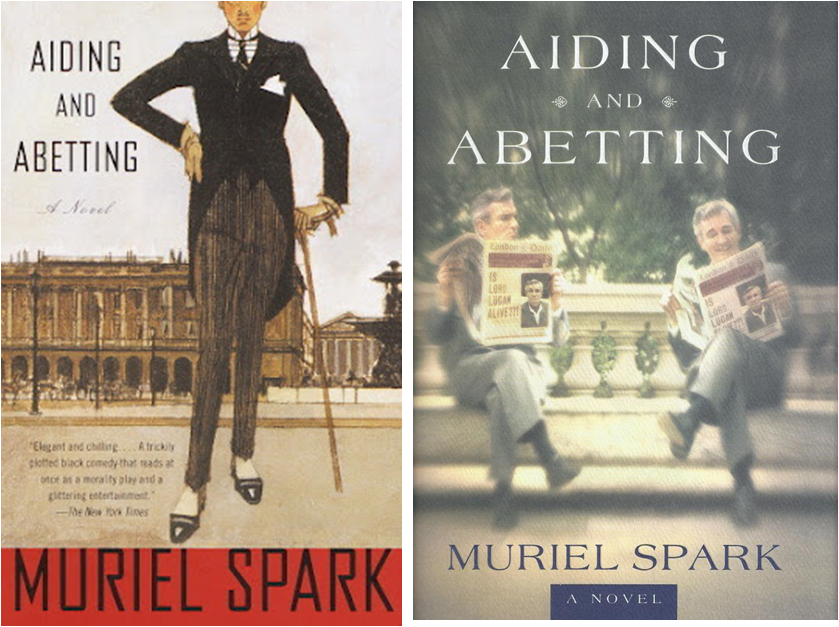 |
| I really like Simon’s cover on the left, but I think it is more appropriate for something by PG Wodehouse. |
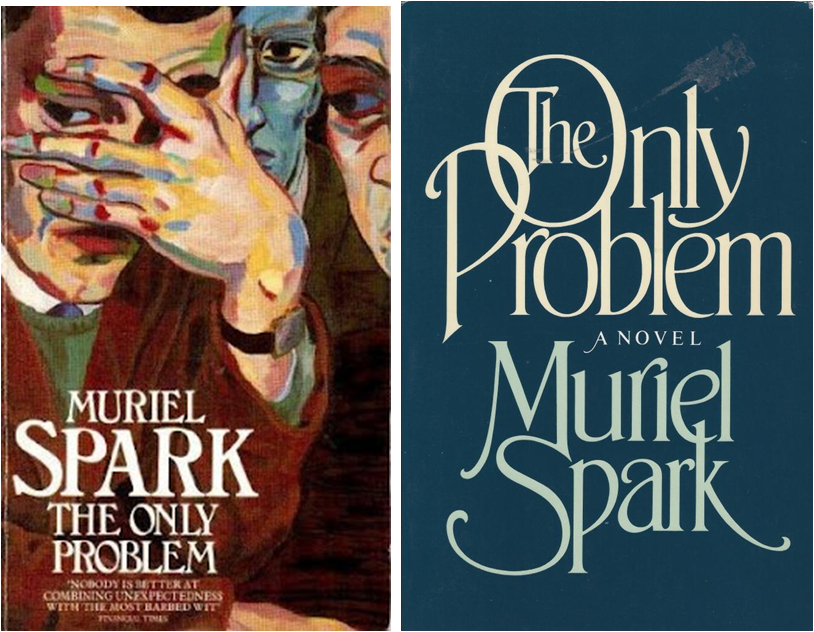 |
| I think the one on the left from Simon’s blog wins hands down. Not only is it a million times better than my lame cop, but it is interesting and evocative in its own right. |
 |
| I don’t like the one on the left in general because I tend not to like this kind of photo illustration. Plus this one makes the book look like chick-lit. The one on the right captures the subversive quality of Spark like a Blathus painting. |
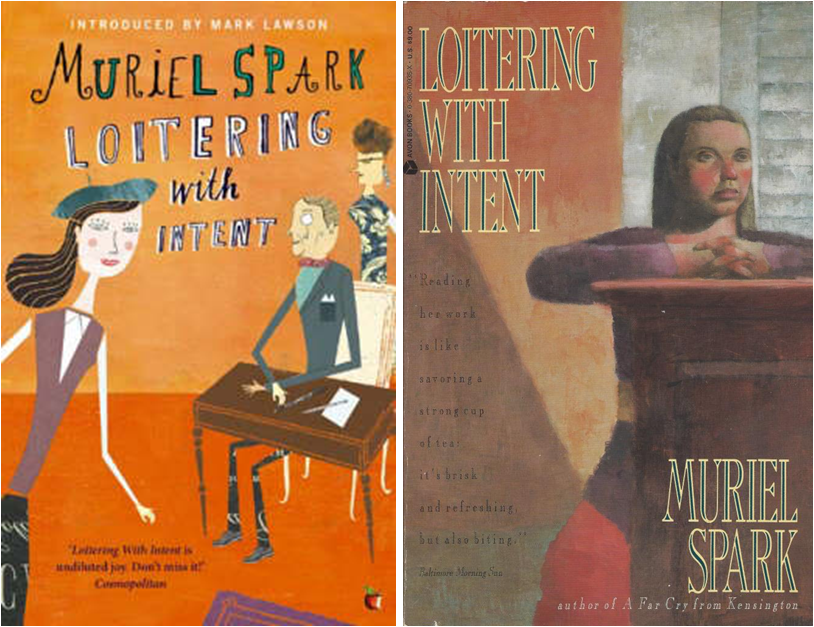 |
| While this book is pretty amusing, I think it has bite as the cover on the right says. The one on the left is just too frivolous. |
 |
| These are both boring as toast. (Although I love toast, and love books and movies that have English people buttering toast.) |
 |
| I really don’t like my copy on the right in person, but I kind of like it better on the screen. But overall I would say that Simon’s version is more Sparkian. Although I haven’t read this particular title.  |

Forty-two years before Dame Maggie Smith dominated Downton Abbey as the Dowager Duchess, and seventeen years before she brilliantly played “poor Aunt Charlotte” in A Room With a View, Maggie Smith won an Oscar for Best Actress for her role in the film adaptation of Muriel Spark’s The Prime of Miss Jean Brodie.
If you haven’t seen the film, what are you waiting for? If a young, glamorous Maggie Smith isn’t your cup of tea, maybe you could be enticed by a young, virgorous Gordon Jackson (Hudson from the original Upstairs Downstairs).


I know I am jumping the gun a bit on Muriel Spark Reading Week which starts tomorrow, but one must use the blogging time one has when one has it. And once I finish a blog post, I have a hard time not hitting the publish button. Plus, I figure the topic of my post might provide some guidance to anyone not sure where to start with Spark.
My first encounter with Muriel Spark came back in 1999. Her most famous novel The Prime of Miss Jean Brodie was included in the Modern Library’s Top 100 Novels of the 20th Century and I had decided to read the books on that list, so it was only a matter of time. I think I may also have gotten additional encouragement from Nancy Pearl’s Book Lust.
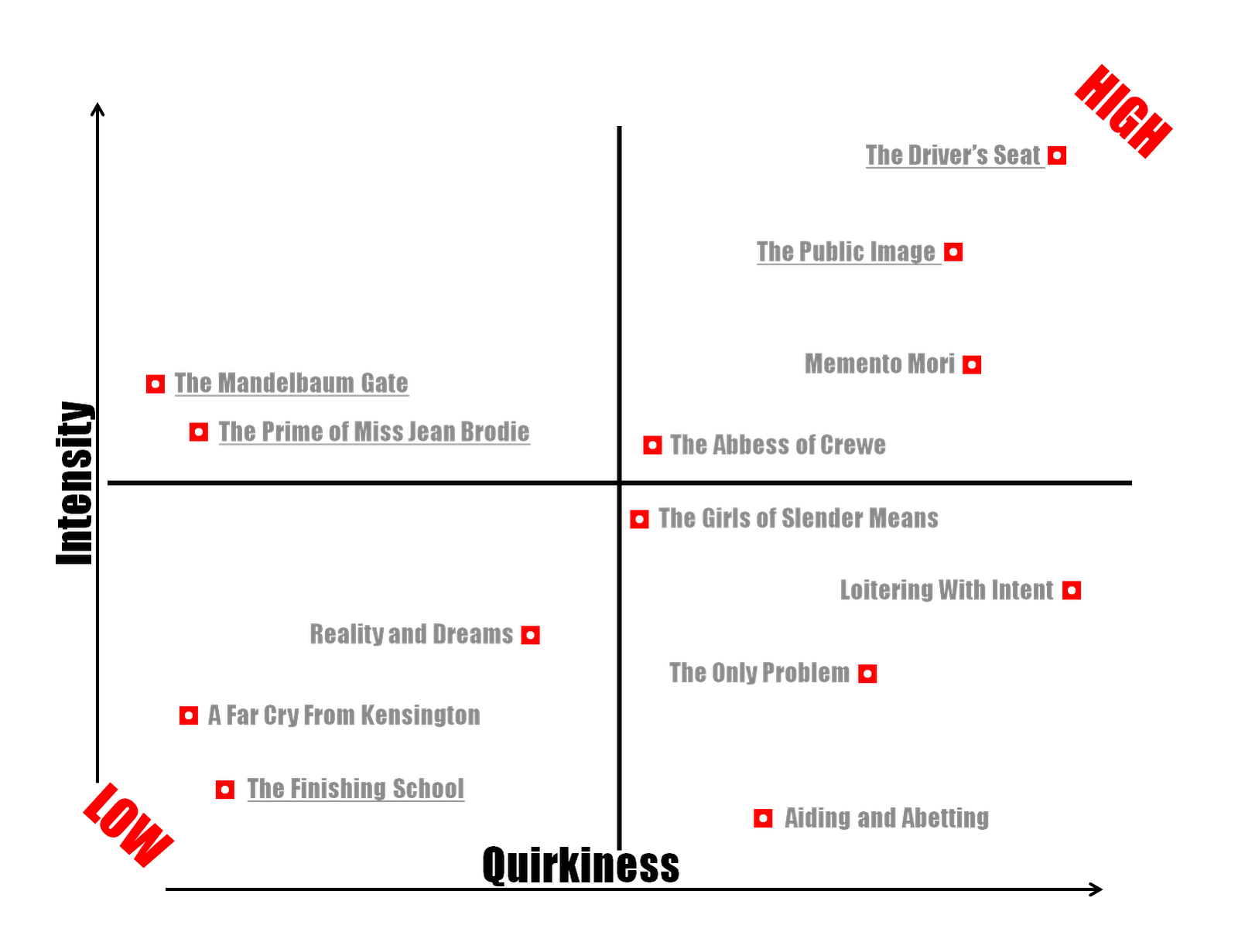
As I started to make my way through Spark’s many novels and novellas, I quickly noticed that she definitely had a quirky side, and often a subversive side. Upon analysis, it is easy to see how Spark’s novels are all clearly written by the same person, but at a cursory glance her books can seem like the work of many different authors. For instance The Prime of Miss Jean Brodie is a pretty straight forward narrative with characters who, while a little quirky, don’t seem too far outside mainstream ideas of normal. Despite making one chuckle and smile the novel ultimately ends up being more intense than those chuckles would initially indicate, but still a pretty conventional narrative structure. In contrast, with The Driver’s Seat, I almost immediately sensed that the book wasn’t a run of the mill tale of a woman off on a holiday. It is like a one-person psychological thriller that I found pretty intense. The Public Image on the other hand was less quirky and more amusing, but ratchets up the intensity in a different way. And then I ran into The Mandelbaum Gate which is so conventional it almost feels like Iris Murdoch could have written it. And I am not saying conventional is bad (god knows I love me some Iris Murdoch), but it is wholly serious and reads today like historical fiction about the early days of Israel and the accompanying religious and political tensions. But then I bounced back to the quirkier side of Spark but this time with a decidedly much lighter touch in Aiding and Abetting And then there are those like the The Only Problem, and Loitering With Intent, where the quirkiness and intensity is almost entirely in service of comedy.
As I thought about the chameleon like quality of Spark’s work, I thought it might be easier to show my thoughts graphically. The graph is not perfect but it comes close to approximating the variation in the thirteen Sparks I have read. Just keep in mind that intensity doesn’t always mean serious.
This morning the Space Shuttle Discovery made its way, piggyback on a Boeing 747, from Florida to the Smithsonian’s Udvar-Hazy Air and Space Museum next to Dulles Airport just outside of DC. On its way to the Smithsonian it buzzed the Capital a few times along the Potomac and over the National Mall. This particular Shuttle made 39 trips into space.
I remember back in the late 1970s when I saw on TV footage of when they first put a Shuttle on top of a 747. Kind of cool that 30 some years later I get to see it in person for its last piggyback ride. I still wonder how they whole darn thing doesn’t just fall off.
Unfortunately, my lense was dirty.






Some friends think I am odd because I smell books.
What’s a serial reader to do?
My friend Roz just finished Trollope’s Chronicles of Barsetshire series and she doesn’t know where to turn next. And don’t bother saying the Palliser novels because she finished those this year as well. In fact, she read both series in the span of two years all the while voraciously reading a million other things. I suggested there are lots of other Trollope novels to read (thirty-five others, in fact) but I think she will miss the serial form as much as the fact that it is Trollope. And when I say “serial form” here, I don’t mean a long Victorian novel that was serialized in a newspaper or periodical, I mean a multi-novel series like the Barset and Palliser novels. So what say all of you? Where should she go next? I haven’t read The Forsyte Saga or A Dance to the Music of Time, so I have no idea if those would be appropriate. Is The Forsyte Saga even made up of separate novels? I have read The Alexandria Quartet by Lawrence Durrell, and as much as I liked it, I am not sure it is a good replacement for Trollope. Is Miss Read (may she rest in peace) too simple? Thoughts?

And speaking of Roz…
It just occurred to me that you all would like Roz and her wife Layla. First and foremost because they are readers, but also the fact that I met them thanks to their acquaintance with blogosphere luminaries Polly (Novel Insights), Claire (Paperback Reader) and (I think) Simon (Savidge Reads). They were all part of a book club in London. When Roz got a VIJ (very important job) in Washington, DC, those bloggers said “you should meet Thomas”. And so she has. Always happy to have bookish friends, I wasted no time in getting acquainted with Roz and Layla.
Meeting them within the first week of their arrival in the United States, I stopped into Kramerbooks to find an American novel or two to welcome them. My enthusiasm in choosing American novels for them bordered on the evangelical. I ended up choosing five novels each representing a different geographic part of the U.S.: Main Street for the Midwest, A Confederacy of Dunces for New Orleans, Paul Auster’s Brooklyn Follies for New York, Then We Came to End by Joshua Ferris for Chicago (which is also the Midwest but in a much different way than Main Street) and of course they needed a novel about their new home, so I chose Ward Just’s brilliant Echo House about a dynastic political family in old Washington. (I realize I totally missed the West Coast, but nothing popped into my head as I hastily purchased the five books.) The best part about choosing these books for Roz and Layla, is that they actually read them with alacrity and, while they liked some more than others, didn’t find a dud among them. And what is more gratifying for a book lover than to have someone enjoy one of your recommendations? How many times have you given, or lent, or recommended a book to someone only to have the book go unread? I might now be afraid to recommend anything else to them lest I choose a clunker.
And Roz and Layla are convinced that, despite the fact that I didn’t like the movie (twice), I will indeed like Cold Comfort Farm. So they bought me a wonderful Penguin edition. I wonder if they know that the cover illustrations are by another Roz (Chast) who does lots of illustrating for The New Yorker?
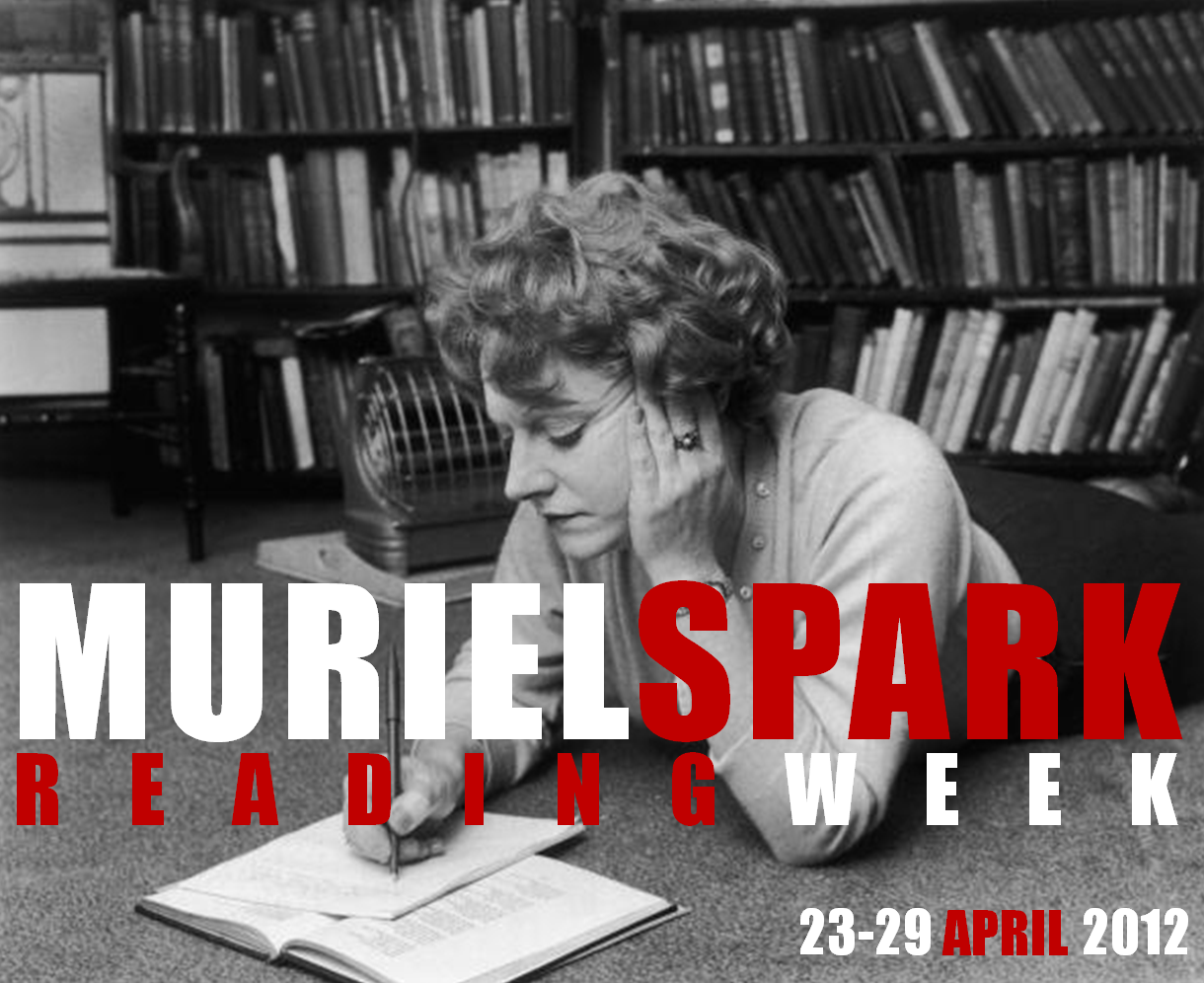
Muriel Spark Reading Week is coming up
Mustn’t forget that Muriel Spark Reading week begins on April 23rd. Simon of Stuck-in-a-Book and Harriet at Harriet Devine’s Blog will be hosting the festivities. I am definitely going to read at least one Spark novel so I can join in. Spark’s work is funny and subversive and quirky and she was prolific. I have read about 12 of her novels to date and am excited to see which one I read next. I have a few on the TBR pile to choose from.
Two Sentence Reviews
Gideon Planish by Sinclair Lewis: Con artist makes a living proselytizing about intellectual nonsense not unlike modern think tanks. Good if you are in the mood for the satirical dry wit of Sinclair Lewis and have already read his masterpieces.
The Pursuit of Love by Nancy Mitford: A satisfying and often funny family saga from interwar England that will leave you craving the other two books in the trilogy. Will also leave you wondering why no one ever mentions Don’t Tell Alfred, the third book in the trilogy.
A Glass of Blessing by Barbara Pym: I don’t know why this was in my TBR pile since I read it back in 2002. Pym is brilliant and based on this experience, I think her novels are the kind one can read over and over.
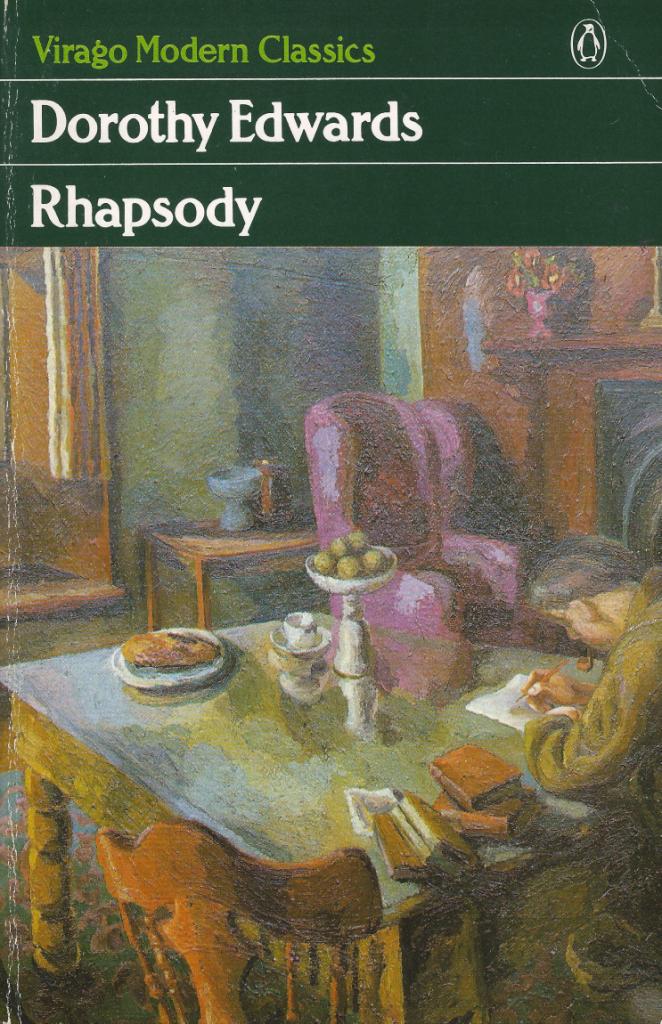
Rhapsody by Dorothy Edwards: A collection of short stories most of which have music and musicians as part of the story. All are about love (both requited and unrequited) and relationships and, oddly, all are told from the perspective of a male character.
Bossypants by Tina Fey: A quick, fun read IF you are Tina Fey fan. I only needed one sentence for this one.