Book Review: The Woman in White

The Woman in White
Wilkie Collins

Back in July I came across Savidge Reads, a great blog all about great books. Written by Simon Savidge, the blog has a section that Savidge refers to as his Readers Table where he lists some of his favorite books. Among the titles listed there are some favorites of mine like Brideshead Revisited and On Chesil Beach but there are also lots of books I had never even heard of let alone read. The Woman in White by Wilkie Collins was one of the latter. In the ensuing weeks as I traveled around the blogosphere, I kept running across mentions of Collins and The Woman in White in particular. I began to feel like I might be missing out on something. So when I was online buying a book or two, I decided to add The Woman in White to the list.

When the 600+ page book showed up I thought “My, that will make a great door stop.” The thing was huge. When was I ever going to pick that baby up and read it? Somewhat to my surprise I picked it up last weekend. I had just finished two very slim volumes and for some reason six hundred pages of Wilkie Collins began whispering to me from my TBR pile. The introduction in my edition (Barnes & Noble Classics) and the two prefaces by Collins’ himself almost made me put the book back on the pile. Not that there was anything wrong with them, I just feel sometimes like prefatory remarks can suck the life out of the main event. So I skimmed and skipped forward to the actual text of the novel and within a page and a half I was hooked in a big, big way.

The Woman in White is pure plot, every page is a turner and every chapter is a cliffhanger. Not surprising then to find out that the book began life as a serial. Beginning in 1859, installments of The Woman in White appeared in Charles Dickens’ weekly publication All the Year Round in Britain and in the U.S. in Harper’s Weekly. The first installment ran in the same issue as the final installment of Dickens’ A Tale of Two Cities. (Dickens was a mentor of Collins and in 1860 Collins’ brother married Dickens’ daughter Kate.)

I have been accused from time to time of liking books without a whole lot of plot and that are very low on thrills and spills. In that regard The Woman in White is decidedly not a typical book for me. It is full of intrigue, mystery, and anxiety induced moments. A kind of whodunit, except often times the mystery at hand isn’t who done it, but what “it” is in the first place. On the other hand, the period detail and the inclusion of letters, journal entries and other English bits and bobs put the book right up my alley.

I won’t even attempt to give a synopsis of the plot which is fabulously and plausibly implausible. It is way too complicated and too convoluted to make much sense of it here. It has lots of little peaks along the way with one or two big climaxes before you actually get to the final resolution. One could argue that some of the earlier plot climaxes could have easily, and perhaps appropriately, ended the book a couple of hundred pages sooner. But given that it was in Collins’ self-interest to stretch the serial out as long as possible, it is easy to understand why the book is as long as it is. But the book is interesting enough that you want it to last for 600 pages anyway.

Suffice it to say that The Woman in White is an entirely satisfying book. It is the kind of book that is hard to put down. The one that makes calling in sick worth it.

For other takes on The Woman in White check out these other blog posts on The Zen LeafA Guy’s Moleskine Notebook, The Critical Cynic, A Reader’s Journal.

Note on the cover image shown above.
A few editions of The Woman in White, as well as other novels use this striking image. It is James McNeill Whistler’s “Symphony in White, No. 1: The White Girl” painted in 1862. I have been lucky to see this painting in person many, many times since it lives at the National Gallery of Art here in Washington which is only about three miles from my house. And at almost 84 inches (213 cm) it is taller than my 6’2” frame. Pretty impressive. (The painting, not my frame.)

Book Review: Margaret Atwood Can Do No Wrong

Murder in the Dark
Margaret Atwood
I know I am prone to hyperbole, but sheesh, Margaret Atwood really knows how to write. I am always a little stunned to enounter avid readers who are lukewarm, or even dare I say, cold, to Atwood’s genius. Her fiction is always interesting, sometimes disturbing, and in many cases substantively challenging, but it is all written in beautiful, clear language that is a pleasure in itself. Over at Savidge Reads Simon’s Gran got it exactly right when she said that Atwood “isn’t one to be missed, even when I don’t like her”.

Thanks to some ordering stupidity on my part, I won’t be getting Atwood’s newest novel The Year of the Flood until the end of October. So I have had to make do with Murder in the Dark, a slim volume of “short fictions and prose poems”. One of my favorites was a piece called “Women’s Novels” which isn’t much more than a numbered list of observations, but it encapsulates all of Atwood’s insight, humor, and clever writing. A few of my favorite bits:

Men’s novels are about men. Women’s novels are about men too but from a different point of view. You can have a men’s novel with no women in it except possibly the landlady or the horse, but you can’t have a women’s novel with no men in it. Sometimes men put women in men’s novels but they leave out some of the parts: the heads, for instance, or the hands. Women’s novels leave out parts of the men as well. Sometimes it’s the stretch between the belly button and the knees, sometimes it’s the sense of humour. It’s hard to have a sense of humour in a cloak, in high wind, on a moor.

 and

I like to read novels in which the heroine has a costume rustling discreetly over her breasts, or discreet breasts rustling under her costume; in any case there must be a costume, some breasts, some rustling, and, over all, discretion. Discretion over all, like a fog, a miasma through which the outlines of things appear only vaguely. A glimpse of pink through the gloom, the sound of breathing, satin slithering to the floor, revealing what? Never mind, I say. Never never mind.

Another piece called “Happy Endings” is a kind of “choose your own adventure” tale about relationships. After offering six different endings to follow the phrase “John and Mary meet” Atwood ultimately concludes:

You’ll have to face it, the endings are the same however you slice it. Don’t be deluded by any other endings, they’re all fake, either deliberately fake, with malicious intent to deceive, or just motivated by excessive optimism if not by downright sentimentality. The only authentic ending is the one provided here: John and Mary die. John and Mary die. John and Mary die.

On bread: “The bread they offered you is subversive, it’s treacherous, it does not mean life.” Subversive bread. Fabulous.

On writing:

The page waits, pretending to be blank. Is that its appeal, its blankness? What else is this smooth and white, this terrifyingly innocent? A snow fall, a glacier? It’s a desert, totally arid, without life. But people venture into such places. Why? To see how much they can endure, how much dry light?

and

The question about the page is: what is beneath it? It seems to have only two dimensions, you can pick it up and turn it over and the back is the same as the front. Nothing, you say, disappointed. But you were looking in the wrong place, you were looking on the back instead of beneath. Beneath the page is another story.

I could continue to quote, but perhaps, for the sake of copyright laws, I should encourage you get a copy of Murder in the Dark and read it for yourself.

Book Review: George Eliot Makes it Up

Amos Barton
George Eiliot

I have had this lovely Hesperus edition of Amos Barton, George Eliot’s very first attempt at fiction, for a couple of years now. After reading my first Eliot earlier this summer (The Mill on the Floss), I turned to this little tome with renewed interest. This one is all about curates, money, housekeeping, and village gossip. The storyline is engaging enough (your basic poor curate and his family suffer the slings and arrows of gossip and hardship, suffer a loss, and ultimately resign themselves to the outcome) and the world that Eliot creates is interesting to live in for 94 pages. In our overstimulated lives it is hard to imagine living such a staid existence. In particular I loved this description of dinner party conversation that Eliot was no doubt mocking but which must have been all too common during her life:

Mr. Bridmain studied conversation as an art. To ladies he spoke of the weather, and was accustomed to consider it under three points of view: as a question of climate in general, comparing England with other countries in this respect; as a personal question, enquiring how it affected his lady interloctutor in particular; and as a question of probabilities, discussing whether there would be a change or a continuance of the present atmospheric conditions.

I don’t know how the ladies could stand all the excitement.

Book Giveaway

UPDATE:  When I set the date for this drawing I forgot about some other commitments that would make it hard for me to get the book to the winner in a timely manner. So, I am closing the drawing immediately and choosing the winner tonight.. However, I have decided to give away two copies instead of only one!


When I purchased this book directly from the publisher I ordered two for some reason. Since I can’t remember who I was going to give the extra copy to, I am going to give it away here on MyPorch. And since the book is impossible to find in North America, I am going to limit participation to North America. (Although anyone else with a compelling argument as to why they should have it will be included in the drawing.) Simply leave a comment or send me an email by 30 September 2009.

I wrote about Henrietta’s War earlier today. See below.

Book Reviews: Stiff Upper Lip and All That


Henrietta’s War
Joyce Dennis

The Guernsey Literary and Potato Peel Pie Society
Mary Ann Shaffer and Annie Barrows

I didn’t consciously plan to read these two books in quick succession, yet both of them are epistolary novels about coping with the trials and tribulations of World War II in the United Kingdom. In Henrietta’s War, the action takes place in 1941 in a small Devonshire village and is told through a series of letters from Henrietta to her childhood friend Robert who is serving in the British army. In the case of The Guernsey Literary and Potato Peel Pie Society, the action takes place in 1946 and is described in a series of letters between Juliet Ashton, a journalist living in London, her friends and colleagues, and a group of folks who lived through the Nazi-occupation of Guernsey, a British territory in the Channel Islands just off the coast of France.

Henrietta’s War has been much reviewed in the blogosphere by a generally adoring fan base. While I thoroughly enjoyed it, it didn’t necessarily sweep me off my feet. Perhaps I had read too much hype before I finally got to read it. In any case I won’t spend much time talking about it so you might want to check out reviews by Stuck-in-a-Book, Cornflower, Paperback Reader, Read Warbler, and Frisbee, to name just a few of the great reviews of the book.

TGLPPS has also been reviewed by a great number of folks like Savidge Reads, Letters from a Hill Farm, and Bibliophile by the Sea. But I found this book so delightful that I feel the need to wax rhapsodic about it. I love the book for several reasons. First, the characters come together over their love of literature and they “meet” through their letters. Shaffer and Barrows essentially create a scenario that is not unlike the communities of folks who blog about books and get to know each other by trading literary likes and dislikes on the Internet. The only real difference is that in 1946 the medium was ink, paper, stamps, and the Royal Mail. Which, frankly is another reason I love this book so much, I absolutely love letters. Back in high school I had about 30 pen-pals and I miss the day when people would put pen (or even typewriter) to paper.

The subject matter is also fascinating. I have an undergraduate degree in history, but I am not much of a fan of historical fiction. I am not sure if TGLPPPS would fall into the category of historical fiction, probably not, but it does a great job of describing what life was like in Nazi-occupied Guernsey. In 2005 Masterpiece Theater showed a fantastic British drama called Island at War, a fictional account of life in the occupied Channel Islands. The storylines are completely different, but the historical detail in Island at War and TGLPPPS complement each other rather well. And both of them make me want to visit the Channel Islands.

Another reason to love TGLPPPS is that it is a joy to read. I loved the characters, I loved the plot lines, and I loved the humor. And Shaffer and Barrows are quite deft at weaving the reality of Nazi atrocities into the story without minimizing them or being pedantic.

Occasionally, but not often, the language seems a tad too modern for the 1946 correspondence. But it is just a little whiff here and there, overall it seems very appropriate to the era. I was, however, quite disappointed with the introduction of what I think is a rather pointless reference to one of the character’s homosexuality. The information doesn’t really add anything to the story, unless the authors were just trying to prove that homosexuals existed during World War II. But what was truly jarring to me was the very unrealistic way in which the characters talk about the subject. The dialogue doesn’t ring true for one second. In fact it was so stylistically and historically incongruous it was like having a Sousaphone player toot his way across stage through the middle of a Mozart string quartet.

Having said that, the book is wonderful and everyone should read it.

My only other quibble with both Henrietta’s War and TGLPPPS is one that I have with most epistolary novels. When people write letters they almost never include actual dialogue. In a letter (or email) one may write something like “Then he told me to shut-up and I told him to go to hell.” But it is unlikely that someone would write you a letter like this: “Shut-up!” he yelled. “Oh yeah, well you can go to hell!” I replied shaking my fist. And so on. Most people just don’t write that way. One of my all time favorite authors, Carol Shields wrote an epistolary novel with Blanche Howard called A Celibate Season that was so full of quoted dialogue that I had a hard time suspending my disbelief. On the other hand 84, Charing Cross Road which is a series of actual letters written by author Helene Hanff that tell a wonderful story and is entirely free of quoted dialogue. In my opinion that is the way it should be. Otherwise epistolary novels are just lazy ways to describe settings or advance plots without needing to be clever enough to connect it all together. A bit of an overgeneralization, I know, but for OCD types like me, it just seems wrong.

But enough of all that, what’s on TV?


With all this travel and book blogging lately some of you may think that I have forgotten how to watch TV. Fear not my friends. My love of good and bad TV is alive and well. The TiVo was humming away during the 16 days we were out of town so there has been a lot of catch up viewing over the past week. And being that it is still the summer season, reality TV takes up the lion’s share of my time. In fact, only one scripted show even makes an appearance on this list

Entourage
This dramedy on HBO continues to entertain. All of the characters seem to be on an upswing lately which I like much better than when things are going poorly. Turtle has definitely lost weight since last season. But you know, the show is so darn short. I think they could easily fill an hour or at least 45 minutes, heck how about a full 30 minutes. It seems like once you subtract out opening and closing credits the show is only 2o minutes. That may be fine for broadcast TV, but I want more from HBO.

Real Estate Intervention
Ah, the overinflated DC housing market is finally waking up to reality. Each week Mike Aubrey is the truth talking real estate agent that tries to set the record straight for desperate but clueless house sellers who think it is their god-given right to make money on their house, rather than just live in it. Mike is a breath of fresh air.

Project Runway
Finally, the creme of the reality crop is back on the air. After a legal battle between Bravo and Lifetime, the show is back on and as good as ever. I am not sure I like the move to LA over NYC, but it seems okay enough. Although it does appear harder for some judges to make it to the tapings. Michael Kors has been missing a few times, and the usually ever present Nina Garcia has even missed a show. But other than that the show continues to be a fantastic look at the creative process. I think the contestants are much better across the board this season. There are fewer, perhaps even none of the “I don’t sew” or “I don’t sketch” types this time around. And it is harder to decide who should go home because the bads just are as bad as they have been in past seasons.

Top Chef
The food version of Project Runway, it too has a much more consistent caliber of talent this season. Usually by the first episode you can pick who are going to end up in the top three. This time it is a little harder. Although if I were a betting man I would put it on the two brothers and the woman who works for Eric Ripert.

Real Housewives of Atlanta
Where in the hell do these women get their money? On the other housewife shows (excluding New Jersey, I didn’t really watch it and I am afraid to ask where they get their money) you can kind of see where they money comes from. On the Atlanta show, not so much. Newcomer Kandi is the outlier. You know where she gets her money, she is a grammy-winning singer/songwriter who used to be in the group Xscape and still writes for big names. She also seems like the only one in the bunch who has some manners and isn’t a big ol’ b****. So when completely talentless Kim or NeNe compare themselves to Kandi? Or in NeNe’s case try to question Kandi’s talent. Give me a break NeNe, the woman has gotten rich and won a grammy on her talent. What was it you do again? And Kim, has added a Bently to her Escalade, is dripping in diamonds, has an assistant and a nanny…and she pays for it how? Do her giant boobs generate electricity that she sells back to the power grid? Sheree, despite her financial situation, is still as clueless as ever and seems to spend money like crazy. Lisa sometimes seems sane, but usually not for long.
What is wrong with these women is what is wrong with this country. A bunch of shallow, self-involved, overspending people screaming about respect and disrespect while they clearly have no idea what either word means. Wouldn’t miss an episode.

Flipping Out
Everyone’s favorite OCD house flipper is back on. Except the housing market is in the toilet so he can’t flip at the moment and is doing renovation work. He continues to drive his friends and staff crazy, and he overreacts about many things. And no doubt, in real life he must be a huge challenge to be around. But at the base of it all he actually seems like a genuinely nice, upstanding guy. If you can tolerate his aggressive sense of humor and need to control everything.

House Hunters International
The international version of House Hunters is tolerable in a way that the original show is not thanks to the foreign locations. The show’s formula and host can be just as annoying as the original program but it is fun to see what’s for sale in Umbria, Bali, and New Zealand (to name a few) rather than the cookie cutter houses they seem to focus on in the US version. There was one beautiful, huge, Parisian style apartment in Buenos Aires for $175,000 that made me want to move to the Southern Hemisphere. And then we look at the house listings in DC and just get depressed.

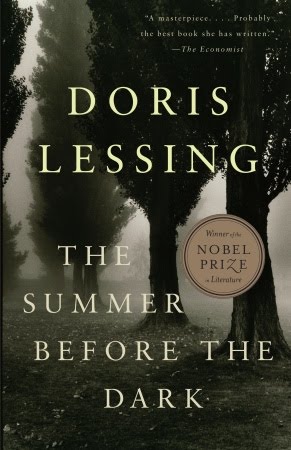
Book Review: Doris Lessing Teaches Me a Lesson?


The Summer Before The Dark
Doris Lessing

In 2007 Doris Lessing won the Nobel Prize for literature, but until this month I had never read anything by her. I knew that she has written The Golden Notebook, but I didn’t know anything about it or Lessing. So when I came across a cheap pulp edition of The Summer Before The Dark, I thought it was time to acquaint myself with the Nobel laureate and it would be a good book to take with me on our vacation.

Written in 1973, The Summer Before The Dark is the story of Kate Brown, a married, empty-nester in her mid-forties. She finds herself alone for the summer as husband and kids scatter to pursue various interests. On short notice she is drafted to assist a friend of her husband who needs a translator for a month-long conference he is holding in London. Kate quickly proves adept at the work, makes herself invaluable to the organization without even trying, and gets paid a salary almost as big as her doctor husband after years of being a housewife.

Kate’s sudden and unexpected success in the workplace made me think that this was going to be a particular kind of story of positive transformation. A “housewife discovers hidden talents and surprises everyone” kind of story. And frankly, this is one of my favorite kind of tales. But alas, Kate’s transformation turns out to be much more torturous and complicated than that.

After helping organize a conference in Istanbul, she finds herself traveling through Spain with an American man about ten years her junior. Hoping to avoid the touristy parts of southern Spain, the American keeps pushing them inland only to end up seriously ill. Kate does her best to make do with the complicated situation but her facility in French, Italian, and Portuguese are of minimal help to her in rural Spain. And traveling with a man who isn’t her husband puts her at silent odds with the people in the small village.

As Kate begins to show signs of the same unknown malady as her traveling companion, she makes her way back to England where she checks herself into a Bloomsbury hotel rather than a hospital. Although never dangerously ill, she has a physical and mental meltdown that leaves her incapable of functioning for some weeks. Eventually she rents a room in a flat occupied by Maureen, an angst-ridden twenty-something who is confused about her own freedom and whether or not to get married. While she is living with Maureen, Kate makes her way back to a degree of normalcy and the book ends with certain amount of hope if not outright resolution.

One of the themes I found particularly interesting, because of my proclivity to whine about my own existence, was the way Lessing juxtaposes comfortable middle class life with others in the world who struggle merely to live. Kate works for a non-governmental organization that focuses on global food policy and she is startled by how much she and others in the organization are paid and how much money is put into conferences that might be of little value. Especially troubling to her when compared to economic conditions of the communities that they serve.

Similarly she sees her own issues relative to the natives she runs into in rural Spain, where they have not learned to overcome their moral qualms about the behavior of the rich tourists. The social mores in the small inland village in which she is stranded are at odds with her own life and her choices she has made and the situation leaves Kate feeling isolated. She compares her own freedom with that of the women in the village where there is “not a woman or girl in this place who was within a hundred years of such freedom.”

Perhaps it isn’t a major theme of the book but I identified with what I saw as Kate’s recognition of the self-indulgent nature of upper middle class ennui. It is akin to the moments on MyPorch where my idea of thoughtful introspection and self-awareness gets boiled down by my father (Ernie in Peoria) to self-pity or whining. He is not as blunt as that, but he is essentially right. Privilege breeds whining. The fewer real obstacles one has in life, the more petty the complaints are. I thankfully don’t have to battle illness, or worry where my next meal is going to come from, or worry about being killed by a missile, or not having safe drinking water. I get to sit at a computer and worry about whether or not my life’s dreams will be realized today or tomorrow.

One of Kate’s upper middle class struggles is finding out who she is now that she is no longer defined by her children’s wants and needs. When you think of the struggles in the world, this is ultimately a self-indulgent worry. But things in life are relative and it is hard to keep a healthy perspective. One of the things that struck me is that I am almost Kate’s age, but I haven’t raised a family and I have been free to pursue just about every avenue of interest that has popped into my head. The only task in my adult life has been to raise myself. My angst about where my life has been and where it is going seems even more self-indulgent when viewed through the prism of those who have children to care for. Am I trying to say that I should just shut up and quit complaining? Not really. I think it is too much to ask anyone to try and live too far outside of their own existence. And my existence is that of a middle class, childless, coupled, white, gay male in the richest country on Earth. I think a little more balance, keeping things in perspective, perhaps putting a little more of my altruistic tendencies into action, are important things for me to keep in mind. For someone like me who seems incapable of ever being able to decide what I want out of life, perhaps the only things that make the inexorable march toward the grave manageable is the quality of my relationships and the actual process of living. After all, the only finish line in life is death, so I’d better enjoy the run.

Book Reivew: Portrait of a Man Reading The Portrait of a Lady


The Portrait of a Lady
Henry James

You may recall that I brought eight books with me for our 16-day trip. I managed to get through five of those eight. No doubt I would finished more had Henry James not been in the bunch. You can see from the pictures above that I had it with me everywhere I went in Switzerland. Including reading a paragraph or two at over 11,000 feet.

I have never had an easy time with James. He seems like an author I should like more than I do. It took me some time, over a hundred pages or so, to get to the point where I started to be interested in what I was reading. I was bemoaning his long-winded sentences when I began to wonder if the novel could be improved with some judicious pruning. As I read, I started mentally editing the text to remove what seemed like extraneous words. I was reminded of that line from the film “Amadeus” about Mozart’s music having “too many notes.” But then a funny thing happened. As I started to edit the book in my head, all the extra words that I thought might be expendable turned out to add quite a lot nuance, and weren’t as expendable as I thought. And from a process standpoint, trying to mentally edit the book turned out to be a good way to read the text more closely and ultimately get more out of it.

Having said that, I am still not a huge fan of Henry James. There were some things about this particular book that annoyed me more than a little. I had a hard time believing that the main character, Isabel, was as fascinating and smart as James and the characters in the book kept telling me she was. She seemed more like a game player than anything else. Willfully obtuse and unwilling to communicate clearly with people who loved her most and had her best interest in mind. And a bad judge of character of those who were prone to use her or steer her in the wrong direction. Her friend Henrietta I found particularly annoying and meddlesome. Madame Merle was perhaps the biggest villain in the book, yet everyone loved her until they hated her.

As far as the story goes, let me try and sum it up in 50 words or fewer: Young American woman taken to Europe by wealthy aunt. Becomes everyone’s darling and has men falling at her feet. Claims to have an unquenchable independent spirit that refuses to be tamed (married). Then gets inexplicably married to a man who ultimately tames her and makes her miserable. Finally admits her misery but is seemingly unable or unwilling to do anything about it. (Okay that was 62 words, but we are talking about Henry James after all.)

No doubt there are some great themes that I missed. For instance, I am pretty sure James was trying to say something about Americans and Europeans, but what that was I am not entirely sure. And the last pages of the book left me scratching my head. The language was just antiquated enough that I am not really sure what happened at the end.

I didn’t dislike the book, and I must say I missed the story once I finished the 580 or so pages, but I can’t say I was a big fan.

Although I may be a bit thick when it comes to picking up on some of the grand themes of the book, I did pick up on one inconsistency. At least I am pretty sure it was an error. Chapter 34 begins just before lunch time:

One morning, on her return from her drive, some half-hour before luncheon…the
stillness of noontide hung over it…

Yet, despite the fact that the action in the chapter was linear (and moving forward), the chapter inexplicably ends with Isabel asking her cousin if he is going to come in for breakfast to which he answers in the negative and returns to the garden

…to breakfast on the Florentine sunshine.

Maybe James and his editors got confused by his own run-on sentences and didn’t notice the mistake. Or perhaps there is a James scholar out there who will tell me that I missed something and I am the one in error, not James.

Book Review: Curates and Cauliflower


Some Tame Gazelle
Barbara Pym

Barbara Pym’s Some Tame Gazelle was the third book I finished reading while we were traveling through southern France. It is a good thing that I am not one of those people who likes to read books germane to the places I am visiting, because the setting of Pym’s novel was in pretty stark contrast to where I had set my butt to read the book. Some Tame Gazelle takes place in an English village in the late 1940s, where the major concerns seem to be about darning socks, the proper way to dust the front room, and the topic of the Archdeacon’s latest sermon. All a far cry from a warm sunny day in Provence lounging by the pool. Of course, this begs the question, why in the world would I want to mentally transport myself from my sybaritic lair in the south of France to the mundane minutiae of post-war village life? Because everything about these industrious, gossipy English villagers fascinates me.

This is the kind of book that is manna for Anglophiles like myself. First published in the UK in 1950 (but not until 1983 in the US), Some Tame Gazelle is Pym’s first novel and it sets the tone for many others that she wrote later. Her books are full of competent, independent, often single women, usually mixed in with lots of vicars, curates, archdeacons, bishops and the like, and lots and lots of tea. A little bit of Trollope, a little bit of E.F. Benson, with dashes of Austen and Wodehouse.

The action, if you can call it that, centers on two middle age spinster sisters Harriet and Belinda Bede who keep house together. Harriet develops a platonic fetish for each of the young curates who pass through the local church over the years. Her interest in nurturing these young men, and an attachment to her life with her sister, keeps her from accepting the many offers of marriage that come her direction. Belinda, on the other hand, has had one overriding, longstanding, and unrequited love, for the archdeacon who she has known since their days at university together.

A mellow comedy of manners, the plot has a relatively gentle arc that is nonetheless engaging and surprising in its way. In many cases it is the routine details of their daily lives and their everyday interactions with their neighbors that are interesting and revealing about these characters. And I am never more interested in the minutiae of their housekeeping than when they talk about food. We aren’t talking Babette’s Feast here, we are talking about the obsession that many Briton’s must have had with food in the days of food rationing and fiscal diligence. These are the kind of descriptions of food that help give British cooking a bad name. Perhaps unjustly so if you consider what crap Americans were eating in the 1950s. There is a scene where the sisters serve Cauliflower Cheese for lunch and a caterpillar is found by their traveling seamstress Miss Prior, in her portion of the midday meal. The semi-polite interchange between master and servant over the caterpillar is hilarious in its subdued way. But for me the real fascination is with the Cauliflower Cheese itself. Some kind of gratin with cheese and cauliflower? A head of cauliflower with a cheese sauce poured over it? Can my British readers enlighten me? What is it? Do people still make it? Is it delicious or is it kind of bleak?

If mid-century middle-class British manners and mores are your thing, Barbara Pym is for you.
    

Book Review: Marge Piercy Satisfies

Fly Away Home
Marge Piercy

Fly Away Home is the third Marge Piercy book that I have read, and I must say I have enjoyed them all. (The other two are Three Women and The Third Child.) They have all been about women in transition. A little divorce, some intergenerational conflict, career highs and lows. And all of them definitely fall into the category of easy reads. The kind of novels that are interesting and smart, and bring up some deep issues, but are totally fun to read. Luckily this was the book I had started when John was a little under the weather while we were traveling in Provence. For hours I plopped myself on the couch in our hotel room and read while John slept.

Written in the early 1980s, the book is modern but depicts a period that seems refreshingly simpler than our current fractious times. Don’t get me wrong, I know that Ronald Reagan was busy oversimplifying or outright ignoring complex issues of huge significance. And he was sowing the seeds of an overly politicized Christian right that found its very un-Christ-like apotheosis in George W. Bush and his hypocritical, anti-intellectual minions. But the latter hadn’t happened yet and thinking about nuclear winter seems somewhat quaint compared to the wild cards of global terrorism and global warming.

But I digress…the protagonist in Fly Away Home is Daria Walker, a successful cookbook author, mother, and wife. That is until it becomes clear that her selfish, immature, husband is having an affair and wants a divorce. Daria’s world starts to fall apart, but like all good books of this genre, she slowly starts to pick up the pieces, and everything turns out groovy in the end. Piercy is a little heavy-handed in portraying the husband as a total piece of excrement, but it is actually kind of fun hating him and relishing in his ultimate downfall.

But this book is about more than just their relationship. It also is a bit of a thriller in the sense that even though you know things are going to turn out alright, there are so many twists and turns that it kept me on hooks wondering what would happen next. The mystery hinges a lot the husband’s business dealings and how they become intertwined in the unravelling of the marriage. And for someone like me who has trained in urban planning, it also included a really interesting look at gentrification and community organizing in urban Boston. You don’t have to care about those issues, however, to enjoy this book–they are pretty seamlessly written into the narrative. And on top of everything, Daria is a food writer with plenty of foodie stuff sprinkled into the story as well. Her references to Julia Child foreshadow the current craze for all things Julia.

I look forward to reading more of Piercy’s bibliography. After three successful reads, I don’t think I will be disappointed.