Book Review: The Group by Mary McCarthy


As part of Virago Modern Classics Reading Week hosted by Rachel and Carolyn back in January I won a copy of The Group by Mary McCarthy. Oddly for me, and annoyingly for Rachel, when asked to pick a VMC book from a list of about five titles I felt great ambivalence about what to choose. I either already had copies of some of the prize choices or I couldn’t muster enough interest in the unknown titles to choose one. In the end I forgot to respond to Rachel’s email until she she wrote me and said “Hey dummy, send me your address so I can send you the prize that you were too lazy to pick.” Well, I paraphrase a bit, but I had been rather inconsiderate in not replying to Rachel’s initial email.

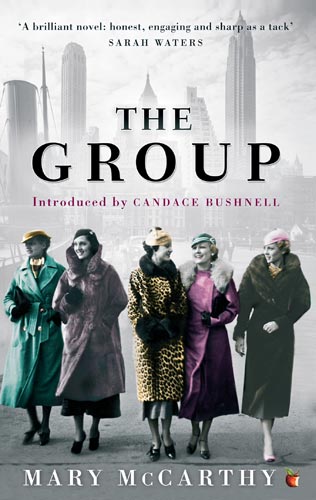
Long story short, I am glad that Rachel ended up choosing the book for me. I ended up loving The Group and I don’t think I would ever have picked up this book on my own. The cartoonish colors applied to the cover photo made me think it was some recently published book pandering to readers who wanted to read about pre-WWII girl power. Not that I have any problem with pre-WWII girl power, in fact quite the contrary, I just shy away from books that are trying too hard to embrace a lucrative demographic marketing niche. (Unfortunately I think Virago has been trying too hard with their covers of late. I don’t blame them, they do after all need to sell some books. But I really don’t think that a Barbara Pym or Muriel Spark novel should have a bubble gum and puppy dog cover. Then again, if it means more people will read them I should really just shut my mouth.)

Turns out that Rachel, my VMC benefactor, is reading The Group at this very moment. I can’t wait to see what she thought of it.

The Group follows a collection, some might say a group, of women in 1933 who have all recently graduated from Vassar. Although it has been 16 years since I read The Feminine Mystique, The Group definitely felt like a fictional sister to Friedan’s ground-shifting non-fictional magnum opus. (Both books were published in 1963.) McCarthy’s tale follows the mostly well-off women as they enter the world of work, husbands, and babies and she explores the ties that bind the women together over the years. This is, however, no romanticized view of the women or their friendships with each other. As omniscient author McCarthy deals plainly and openly with sex, sexuality, domestic violence, mental health, and motherhood, in a way that is difficult for most of her characters. Most of them rejoice or suffer in silence as they adjust to adulthood. And I have to say that I now know more about the fitting, care, and use of a Dutch cap than I ever thought possible.

Even if one sets aside McCarthy’s brilliant depiction of the challenges facing educated women in the 1930s, the book remains an expertly drawn tale of the many ways in which friendships evolve from student days to real life and the associated and ever changing landscape of loyalties.

Book Review: Wishin’ and Hopin’ by Wally Lamb


I loved Wally Lamb’s first book She’s Come Undone. During one reading session with the book, I was so swept up by it that I completely forgot I was lying in the grass in the Place des Vosges in Paris on a beautiful, warm, October afternoon.

I looked forward to Lamb’s second book I Know This Much is True. But I found it just so-so. I felt like Lamb tried to throw in way too many things and the unintended result was that I stopped paying attention to his work. But when I found this attractive volume at a Border’s liquidation sale I thought it was worth a go. But it wasn’t. I’ve read some really wonderful books lately and following it up with this phoned-in, first person fictional memoir was not only sad, but it made me crazy that I had nothing else to read on my commute.

And really, how many times do we have to hear the story of a young Catholic boys coming of age, getting boners and being afraid of nuns? Who cares?

(In looking for an image of the cover, I found out that this book has also been marketed as a Christmas tale. That makes it even more lame. Or maybe it would have helped if I had known I was reading a marketing tool rather than a novel.)

Book Review: My Life in France by Julia Child with Alex Prud’homme


Julia and Paul Child

Do the French dream about living abroad as much as the rest of the world seems to dream about living in France?

Much has been written in the blogosphere about this book since the movie and “Julie and Julia” hit the big screen. I probably won’t break any new ground in this review as I loved it as much as every other sane person on the planet. What is not to love? It works on so many levels. Not only does the book allow us to vicariously live in France and eat amazing food but we also get a chance to hang out with one of the most enthusiastic, life affirming humans to ever walk the planet. I have loved Julia since I was a child. And she was the subject of an early post here on My Porch.

Back in the late 1990s as I approached my 30s, I read Appetite for Life a biography of Julia Child by Noel Riley Fitch. The most important thing I took away from that reading was that Child, a revolutionary force in American food, didn’t start cooking until she was in her early 30s.  This gave me the added boost I needed to leave behind a fun, well-paying job to go back to school for another Master’s degree. And now here I am in my early 40s and am again inspired by Child’s late bloomer success and absolute lust for life.

Like I said I don’t have much new ground to cover on this well reviewed book so I won’t say too much more. There were two literary connections in this book that I found fascinating. One was that Dorothy Canfield (Fisher) makes a few epistolary appearances in the text. Canfield Fisher, author of one of my favorite novels The Home-Maker, was friends with one of Child’s cookbook collaborators and played an early, cameo role in the development of their magnum opus Mastering the Art of French Cooking. And the second, perhaps even more impressive literary connection is that Judith Jones, the editor who finally brought MAFC to print was an editorial assistant who convinced her boss to reconsider his decision to not buy the US rights to publish Anne Frank: The Diary of a Young Girl. Jones sure knows how to spot a gem.

Unless you are a cranky, life-hating, mistanthrope who doesn’t like to eat, you will love this book.
  

Book Review: The Magnificent Spinster by May Sarton


This review contains a giveaway.

One of the best reading chances I ever took was to buy a stack of May Sarton books without knowing anything about her. I had seen her name over the years but knew absolutely nothing else. Then in 2008 we were in a very cute used bookshop in Woodstock, Vermont back when I spied this stack of May Sarton paperbacks in old Norton editions and for some reason decided it was time I check her out. But I didn’t just buy one, I bought the whole stack. That was one of the best reading gambles I ever took Three years later I have read many of those volumes and added several more to my collection. Sarton wrote wonderful journals and wonderful novels. She also wrote poetry but I haven’t looked at that yet. In both 2009 and 2010 her books made it into my top 10 for the year.

So what did I think of my latest Sarton experience? It was fantastic.The Magnificent Spinster was the kind of book that I didn’t want to put down, but even more important it was the kind of book that I actually relished reading slowly. I tend to be too results oriented to ever slow down my reading too much–I feel I need to finish things–but with this book, I really did enjoy going slowly.

In The Magnificent Spinster, 70-year old Cam decides to write a novel about her 50-year friendship with Jane Reid who has just passed away. I haven’t done the research, but my guess is that the novel is based more than a little on the book’s dedicatee, Anne Longfellow Thorpe (1894-1977). Before each chapter there is a nonfiction-style (but fictional) prologue that sets up the fictionalization of Thorpe’s life in the guise of Jane Reid. But Cam’s prologues become just as much a part of the Jane Reid story as the chapters themselves. It kind of reminded me of the layered narrative structure in The Golden Notebook by Doris Lessing, but I don’t even want to make that comparison because the Sarton wonderfully readable and so full of joy and life in a way that the Lessing is not.

The Magnificent Spinster is cosy, cosy, cosy, but with feminist, political twists and some somber earnestness that elevates it to something more profound. Parts of it reminded me of Betty Smith’s A Tree Grows in Brooklyn but it also had a Pepysian quality as WWI, the Spanish Civil War, WWII, the McCarthy Communist witch hunts and Vietnam all scroll through proceedings. And these aren’t really Pymsian spinsters. As much as I love Pym, the women in The Magnificent Spinster would never be as complacent or docile as Pym’s excellent women.

You should read this novel if any of the following things appeal to you:

  • Stories of deep, abiding friendships
  • Idyllic summers on an island in Maine
  • A multi-generational story told through the lens of the women
  • Lots of great housekeeping details (linen changing, bath drawing, travel arranging, brownie baking, flower gathering, etc.)
  • Career minded women living against gender expectations in the early 20th century
  • Warm, gregarious characters determined to live full, exuberant lives
  • Pre-Stonewall Lesbians (just a few, although they all might have been)

It isn’t often that I get tears in my eyes when I read a book, but the scenes where Ruth, Cam’s partner of 20 years dies was so beautifully rendered. (This is not a spoiler, the fact of her death is mentioned very early on.)  There is so much about this book that made me love it. If you haven’t read any Sarton, I think this would be a good place to start. It is a wonderful combination of her novels and her journals.

And, for one lucky random person who posts a comment there will be a free copy of this book. As a result of all my Sarton book buying, I appear to have acquired three copies. I not only have two old Norton editions (the one I read was a paperback, but it turns out I also have the hardcover edition) but I also have a more modern Norton edition. It is the newer one that I am prepared to send anywhere in the world to someone who wants to read it (not just collect another free book). This is for the reader in you, not the bibliophile…

Book Review: The Spoils of Poynton by Henry James

   
It isn’t often (ever?) that I post bad book reviews. Well, that isn’t true, many of my book reviews are bad…but it isn’t often I post a review of a bad book. (ha) And I might be overstating the case to say that The Spoils of Poynton is a bad book. No doubt it is chock full of redeeming value that I am too dense, or was too bored and confused to understand.

The gist of the story is that mother doesn’t like son’s choice of fiancee. Mom is afraid the vulgar young thing won’t properly venerate the art and collectibles that she (the mom) has spent her adult life collecting. Mom steals everything and puts it in her dowager house. Mom enlists young woman of limited means to help split them up. Young woman is too principled to do so despite falling in love with son who also seems to fall in love with her. Son ends up marrying fiancee who he now seems to hate, once mom returns all items. House full of returned treasure burns to the ground.

I assume that somewhere in this tale about a worshipful, singular, fixation on material goods there is a moral, but Henry James’ use of language is so convoluted at times that I was never more than 80% sure I knew what was going on. There were times while reading this when I felt like reading Shakespeare would have been less taxing and far more rewarding.

Still, I give it a 5 (out of 10) on my rating scale which equals “ambivalent” because there was some pleasure in the formal Victorian details. I plan to read more Henry James. He wrote too much to ignore. And I didn’t hate Washington Square or Portrait of a Lady.

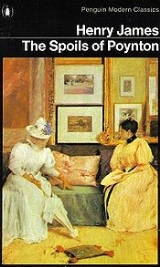
I bought this book for the Penguin cover. And it was only 50 cents.

Book Review: The Glass Room by Simon Mawer


This is one of those books I was kind of avoiding because it seemed like everyone was reading and reviewing it. I know that is a dumb reason to avoid a reading a book, but I also know I am not the only person who gets caught in that psychological trap. Fortunately, I found a cheap remaindered copy The Glass Room when I visited Daedalus Books this past summer with Frances of Nonsuch Books and Teresa of Shelf Love. Once the book was in the house it seemed like I was one step closer to getting over my aversion to popular books, at least in this instance. I had picked it up a few times since I bought it and thought I might be in the mood to start it, but it wasn’t until I focused in on the TBR pile in my nightstand that it really started to bubble to the surface. And I am so happy that it did.
It is easy to see why The Glass Room was short-listed for the Booker Prize. Despite a typo or two (see here), it is a marvelous novel that is hard to put down. At its essence it is a World War II story focusing on the lives of a group of people in Czechoslovakia. What makes the novel unique is that its organizing structure really is an organizing structure. When Viktor and Liesel Landauer are on their honeymoon in Venice they meet Rainer von Abt, a German modernist architect, whose design philosophy is right in line with the couple’s desire to live in a house that looks to the future rather than the past. The result is a stunningly modern architectural gem which acts as far more than a piece of the backdrop for the events of the novel. The clean lines and pure spaces of the house not only provide a multifaceted and apt metaphor for many of the themes of the book, but the house also often plays a catalytic role in the lives of the people who live and work in it.
And the lives of the people that Mawer creates are interesting and joyous and tragic. He shows the many ways people learn to survive not only politics, war, and dislocation, but also how we survive personal upheaval and adversity. None of Mawer’s main characters are paragons of virtue but they are all likable and so believably human.
I am often fascinated, perhaps morbidly so sometimes, by the fact that human lives are so fleeting and ephemeral. That regardless of the importance of any given thing, or feeling or event in our lives, they are but  momentary blips on the map. They only matter to a relatively small circle of people and even then for only a brief period of time. The memory of the feeling or event event fading into oblivion faster than most of would care to admit. It is just a matter of decades before the Landauer House, so important to those who imagined it, built it, and lived in it, loses its original use and meaning and its history is defined and redefined by those who don’t necessarily have the knowledge, or the right, to do so.
The life of the house before, during, and after the Landauers illustrates wonderfully the ways in which buildings change use and sometimes form over time. Think of seminaries that became grand houses, that became wartime hospitals, that became prep schools, that became something else. Sometimes those new uses suit the building and other times the fit is less than ideal.
I liked this book a lot on many different levels. Certainly not a perfect novel, but one that gives the reader a lot to think about and discuss. This really is a perfect book club book.

A few other reviews:
I know that I saw many other reviews out there in the blogosphere but I am having a hard time finding them now. For those of you who review lots of books you should go over to FyreFly’s Book Blog and register your blog for the Book Blogs Search Engine.  That way I can find your reviews more easily in the future.