I haven’t stopped following you…


I am not sure how closely any of you follow the number of people who “follow” your blog, but I just wanted you to know that I have not stopped following your blog but I have stopped “following” your blog.

In my efforts to clean up my Google Reader I decided that I didn’t want the “blogs I follow” to be in a separate place from all the other blogs that I follow. I want them all in a nice alphabetical list.  But in order to do that I have to “unfollow” everyone, and then manually add you into my Google Reader.

I wish I could still “follow” all of you (I hate to be the reason that your “follow” stats dip by one), but Google won’t let me do that I put you in the order I want.

And for those of you who don’t see your blog in this image, don’t worry, I still follow you on my Google reader but for some reason I never “followed” you or you are on a platform that doesn’t allow following. I stopped “following” people many moons ago when I first got Google Reader and saw how it kept the “followed” sites separate from the rest.  It bothered my sense of order back then, but I have only now, decided to take the bull by the horns and clean it up.

If none of this makes sense to you, you have nothing to worry about.

Bits and Bobs (the struggling woman edition)

I tried to find a picture of the Queen Mum looking mean
but they really don’t exist. This was the best I could
come up with. But I thought the unwritten rule is that one
doesn’t take photos of the Royal Family eating.

  
[3/19/12 Update: Boy, did I forget to proofread this. It should be better now.]

Was the Queen Mum cold hearted, or a hypocrite?  
I knew that would get your attention.  Am I about to trash the Queen Mum? No. At worst I am ambivalent about her, but I did wonder as I read Lady Rose and Mrs. Memmary by Ruby Ferguson if the QM suffered from a little cognitive dissonance when it comes to marrying for love. In Ferguson’s 1937 novel, the heroine marries for love and ends up old and impoverished. Now, the Queen Mum is said to have been a great admirer of this book. So why did she love this book? Was she clueless to the fact that her life-long grudge against the Duke of Windsor and Wallis Simpson was similar to the class-induced opprobrium Lady Rose faced? Or, more sinisterly, did she relish the comeuppance Lady Rose got for marrying below her? If either of these is true I tend to think it is more the former than the latter. Or was she so caught up in this romantic paean to Scottish life that she couldn’t think clearly?

I don’t really feel strongly enough to care one way or the other, but it was on my mind the entire time I was reading Lady Rose. And for the record I really enjoyed the book. Highly recommended for Persephone fans.

Why those ungrateful…
My second struggling woman for the week is Patricia Lindsay (née Crispin) the heroine of Princes in the Land by Joanna Cannan. We follow Patricia as she gets her own lesson in marrying beneath her. She sacrifices much for her insecure husband and her ungrateful children. In a town and gown story as old as the academy itself, Patricia’s eldest gets the newsagent’s daughter preggers and marries her much to his mother’s horror. Patricia’s distaste over the marriage is not dissimilar to her mother’s, but Cannan does such a good job describing the mock gentility of the newsagent’s wife and daughter that it was hard not to chuckle at the characterization and sympathize with Patricia. Does that make me a snob? Yes, but so be it. I know I would have trouble if my (non-existent) son married a woman with all the crass, intellectual idiocy of Sarah Palin–albeit in this case non-political idiocy. The second son falls in love with his friend Peter, I mean with his friend Peter’s love of the Oxford Movement. This makes his high church, only on Sundays mother openly hostile. And then the daughter…what does she do that is so wrong…I don’t remember. Was it that she loved cars more than horses?

Thankfully we see Patricia at middle age (my age) seeing a light at the end of the tunnel.  Another Persephone I thoroughly enjoyed.

This story had very little to do with spoons
I think my third struggling woman for the week struggled more than the other two combined. In Our Spoons Came from Woolworths by Barbara Comyns, artist Sophia Fairclough her artist husband Charles marry young, and (surprise) against the wishes of his family. Unlike her marginally talented husband, Sophia takes work so she can keep them fed and housed, a task that becomes harder when she has a baby. There is much about Sophia’s fertility that I would like to talk about but that would be too spoilery. But I will say that it makes me even more crazy that Rick Santorum and idiots on the far right are talking about contraceptives these days as if we were about to enter the dark ages again.

One of the great things about this book is that you never quite know where it is headed. The only constant is that one keeps hoping for Sophia’s day in the sun. Whether or not she makes it is something you will have to find out for yourselves. I highly recommend this (and the other other Barbara Comyns book I have read The Skin Chairs).

Struggling is not just for women
My struggle these days has been to find time for blog reading and blog writing. Happily my work has my brain occupied such that I don’t have as much mental stamina for appreciating the blog world as I had when my work didn’t engage me so. I fear I have turned into a once a week kind of guy. Hopefully that will just make you all fonder of me rather than make you forget about me. I do know that I have too many blogs in my feed reader and the sheer number of unread posts makes me not want to look at anything. So today I am going to do a huge cull and only keep around those that regularly interest me. I might try and sequester the ones that only marginally interest me into a separate folder, but if the result is that the unread posts for those still show up in my total of unread posts–thus triggering my OCD–I might have to give them the boot altogether.

Struggling through the Century?
No. Even though I have only read 14 of 100 books for the A Century of Books challenge, I am kind of enjoying paying closer attention to when books were published. For a while I even entertained reading my TBR pile in chronological order. I was reading the oldest, then then newest, then the oldest, then the newest, etc. But then I bumped into Women in Love and that took away my desire for chronological symmetry. I still might try and finish “that bastard book” (to paraphrase Corky St. Clair from Waiting for Guffman, one of the best movies of all time) D.H. Lawrence, but it is going to be a slog. I also updated my Century list today with books from my larger TBR pile (i.e., outside the nightstand).


Oh Cluny

 
Isn’t it often the case that one never has enough time to properly scour a used bookstore?  Sure, there may be enough time for a good, satisfying browse, but how often is there enough time to really go looking for the needles in the haystack?  Last August in Maine when we spent two weeks on Islesboro I had all the time in the world to really comb through the fine used bookstore on the rather small island. When we first visited the store I did all my usual checks for my favorite authors and didn’t really come up with much that was interesting. In fact, at first browse I was quite disappointed. Here was a wonderful bookshop in an old one room school building filled to the ceiling with mainly hardcover used books and they didn’t seem to have anything that I wanted.  But given the fact that we were (happily) captive on the island I realized I had time to really make sure that I wasn’t missing anything. So, with nothing to hurry me along and no other distractions save the beauty of the island, I actually took the time to look at every single spine in the shop.

Over the course of a couple of different browsing sessions I managed to come up with a pretty tall stack of books that I found interesting or unique, and quite a bit more non-fiction than I would typically find.

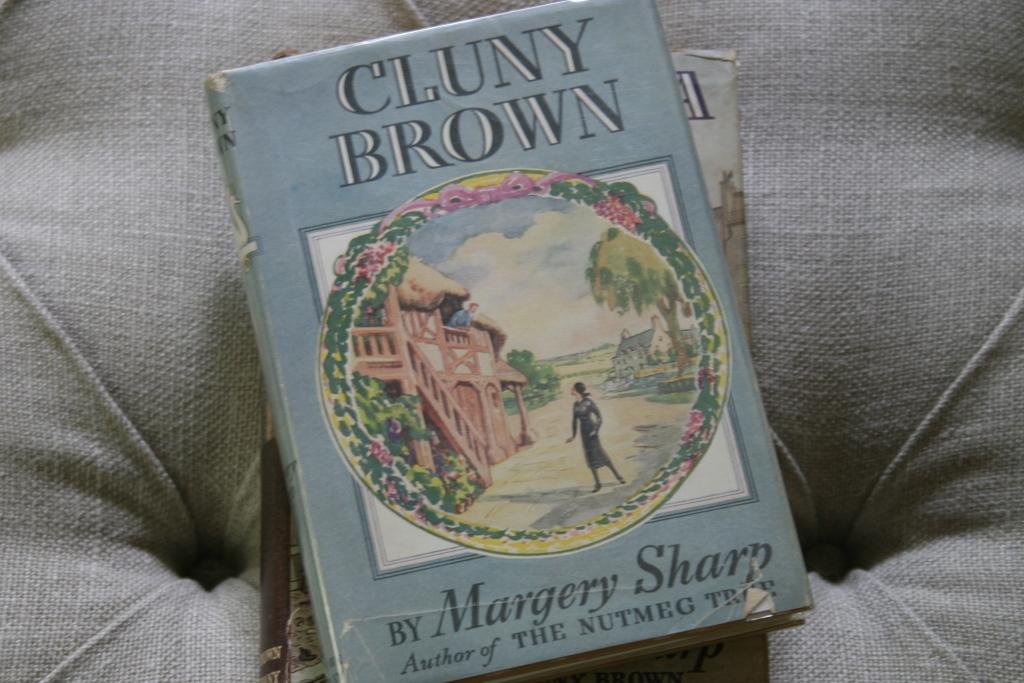
In that stack were two novels by Margery Sharp, an author I had never heard of. (As it turns out, in addition to her 26 novels for adults, she also wrote 14 for children, including The Rescuers.)  In any case, I must admit that the first one that I came across went into my purchase pile because of the cover. How could any anglophile, urban planner, historic preservationist pass up this cover?

I was actually a bit worried that the book might be nothing but pap, and the price was closer to antiquarian than used, but I couldn’t resist the cover art. And then I noticed “Author of Cluny Brown” at the bottom which immediately made me think that Britannia Mews may be a lesser book than the obviously popular Cluny Brown. And it just so happened that they had a copy of Cluny Brown on the shelf as well. So, with my OCD kicking in, I thought I really should start with Cluny Brown and see if I liked it. But how could I pass up the Britannia Mews cover even if Cluny did come first?  And I really shouldn’t buy both, they were about $30 a piece, what if I didn’t like Margery Sharp? But then I worried that if I only bought one and found out I loved Margery Sharp, wouldn’t I be annoyed that I only bought one of these pretty first editions?

I am happy to say that now that I have read Cluny Brown, I am glad I bought both and am wondering how to get my hands on the rest of Sharp’s novels. Based on the cover, and the fact that I had never heard of Sharp, I was thinking it might be some enjoyable, mindless, 1940s chick-lit. But it is pretty clear from early on that Sharp has a few edges. Cluny Brown is a young woman of about 19 whose parents died when she was young and has been living with her Uncle Arn, a genteel plumber who never knows quite what to do with Cluny and her potentially dangerous naivete. He worries that Cluny doesn’t know her place in life, having committed the class crime of going to tea at the Ritz. It doesn’t matter to Uncle Arn that she paid for the experience with her own money. After an episode where Arn finds her (innocently) emerging from the bathroom of a bachelor client he decides he needs to save Cluny from herself and sends her out of London to go into “good service” in Devon.

What follows is a bit of an upstairs, downstairs tale. But Cluny and her irascible high spirits would never survive in the starchy world of Gosford Park, or Upstairs, Downstairs (or even the rather lame, poorly written world of Downton Abbey) if not for the fact that domestic help was pretty hard to come by after in the years between the wars. The housekeeper, Mrs. Maile, overlooks many a transgression, knowing that replacing Cluny might be more trouble than it is worth. One knows from the start that Cluny is going to end up in clover by the end of the book (in fact her real name is Clover), and though one can, and does, guess at two or three outcomes, the final result is not what one expects. So surprising to me was the final twist that I feel a bit of a spoiler for even mentioning it.
Cluny Brown has Persephone written all over it. Cozy and fun, but with a definite feminist outlook. Now I can’t wait until the TBR Double Dare is over so I can read Britannia Mews. And maybe this summer’s trip to Maine will yield a few more Sharps for my library.

My Trollopian Work Life (or getting paid to have fun)

Imagine this plot: In 1869 a well respected superintendent of an insane asylum is accused of profiting from his position, defrauding employees, neglecting the patients under his care, and even the non-return of two horses that wandered onto the grounds of the asylum. Months of letters, testimony, and committee investigations ensue in order to determine if the charges have any basis in fact.

Then imagine that the story is told with all the twists, turns, and commas of Victorian syntax with no little attention to bureaucratic details.

Could this be a lost Trollope manuscript? Some mix of The Warden and The Last Chronicle of Barset? It could be, but it isn’t. It is actually a description of a real life scenario I stumbled across in the course of my job. You see, my job for 2012 is to research and write a book-length history of an insane asylum that dates back to 1855. After a few years working as an urban planner on a project to redevelop said insane asylum, and after working for a few more years dealing with the historic preservation issues related to that same project, I now get to write this history to help mitigate the adverse effect the redevelopment is having on the asylum which is a National Historic Landmark. (You may remember me posting some pretty cool historic photos of this asylum last spring.)

So the majority of my work day is spent in places like the National Archives and the Library of Congress. The archive work is particularly fascinating because I am working with primary documents that read like excerpts from a Trollope novel and are filled with lots of fantastic (mundane) Trollopian details.

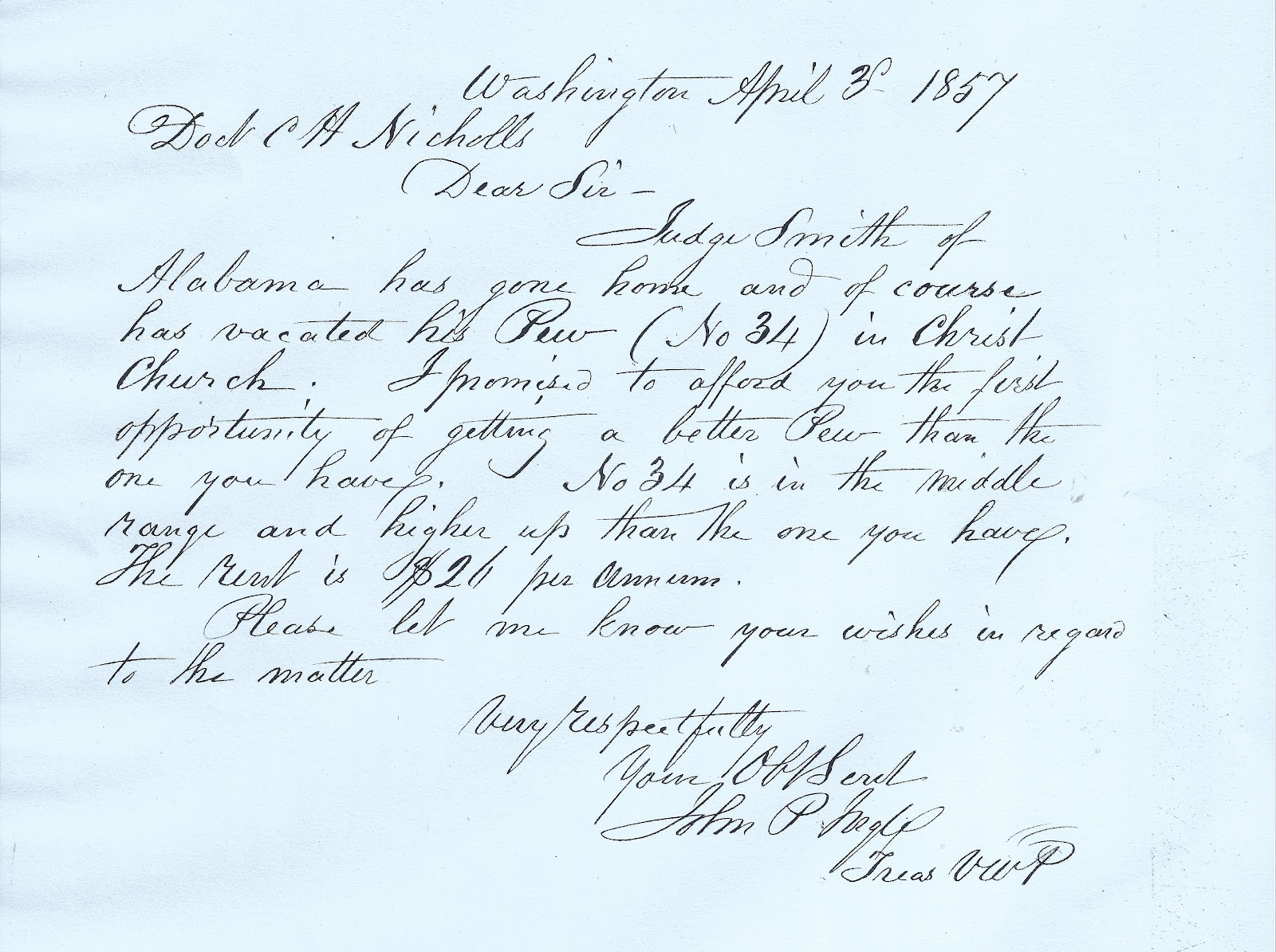
How about this letter from 1857 offering the superintendent first refusal on a soon-to-be vacant (and better) pew at Christ Church for only $26 per annum?

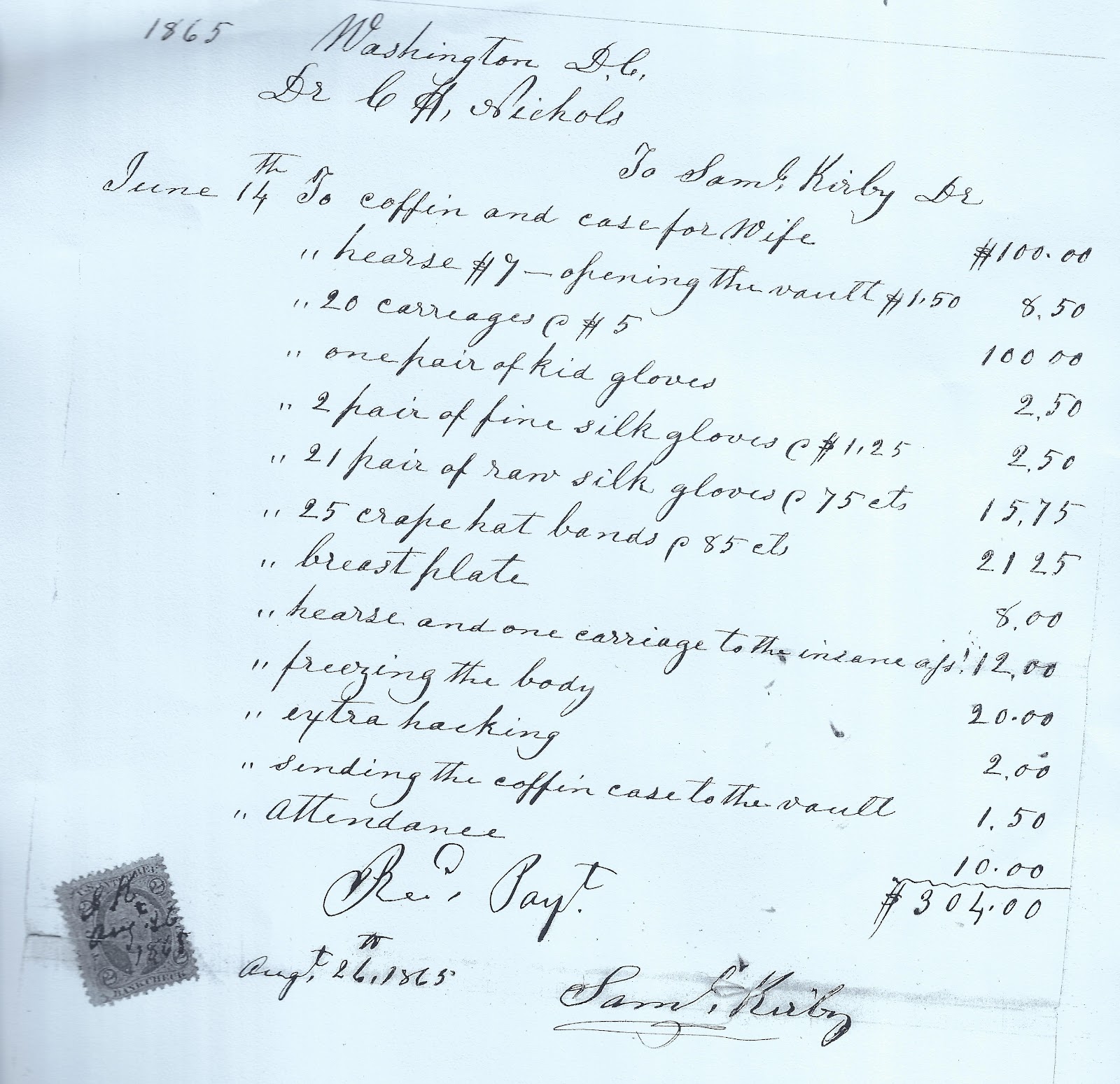
Or how about the story suggested by this invoice for the superitendent’s wife’s funeral? Twenty carriages at $5 a piece, 21 pair of raw silk gloves, $20 for freezing the body. The superitendent was well paid at $2,500 per year, but this $304 funeral was more than 10% of his annual income.

And I must say, reading plenty of Trollope over the years has prepared me well for sifting through thousands of letter from the second half of the the 19th century. What it didn’t prepare me for, however, was deciphering the sometimes cryptic handwriting which can make for really slow going. I can’t wait until the typewriter is invented and the hospital buys one. Maybe my eyes will uncross when I get to those years.

One of the more fascinating, and Trollopian letters I have come across relates to the plot I described earlier. So again imagine this plot where the superintendent is fending off attacks on his professional integrity when he gets a letter from one of his former clerks George Kellogg, who is now farming in Jamaica, Vermont. In that letter Kellogg tells the superintendent of a visit from a man he judged

…to be about thirty years of age, light hair, red side whiskers, quite a full face (judge caused by whiskey), he had a small bottle of whiskey with him and he offered me some the first thing. It being nearly gone he drank it himself.

The farmer goes on at some length to describe how the visitor attempted to bribe him to go back to Washington to testify against the superintendent.

The bribe was like this: 1st, I was to have my old place with better pay &c, 2nd, If one or two thousand dollars would induce me to tell all I knew for, said he, you know enough of Dr. Nichols to send him to State’s prison…

Kellogg is taken aback by the charges and the man’s bald attempt to bribe him.

I told him he was a stranger to me and that I knew nothing about him or his friend whom he was working for and that I should be very careful what I said or did. He then said that his friends name was General M. McGowan who was a surgeon in the army a was third or fourth cousin of General Grant [presumably the newly elected President Ulysses S. Grant] and was a very fine man, and a great friend of Secretary [of the Interior] Cox and a man who would surely be appointed in Dr. Nichols’ place.

What amazes me about this scenario is that in 1869 someone was so intent on procuring the position of superintendent of this asylum that they sent this inebriated boob 451 miles north to try and bribe a former employee–and one who was still on good, personal terms with the superintendent. In the end, like a good Trollope novel, the superintendent was cleared of all charges but with an admonishment or two to keep better account books going forward.

And this is just the tip of the iceberg.  There are so many fascinating aspects to this project.  Life in a Victorian-era insane asylum (Wilkie Collins anyone?) The role of the hospital during the Civil War. A pioneering institution in the understanding of brain pathology in the insane with over 2,500 brain specimens collected over the years. The place where Ezra Pound was kept for 15 years after being charged with treason after WWII. And the list goes on.

I don’t think I have ever been so excited to go to work each day.

Bits and Bobs (the book edition)


Miss Buncle wrote other books
You may recall my delight (and perhaps your own) with Miss Buncle’s Book by D.E. Stevenson. I loved that book from cover to cover. The follow-up Miss Buncle Married was nowhere near as amusing or original but I still enjoyed reading it. After reading the first of the Buncles I went online and bid on a bunch of DE Stevenson novels despite having been warned by one of you that most, if not all, of her non-Buncle fiction was pretty much just straightforward romantic novels set in the Scottish lowlands. And behold, I give you Sarah’s Cottage. A straightforward romantic novel set in the Scottish lowlands. This is a novel where everything always ends up just the way it should and where every character has two dimensions whether he or she needs the second one or not. Lots of breathless excitement and despair! (That is an ironic exclamation point.) And like Miss Buncle, lots of feverish book writing into the wee hours of the morning leading to a book that becomes a hit and goes into a third printing before being published in America. And like Miss B, it was published under a pseudonym as well. One thing I love to hate (and I think Nevil Shute does this as well) is when authors insert a character’s name into dialogue in places that don’t seem plausible. Who knows maybe it used to be so, but I find this awkward. For instance, if you were having a conversation with me and I asked: “Would you like to come to tea?” would you answer: “I’d love to come.” Or would you answer “I’d love to come, Thomas.” And in the same conversation would you also say “Do you want children of your own, Thomas?” or “Do you find it difficult, Thomas?” or “Is ‘Beric’ a family name, Thomas?” There are only two of us in the room. You don’t need to keep addressing me by name. I know who you are talking to. There is no confusion.

Still, if you want a cozy story where even the bad stuff exists only so you can be happy later, then you should pick up some non-Buncles.

I think I loathe D.H. Lawrence
I am 111 pages into Women in Love, the third Lawrence novel I have read, and I really think I hate it, and in retrospect have hated every word of Lawrence I have ever read.  I wish I could explain why. I find it tedious and detached and depressing. I think Lawrence could have used some meds. Maybe if I read 10 pages a day I can hold my nose and finish it.

Joseph Conrad seems to be thinking about hopping on the Loathe Train as well
First Heart of Darkness, and now The Secret Agent. In comparison, I prefer Conrad to Lawrence, but I can’t say that I have enjoyed reading him. I will say that I kind of enjoy every other paragraph of Conrad. I will find myself enjoying the story for a minute, but then something about his prose style makes me glaze over and wonder if I should clip my nails or do the dishes. Unlike Lawrence, however, I could actually see myself picking up another Conrad novel, if just to cross Lord Jim off the Modern Library list.

A lame, gay, two-fer
While England Sleeps is the David Leavitt novel that became notorious because Stephen Spender thought that it resembled his memoirs a little too much. Leavitt claims he was inspired by Spender’s life, but I think that some of the similarities that Spender pointed out are a little too close to not suspect monkey business on Leavitt’s part. This book had more than a few flaws but I must admit I found it enjoyable and even quite emotional in a place or two. I think I even teared up a bit at one point.

The second gay book I read was Felice Picano’s The Book of Lies. Remember when I busted Julia Glass’ butt over all of the inaccuracies and dubious notions in her book The Whole World Over? Well this is the gay version of that critique. Different in details, but the same sloppy mind. Perhaps the most egregious error was the notion that someone could go pick up a baby at the airport. That is, one of the characters would go to JFK to pick up babies that had been sent from Central America. Really? The INS has a counter with a bunch of unaccompanied babies in bassinets just waiting to be picked up like a piece of lost luggage? ARE YOU SERIOUS?  How about a PhD candidate teaching a summer session and the students (and others) all call him professor. I have three degrees from three universities, and I never heard a grad student called professor in any context. And then the author has the notion that a mechanism exists that will control the speed of your car. Picano posits that for a stretch of familiar road with varying speed limits his character’s car has a speed governor that can be preset to change when the speed limit changes. In 2000 I drove across the country in a moving van that had a speed governor and the only thing it did was keep me from being able to go faster than 65 mph. A cruise control requires that manually set it each time the speed limit changes. And a GPS unit can tell me what the speed limit is and what my speed is, but it sure can’t automatically make my car go that speed. And even if that did exist on some model of car I am unfamiliar with, it sure didn’t exist in 1998.

Too Good to Miss: Marge Piercy
Although the title made for a few self-conscious Metro rides, I thoroughly enjoyed The Longings of Women by Marge Piercy. This is the fourth Piercy book I have read and I have liked all of them (this one probably the least so). They all have multiple women, usually in the Boston area, who are building their lives after some sort of male perpetrated malfeasance. They are warm, smart, realistic but ultimately uplifting, and never feel like male bashing. One of the characters in this one gives a very believable account of what it would be like to be homeless after a long marriage ends in divorce. More of you should be reading her. Try Three Women, The Third Child, Fly Away Home, or The Longings of Women.

Is the UK ready for me doing this?

  
Given our interest in visiting some out of the way places and having a generally out of the way kind of time when we go to England in May, we decided to rent a car. I have driven all around France with no problems, but I have never attempted to drive on the wrong…I mean left side of the road before.

I have no problems with roundabouts, but can I do one this way?  I am thinking of renting extra air bags…if only that were possible.

So, look out my pedestrian friends of the sceptred isle, Toonces is going to be on the road.

EEEK!

 
One should not start writing a post when one is still half asleep. This morning before I left for work I started to write a post, but it was far from finished. And now all of you will see the draft in your feed readers despite me taking the post down…

I promise the real post, when it is done will be great.

What would you do?

Williams College in the gorgeous Berkshire hills of Western Massachusetts.

Back in April of 2009 before most of you had even heard of My Porch, I posted something that I still find fascinating. John and I had been on a road trip where we talked about how much fun it would be to spend a semester studying whatever we wanted to. A kind of academic fantasy camp. No real worries about grades or anything stressful, just the chance to learn about something you never had time for in school.

(I am aware that more than a few of you are still in the halls of the academy, so this may be less interesting to you…but you still may want to play along)


Q: If you could spend a semester studying anything you wanted, what kind of classes would you take?

Rules:

1. Assume everything else in your life is manageable (e.g, your
family isn’t neglected, bills are paid, you don’t have to work, etc.)

2. Choose classes that you would want to take just for the fun of taking them. That
is, stay away from stuff that would get you a promotion at work or help you to
finish a degree or something like that. This is your chance to explore anything
you want.

3. Extra points for being specific.

4. Double extra points for telling me where you would want to spend your semester.

Amherst College, also in Massachusetts.

A: If I had to narrow it down to one semester, this would be my course schedule:

This was my list in 2009.

  • Survey/History of British Lit
  • History of Victorian and Edwardian England
  • Infrastructure 101 (A more in-depth, much smarter version of all those Discovery channel shows about utilities and transportation and stuff like that.) This class includes a two week “field trip” to learn about European passenger rail infrastructure.
  • Photography
  • Choir

As to where, I am tempted to say Cornell because it is a nice campus in a beautiful setting and is
kind of isolated. Cozy and big at the same time. Or some other similar campus in the Northeast.

Those are all still interesting to me, but I have some other things that have me captivated at the moment.  My course list today would look something like this:

  • Survey of American History from 1850 to 1900 – not generally a period in history I am naturally drawn to, but it would dovetail really nicely with what I am researching at work these days–which is fascinating–and will be blogged about in the near future.
  • A research methods class. I have had one or two of these in past, but I could use a refresher as an adult who is actually paying attention.
  • I would still do the Infrastructure class I mention above.
  • Geometry – I was terrible at it in high school–I felt confused my whole sophomore year in Mr. Varty’s class. And I generally disliked math, but for some reason this has been interesting to me lately. I am not sure it would fill a whole semester as an adult, so maybe I would throw in an Algebra refresher course as well.
  • Some kind of art class–like the kind we had in junior high which included everything from drawing to woodblock carving to pottery to painting.
  • Choir
  • And I still think I would do the survey of British Lit. Kind of tempted to narrow it down, but I think I would still like to take in the whole sweep of British Lit to put my reading into a broader context and framework.

As for place, I would still tend to say somewhere like Cornell. Not only is it beautiful, but I like how isolated it is relative to the the hustle and bustle of downstate New York. Even though it is set overlooking the town of Ithaca, the overall feeling is still one of a retreat. I also think I would want a larger school like Cornell, or at least one with a big research library that might be harder to find at a small school. And oddly, as much as I love places like Cambridge and Oxford, I see myself doing this at an American university.

I got to spend two lovely, interesting years here at Cornell. I could easily do another semester.

 
Now tell me, what would you do? Go ahead, click the comment button…

Maybe you would prefer Berkeley and its proximity to San Francisco.

Books will be blogged about soon, but first: My Weekend

   
Despite what you are about to read, I did actually get some reading done this weekend. In fact I have many books about which I wish to bend your ear. However, my weekend was full of other activities as well.  We were in Austin, Texas visiting John’s brother and family.

For the first time in about 15 years I went bowling. John hadn’t been in about 30 years. We weren’t good, but we had lots of fun. And the food (nachos, fries, club sandwich, washed down with Dr. Pepper) was really tasty.

We also went to an arcade where I spent all my time playing the Shrek pinball machine which was oddly satisfying.

Then there was the 3-D showing of Star Wars: The Phantom Menace which I had never seen before. The dialogue and much of the acting was rubbish, but it was still kind of enjoyable. (Except for the racist depiction of the happy/stupid Jamaican-esque Jar Jar Binks and the racist depiction of the evil villains with their Asian-inspired broken English.)

And finally, I got to help John’s nephew finish his giant, complicated Lego Death-Star. That was tons of fun. I was worried I was doing too much of it, but it turns out, he was more interested in playing with the finished product than actually putting it together. So hurray.