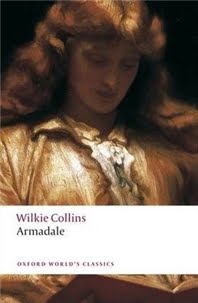
Armadale by Wilkie Collins
I think Wilkie Collins should be the patron saint of the Royal Mail and postal services in general. If his characters didn’t have use of the mail his whole oeuvre would be turned on its head and lots of villains would have gotten away with their crazy schemes. And it just so happens that all of the letter writing is one of my favorite things about Collins.
In Armadale there really isn’t one big mystery, but several with lots of twists and turns along the way. Would Allen Armadale ever find out about Allen Armadale? Would Lydia’s secret past come out? Would Lydia get away with her scheme? Would Miss Milroy be married before she graduates out of her training bra?
If you haven’t read Collins yet, you really are missing out. Six hundred pages fly by pretty quickly. Out of the three of his that I have read I would still rank The Woman in White as my favorite, Armadale now comes in second and No Name is a somewhat distant third. Many people tell me Moonstone is their favorite so the next time I am in the mood for a little Wilkie and cookies I will give that one a go.
Peter Camenzind by Hermann Hesse
I loved this novel. It isn’t necessarily a book that grabs one and says “I am great”, but there was much about it that really connected with me emotionally. Basically the story of Peter C’s childhood, university days, and career as writer/journalist. I was particularly struck by his university days. There was something about the way Hesse wrote about them that really transported me to my own undergraduate days. There was nothing superficially similar about our experiences, quite the opposite in fact. But there was a quality that deeply reminded me of something…something that I can’t really put my finger on, but pretty fundamental to that period of my life.
Beyond the emotional connection to my youth I was also struck by a scene where Peter’s attitude toward a disabled man was transformed and results in a deeply meaningful relationship between the two. It was unexpected and very touching. 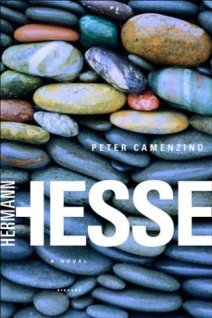
When I was in high school I first stumbled across Hermann Hesse’s name when I was reading some modern gay novel–I think it was Edmund White’s A Boy’s Own Story–in which is mentioned the sexually ambiguous quality of Hesse’s books. As a young village gay (hat tip to Little Britain) in the mid-1980s I was always looking for reading material that spoke to my still secret identity. I ended up reading a lot of Hesse and he does provide a lot of (platonic) male friendships that gave comfort to a sixteen year old hoping to have that kind of connection with another male. Well, except for the platonic part–I wanted romance not bromance.
The fact that most of Hesse’s protagonists are book-reading, school-loving, culture hounds also makes him a very attractive author for me. I really need to go back and re-read Narcissus and Goldmund which was a favorite of mine almost thirty years ago.
Overall, a fantastic way to cross 1904 off of my Century of Books list — and so much more modern than the books that surround it on the list.
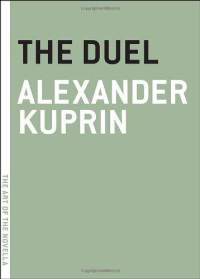
The Duel by Alexander Kuprin
For some reason this 300-something page book is part of Melville House Publishing’s Art of the Novella series. Perhaps because the publishers think that if the novel had been edited properly it would have been at least a hundred pages shorter. That explanation seems highly unlikely, but it does begin to desceibe how I felt about this book. It really didn’t need to be so long. But I guess in a world of Russian writing where the greats (like War and Peace) can clock in at 1,300 pages, maybe this does qualify as a novella. In any case, I was not a fan. It just seemed so of a piece. Soldier perpetually short of cash tries to continue to party and woo and control his temper. (And do married Russian women always act like they have no husband?) If it weren’t for the fact that this one knocked out 1905 on my A Century of Books list, I am not sure I would have bothered finishing.






















 hogglestock