Blogger 3M has issued a challenge to the book-reading blogosphere to read books from as many consecutive decades as possible by the end of the year. She is going to do 15 books/15 decades between January 1, 2007 and December 31, 2007. You can check out her By the Decade Reading Challenge and sign up by June 30, 2007 if you want to participate officially.
Author: Thomas
Somerset Maugham and my Addiction to Spreadsheets
Back in 1994, after getting through about 30 pages of W. Somerset Maugham’s novel Cakes and Ale, I realized that I had read it before. As a result, I began keeping a log of all of the books that I finished. I had a blank journal where I kept track of the title, author, and the date I finished each book. I loved watching the pages fill up and comparing what I was reading at the moment to what I finished a year earlier. Looking back at the titles on the list conjured up memories about where I was and what my life was like when I read a particular book. I finished Wally Lamb’s She’s Come Undone on a gorgeous sunny September afternoon in 1997 while lying on the grass in the Place des Vosges in Paris. Ann Patchett’s Bel Canto was finished on a frigid January day in Minneapolis while I was on winter break from graduate school. I finished Love in the Time of Cholera while I was lying in a hammock overlooking the Pacific on the island of Kaua’i. These are welcome associations I doubt I would make if it weren’t for the list.
Oh, the Buskers I’ve Known (or Death to the Peruvian Pan Flute Mafia)
A good busker can turn the crankiest of commuters (me) into the happiest of humans no matter what the time of day. A bad busker can drive me to fantasies of instrumenticide. For me the difference between a good busker and a bad busker is not always related to level of talent but has much more to do with the artistic honesty of the performer and the performance.
The worst offenders are those guys with the Peruvian pan flutes playing their crappy, amplified garbage. They generally wear some kind of “native” dress to fool the unknowing rube into thinking that their craft is somehow genuine. It may have been genuine at some point, but the fact that they seem to be in every city in the world leads one to believe that somewhere there is an academy churning out pan flute trios to terrorize the world and make big bucks for some musical pimp. (Kind of like the time Homer Simpson went to Krusty the Klown Clown College…) Since 1989, I have seen these groups all over Europe and North America. The bland homogeneous nature of their music makes them the McDonald’s of the busking world.
And like McDonald’s, their omnipresence displaces a wide variety of performers that are much more original and life affirming. The most egregious example of this I encountered here in Washington DC. At the Dupont Circle Farmer’s market a few years ago, there was a group of three junior high-aged kids playing their instruments. No amplifiers, no CDs to sell, just three kids making music and a little extra money. The following week the Peruvian pan flute mafia showed up with their overly loud amplified garbage and drowned the kids out.
The beauty of busking is that it showcases variety, creativity, and oftentimes musical expressions that have roots in the local area. I have heard buskers that have moved me to tears or made me smile uncontrollably.
Some of my favorites have included:
- an old blind woman in Lisbon singing traditional fado music in a haunting contralto with nothing but a triangle to accompany her
- an accordionist playing on a warm summer’s evening who made Washington DC feel like Paris on the Potomac
- two guys with acoustic guitars covering Indigo Girls tunes in Munich.
Some of the weirdest include a gorilla playing a trumpet on the London Underground and a bunch of shirtless guys banging on boxes singing “We’re Not Going to Take It”. Some of the more annoying ones (beside the pan flute mafia) include the guys who sit for hours playing the same monotonous rhythms on some old buckets (enough already, it was creative the first 82 times I heard it…) or the guy who regularly plays the trumpet really loudly on the street in DC.
I know not everyone feels the same way that I do. Most people really don’t care a whole lot about buskers. Recently the Washington Post did an experiment by placing the world famous virtuoso violinist Joshua Bell at a Metro stop in DC and no one paid much attention to him. I am not sure if I would have recognized Mr. Bell, but I do know that I would have stopped to put some money in his case. I alight from that very same Metro station every weekday and on the rare occasion that I hear a busker as I ascend the long escalator I am immediately drawn out of my morning funk. Unfortunately, I missed Mr. Bell’s appearance but I guess that means I have an extra dollar for the amateurs that are out there trying to make a buck by making me happy.
The Best Whoopie Pies in America!

Do you remember the episode of Seinfeld where Elaine opened a store that only sold muffin tops (leaving a mountain of muffin stumps that even the homeless wouldn’t eat)? Imagine if those muffin tops were made out of delicious moist chocolate cake and two of them were used to sandwich a thick layer of sweet, fluffy, creamy, whipped something. If you still can’t quite imagine it, think Hostess Suzy-Q—only infinitely better.
In late August 2004 I had my first Whoopie Pie when my partner took me to one of his favorite places on earth—Monhegan Island, Maine. The cat is already out of the bag about Monhegan, but it is a place that is so special that we try and play it down. We selfishly don’t want to increase the relatively modest tourist traffic that plies the island in the summer.
This past August we were again privileged to stay on Monhegan. Our lodging of choice is the lovely, unpretentious Monhegan House. With no television, cozy cotton bedspreads, and a large communal bathroom on the second floor, the Monhegan House is the perfect place to get away from metropolitan life (although you can’t swing a dead cat without hitting someone reading the New York Times). Aside from the sheer beauty of the island, we were most looking forward to the Whoopie Pies available at The Novelty attached to the back of the Monhegan House. The Novelty has the best Whoopie Pies available anywhere in Maine, perhaps the world.
Sue, The Novelty’s master baker, food goddess, and all around wonderful person makes a Whoopie Pie that will knock your socks off. Before we left Monhegan we told Sue we were going to need a half dozen of them to take home with us (why God did we only ask for six?). I emptied out my Dopp kit which has a rigid structure, trying to ensure that they would make the trip unharmed. We were momentarily worried that the TSA might think that the cream in the middle of the Whoopies constituted a gel that would be confiscated before we boarded our flight back to Washington. We vowed to eat every single one before passing through security if necessary. But then we thought that no Mainer, TSA agent or not, would be so cruel as to deprive us of our Whoopie Pies. Although we did imagine a scene that would involve having to bribe one of them with some of our WP booty.
We confirmed Sue’s Whoopie Pie prowess when we spent subsequent days traveling through Maine trying every WP we came across. None of them even came close. Even with my sweet tooth, these lesser WPs went unconsumed after the first bite. We don’t know Sue’s last name, but we do know that she makes the best Whoopie Pies anywhere. She also makes fantastic pizza and amazing oatmeal raisin cookies that have a bit of orange flavor and a hint of salt on the outside.
Although I love to bake, I am not going to attempt to recreate Sue’s WPs at home. No doubt there is more to Sue’s genius than a mere recipe.
The Best City in the USA
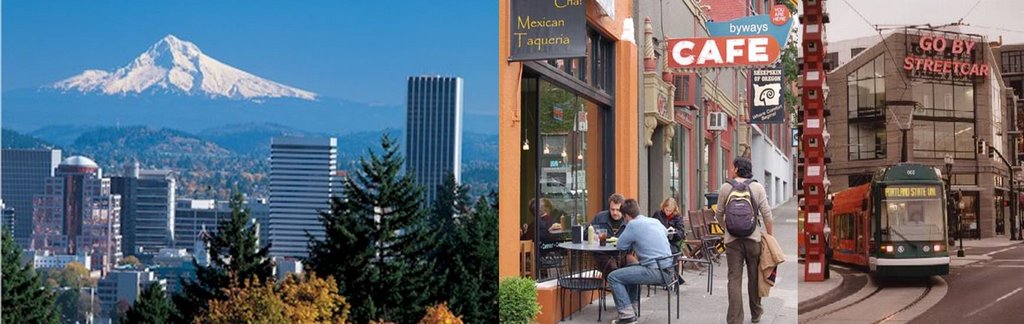
I have spent the better part of an hour trying to come up with just the right kind of clever angle to put on this post. Being an urban plannner, I feel I should present all kinds of deep nuance to explain my fascination with Portland, Oregon. But the bottom line is that no clever angle could really convey my enthusiasm for this rain-soaked gem in the Pacific Northwest.
As a planner, I have heard for years how Portland is the holy grail of city and regional planning in the United States. Not a day went by in graduate school that someone didn’t cheer for (or jeer at) Oregon’s 1970s groundbreaking law mandating urban growth boundaries for all its 241 urban areas. Finally, one weekend last November I had the chance to see the place for myself. It lived up to all of my expectations. The impact of the urban growth boundary is a wonderful, vibrant, walkable city. Even the constant rain and gray didn’t dampen my enthusiasm. I made a return trip a few weeks ago with my partner who is a big fan of the glamour and pace of much larger cities. I was a bit worried that he might find it all a little sleepy–that my urban planning lenses were making the place much more interesting than it really is. Much to my delight and surprise, he loved the place as much as I do. Perhaps the only real difference between us is that he would qualify “The Best City in America” by inserting the word small before city.
I don’t mind this because I never include New York City in any comparison, the place is just too damn fabulous and unique to be compared to any other–and once you remove New York from the discussion Portland rises right to the top of my list. I don’t think it is my urban planner’s bias that makes me feel like the success of Portland can actually be attributed to its wise land use. So often I go to American cities and just wish I could squeeze all the great things about the metro area into the core of the city and generously sprinkle it with housing, green space, services, and shopping (even for groceries). Imagine how much more dynamic Cleveland would be if all of those empty lots downtown contained Severance Hall, or the Cleveland Institute of Arts, or condos, or streetfront retail, or anything. Imagine how lively Minneapolis (or even Chicago) would be if its downtown loop had better integration between its housing, retail, and office districts. What if the fabulous Asian markets and restaurants in northern Virginia were in Washington DC’s Chinatown instead? What if Seattle didn’t have that hideous freeway separating its downtown from its residential neighborhoods? What if pigs could fly…?
Still, Portland is about more than its land use patterns, and it is certainly more than the sum of its parts. Its public transport is second to none, it has the legendary Powell’s books, it has a lively arts scene, great shopping, great restaurants, great neighborhoods, a great physical setting, great proximity to the mountains and some of the most amazing coastland in the world, and has beautiful agricultural lands within 10 miles of the city line. Its corporate architicture is mundane at best, but its smaller scale arhitecture is quite interesting and has a vernacular flair. In fact, the best thing about Portland is that it knows what it is and it does it really well. Even its provincialism is more like a contented self-awareness then the boosterism or narrow world view found in many other cities that seem to care more about being something they are not, rather then being happy with what they are.
In general I can find something to love in almost any city. It just so happens that Portland puts it all together in a way that makes it a very special place, and to me, the best city in the USA.
Four Women Who Rocked the 60s and Changed the World

The recent deaths of writer and urban planning iconoclast-turned-icon Jane Jacobs and feminist godmother Betty Friedan has me pondering how four women altered the contours of American life. I realize that the conversations I have had about these four women and this post are not particularly original thought, but bear repeating anyway. For one other discussion of the topic (minus Julia Child) see this article in the The Nation.
Jane Jacobs (1916-2006)
When journalist Jane Jacobs published The Death and Life of Great American Cities in 1961 she helped pull the urban planning profession from its darkest days of “slum” clearance and the worst excesses of 1950s urban renewal. Originally decried by planners of the day, Jacobs’ view of what constituted the components of a healthy neighborhood and a healthy city is the standard by which they are still judged today. Jacobs’ description of her Greenwich Village neighborhood and the ways in which it nurtured its residents provided a powerful example in favor of mixed-use, mixed-income, walkable neighborhoods that are the mantra of virtually every municipal planning department today. Like the other three women discussed here her work is not without its flaws. But, like the others, her clarion call woke up a sleeping nation and defined the terms of discussion for going on fifty years now.
Rachel Carson (1907-1964)
The marine biologist/zoologist, professor, and author’s 1962 book Silent Spring stood the US and the world on its ear about the connection between chemical pesticides and the degradation of the environment. Her book woke up America and kicked off the modern environmental movement. Of course she has her detractors even today (not being a scientist I am not going to try and wade through the arguments), but the fundamental truth is her work put environmental issues firmly on the policy table and in the minds of the American public.
Betty Friedan (1921-2006)
The 1963 publication of Betty Friedan’s The Feminine Mystique ushered in the modern feminist movement. Despite the book’s somewhat limited prospective of the white, college-educated, middle class woman (i.e., the typical Smith graduate), the notion that the sexist, conformist expectations of the times had trapped most women into a life of unfulfilled potential had near virtual universal application. (One could also argue that suburban sprawl contributed greatly to the imprisonment of women in the 1950s, but that is the topic for another post.) Friedan’s writing and her co-founding of the National Organization of Women (NOW) and National Association for the Repeal of Abortion Laws (NARAL) set the U.S. on an unstoppable path toward the as yet unfulfilled equality of women in America.
Julia Child (1912-2004)
When I was a child in the 1970s the whole family would gather around the TV on Sunday afternoons to watch The French Chef with Julia Child on PBS. We never made any of her recipes but we sure liked watching. Her show, which began in 1963, and her contribution to the popularization of TV cooking shows is not the most impressive change she brought to American life. Julia introduced Americans to recipes and ingredients that were anathema to the post-World War II salt, pepper, and paprika school of American cooking. When her show began Americans were gorging on TV dinners and canned vegetables. Thanks to Julia and others in her circle or under her influence, we have so much to choose from today when we head to the grocery store. Not all of the “food” created by scientists but those fabulous ingredients that no one had heard of thirty years ago.
For you big fans out there, you must check out her kitchen which on display at the Smithsonian in Washington DC. I’ve been there five times myself.
The Best Chip Dip Ever!

Porches are good places to eat chips and dip (and share recipes). This one goes out to my pals at the (in)famous Anarchists Book Club. To the rest of you, you really should try this dip, especially with summer picnic season upon us. It is so fresh and tasty. Oh, and for those of you suffering through the pain of Phase I of the South Beach Diet, make this with low fat cream cheese and dip your celery instead of chips. Tip o’the hat to Mary Feehan in Houston, Texas who originally got a version of this published in Gourmet magazine.
CREAMY PICO DE GALLO DIP
1 small tomato, coarsely chopped, about 2/3 cup
3/4 cup coarsely chopped fresh cilantro
1/3 cup coarsely chopped red onion (I always add a bit more)
2 tablespoons coarsely chopped pickled jalapenos
8 oz cream cheese softened (lowfat works quite well)
1/2 teaspoon salt (be careful, the chips add salt as well)
Pulse all but cream cheese and salt in food processor until everything is minced. Add cream cheese and pulse until everything is blended well together. Taste and then add salt accordingly. Put it all in a serving bowl, cover, chill for about one hour until slightly thickened.
Serve with chips.
Nancy Pearl: Too Good to Miss

Living in Washington, DC I run into a lot of smart people who read a lot, but few of them seem to be doing it for fun. Until recently I didn’t really know many people who I could trust for book recommendations. I would rely on lists like the Modern Library’s 100 Best Novels of the 20th Century and the Booker Prize winners and other lists I could get my hands on. That is until I met Nancy Pearl. Well, I didn’t actually meet her, but I wish I had.
The first time I heard of librarian Nancy Pearl was in a blurb in The New Yorker where they described her new librarian action figure that came complete with genuine shushing action capabilities. Besides being known for her work in the Seattle Library System and her book reviews on Seattle’s NPR affiliate, Pearl has written two of the most important books in my library: Book Lust and More Book Lust. Essentially each book is a series of annotated lists of books that she has enjoyed. Let me tell you, Pearl has enjoyed a lot books, both fiction and non-fiction, and the breadth of her reading interests seems limitless.
Each chapter is organized around a theme. Some of them are appropriately predictable like “Small-Town Life” and “World War I Fiction”. Others are somewhat quirkier like “Sex and the Single Reader”, “Nagging Mothers, Crying Children” and one solely on U.S. government documents that are worth a read.
My favorite chapters however, are the ones where Pearl picks an author that she thinks is just “Too Good to Miss” giving an overview of what the author is all about, some of Pearl’s favorite titles by that author, and in some cases a list of all of the author’s works. Some of these chosen authors I was already aware of like Iris Murdoch, Ian McEwan, and Carol Shields. But others were completely new to me including reporter turned novelist Ward Just. His subject matter tends to focus on fascinating depictions of some element of politic life and his prose is flawless. Without being pedantic or preachy or even very political, Just has written novels about an Ambassador with a wayward terrorist son, a political operative in Chicago, an American saboteur in Vietnam, a Washington political dynasty and many others. Needless to say I am glad Pearl gave me the heads up.
For those of you looking for something good to read check out Nancy Pearl for ideas. For those of you who aren’t looking for something to read: Why not? You should be. Unless of course you already have a book in your hand. In any case Nancy Pearl really is too good to miss.
The Inaugural Post

[4/25/15: This was the inaugural post for my blog from 2006 to April 2015 called My Porch.]
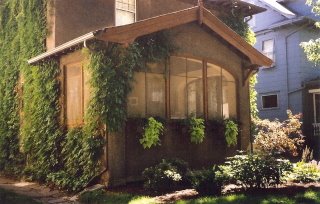
In thinking about the kind of online discussion I wanted to initiate, I kept coming back to the idea of a place where people would engage each other. A place that would serve as an antidote to banal office conversation and the anonymous interactions that characterize most of our lives. Despite the absence of a physical location, the internet has done more to connect people with each other than anything else since television and suburban sprawl first disconnected us back in the 20th century. Sprinkled among the wasteland of post-World War II development, one can still find places like this–town squares, corner stores, and front porches–they just don’t get used much anymore.
Although I may end up ranting and raving from time to time, I want My Porch to be a place where the basis for every discussion is respect. I want us to disagree and argue like mad, but to remember above all that we are neighbors and have to live with each other. (Assuming someone other than me actually reads this…)
Topics of particular interest to me that will be featured in posts to come include, politics, urban planning, travel, TV (the great and the trashy), classical music, art, books, and about a million other things.
I take my inspiration from Samuel Barber’s (1910-1981) nostalgically beautiful Knoxville Summer of 1915.
“…It has become that time of evening when people sit on their porches, rocking gently and talking gently and watching the street and the standing up into their sphere of possession of the trees, of birds’ hung havens, hangars. People go by; things go by…”
Based on the opening section of James Agee’s A Death in the Family (which I haven’t read), Barber’s piece for soprano and orchestra opens in a rather peaceful, lilting way that never fails to remind me of some happy, yet undefined and fleeting moment from my childhood in small town Minnesota. A feeling rekindled during my graduate school sojourn in Ithaca, New York from 2000-2002. You know the feeling, one of those summer evenings at twilight with warm gentle breezes and crickets.
If you think I am living in a fantasy world you are partly right. It is a fantasy about living in a place where people care for other people and the world around them, and live honest, positive, engaged lives. It might actually be a great place. Let’s give it a whirl.