2022/2023 Season Post IV: Works by American Composers

[This year I collected and analyzed the subscription concert programming for 51 orchestras in the U.S. and Canada. This is a pretty big expansion from my effort last year when I just looked at the ‘top’ 19 orchestras in the U.S. You can see last year’s posts here and here.]

Sigh. Along with works by BIPOC composers and women composers, the percentage of programming devoted to U.S. composers also declined from 21/22 to 22/23. Last season it was 23% of all programming. Just by looking at the top 20 orchestras, you sure can’t blame the expanded data pool, given that 15 of the top 20 are smaller bands that weren’t part of last years list, and, as you will see further down this post, some of the big guys failed in a really spectacular way.

some observations

First off, I didn’t think it fair to keep the six Canadian orchestras in the mix, so all of the dashboard calculations were based only on the 45 U.S. orchestras in my dataset. Here are some other thoughts:

  • How about the Albany Symphony? It’s number one in American music, it was number one in music by BIPOC composers, and it was number nine in music by women composers. They certainly seem like a shoo-in to come up as the orchestra with the most diverse programming.
  • The little guys in general. What is it about smaller markets that seem to respond better to more diverse programming in general, and in this case, a warm embrace of American music. This year the lowest percentage to make it into the top 20 was 22.6%. Last year that score would have gotten you into the top 10.
  • Only one of the small guys, Phoenix, relies a bit too much on the BBC (Bernstein, Barber, Copland) to earn their spot on the list. Not that there is anything wrong with any of those composers, they just tend to be the ones that crop up when someone says American composer..
  • It does appear that orchestras are using their American programming to come up with a fair chunk of their programming of both BIPOC and women composers. Perhaps it means that the US is a hotbed for encouraging BIPOC and women composers, or perhaps, more cynically, orchestras don’t want to chip away at the market share they give dead, white, European guys.
time to clean house

For each of the categories I have looked at so far, it’s clear that some orchestras could really benefit by looking somewhere other than Europe for their programming and their leadership. I’m tired of the cult of the composer and the maestro. Many of these idolized men are brilliant, but hype begets hype, and I find knee-jerk veneration of all things European in the musical context really boring. (And trust me I LOVE Europe–even the UK bit.)

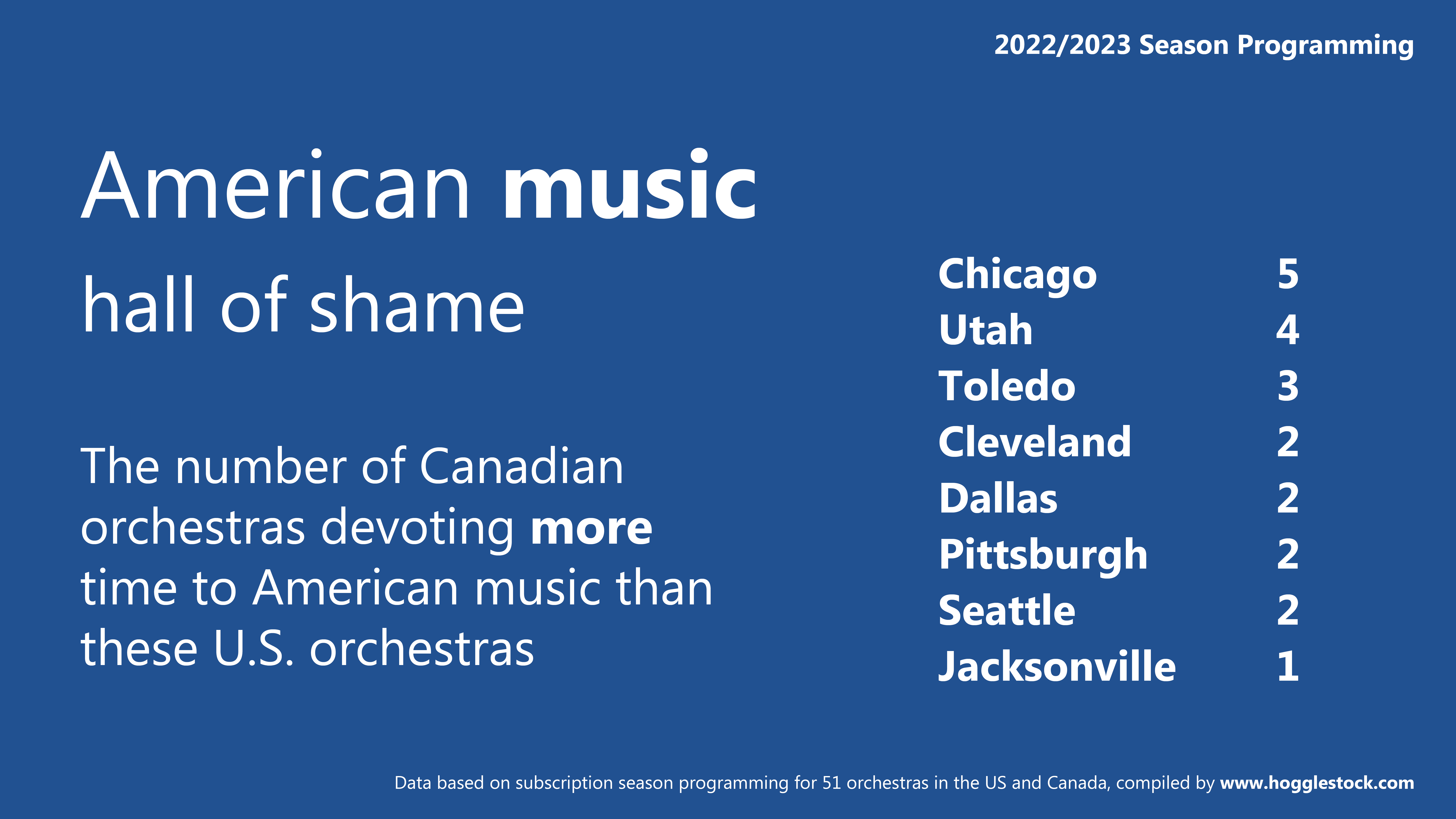
And this is no more evident than in the hall of shame. These fine orchestras are devoting less of their seasons to U.S. American composers than the Canadians. What’s up with that?
canadian music

Since I added in six Canadian orchestras this season, I would be a true chauvinist if I didn’t say something about music by Canadian composers. Nine U.S. orchestras have all programmed one piece by Canadian composers (Albany, Boston, Cleveland, Kansas City, Milwaukee, NSO, New York, Pittsburgh, and Toledo). Among the Canadian orchestras, Orchestre Métropolitain leads the pack with 26.8% of their programming devoted to Canadian composers, then Calgary at 20%, Toronto at 13.9%, Vancouver 9%, Montréal 6.7%, and Edmonton 6.3%.

With Samy Moussa and Iman Habibi leading the pack with five pieces each, other Canadian composers who get multiple plays next season include, Alan Gordon Bell, Vivian Fung, Stewart Goodyear, and Rita Ueda. I must admit Samy Moussa is the only one I knew prior to crunching this data. I had come across and fell in love with a recording by the Orchestre symphonique de Montréal of his work for organ and orchestra, A Globe Itself Infolding. One of the few pieces in the repertoire that effectively integrates organ into the orchestral texture. It also got a play at the Proms a season or two ago.

the whole list and nothing but the list
This includes all 51 orchestras so the total won’t match the dashboard above

2022/2023 Season Post III: Works by Women Composers

[This year I collected and analyzed the subscription concert programming for 51 orchestras in the U.S. and Canada. This is a pretty big expansion from my effort last year when I just looked at the ‘top’ 19 orchestras in the U.S. You can see last year’s posts here and here.]

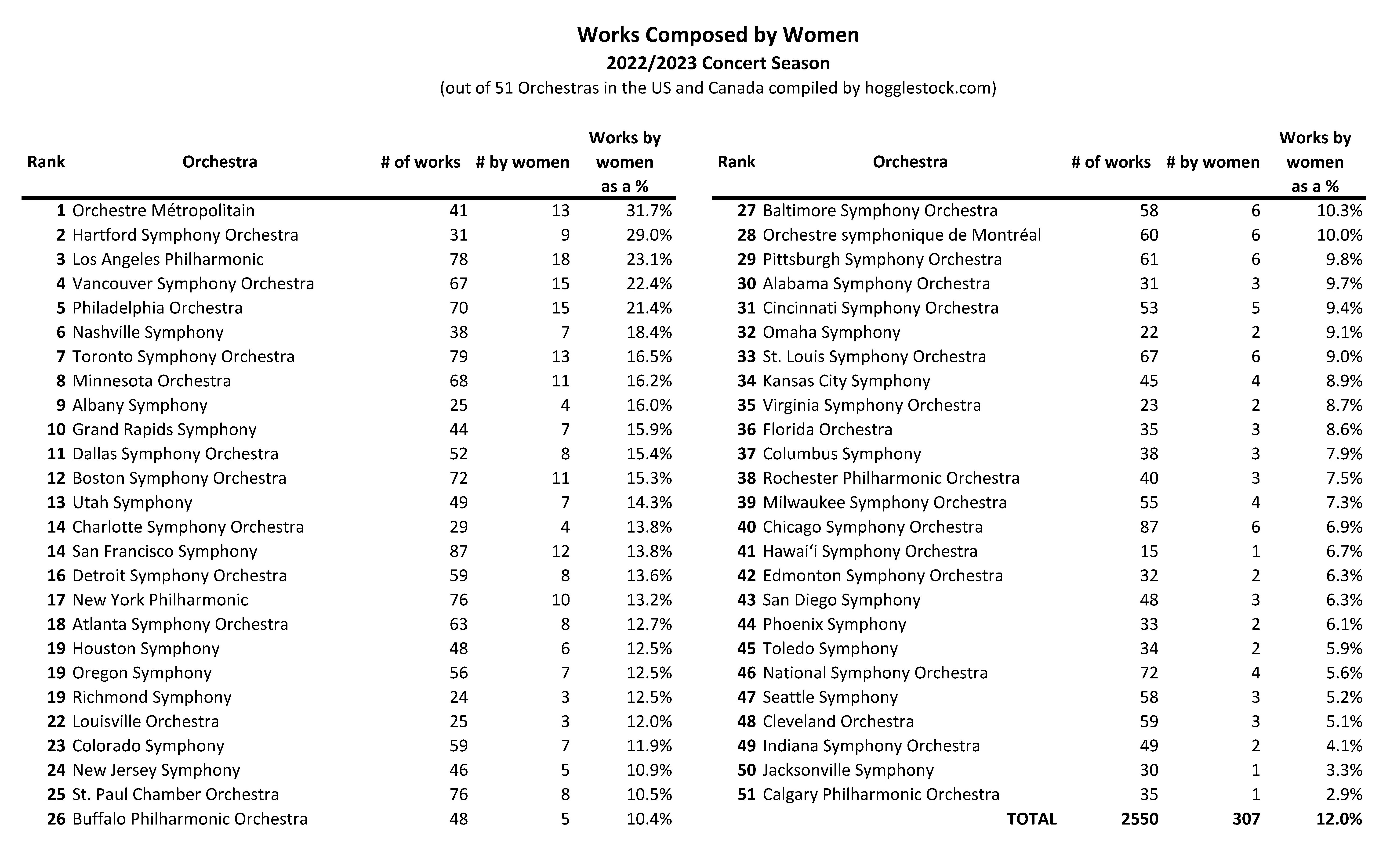
Sadly, the shaky commitment orchestras have to diversity and variety that I mentioned in my post on BIPOC composers, continues in the wrong direction, with the percent of works by women composers dipping ever so slightly from 12.1% in 21/22 to 12.0% in 22/23. It is one area, however, were the ‘top’ 19 orchestras look slightly better than they did last year. If I isolate results for those 19 orchestras their total is 12.4% which is slightly higher than their overall percentage last season as well as better than the larger group this year.

more women get a chance

Although the overall percent is pretty dismal, one improvement over last season is that the pool of women composers being programmed almost doubled from 57 to 99. Granted there are an additional 1,445 total works programmed this season over last, but I like what it suggests about the industry recognizing the breadth of women composers to choose from.

men are programming women?

I guess a bit of good news is that men are programming women? Women only lead three of the orchestras in the top 21 (Hartford, Atlanta, and Richmond), so it appears like men are being reasonable? Women music directors don’t appear to be skewing programming towards women composers. And I was all set to make an anecdotal observation about women guest conductors and the degree to which they do or don’t program women–partially influenced by what I ‘felt’ as I did the data entry over the course of several months, and partly based on this list of the top 21 you see above. But then I thought, hold on fella, you have the data, crunch the damn numbers. So I did. And it tells a different story.

some other thoughts
  • Orchestre Métropolitain continues to show leadership in programing coming in at #1 after a strong showing in pieces by BIPOC composers. (And Orchestre symphonique de Montréal does much better after their dismal showing in pieces by BIPOC composers.)
  • Overall the ‘big’ orchestras do better as a percentage compared to the overall field than they did with BIPOC composers.
  • Orchestra-rich Ohio continues to be bad at diversity with their four orchestras coming in at 31, 37, 45, and 48. And I have to say another word about how bad Cleveland is. No women on the podium, 49th in BIPOC programming and 48th in works by women. Seriously. It’s time for Franz Welser-Möst to be shown the door.
  • Michigan appears to be the anti-Ohio with both the Grand Rapid Symphony and the Detroit Symphony Orchestra placing quite well in both programming works by women and works by BIPOC composers. And Detroit has one of the most exciting bits of programming next season with a February concert that ends with Dora Pejačević’s symphony. I’ll be making my way to snowy Detroit for that concert.
the whole list

2022/2023 Season Post II: Works by BIPOC Composers

[This year I collected and analyzed the subscription concert programming for 51 orchestras in the U.S. and Canada. This is a pretty big expansion from my effort last year when I just looked at the ‘top’ 19 orchestras in the U.S. You can see last year’s posts here and here.]

In the wake of the pandemic, I thought that pent-up demand by orchestra audiences would mean that orchestras would feel a bit more free to program works by women, and BIPOC composers, and living composers, and American composers, etc. In general, I thought they might take a moment to cast a broader net for the sake of both diversity and variety. When the 21/22 seasons came out, they kind of seemed more diverse than pre-pandemic seasons, but without a data baseline, it was all just conjecture on my part.

And now we arrive at 22/23. Surely the diversity/variety trend would continue. More new, more different, more diverse, etc. Right?

And then I crunched the numbers. They went backwards. So I guess we got a tiny bit of pent-up courage in 21/22 and then a backslide for 22/23. Not a huge one, mind you, but the trend is going in the wrong direction.

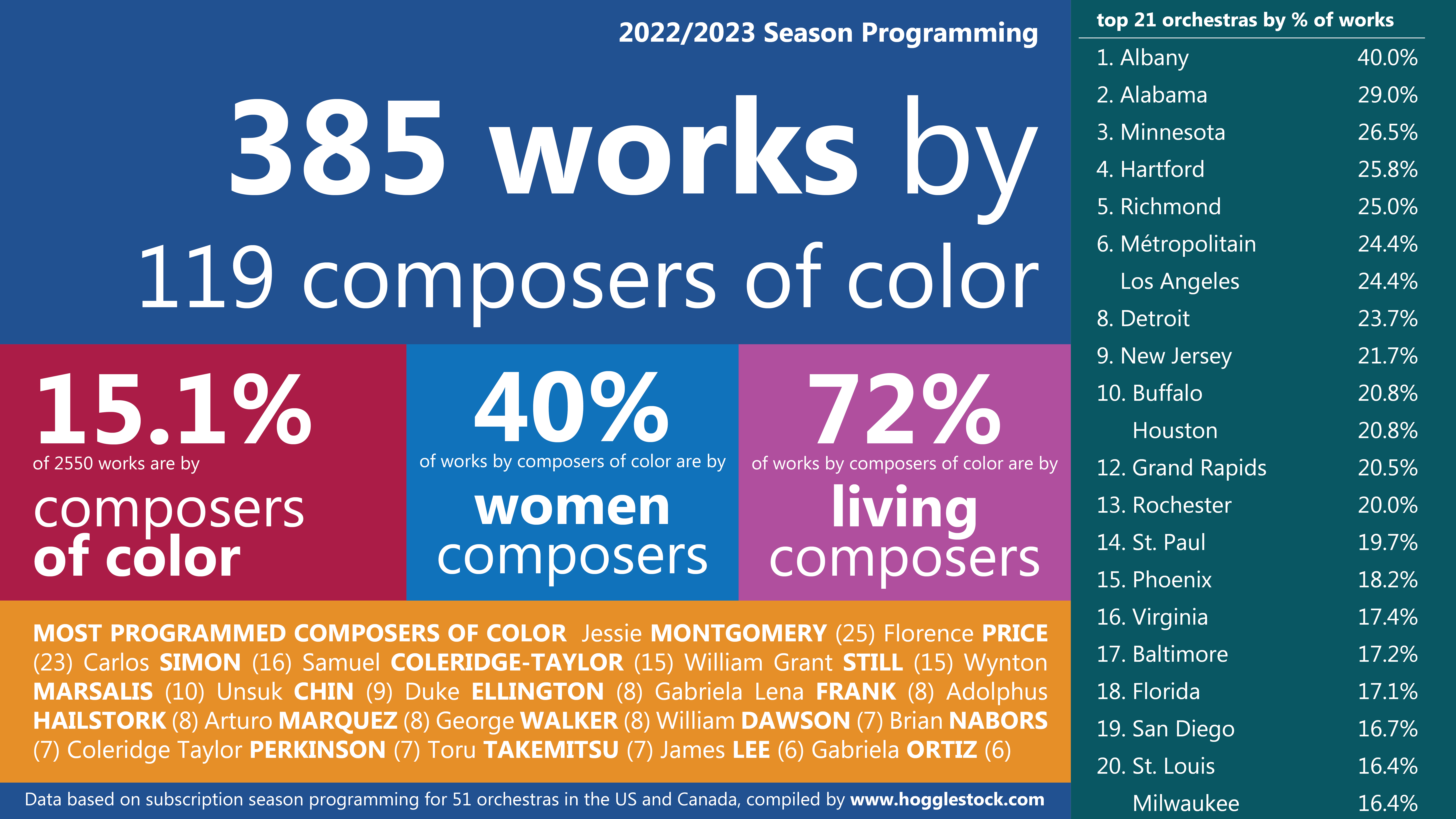
So let’s look at the dashboard:

programs are whiter next season

Whether you think 15.1% is a decent number or not, it’s not as good as last season when the number was 16%. But wait! you might say, this year you included so many more orchestras, they no doubt are the reason for the decline. But you’d be wrong. When I pull out the data for the 19 orchestras I analyzed last year, they are only only at 13.6%–down almost 3% compared to their programming last season. And only six of the 19 from last year even made it into the top 21.

size doesn’t matter

Prior to crunching the numbers for 22/23, I would have thought the bigger and more northern the orchestra the better they would do on the diversity front. The northern part largely holds up, with only six of the 21 being in the south (with LA and Phoenix not counting as north or south). As for size, it’s maybe half and half between the small and large. (But I’m not about to tell you which orchestra is which. After all, when we are talking about size, it’s really some subjective combination of annual budget, size of the market, and/or the number of concerts presented, not necessarily the number of players in any given group–and I chose not to define actual metrics.)

leadership does matter

Leadership clearly matters when it comes to programming a diverse season. But it would take a deeper dive to understand what leadership means. To what degree is it the music director, the orchestra itself, the staff, the board? There doesn’t appear to be a correlation between ethnicity, gender, or nationality. If there is any trend it might be that youth matters. While only one or two of the music directors for the top 21 are truly young, most of them trend younger. But then again, in the field of conducting the retirement age is about 160, so young is a relative term.

some other thoughts

Looking at the whole list, a few observations pop into my head.

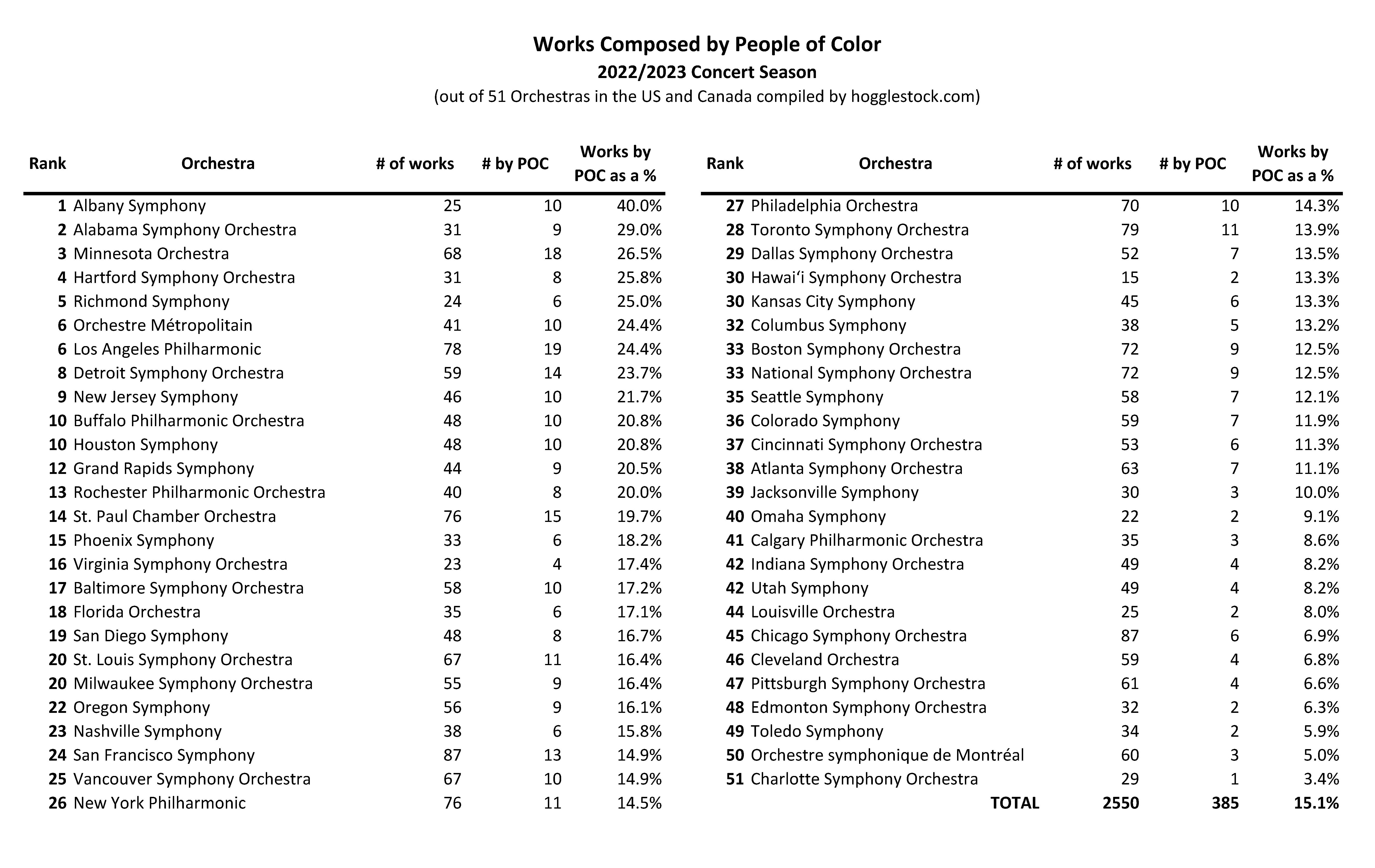
  • I think praise for Albany is due. A small organization, with a limited season, and a small budget and they managed to program 40% of their season with works by people of color. Almost every concert has at least one work by a POC, and they have one program that is entirely by composers of color. That is some serious leadership. (They also have some very interesting venues and a very compelling discography.)
  • It seems like there could be a reverse correlation between endowment size and willingness to program diverse seasons. I would have thought it was the other way around with the poor guys needing to max-out ticket sales with the same old fucking chestnuts…oh wait, that’s Chicago.
  • Alabama at #2 is a bit of a surprise to my northern bubble bias. Their numbers are boosted by hometown composer Brian Nabors who has three works programmed, including a premiere of a concerto for a Hammond organ. You heard me. This might be the single piece out of 2,550 that I am most interested to hear. I just don’t know if the timing of it will make it possible for me to fly to Birmingham to hear it.
  • Both of my home state bands fare well despite being a very white place. Minnesota at #3 and St. Paul at #14.
  • What’s going on in Ohio? On one hand, they have four (!) orchestras that make it onto the list, which is amazing, and they must have an orchestra per capita rate that is the highest in the nation. On the other hand they rank at 32, 37, 46, and 49. Can the venerable Cleveland Orchestra really do no better than a measly four works out of 59?
  • Montréal is a battle between a dinosaur and whatever the opposite of a dinosaur is. They have the Orchestre Métropolitain coming in at #6, but they also have the Orchestre symphonique de Montréal which is at a pitiful #50. The former is led by Yannick Nézet-Séguin who also does a somewhat respectable job with the Philadelphia Orchestra’s spot at #27. The OSM, on the other hand, is led by Rafael Payare who has done a much better job with #19 San Diego. Perhaps the poor showing in Montréal has more to do with his music directorship there not becoming full-time until 2022.
  • Let’s marvel at how Richmond, the capital of the Confederacy, comes in at #5, and the tidewater-based Virginia Orchestra comes in at #16. Meanwhile the NSO, which serves not only the bluest part of northern Virginia–not to mention DC, a majority minority city–only manages to tie for #33.
  • Kudos are probably due to JoAnn Falletta who keeps Buffalo highly relevant at #10 and who probably left a legacy at #16 Virginia.
  • In general, the Canadians need to up their game with only two orchestras in the upper half.