My Wall of Humanity

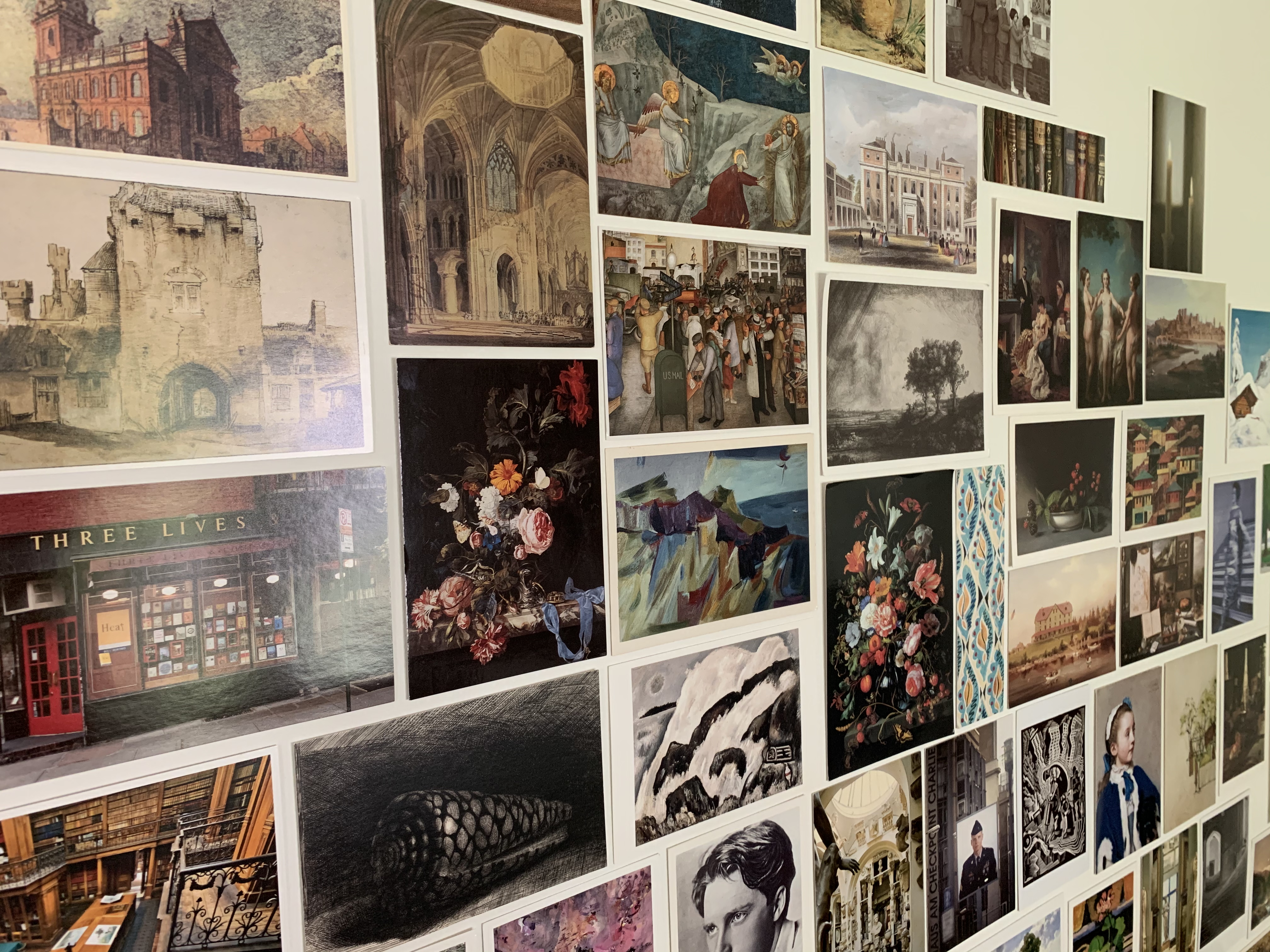
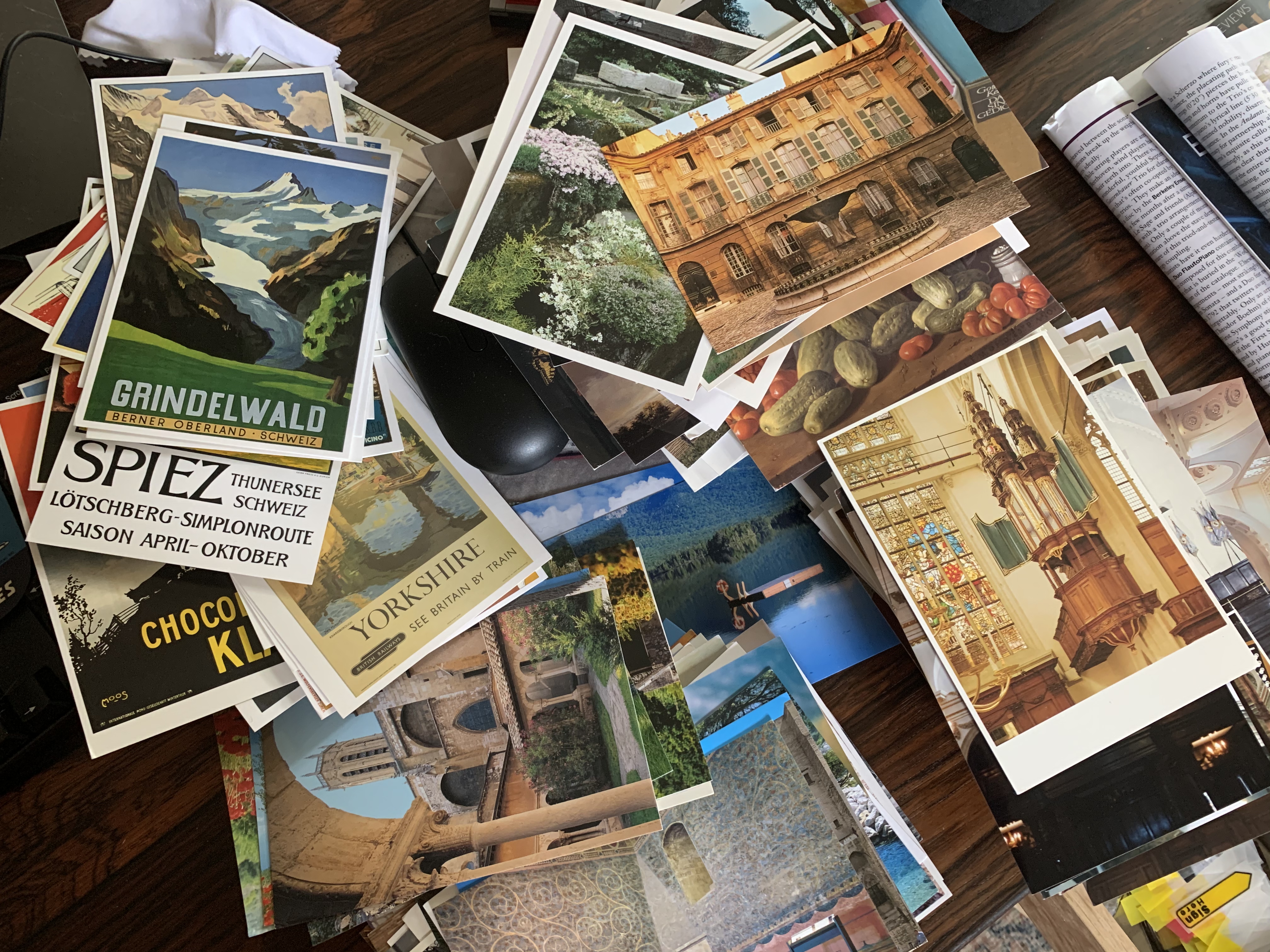
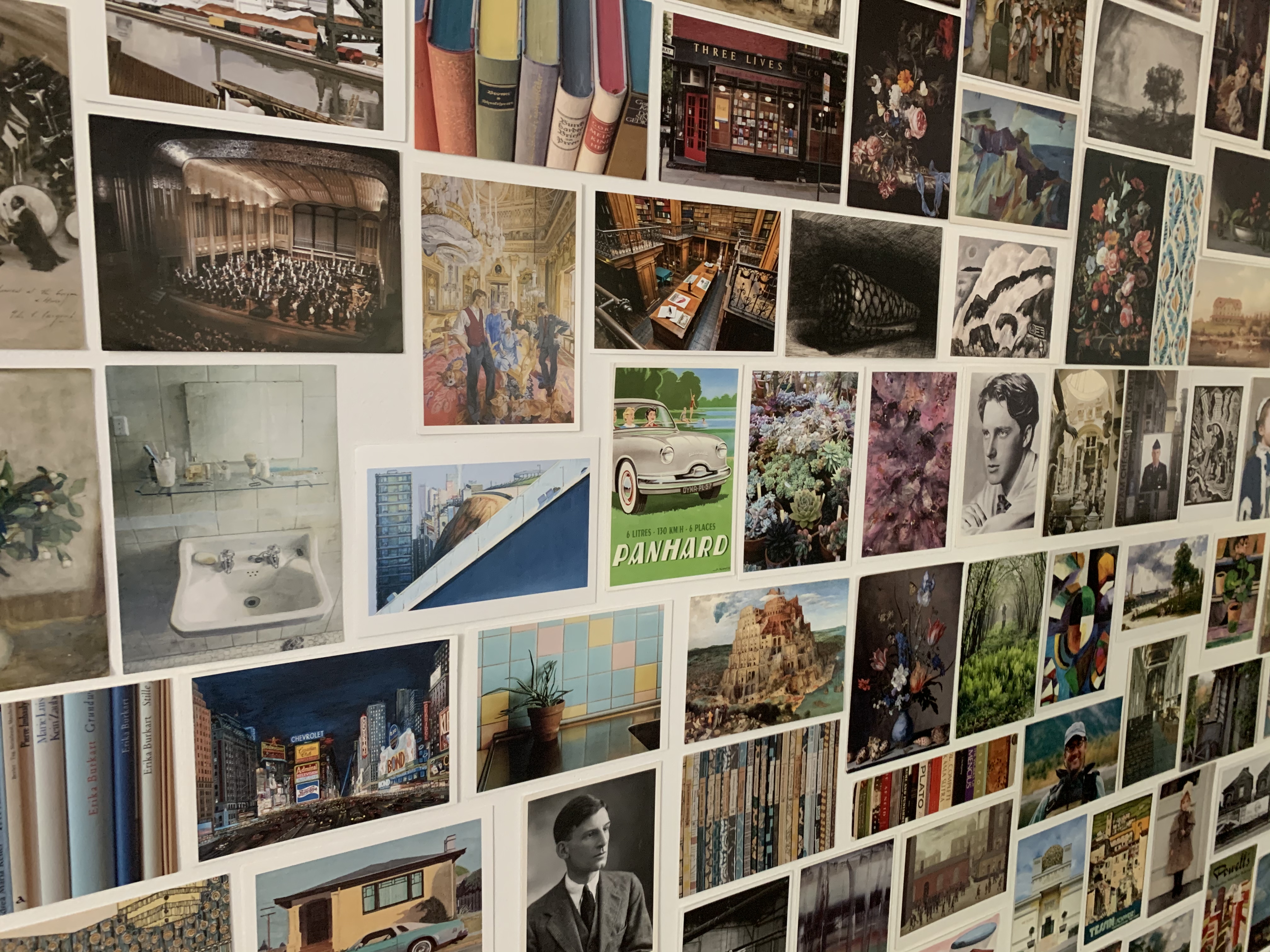
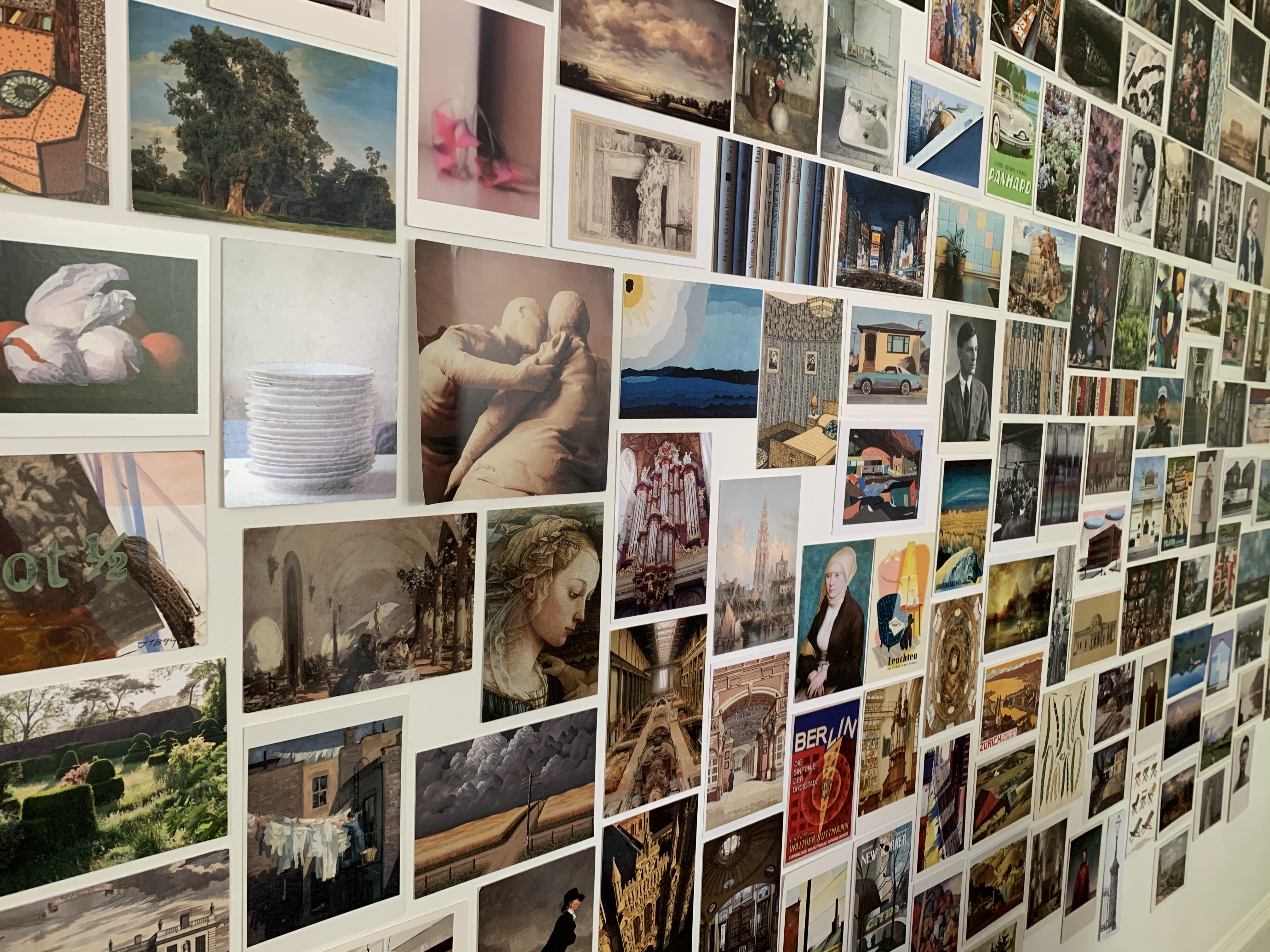
Recently I cleaned out a box and came across hundreds of postcards that I had purchased over the years. I guess the more adult I become, the more real art I hang, the less likely I am to plaster my walls with the detritus of my travel. Since we did our house renovation in 2014 there has been this very large wall in my office just waiting for something. What I wanted was a giant bulletin board that I could litter with all sorts of things that I like to look at. Photos, postcards, pages from magazines, spent tickets from trips. But do you know how hard that is for someone who is a totally incapable of DIY projects? And who do you call to source an appropriate material and install it? And what would a 12-foot long bulletin board look like? Anything shorter would look ridiculous.

The wall has been a big white whale–albeit a lovely one in Benjamin Moore Moonlight White (OC-125)–for about five years. But five months of working from home had me hankering for something to look at. So when I came across the box of postcards I thought I would do something about it.

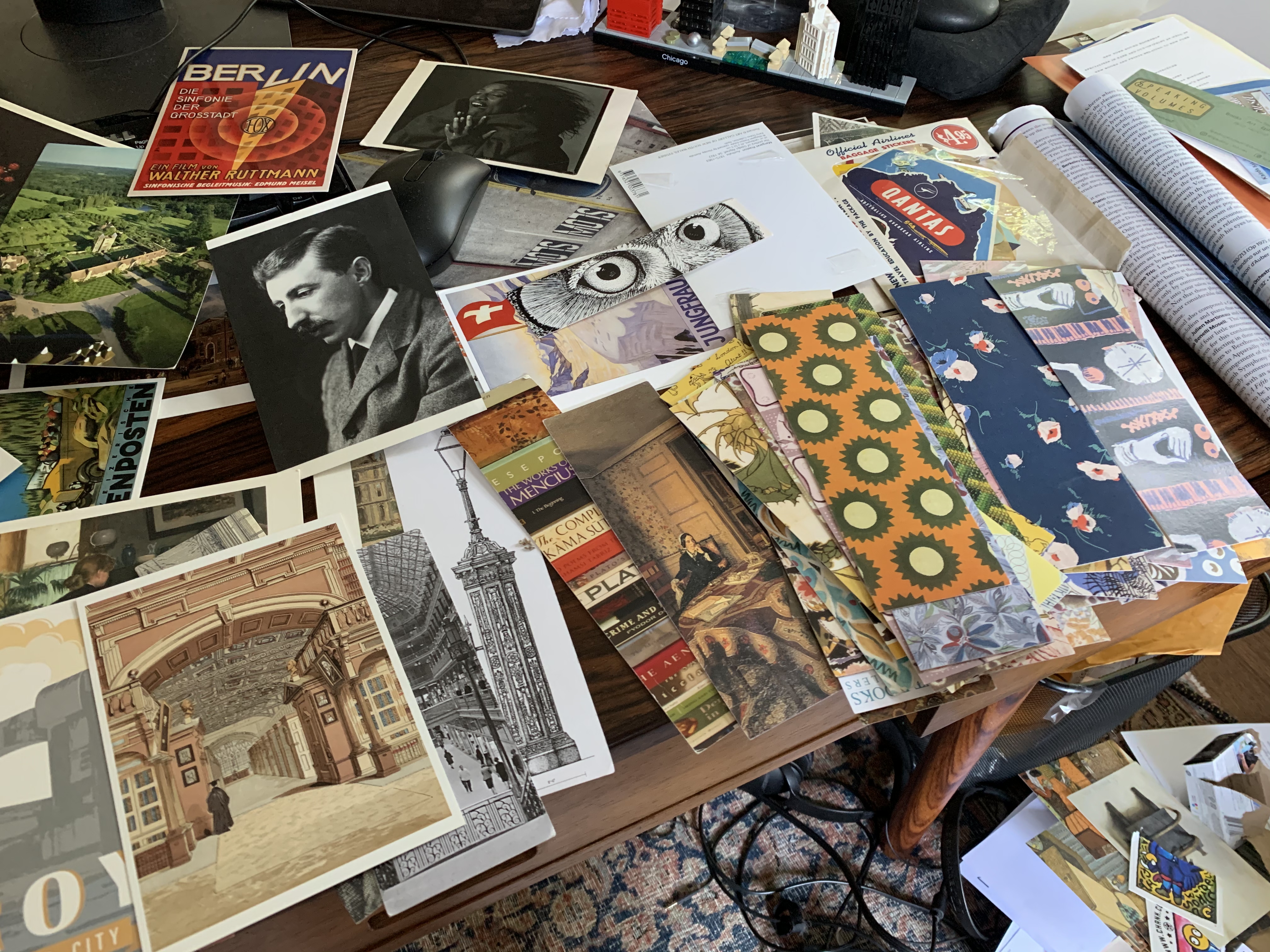
Not all postcards are the same size and so I ended up with some funky narrow spaces that needed to be filled. So I ended up using some bookmarks here and there.

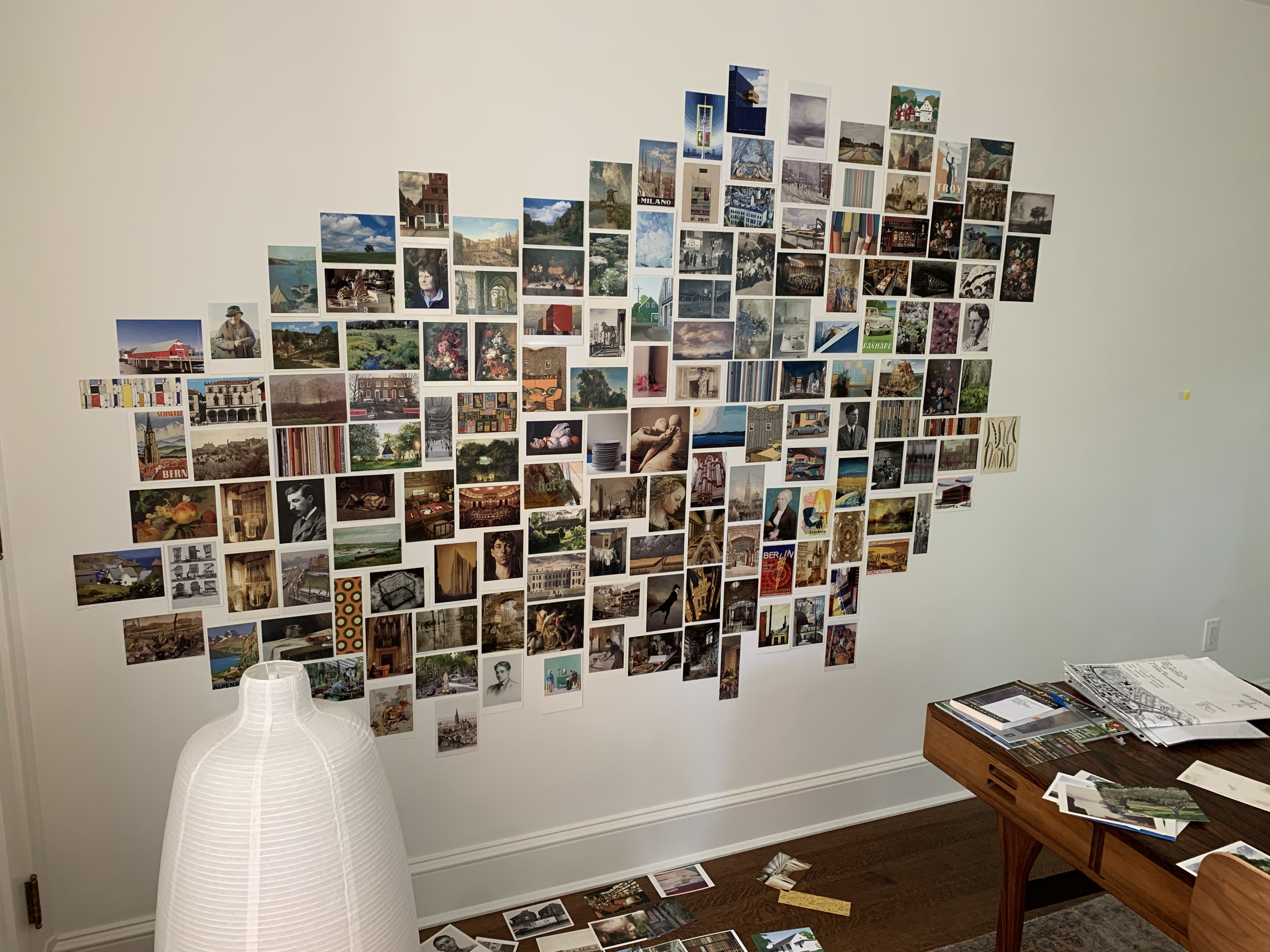
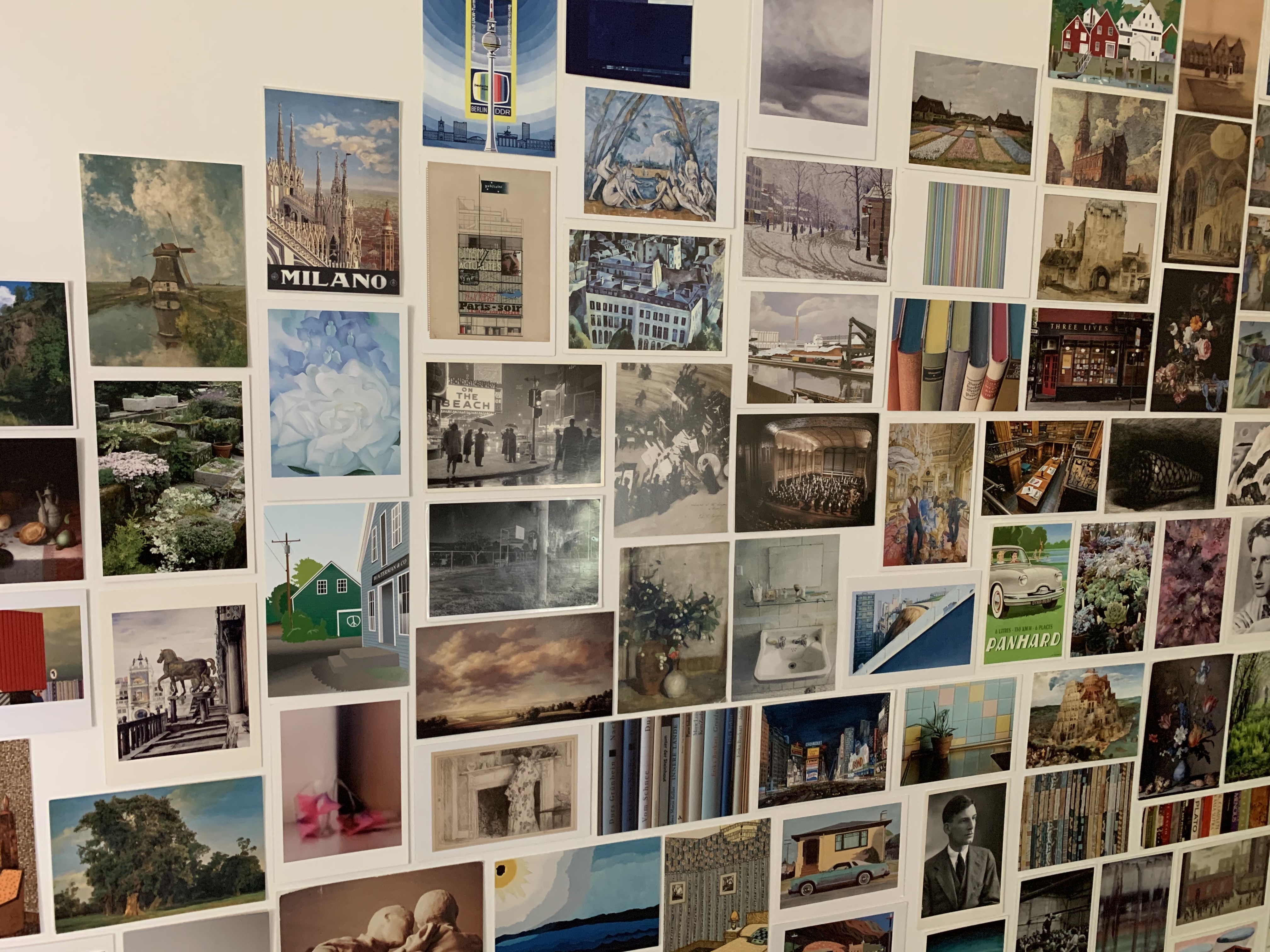
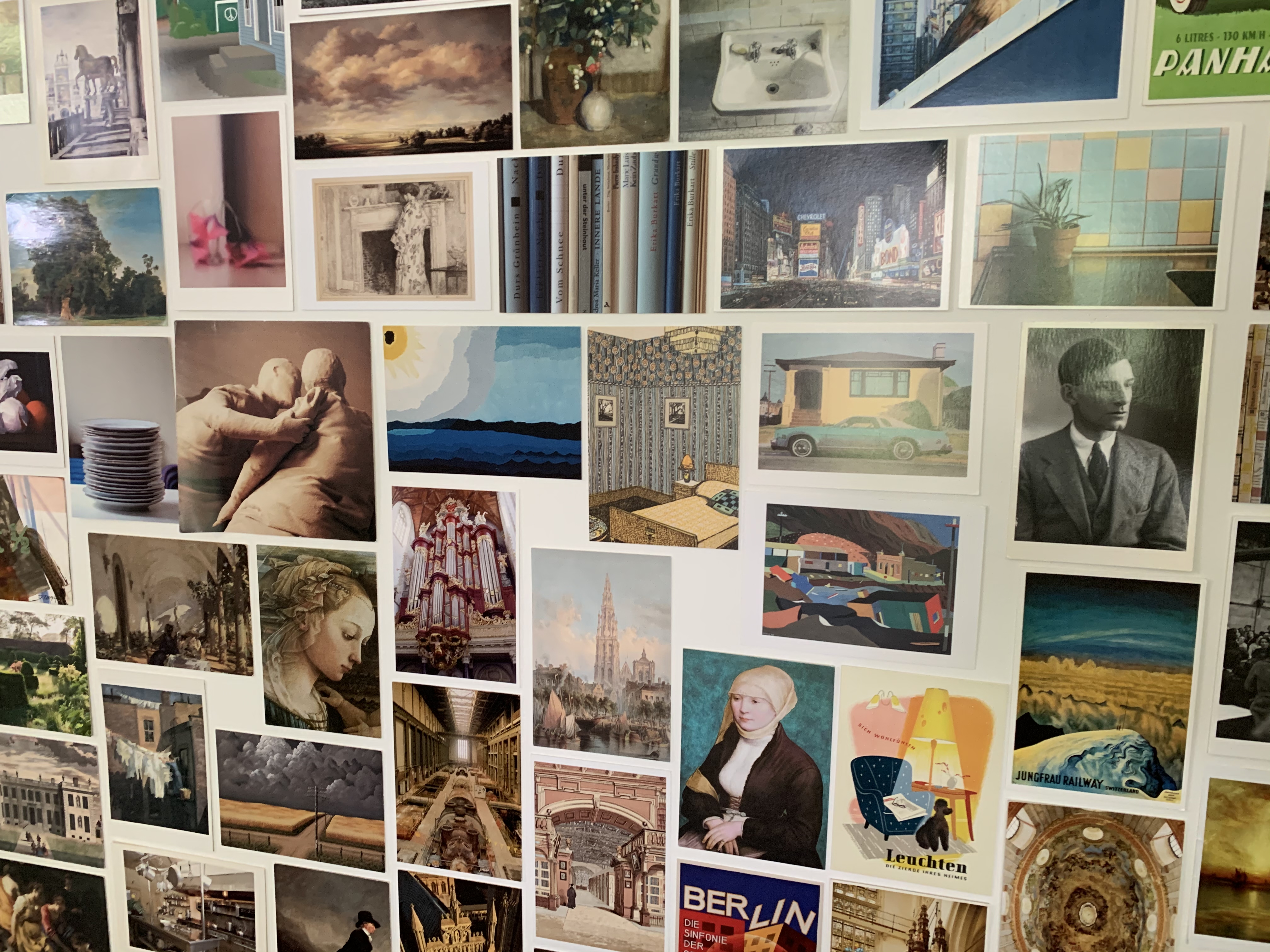
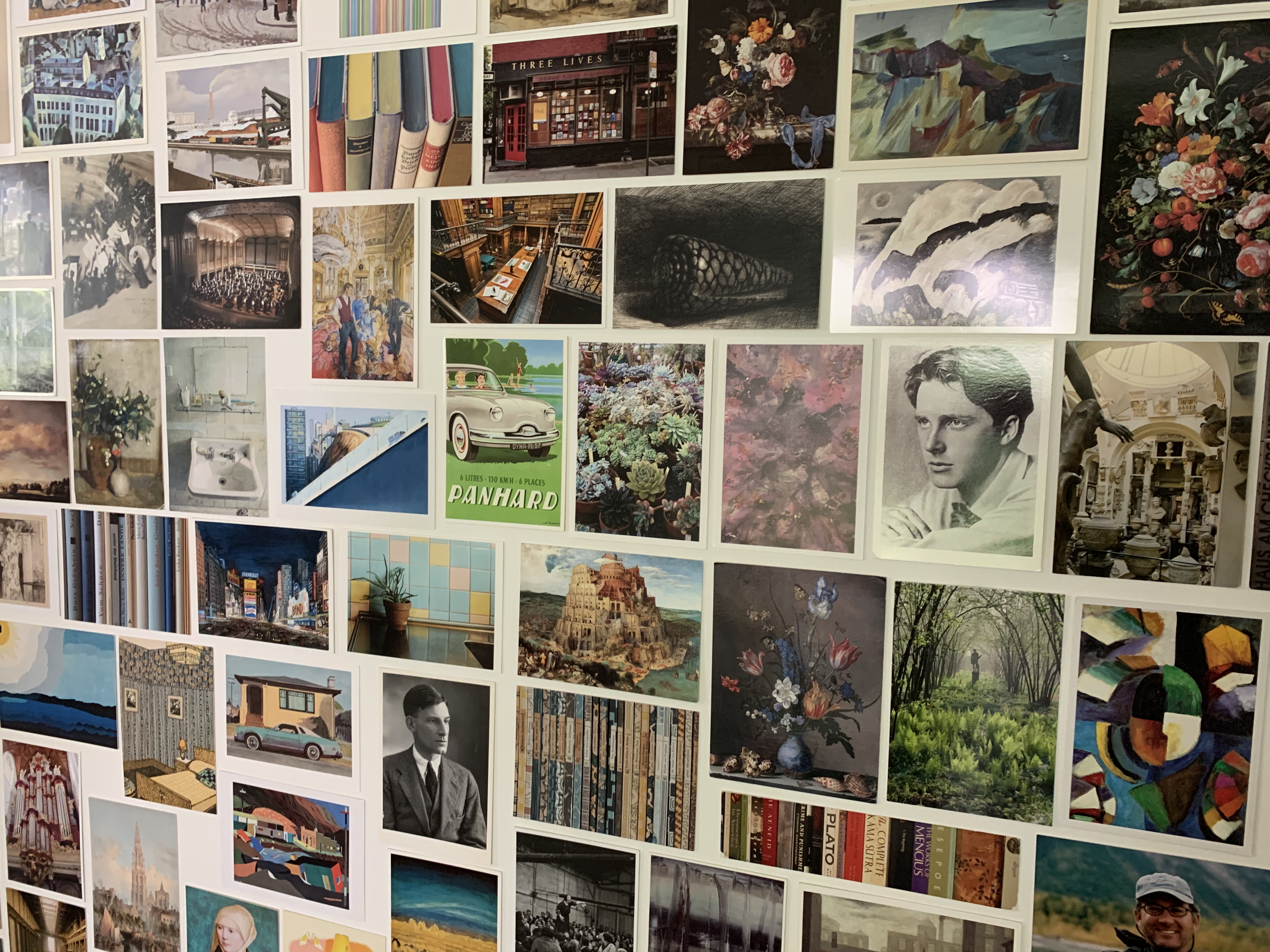
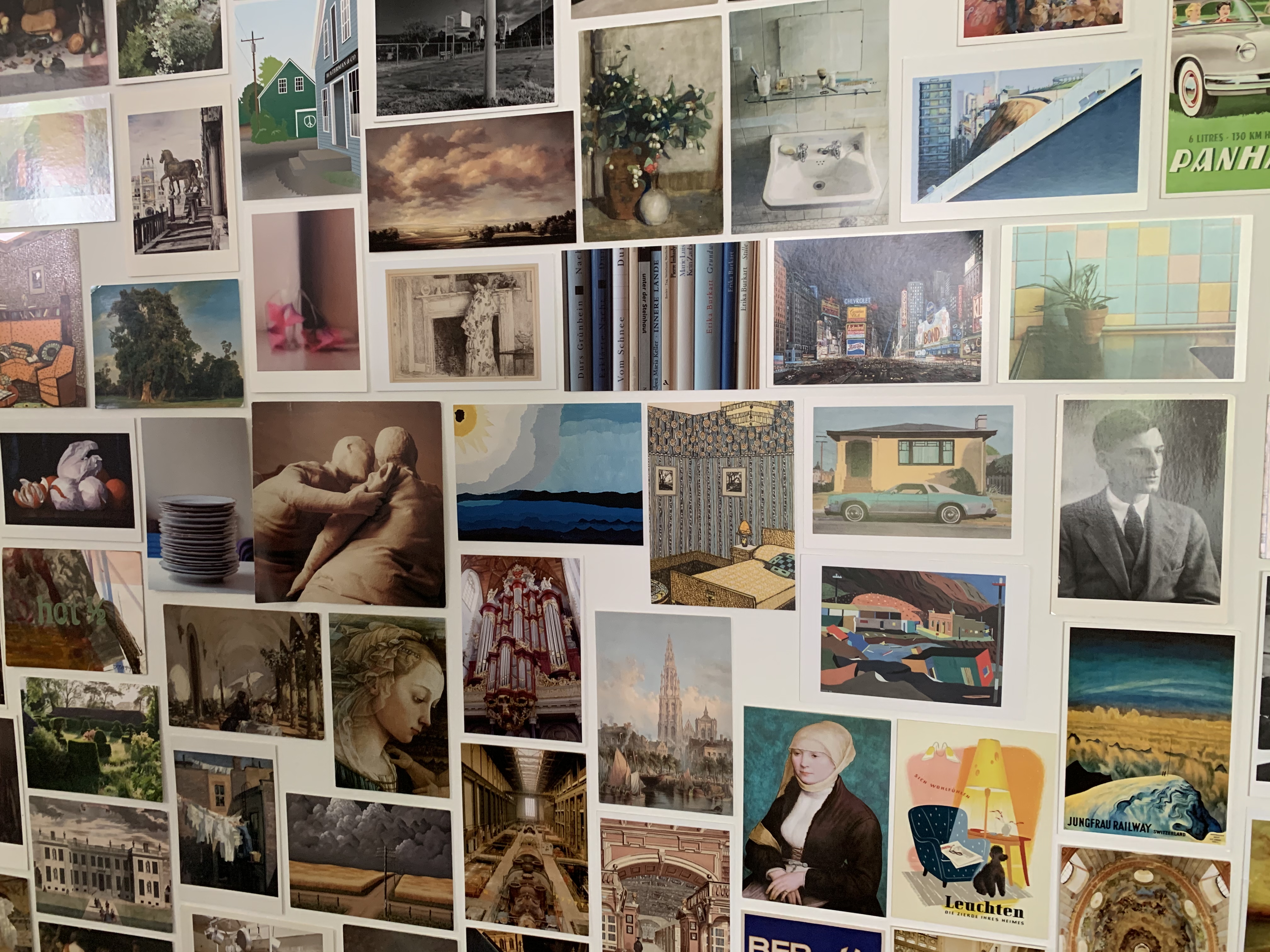
Turns out putting up this wall of post cards led to an extremely satisfying result. It is amazing to be reminded of beautiful, interesting things I saw in the before times. As I put them up I began to think about how they represented the best humanity can put forward. The antidote to the dark days we are living through. I am also delighted on a daily basis looking over at the wall and getting lost in one of them images.

Someday we’ll be back out there again. Someday.

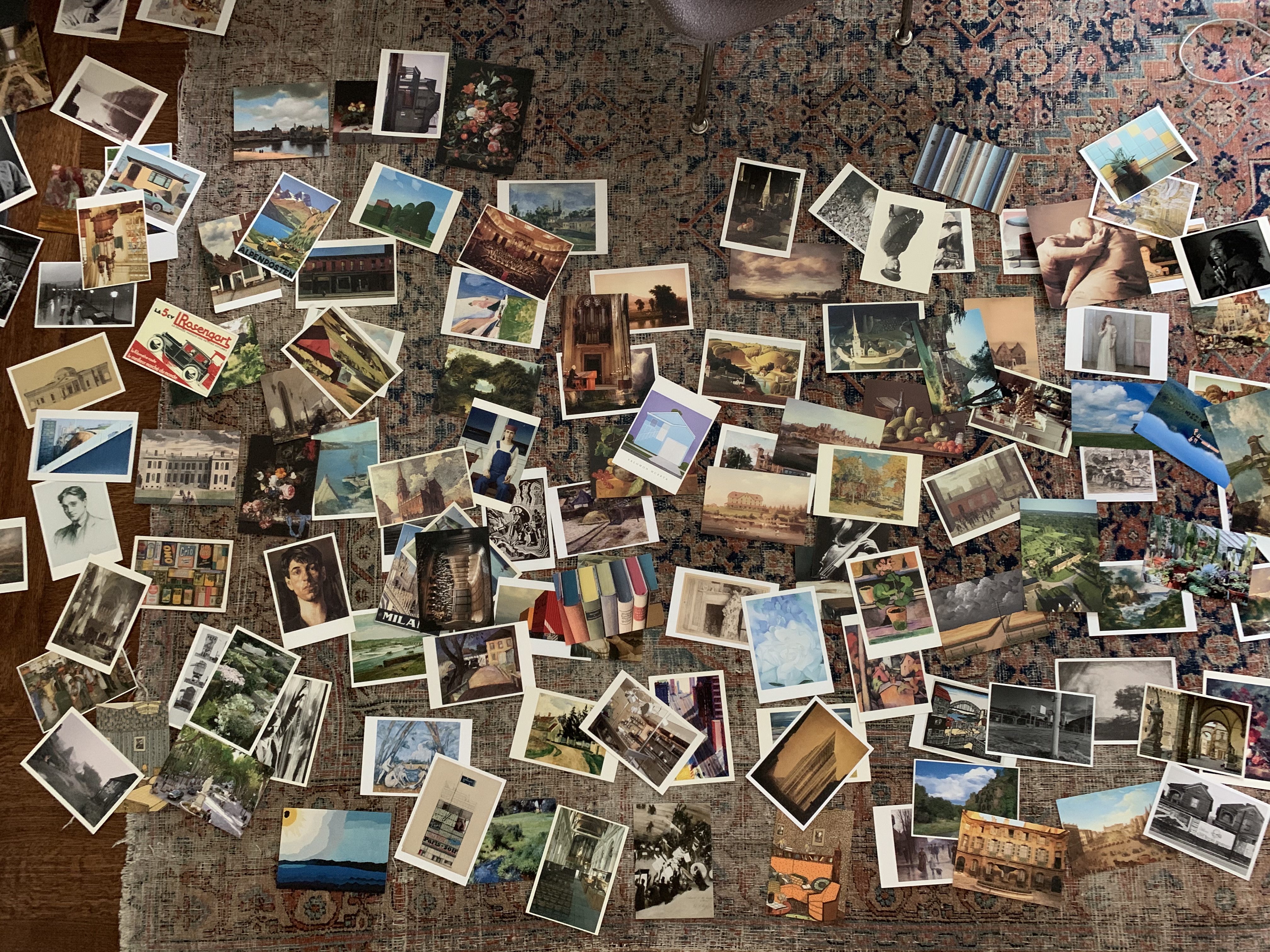
I thought maybe I would arrange them on the floor first.
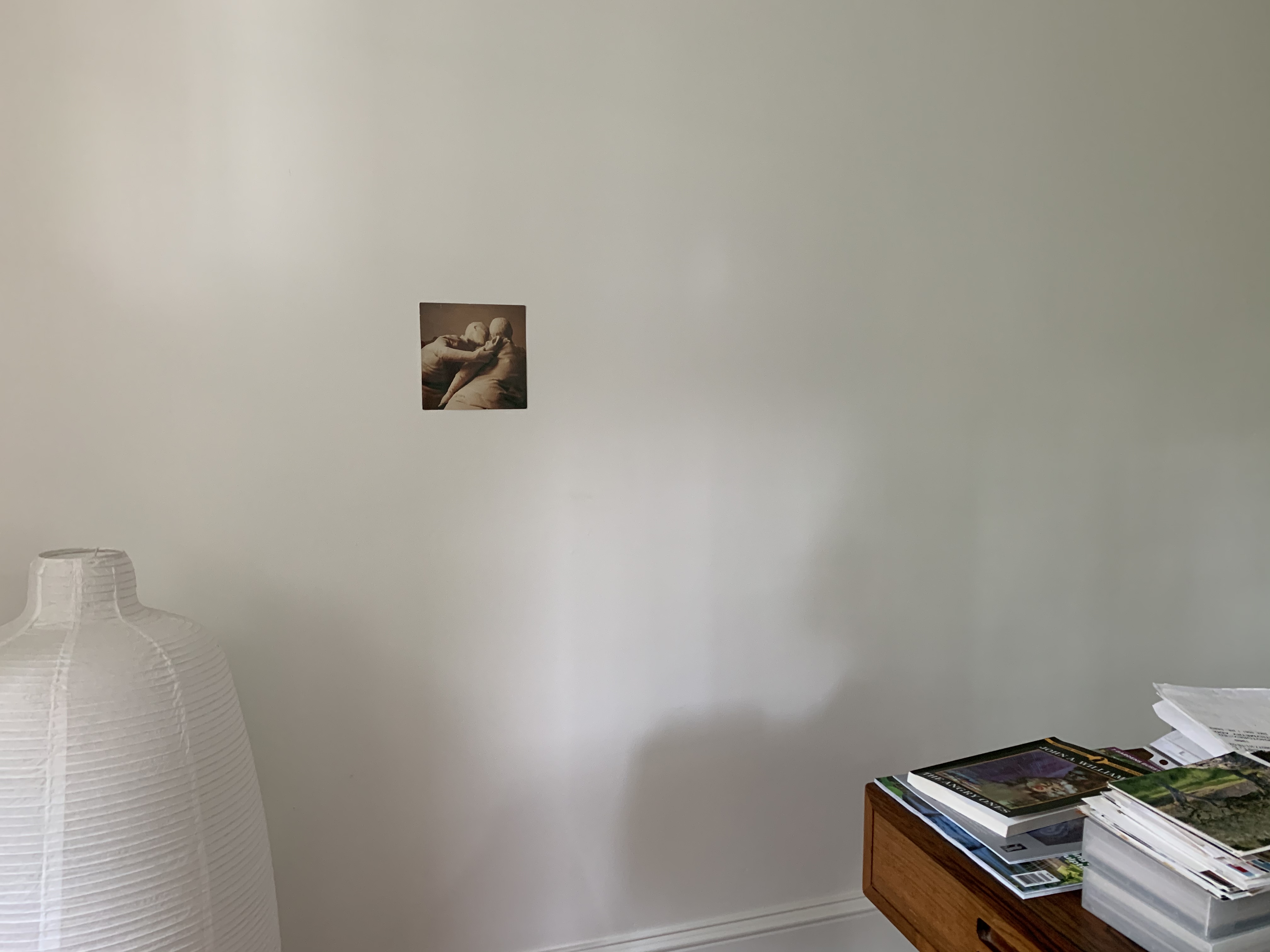
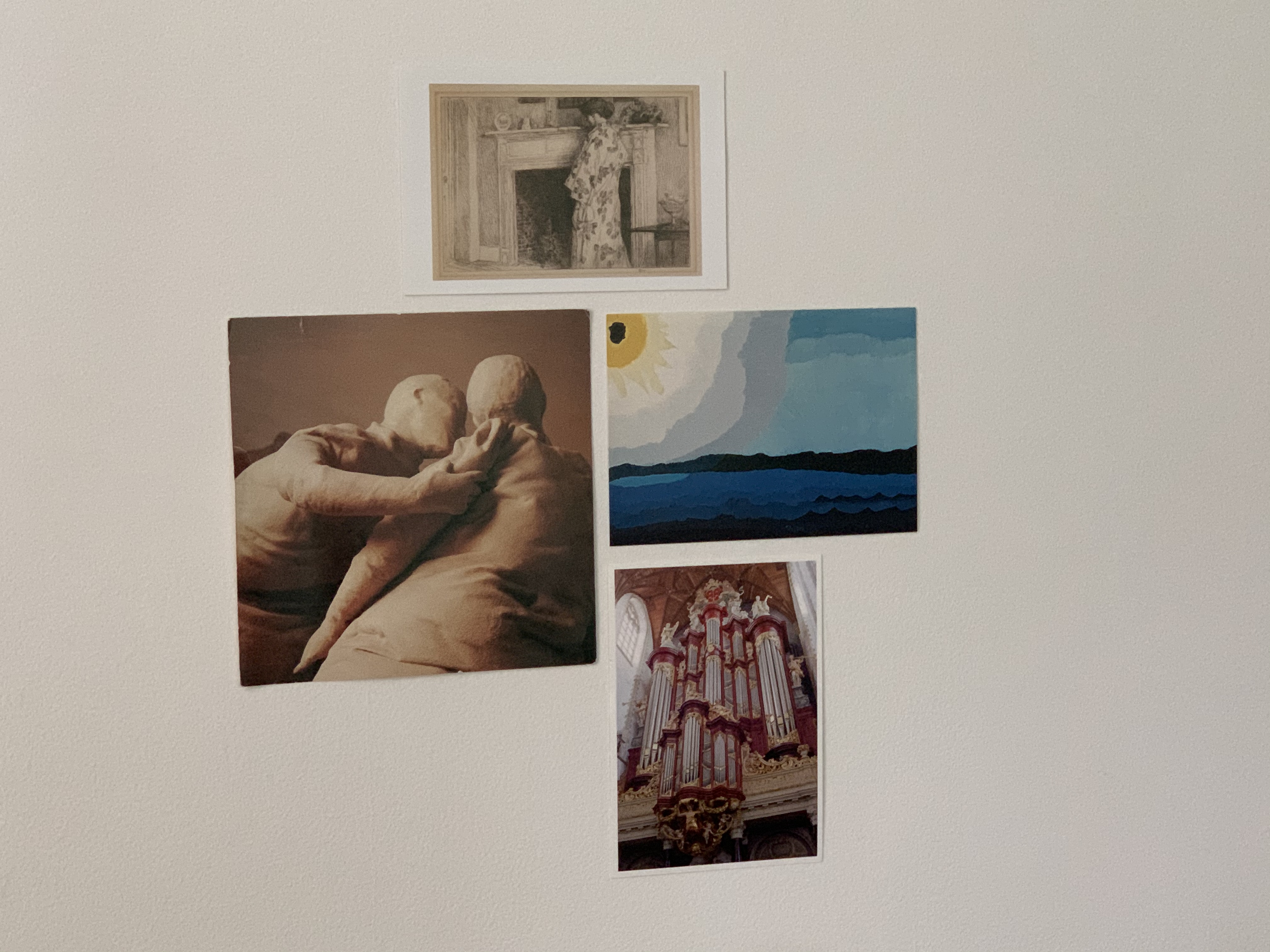
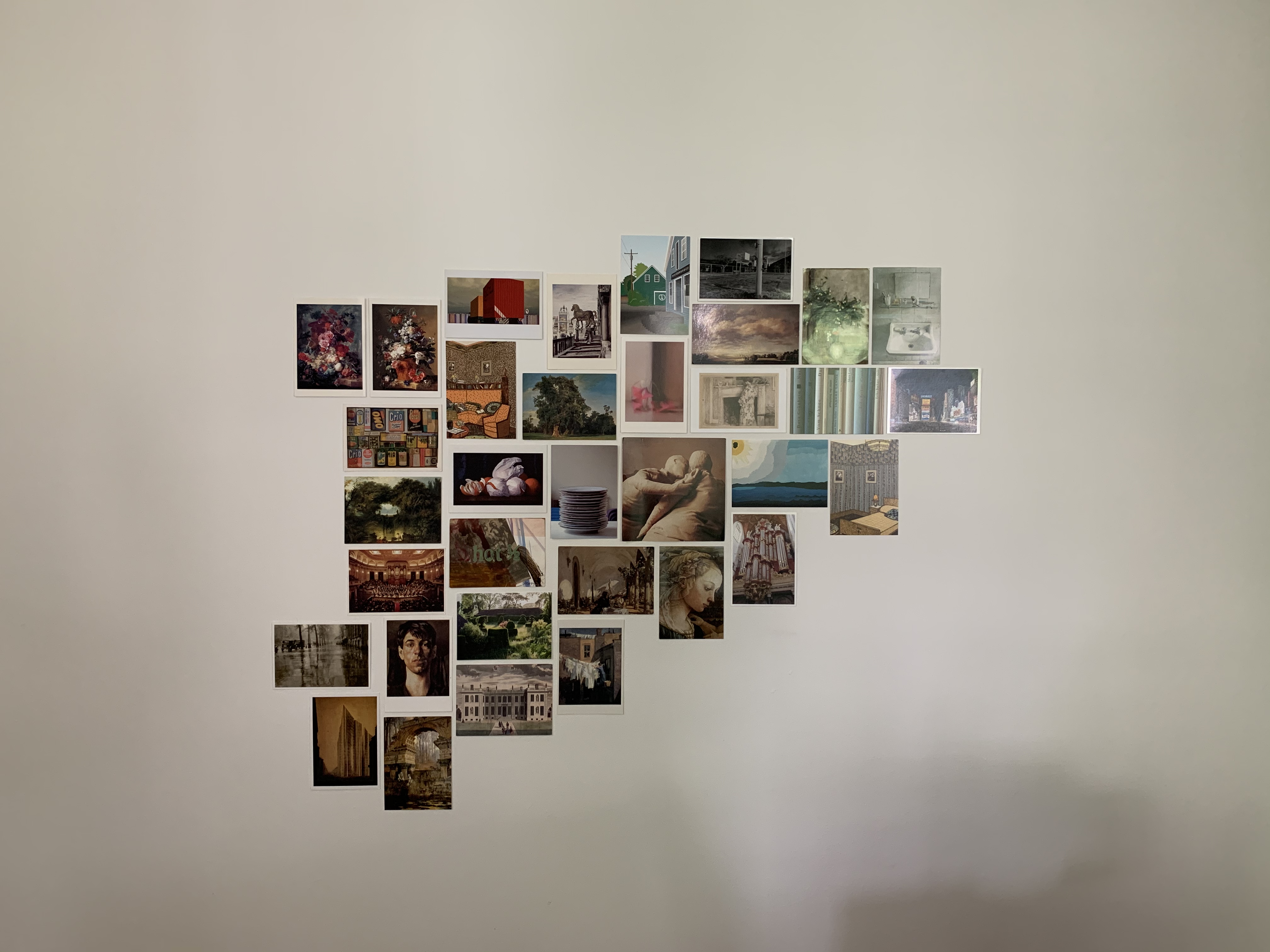
I had to start somewhere. One of my favorite sculptures here in DC in front of the Hirshhorn is “Last Conversation Piece” by Juan Muñoz. When we were in Nîmes at the Maison Carree about 10 years ago I came across this postcard by him with similar figures.  I used a level to set the first one, but then it seemed maybe the room wasn’t level or my eyes were funky. I stopped using the level after about three postcards.
I kind of liked how the drawing worked nicely with the sepia tone of the Muñoz piece. But then I thought some color was needed so I added the Arthur Dove. And then the pipe organ started to make take things in other directions.


I thought I might try and do a random approach so I sorted postcards by landscape and portrait orientation. I was going to blindly grab one from one of the piles based on what orientation I needed. I did it once. And true to form, I didn’t agree what the universe chose for me. So that process ended right there.
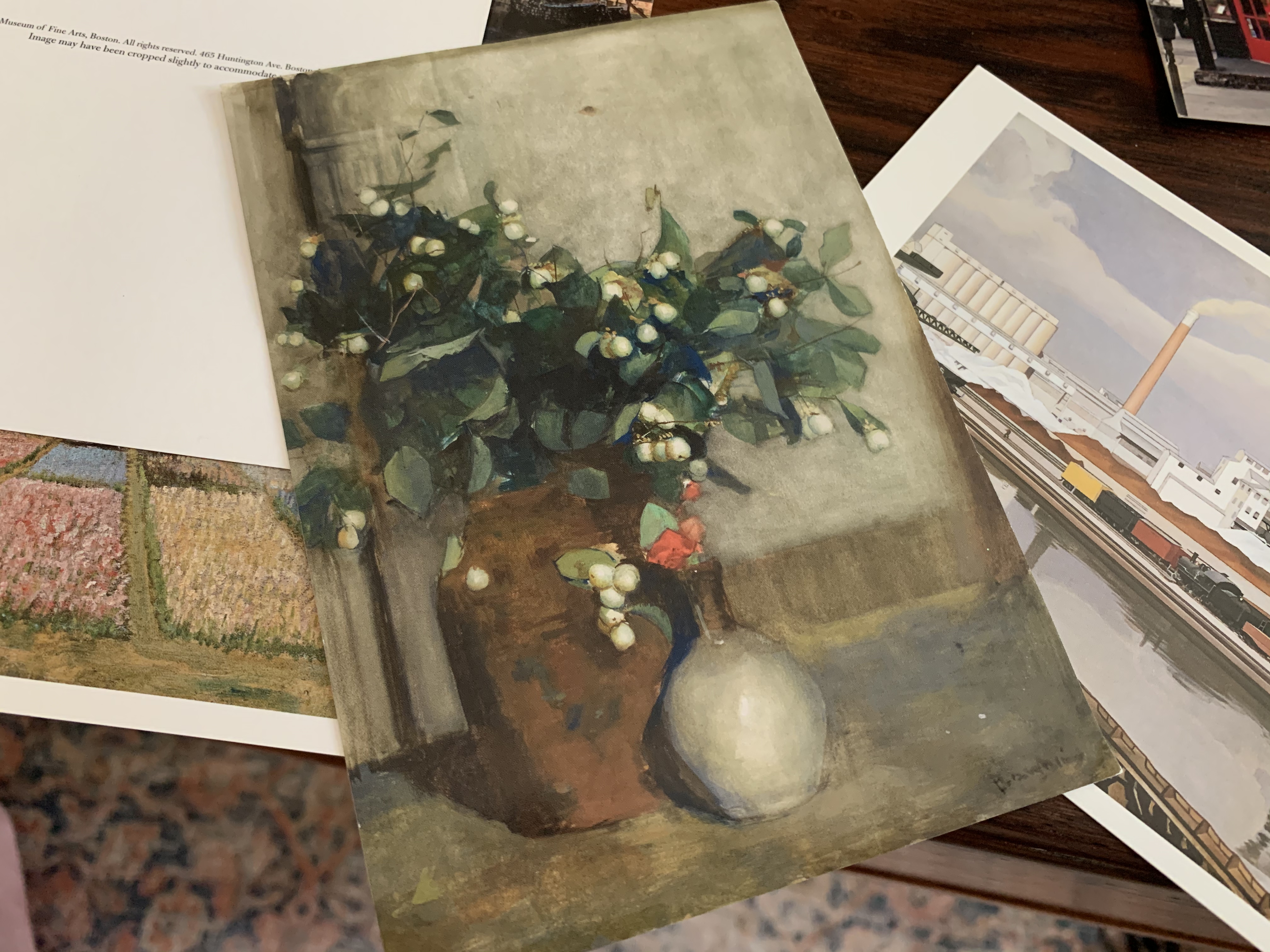
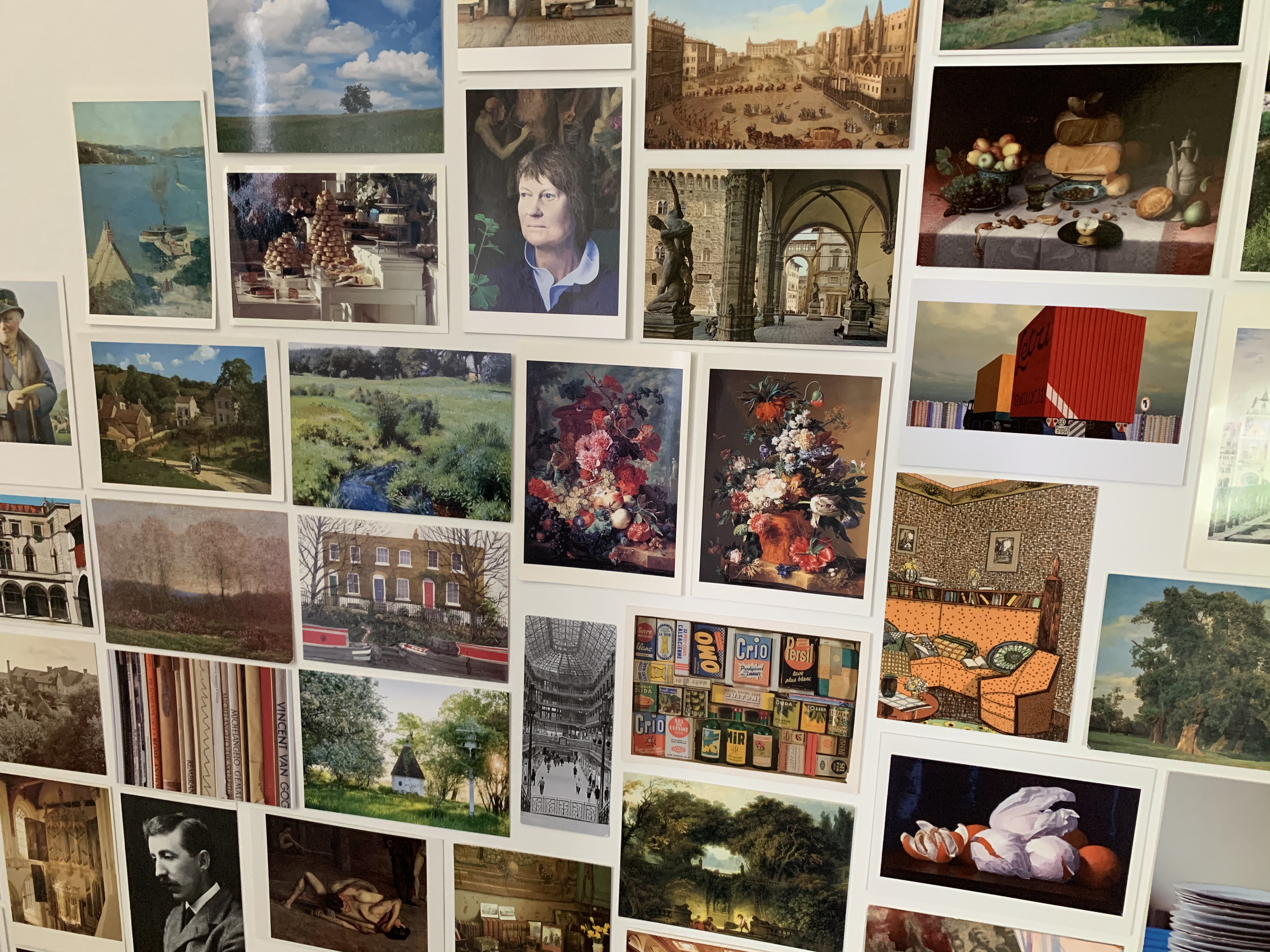
So many beautiful things. (I find this floral still life and Ash Can School scene of equal beauty.)
It grows.
And grows.

Undue Influence by Anita Brookner

[I’m up to number 19 in my chronological re-read of all of Anita Brookner’s 24 novels.]

In her 19th novel, published in 1999, Brookner’s characters are starting to feel like they might actually have inhabited the year in which they were written. Her mention of the Eurostar which had only begun operations about five years earlier seems like a fantastically contemporary reference for Brookner. (In her 18th novel, Falling Slowly published the previous year, there is a journey to France that seems likely to have been made on Eurostar, but one has to be a bit of a transportation nerd with a touch of OCD to even read that much between the lines.) But it isn’t just one mention of Eurostar that makes this Brookner novel seem almost fresh. Her protagonist in Undue Influence is a youngish woman, Claire Pitt, who clearly hasn’t figured out where she is headed in life.

Somewhat recently orphaned by the death of her mother, Claire is working in the basement of a used bookshop where she is transcribing the writings of St. John Collier, the late father of the Misses Colliers who run the bookshop they inherited from him. As the transcription work winds down she becomes a default employee when Muriel Collier needs to stay at home to take care of her sister Hester. The two of them have never married and in their own way never really matured. Muriel, now in her 80s, believes their father drew them into the business as a way to keep them unmarried and close at hand.

It seems like Claire might suffer a similar outcome. Stunted in her own emotional development by her father’s invalidism after a series of strokes beginning when she was 10, Claire abhors any sign of weakness in men that might remind her of him. She has just one friend, another young woman Caroline, who still goes by Wiggy, no doubt a nickname from school days, who is content being the mistress of a married man. Claire and Wiggy meet for dinner once a week, sharing confidences that never go too deep, and, while not explicitly stated, feel like a relic of girlhood. Her avoidance of her financial standing in the months (years?) after her mother’s death and her assumption, based on nothing but conjecture, that she will be hired by the owner’s of the new shop, suggest someone who is less than ready to face the adult world.

But Claire’s stunted development is no more apparent than in the way she spins endless stories in her head about the people she observes. From imagining that a random man in a cafe is the son of her upstairs neighbor to imagining backstories for just about everybody she becomes acquainted with. And these backstories aren’t the product of a burgeoning writer, they never get written down. They don’t even seem to be consciously created. They just seem to be the day dreams of a child, someone who doesn’t have anything more pressing or tangible to fill up her mind.

Claire’s propensity for daydreaming helps explain how 40-something, widower-in-waiting, Martin Gibson becomes the target of her attention. It allows her to insinuate herself into his life, get him into her bed, and eventually focus on him as her life’s obsession. Keep in mind that all of this is through the Brookner lens so none of it is as dramatic as that sounds. In fact, it is so typically subtle, that I sometimes had to go back a few paragraphs just to see if what I thought happened had really happened.

Even realizing that she has exerted undue influence on Martin and created an imagined  trajectory for their relationship that will likely never come to be isn’t enough to shake her loose from those imaginings. She sabotages what little there is between them, realizing she is pushing him away, but is unable to either stop herself or even realize the likely outcome of her behavior. She doesn’t fully take on board that he is distancing himself, but the reality of it seems to be creeping into the fringes of her subconscious as she becomes aware of a new, but still unexplained condition.

The proof of this was my new inability to speculate. This had always been such a resource, an endowment, even a gift, that its disappearance, however temporary, however ephemeral…left me desolate.

It isn’t until she realizes that Martin has moved on from their superficial connection–relationship really is too strong a word–that the scales finally fall from her eyes. Up to that point she had been trying to convince herself that she was moving on. But even as she planned to go abroad to some unknown destination, she seemed to be planning it all either as a means of distraction, or as something she could return from. A bit of evidence of a life, or maybe as proof independence, that she could point to at some future time when renewing her pursuit of Martin. But with the inescapable truth finally in front of her, all of her denial slips away. All of the non-existent emotional ties she had felt were dissolved. After multiple subconscious sputters and false starts, Claire’s adult future is finally clear. She doesn’t really know what the future is, but she knows what it isn’t. It isn’t Martin, it probably isn’t the bookshop, and it definitely isn’t some castle in the sky with no basis in reality. This could possibly sound bleak, but it is actually one of the more optimistic endings in the Brookner canon. Her life is wide open with nothing to hold her back

When the heat in my face and throat subsided and I could bear to get up from my chair, I walked to the window and looked out. I must have stood there for some time, because when I turned around the room was in darkness. I had no conscious thoughts. All I knew was that now, as never before, I should find it easy to leave.


Books in the Time of Covid

At the start of the pandemic I was thankful for the 750-some books I have on my TBR shelves. It certainly seemed like a good hedge against however long it would be before I could get to a bookstore again. But after about two months, a combination of missing bookstores and wanting to help keep some indies stay afloat had me thinking about what I could do. It seems like a no-brainer, just go online and order some books. However, given that my reading tastes are, shall we say, slightly antiquated, this wasn’t as easy as it might seem.

First, although I love buying older fiction (lots of early- to mid-20th century), the hunt is so much a part of the experience for me that going to biblio.com or alibris.com and just ordering titles I want didn’t really appeal too much. (I have since spent a dollar or two with the likes of those worthy used booksellers, but that was the result of different needs.)

Second, I had a bit of a challenge trying to figure out what in the heck I wanted to order from book stores selling new books. As you will see in the pictures below I mainly filled in back catalogs of authors I already knew that I enjoyed.

Third, once I had my list of books to order, I didn’t know where to order them from. Certainly there was my excellent neighborhood indie Politics & Prose, but I wanted to extend my efforts a little further afield. (Plus I asked a bookish friend who knows my reading tastes to pick out five books I should order from P&P, more on that in a future post.) So I thought about indies I had been to and also took to Twitter and asked people for suggestions.

Fourth, about a week after I placed these orders, George Floyd was murdered. Among the many worthy threads on Twitter about Black Lives Matters and racial justice in general, I was made aware of a Black-owned indie here in DC that I didn’t know existed. So I added that one to the list and ordered five more books.

The result was that after two months of no book-buying, I bought 35 books in one fell swoop.
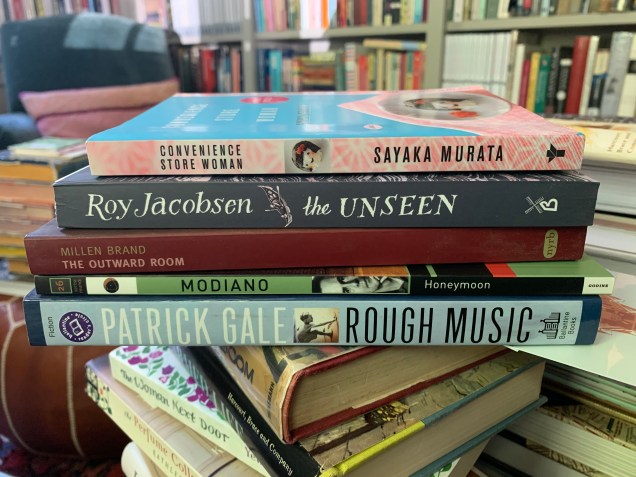
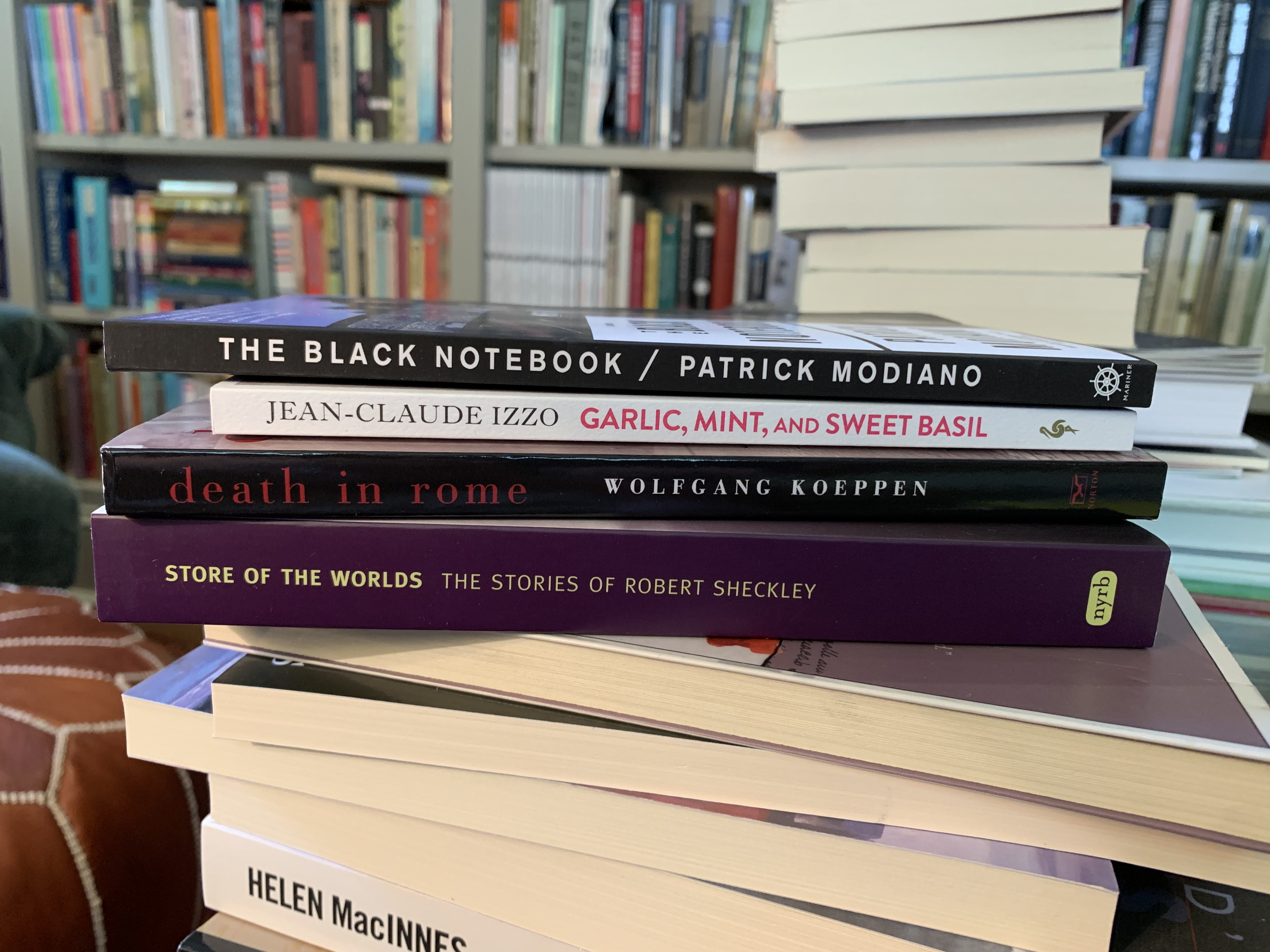
Interestingly, the book store that provided the quickest turnaround was the tiniest, and the one whose online presence is charmingly reminiscent of 1999. I sent Three Lives & Company an email and they followed up within a day or so with a phone call. They couldn’t get two of the books I wanted so I told them to just send me two novels they were recommending. They asked for my preferences but I told them just to surprise me. Having been to their delightful shop in Greenwich Village many times before, I knew they would send something worthy and thoughtful. Those turned out to be the Murata and Jacobson.
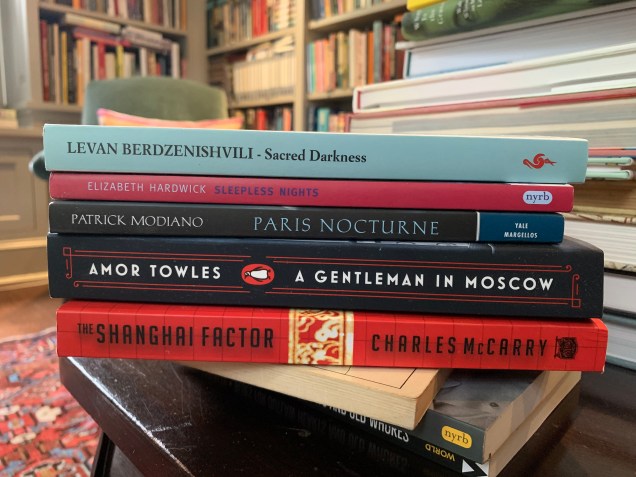
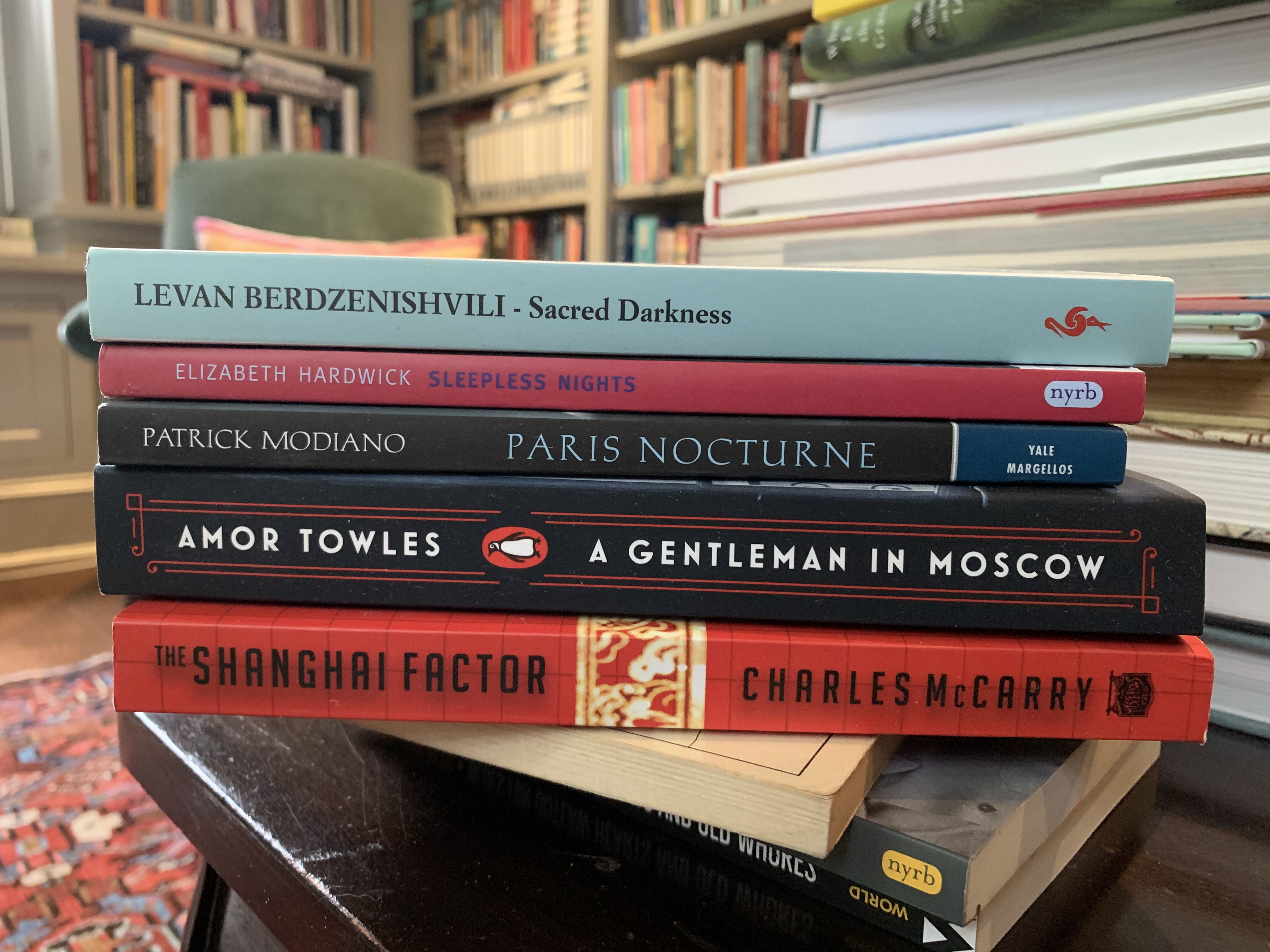
Bear Pond Books in Montpelier, Vermont was next on the list. I’ve always wondered about the Towles and a friend on FB lately raved about it so I thought I would give it a go. I also combed the websites for both Europa and NYRB Classics to come up with titles I might want.
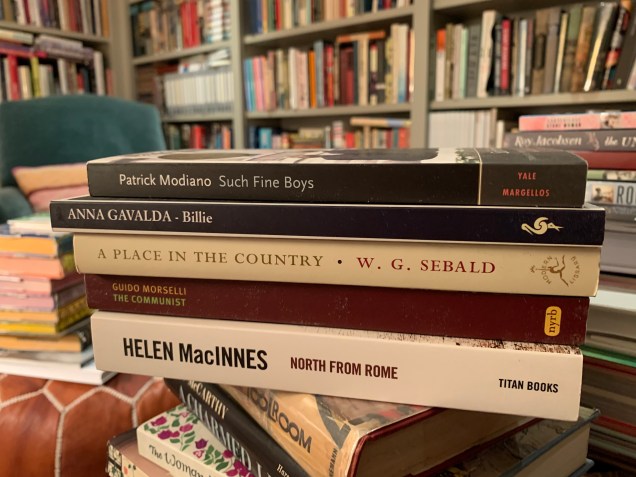
My crowdsourcing on Twitter for suggestions for indies also netted Old Town Books in Alexandria, Virginia which I had no idea existed. I had no idea there was an indie in Alexandria. Seems like something I would have known about once upon a time. #Hermit
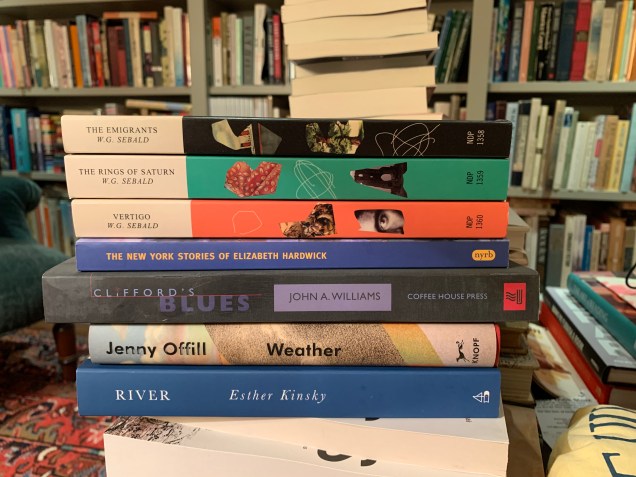
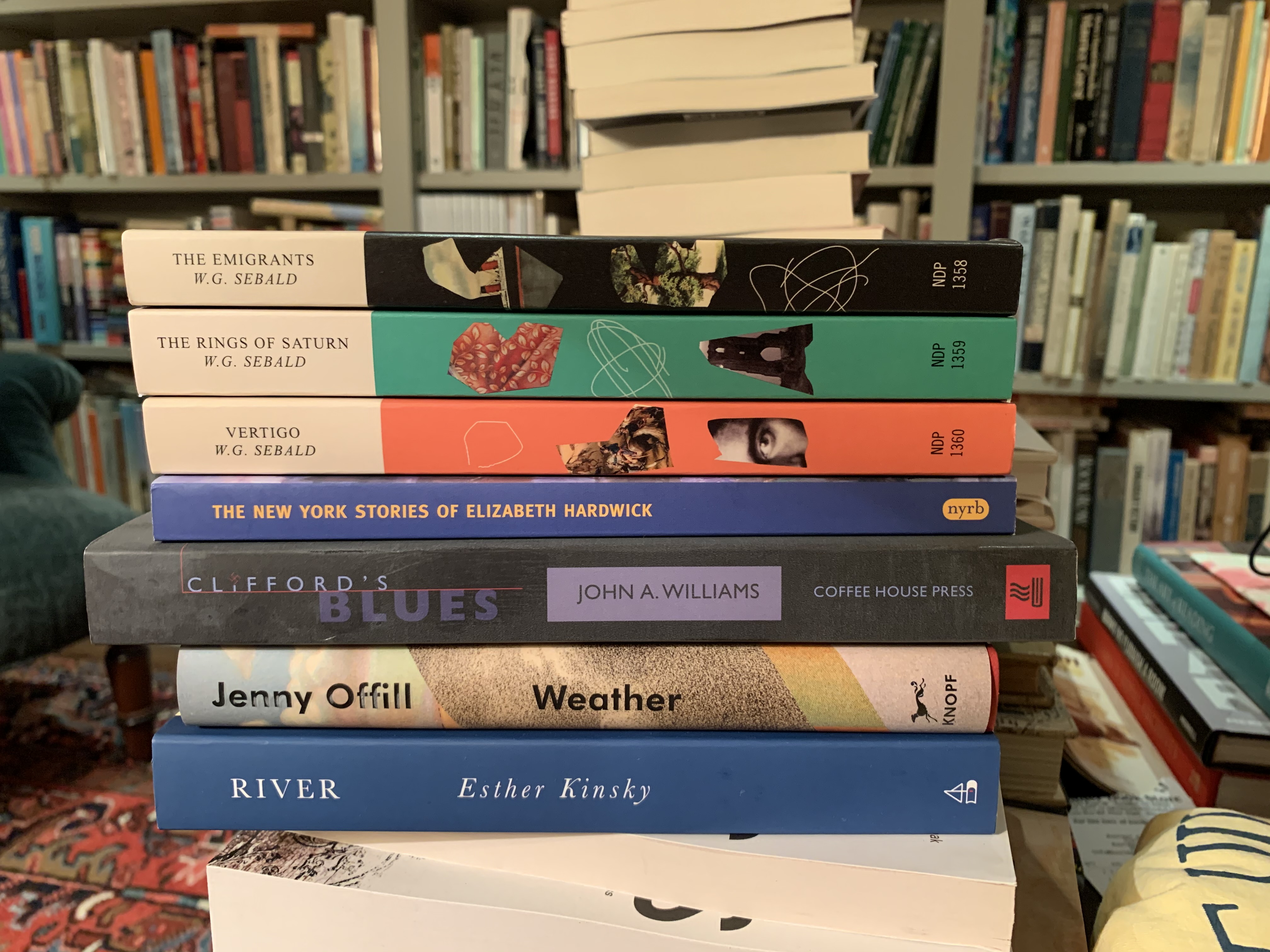
This looks like seven books, but the Sebald were part of a set that came as one unit, so, you know, it counts as one. These I ordered from the truly delightful Blue Hill Books in Blue Hill, Maine. We stumbled across it a few years ago when vacationing in the area. I wrote about that trip here. I had also asked them to fill in for two books they couldn’t get and they chose the Offill and Kinsky. Both of which look very interesting. I have since read Clifford’s Blues by John A. Williams. A fascinating story of a gay, African American musician who survived Dachau.
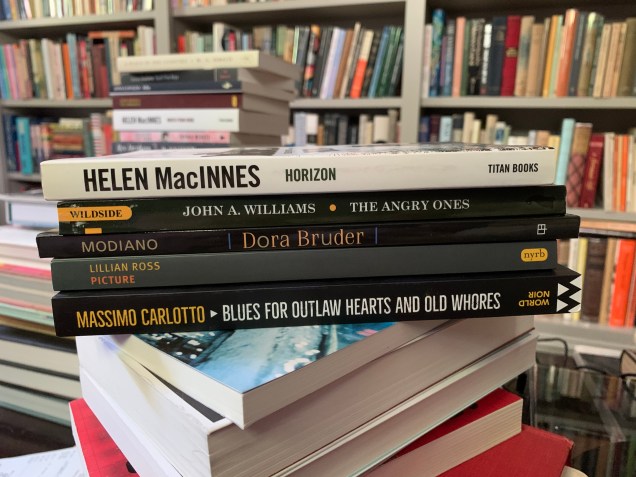
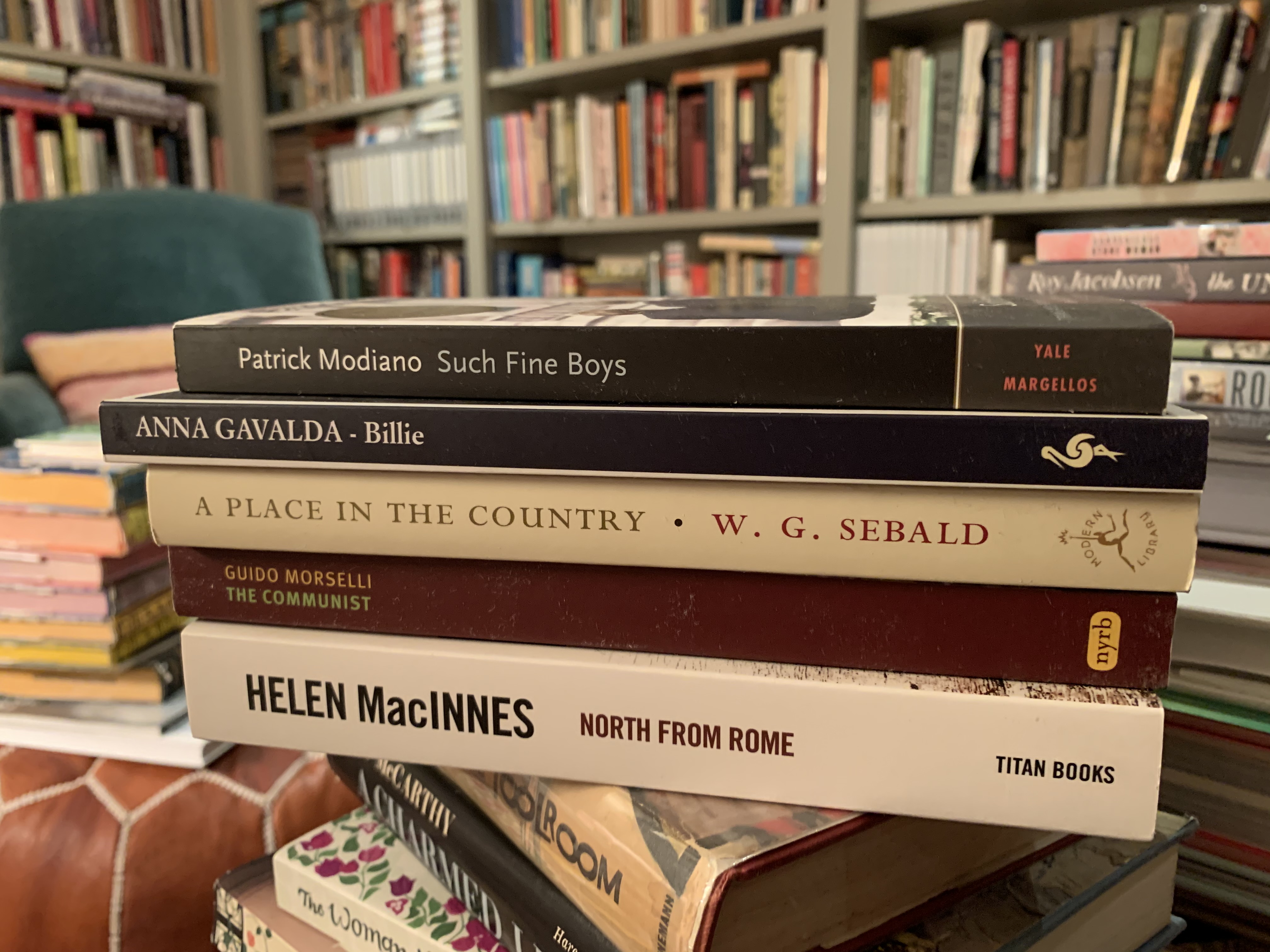
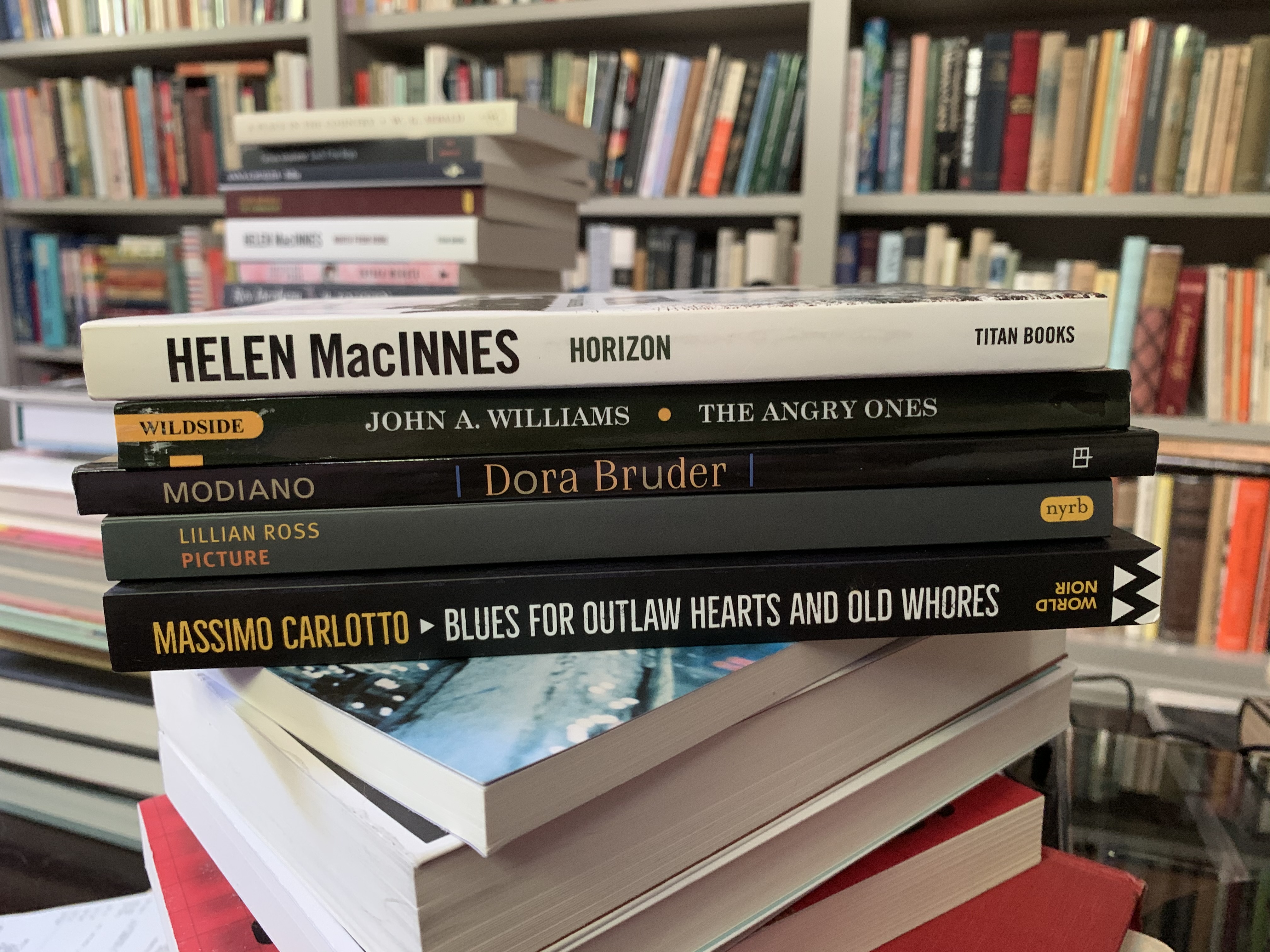
In case you haven’t noticed I bought a fair amount of Modiano, Sebald, and MacInnes.  This stack from Boulder Books in Boulder, Colorado also includes The Angry Ones by John A. Williams. I read this years ago and have never seen it since. I read it again and am amazed that it is not more widely read. Story of an African American man in New York in the 1950s who gets a job at a vanity press because they know they can pay him a pittance. It is tragic and fascinating.

I made a joke about McConnell Music on Twitter (a Mork and Mindy reference) and someone from the shop chimed in and said that their storefront was the one used for the show. I mean what child of the 1970s can hear ‘Boulder’ and not think of Mork and Mindy?
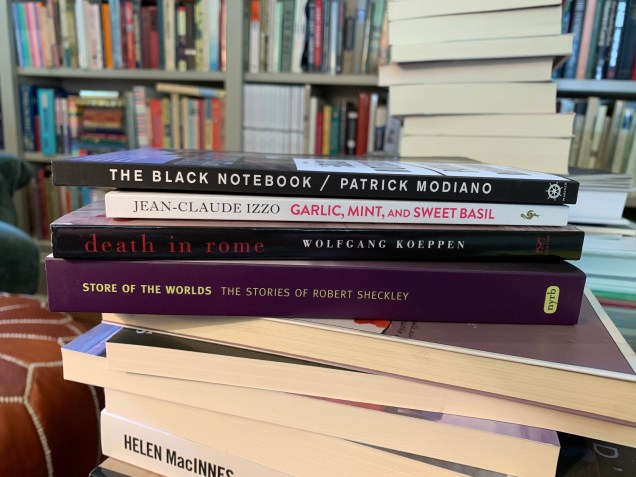
The stack from Malaprops in Asheville, North Carolina is slightly shorter because they couldn’t get one of the titles I ordered.
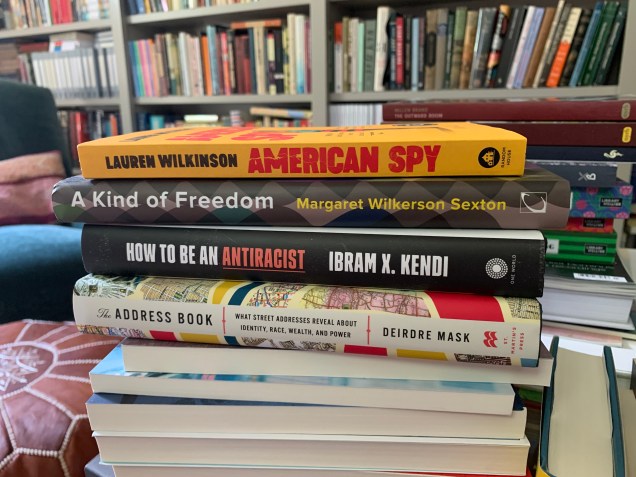
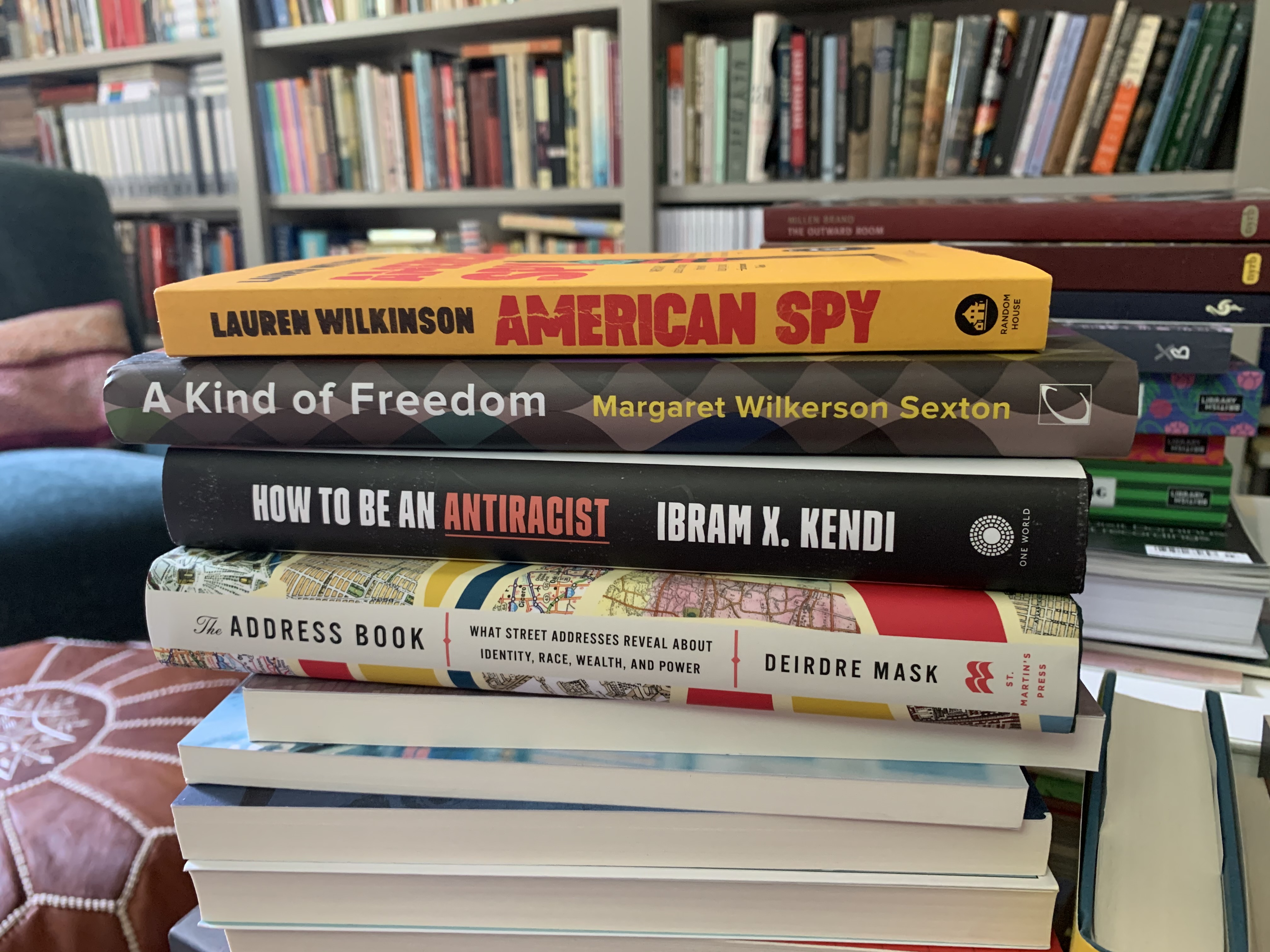
And finally, this is the stack I ordered from Mahogany Books in DC. A Black-owned indie that I didn’t know existed. So far I have read the Kendi and the Mask. The former was enlightening and helpful and the latter was fascinating in so many ways. I also got about 100 pages into the Wilkinson and had to put it on the DNF pile. I was willing to overlook its MFA-ish qualities, but then there were too many sloppy details that stretched credulity. I was no longer willing to suspend my disbelief.