At some point I want to replace the painting that is currently hanging above the fireplace in my library. The work that’s up there now is kind of fun, but it gets a bit lost in the room. It is a bit too small. As I sit here looking at it now, I really do like it. It’s called “Peach Trees” by Doris DeWitt Pogue. It appears to have been painted in Alabama in 1949. (If you’d like to see what I am talking about and to see the setting for the painting you click here. The painting appears in the “before” pictures of the library.)
I’m always on the look out for a replacement. I doubt I could afford this painting by Swiss artist Ferdinand Hodler even if the Los Angeles County Museum of Art was willing to sell it.
The Disillusioned One, 1892 by Ferdinand Hodler. Los Angeles County Museum of Art.
It just seems appropriate for a contemplative room like a library. If Trollope and Brookner had had a baby together he might have looked like this. For me the somber quality of the figure is offset by the lightness of the setting and the sprigs of green popping up at his feet. As if to point out that no matter the fate of man, life is eternal.
On our trip to another city last month, I was quite excited to check out what appeared to be a ginormous used bookstore. I even saw a short documentary about the owner that I found quite admirable.
From almost the minute I entered I didn’t like it. I think it has done a good job providing the general public with books they want to buy, but for someone like me who wants to root around and find some unpopular, unheard of novels, it didn’t offer much.
I’m not going to name the bookstore, but I am going to tell you what I didn’t like.
Too much book “art”. I don’t like seeing books abused, particularly when I feel like that kind of books I am looking for are the ones that don’t make it to the sale shelves.
Too many local looky-lous who seemed to consider it a part of their Saturday night outing, the fact that it was a bookstore was neither here nor there to them. Lots of 20-somethings taking their pictures next to the book “art”.
The classics were separated from the general fiction, further diminishing the chance that I might find something from mid-century by lesser known novelists. All the classics were, of course, the big boys (sic). And among the general fiction there was no chance of finding an esoteric little tidbit. It was one of those things where I seemed to know every title on the shelves. It shouldn’t be that way.
I actually found a Dorothy Canfield Fisher book in this section. That kind of sums up my problem with the place. Because the fiction section was too full of well known authors and books, the decorative section was the only one I found interesting enough to comb through.
There was nothing about the atmosphere that encouraged serious browsing as well. The lighting was either too low or too harsh, the music was annoying and loud…I know I sound like a grumpy old man. It is certainly a place that other people love, but for the die hard book nerd, not so much.
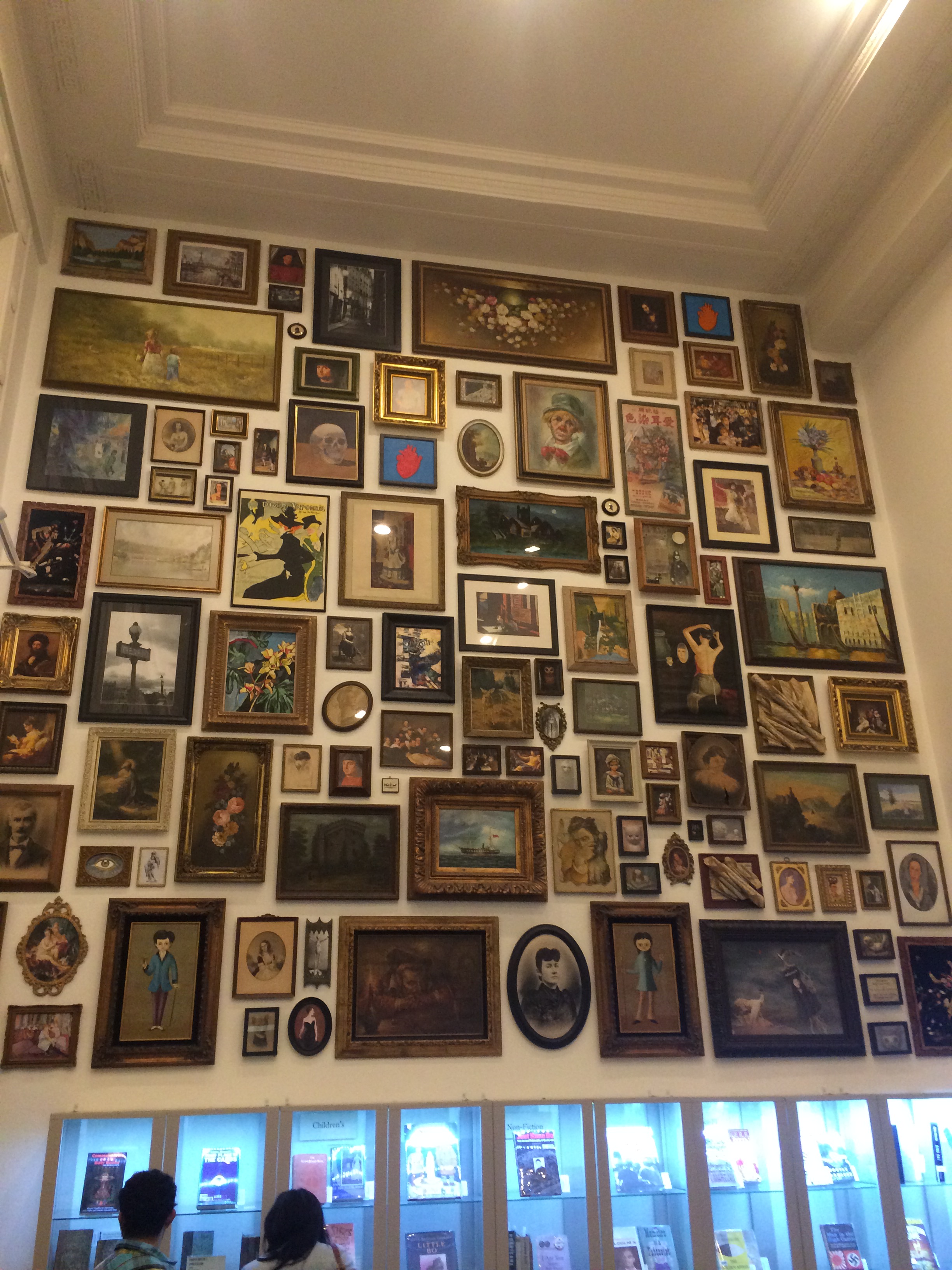
This wall in the rare book room was about the only thing I found to be pleasant.
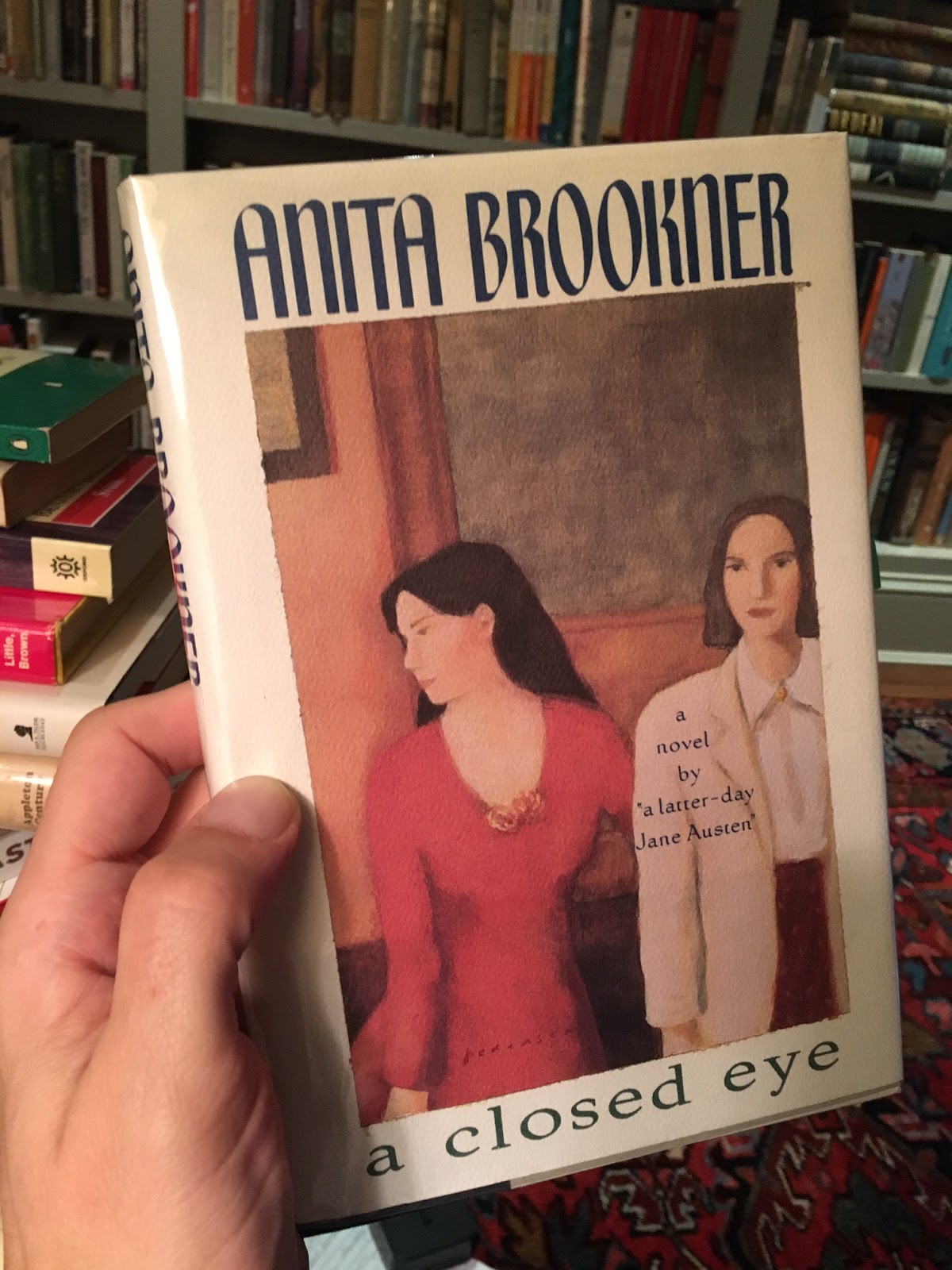
After reading this at the very end of 2016 and having just spent some time working on this review, I was shocked to realize that it was only as far back as 2011 that I read it for the first time. I was even more shocked to see that I wrote about it then as well. Kind of interesting to see the difference between then and now.
[Number 11 in my chronological re-read of Brookner’s 24 novels.]
Harriet Lytton, a recent widow in self-imposed exile in Switzerland, exhorts Lizzie Peckham, the daughter of her childhood friend, and ersatz friend of her own daughter Immy, to visit her in Switzerland. Why Harriet chooses Lizzie to help her mitigate her lonely life in Switzerland, and how Harriet got to this lonely state in the first place, is laid out as the timeline goes back to before Harriet was born.
The daughter of a vivacious, rather driven mother and a father left nervous by his experiences in World War II, Harriet is born with a prominent birthmark on her face. The birthmark not only informs how Harriet feels about her self, her relationships, and her place in the world, but it’s also the motivation for Merle, Harriet’s mother, to gently, but firmly push her into a marriage with a much older man. Harriet finds herself married to a man she doesn’t really love and doesn’t even really like much, but the birth of her perfect, blemishless, daughter Imogen ends up being the focus of her life . As Immy grows older, more independent, and frankly, brattier, Harriet begins to escape the tedium of her marriage by thinking about the possibility of an affair with Jack Peckham. The husband of her childhood friend Tessa, Jack is a TV news correspondent who represents all the danger, and excitement, and passion missing from Harriet’s life.
In the meantime, the relationship between Harriet’s Immy and Tessa’s daughter Lizzie is never what Harriet thought it should be, but Harriet never figures this out. She is blind to how much the two girls dislike each other. Having been raised as the perfect child–the one who redeems Harriet’s life, Immy ends up acting like someone who was treated as perfect. She becomes insufferable and spoiled. Lizzie on the other hand becomes bookish and quiet and old beyond her years. In a way Harriet and Tessa ended up with the wrong children and all may have benefited from a parent swap. Interestingly, re-reading Brookner’s novels chronologically as I am, this is not the first time we see this notion of children born to the wrong parents in her work. The two sets of parents in Latecomers also each have have an only child who appears to be better suited to the other couple. It makes me wonder if Brookner felt she had been born into the wrong family.
And then, rather oddly for Brookner, there are a few spoilers. Without giving these spoilers away, one event that shapes the story fairly early on, and thus, isn’t so much of a spoiler, is that Tessa dies young leaving Lizzie adrift and Jack, the subject of Harriet’s seduction fantasies. But then the spoiler of spoilers happens that cements Harriet’s future. Don’t get me wrong, for those of you used to plot, this spoiler won’t shock you much when you come across it, but for those who have read a lot of Brookner, it’s pretty surprising.
The net result is a life of low expectations that are nevertheless unmet. To paraphrase Gertrude Stein, those of you who don’t mind that won’t mind that.
The jacket flap from my U.S. edition referred to the novel as a story of three generations of women, but I really think it is more accurately thought of as Harriet’s story. Her mother Merle is fairly well fleshed out, but Immy remains pretty opaque even when we know is going on in her life. And all that we do learn about Merle and Immy is not really independent of their association with their daughter/mother. Brookner created a literary work that revolves around Harriet but Harriet’s “real” life most certainly does not revolve around her.
Photo of Penelope Lively by Martin Godwin for the Guardian
A chunk of Penelope Lively’s memoir Dancing Fish and Ammonites deals with the challenges of being over 80 years old. In addition to advanced aches and pains, Lively writes about how the rest of society deals with the elderly, and how it feels like the world is leaving one behind.
As if jinxed by Lively’s memoir, yesterday I felt like I was 47 going on 80. I decided to take advantage of John being out of town to go have a nice long dig through ‘the annex’ at a local used bookshop. I was stunned, however, when I showed up and the formerly chaotic annex had been sorted and organized and priced. Previously the annex was a large space with tall shelves with three rows of books on each shelf, absolutely no order whatsoever, and a pricing scheme that put all paperbacks at $2 and all hardcovers at $4. And it was a glorious. The thing I loved best was not the prices, but the fact that the books were so not sorted that there was often treasures lurking for those of us who like unwanted, forgotten, probably never very popular books that aren’t even all that pretty to look at. When it sunk in that the chaotic mess was a thing of the past I got deeply sad. Not only was this fun (for me) activity now impossible, but it became clear that there would no room in the newly organized shelves for those books that I love to find. They recognize the classics, and the modern classics, and the popular, but the possibility of coming across an R.C. Sherriff, or a Cecil Roberts, or a D.E. Stevenson or even lesser known authors than this esoteric bunch was all but zero. The staff was completely incapable of understanding what I was looking for and pointed me to Victorian-era books no one wants to read but that have pretty spines. And they pointed me to the rare book room. And they pointed me towards the fiction section. It flashed before my eyes that all those books I hope to stumble across would end up as pulp, or as props at a furniture store, or sold as books by the foot to decorators.
I didn’t leave empty handed, it was a bookstore after all, but I did leave feeling like a little bookish part of me had been dulled and a tad depressed. Flashing forward a hundred years I decided to drown my sorrows in Dairy Queen at a nearby mall and thought I would take the opportunity to upgrade my smart phone. I was first a little annoyed by the fact that shopping malls no longer seem to believe in directories or garbage cans. Both were few and far between. Then I get to the Apple store and the 12-year old working there made me feel about 500 years old. I could feel the old man shame creep into my face as I gave him my Hotmail address. I might as well have told him my phone number was KLondike 5-3452. When we discovered that my 8,000 digit Verizon password is not one I have memorized, he suggested I go to the Verizon kiosk and upgrade my phone there. At Verizon, the 16-year old working there made me feel not only old but really dumb. Do they have to talk that fast? Do they have to assume that everyone knows everything about everything about telephony? I might as well have offered him a Werther’s Original as I stuck a used Kleenex into the sleeve of my cardigan.
Perhaps I shouldn’t use the average age of the typical mall employee as a reference point for my own place in the world (don’t get me started on my misadventure in the food court or my failed attempt to buy running shoes at the Foot Locker). As I thought about it later, one of the things I found troubling was the fact that in none of these interactions were any of the people engaging with me aware of anything about me. They all misunderstood or didn’t hear what I was saying. They couldn’t recognize anything emanating from me: hope, friendliness, confusion, frustration, resignation. I’m not trying to make a comment on the state of customer service or the youth of today, or anything like that (that would make me sound like a cranky old guy). But I really do feel like got a glimpse of what life is going to be like when I really do get to old age.
To cap the day off, I had a bit of a nightmare last night. I don’t remember what I was dreaming, but it was one of those situations where my mind wakes up before my body does. Where I am aware that my body is asleep and that I want to wake up but as much as I try and call out (scream) or move my body, my vocal chords and my body won’t respond quickly enough. If it goes on too long it begins to feel like being buried alive. As I was struggling to make my limbs move and my voice audible, I kept thinking that surely John, lying next to me, would wake me from my disturbed dream–a comforting thought in my panic. When I finally did wake up with a shout I realized that I was in bed alone. Remember, John is out of town. As I stumbled to the bathroom I was relieved to be awake, but also haunted by the notion that isolation, both literal and figurative can be a big part of old age. Invisible during the day and trapped in a nightmare at night.
Dancing Fish and Ammonites by Penelope Lively
There is nothing in Lively’s memoir of old age that is as depressing as what I have written above. Lively is a delightful writer who puts a spin on her past, present, and shortish future that is humorous, enlightening, and comforting. Like much of her fiction, this memoir dabbles in the vagaries of memory, personal history, History with a capital H, and includes a the musings of a highly literate, creative, thoughtful mind. She makes me wish I were her friend. I will forgive the fact that she writes that she once enjoyed Pym’s novels, but now can’t stand them.
Judgment Day by Penelope Lively
One of my reading resolutions for the year was to read every month an author bio/memoir/diary/etc. and then follow it with one of their novels. There were only 2.5 days left of January when I remembered this was one of my resolutions and grabbed an unread Lively off my shelves. Judgment Day is basically a slice in time of village life. A group of lives that intersect in mundane and profound ways. Not only does the cast include the interesting-to-me newcomer to the village archetype, but it also includes one of my favorite situations: the closed off/hardened heart open/melted by unforeseen circumstances. I enjoyed every minute of the book and got emotionally caught up in the characters’ lives. And on top of that, it made me want to be a better person–a little more giving and forgiving.






 hogglestock