Ugh

kitchensKitchens of the Great Midwest by J. Ryan Stradal
This book annoyed me so much, I gave up on it about 20 pages in. Before I hurled it across the room, however, I did scan my way through the rest of it and found it oddly easy to hit on what seemed to be the major plot points. What I saw of those annoyed me as well. I think an editor could have saved this book–or at least gotten me past page 20. But maybe Stradal’s editor was as green as his writing.

The book starts off in Minnesota and the very first line is “Lars Thorvald loved two women.” I was born in Minnesota and spent about 25 years of my life there. There may indeed be multiple people in Minnesota named Lars Thorvald, but in a chapter called “Lutefisk” (disgusting, Norwegian fish dish), it is so cliche to pick a name like that. It’s like Rose from the Golden Girls decided to tell one of her stories. Now this takes talent, a cliche in the first two words of the book. And then on page two there’s St. Olaf’s Lutheran Church. There is more than one St Olaf’s church in Minnesota for sure, but again, choosing this name smacks of the Rose Nyland school of Minnesota storytelling.

Perhaps my biggest problem with Stradal’s writing is his constant need to use proper nouns. He does this in two ways. The first won’t bother the average (non-Minnesotan) reader, but it sure got me fired up. He does so much name dropping of places and businesses that it feels like he is trying way too hard to create an authentic setting. But for those of us who know the place, it comes off like he is trying too hard. It feels fake. Second, Stradal just uses too many proper nouns. There is no subtlety. It’s nostalgia masturbation. It feels like those kids’ books where you send in details about your child to the manufacturer and then they send you books with all the information included in the story. Here are some examples with my suggestions for editing:

“…gotten him into a nice Lutheran school like Gustavus Adolphus or Augsburg,”

“…proper pesto, he had learned during a previous job at Pronto Ristorante, is made with…”

“Where’d you get it from? St. Paul’s Farmers’ Market?’  How about just “the farmers market”?

“…sat in his Dodge Omni…” I suppose this is to make the reader think “OMG, remember Dodge Omnis?”

“Mom’s Chicken Wild Rice Casserole” Stradal packs the book full of forced Minnesota authenticity and then uses the word casserole. No. We call them hotdish. The only time I even heard the word casserole as a child was on TV.

“Lars’s younger brother and his girlfriend also lived in St. Paul, a few miles away.”

“Lars was lying on the brown shag area rug, reading to his daughter from James Beard’s Beard on Bread…” Just saying “cookbook” would be even better, but short of that, why oh why does Stradal have to spell out for us that Beard on Bread was written by James Beard? We have Google, or a cultural frame of reference, or it’s a detail that really doesn’t matter.

“…the famous West Coast sommelier Jeremy St. George” Sounds like one of the fancier characters on All My Children.

“…she opened a single-vineyard Merlot from Stag’s Leap that she’d been saving…” I might even strike “single-vineyard” but okay, he is trying to show that she really does know her wine.

“…Lars’s rounds at the St. Paul’s Farmers’ Market were more logistically difficult…” and then in the next paragraph: “But the St. Paul Farmers’ Market would, as always, reward their efforts.” Really? Wait, which farmers’ market? Could we have the address including zip code?

“That’s where the New French Cafe gets their tomatoes…referring to the trendiest of the new Minneapolis restaurants.” Stradal doesn’t allow his readers any credit. You don’t have to know the New French Cafe–or have it described–to understand they are referring to a business that wants quality tomatoes.

“The Southeast Asian vendor sat on a blue Land O’Lakes milk crate…” OMG, another Minnesota brand! This book is SO authentic. If only he would mention 3M. (He eventually does.) I even object to “blue” the only purpose of which seems to be to show the reader that Stradal didn’t miss the day they talked about descriptions in his creative writing class at the Learning Annex.

“…unsmiling, through Ray-Ban sunglasses…” I don’t object to the proper noun here, what I object to is the need to add the word “sunglasses”. We aren’t stupid J. Ryan.

“By the afternoon, he was calling wineries he knew they might have visited: Stag’s Leap, Cakebread, Shafer, Ridge, Stony Hill, Silver Oak.”

And it just goes on and on and on. There are so many capital letters you can pick out these annoying instances just by flipping through the book. Which is what I did.

I had more to say, but I think I’ve tired myself out. Time for a nap.

shelf by shelf : from Pym to Persephone

As you will see as soon as you take a look at the photo, the system breaks down a bit at this point. My largely alphabetical arrangement suddenly gets fudged up by some non-fiction related to Barbara Pym; a stack of Melville House novellas; and the start of my Persephone collection. The homogeneous design of the both the Melville House and the Persephones required me to keep them together rather than intershelve them according to their authors. I’m not saying I won’t ever do it, but I truly can’t imagine ever doing it. And just wait until you see the next shelf. One shelf of nothing by Persephone gray.

shelf-19
Easier to inspect if you click on the image.

SHELF NINETEEN: 50 Books, 19 unread, 31 read, 62% completed

Pym, Barbara – No Fond Return of Love (completed)
Pym, Barbara – Crampton Hodnet (completed)(twice)
Pym, Barbara – Excellent Women (completed)(twice)
Pym, Barbara – Less Than Angels (completed)
Pym, Barbara – Jane and Prudence (completed)(twice)
Pym, Barbara – A Glass of Blessings (completed)(thrice)
Pym, Barbara – Some Tame Gazelle (completed)
Pym, Barbara – A Few Green Leaves (completed)
Pym, Barbara – An Academic Question
Pym, Barbara – Civil to Strangers 
Pym, Barbara – An Unsuitable Attachment (completed)
Pym, Barbara – The Sweet Dove Died (completed)
Pym, Barbara – Quartet in Autumn (completed)
Pym, Barbara – A Very Private Eye (non-fiction)
Cocking, Yvonne – Barbara in the Bodleian (non-fiction)
Burkhart, Charles – The Pleasure of Miss Pym (non-fiction)
Holt, Hazel – A Lot to Ask (non-fiction)(completed)
Bell, Hazel, ed. – No Soft Incense: Barbara Pym and the Church (non-fiction)
Pym, Hilary and Honor Wyatt – The Barbara Pym Cookbook (non-fiction)(completed)
Wow. If you couldn’t tell from reading my blog, you most certainly can see now how much I LOVE Barbara Pym. Not only have I read all but two of her novels, I’ve read three of them twice and one of them thrice. The odd thing is the ones I have read multiple times are not necessarily my favorites.

So, what’s that? You say you haven’t gotten around to Barbara Pym yet? Well, get off your butt, get one of her novels, get back on your butt, and read one. The one that gets the most attention, and for good reason, is Excellent Women. However, I think Some Tame Gazelle is wonderful and not a bad place to start with Pym. And for those of you that like things a little darker, try Quartet in Autumn. It’s a bit Brookneresque but sunnier. For the academic nerd in your life, you can’t go wrong with No Fond Return of Love. It starts at an indexer’s conference and turns into a bit of a stalker tale.

Pym really was a genius. The world she creates is gentle but not twee. Her powers of observation are superb. Her writing is lovely and often funny. But she’s got stuff to say. These are far from fluff. At the risk of overhyping her, I think there is no other author that makes me as happy as Pym does.

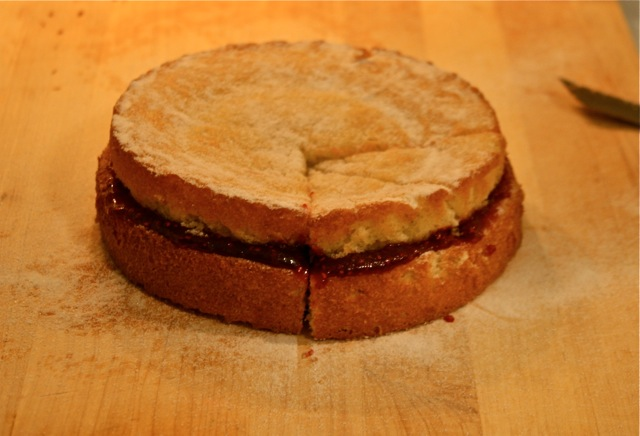
And by the by, I have indeed baked a few things out of the cookbook. The recipes are a bit like the technical challenges on The Great British Bakeoff in that they don’t always give you enough information for a successful bake. A little baking intuition and cross-referencing with other recipes of the same type are recommended. If you would like to see my baking efforts from Pym Week in 2013 follow this link.

1aa23-avictoria
My delicious version of the Victoria Sponge from the Pym cookbook.


Svevo, Italo – The Nice Old Man and the Pretty Girl
Melville, Herman – Benito Cereno
James, Henry – The Lesson of the Master
Wharton, Edith – The Touchstone (completed)
Howells, William Dean – A Sleep and a Forgetting (completed)
James, Henry – The Coxon Fund
Turgenev, Ivan – First Love
Dostoevsky, Fyodor – The Eternal Husband
Constant, Benjamin – Adolphe (completed)
Joyce, James – The Dead (completed)
Twain, Mark – The Man that Corrupted Hadleyburg
Gogol, Nikolai – How the Two Ivans Quarrelled
Tolstoy, Leo – The Death of Ivan Ilych
Morely, Christopher – Parnassus on Wheels
Proust, Marcel – The Lemoine Affair
Austen, Jane – Lady Susan (completed)
Chopin, Kate – The Awakening (completed)
Flaubert, Gustave – A Simple Heart (completed)
Kipling, Rudyard – The Man Who Would Be King (completed)
Jewett, Sarah Orne – The Country of the Pointed Firs (completed)
Pushkin, Alexander – Tales of Belkin (completed)
von Kleist, Heinrich – Michael Kohlhaas (completed)
Tolstoy, Leo – The Devil (completed)
de Balzac, Honore – The Girl with the Golden Eyes
Stevenson, R.L. – The Beach of Falesa
Back in August 2011 Frances at Nonsuch Book decided to read all Melville House’s Art of the Novella novellas in one month. At that time there were about 42 of them. She was crazy to try and I was even crazier for joining her. I think it was the lure of a set of books that caused me to order all of them. I only finished 19 of them, and oddly, not all of those 19 are here. Either I got rid of them at some point or they are lurking somewhere else. Of those I completed, I really loved A Simple Heart by Flaubert, Austen’s Lady Susan, and surprisingly given how much I hate his other work, I really loved The Dead by James Joyce. And The Awakening is one of my favorite books. One that I didn’t keep was Mary Shelley’s Mathilda. I hated that book so much it made me angry.

Benjamin Constant’s Adolphe arrived just as I finished re-reading Anita Brookner’s novel Providence. So what? I’ll tell you what, the protagonist in the Providence was a scholar of Adolphe and the work was woven into the Brookner novel. I liked Adolphe, but the experience of reading right after Brookner heightened my enjoyment and comprehension of it.

Downes, Mollie Panter – Good Evening, Mrs. Craven (completed)
Dickens, Monica – Mariana (completed)
Whipple, Dorothy – Someone at a Distance (completed)
Strachey, Jessica – Cheerful Weather for the Wedding (completed)
Crompton, Richmal – Family Roundabout (completed)
Burnett, Frances Hodgson – The Making of a Marchioness (completed)
The two Persephone books at the left in their gray livery are indicative of the cover design for almost all Persephone books. However, they also publish some of their more popular titles with more colorful colors. In general I really like and often love most of what Persephone reissues. From the group above, I absolutely adored the Crompton, I liked Making of a Marchioness far more than I did The Shuttle, Burnett’s other Persephone. Someone at a Distance is a very popular Whipple but I think it is my least favorite. Next shelf, you are going to get to see nothing but Persephones.

NEXT TIME: Persephone to Persephone

shelf-2

Catching up on summer reading

cover_dubiousThe Dubious Salvation of Jack V. by Jacques Strauss
I think I picked this book up off a remainder shelf in Gaylord, Michigan last September when Simon Savidge and I were on our road trip to Booktopia. I didn’t know anything about novel or author, just thought I would take a chance on an inexpensive book. It paid off well. It turned out to be a charming, funny, gay coming-of-age story in 1990s South Africa.

Something Light by Margery Sharp
I fell in love with Sharp’s Cluny Brown and find myself buying up her books whenever I find them. However, I think this is only the second one of hers that I have read. She goes through a series of men hoping to find one to marry. There were parts of it that were charming and funny but overall it was kind of tedious.

The Grass is Singing by Doris Lessing
The dead body of Mary Turner opens the pages of this 1940s tale of life on a farm in southern Rhodesia (Zimbabwe). The timeline flips back to just before Mary married Dick Turner. Mary’s bad attitude (and racist outlook) goes from bad to worse as she realizes she made a big mistake marrying Turner and going to live with him on his remote farm. Their lives are bleak, bleak, bleak, punctuated only by arguments. A fascinating and depressing novel.

transcriptionistThe Transcriptionist by Amy Rowland
I read this back in August and know this short comment will not do it justice. Lena Respass is a transcriptionist at a New York Times-like newspaper. Her job is to put on a headset and type out what reporters have called in. I found Lena’s job and its setting delightfully old fashioned, a bit like the marketing firm in Calvin Trillin’s brilliant Tepper isn’t Going Out. The story pivots on the news that a blind woman is mauled by a lion after swimming the moat at the zoo. Turns out Lena had had a conversation with the woman on a bus just that week. She becomes obsessed with the blind woman’s story and plight and goes about finding out more. I found the book funny and enlightening and sad. Although I really liked it when I read it, I find I am liking it, perhaps even loving it, the more that I think back on it. Thanks to Leslie at This is the Refrain who recommended it to me during a book blogger meet-up at Capitol Hill Books.

Death’s Dark Abyss by Massimo Carlotto
I enjoy Massimo Carlotto’s Italian hard-boiled detective fiction, but I feel there are misogynistic scenes that are worse than they need to be to convey the fact that his characters are misogynistic. One begins to feel like it’s indicative of Carlotto’s view as well as his characters’. Despite that, I find these books quick, enjoyable, if disturbing, reads.

Let’s Pretend this Never Happened by Jenny Lawson
Another hilarious memoir from a very funny, quirky blogger with lots of issues. I’m not sure what I would think if I read print versions of Lawson’s books, but she does an amazing job with her audiobooks. They had me laughing like crazy in the car. Just don’t listen to with kids around.

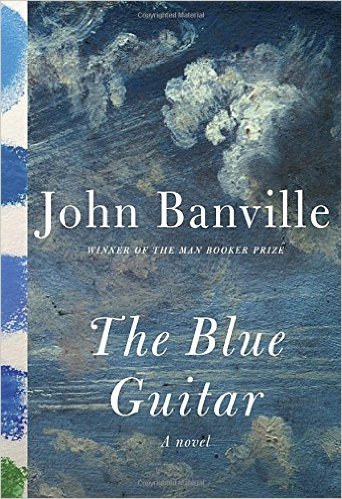
the-blue-guitarThe Blue Guitar by John Banville
I enjoyed this book so much more than I expected–my prior experience with Banville was just okay. This time around I was captivated and amused by washed-up painter Oliver O. Orme. He is a philandering kleptomaniac who is dealing with the fallout of stealing his friend’s wife. Banville has an interesting style that suits this quirky character well.

The Girl with the Lower Back Tattoo by Amy Schumer
This kind of comedian memoir book is almost always an audio book for me. They work really well in the car, making the time fly by. That was true of this book, and I love Schumer’s stand-up and sketch comedy, but I feel like she was really tired when she recorded most of this. Lots of funny stuff and plenty of serious stuff, but she just sounded somewhat sleepy and bored.  It was still funny, but I can’t help but feel that if she had put as much energy into it as say Rachel Dratch did with her audiobook or Jenny Lawson with hers, it would have been a lot better.